
@100pay-hq/checkout
v1.4.12
Published
accept crypto payments on your website and apps in 3 mins


Readme
100Pay Checkout
Accept crypto payments on your website in 3 minutes.
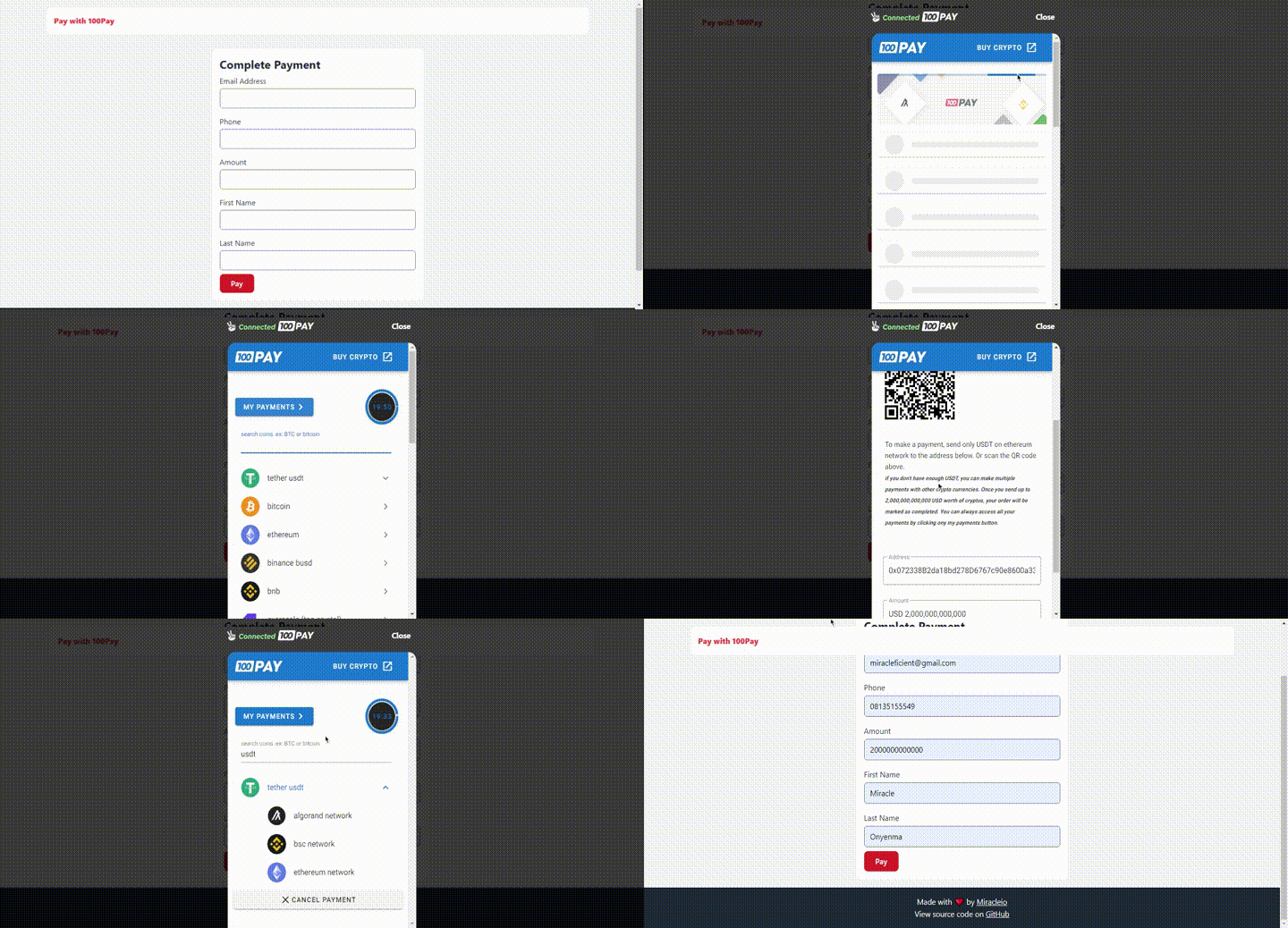
Table of Contents
- Getting Started
- Features
- Installation
- Basic Usage
- Configuration Options
- Framework Examples
- API Reference
- Payment Verification
- Webhooks
- Examples
- Support
Getting Started
Before you can start accepting crypto payments, you need to:
- Create a 100Pay account
- Obtain your API keys from the 100Pay Developers platform
Features
- ✅ Accept crypto payments on your website
- 💰 Withdraw to your crypto wallet or fiat balance
- 📄 Create payment invoices
- 🔗 Create payment links
- 🪙 Create your own coin on any supported network
- 📊 Analytics to monitor your business
- 🔄 Swap crypto
- 💱 Buy/sell crypto
Installation
Via CDN (Script Tag)
Add the 100Pay script to your HTML <head> or before the closing </body> tag:
<script src="https://js.100pay.co/"></script>Via NPM
Install the package using npm or yarn:
npm install @100pay-hq/checkoutyarn add @100pay-hq/checkoutThen import it in your JavaScript file:
// ES6 Import
import { shop100Pay } from "@100pay-hq/checkout";

// CommonJS Require
const { shop100Pay } = require("@100pay-hq/checkout");
Basic Usage
HTML Setup
Create a payment form and a container for the 100Pay modal:
<form id="paymentForm">
  <div class="form-group">
    <label for="email">Email Address</label>
    <input type="email" id="email-address" required />
  </div>

  <div class="form-group">
    <label for="phone">Phone</label>
    <input type="tel" id="phone" required />
  </div>

  <div class="form-group">
    <label for="amount">Amount</label>
    <input type="number" id="amount" required />
  </div>

  <div class="form-group">
    <label for="first-name">First Name</label>
    <input type="text" id="first-name" />
  </div>

  <div class="form-group">
    <label for="last-name">Last Name</label>
    <input type="text" id="last-name" />
  </div>

  <div class="form-submit">
    <button type="submit">Pay with Crypto</button>
  </div>
</form>

<!-- Container for the 100Pay checkout modal -->
<div id="show100Pay"></div>
JavaScript Implementation
const paymentForm = document.getElementById('paymentForm');
paymentForm.addEventListener("submit", payWith100pay);

function payWith100pay(e) {
  e.preventDefault();

  const email = document.getElementById("email-address").value;
  const phone = document.getElementById("phone").value;
  const amount = document.getElementById("amount").value;
  const firstName = document.getElementById("first-name").value;
  const lastName = document.getElementById("last-name").value;

  shop100Pay.setup({
    ref_id: "" + Math.floor(Math.random() * 1000000000 + 1),
    api_key: "TEST;PK;YOUR_API_KEY_HERE",
    customer: {
      user_id: "1", // optional
      name: firstName + " " + lastName,
      phone: phone,
      email: email
    },
    billing: {
      amount: amount,
      currency: "USD",
      description: "Test Payment",
      country: "USA",
      vat: 10, // optional
      pricing_type: "fixed_price" // or "partial"
    },
    metadata: {
      is_approved: "yes",
      order_id: "OR2",
      charge_ref: "REF"
      // Add any custom fields you need
    },
    call_back_url: "https://yoursite.com/payment/callback",
    onClose: () => {
      console.log("Payment modal closed");
      alert("You just closed the crypto payment modal.");
    },
    onPayment: (reference) => {
      console.log("Payment reference:", reference);
      alert(`New payment detected with reference ${reference}`);

      /**
       * ⚠️ IMPORTANT: Never give value to users based on this callback alone!
       * Always verify payments on your backend by calling the 100Pay API.
       * See: https://100pay.co/blog/how-to-verify-crypto-payments-on-100-pay
       */
    },
    onError: (error) => {
      console.error("Payment error:", error);
      alert("Sorry, something went wrong. Please try again.");
    }
  });
}
Configuration Options
Charge Data
The shop100Pay.setup() method accepts two parameters: CHARGE_DATA and DISPLAY_OPTIONS (optional).
Required Fields
| Field | Type | Description |
|-------|------|-------------|
| api_key | string | Your 100Pay API key (get from dashboard) |
| ref_id | string | Unique reference ID for this transaction |
| customer | object | Customer information |
| customer.name | string | Customer's full name |
| customer.phone | string | Customer's phone number |
| customer.email | string | Customer's email address |
| billing | object | Billing information |
| billing.amount | number | Payment amount |
| billing.currency | string | Currency code (e.g., "USD", "EUR", "NGN") |
| billing.country | string | Country code (e.g., "USA", "NG", "GB") |
| billing.description | string | Description of the payment |
| billing.pricing_type | string | Either "fixed_price" or "partial" |
| metadata | object | Custom data to attach to the transaction |
| call_back_url | string | URL to redirect users after payment |
| onPayment | function | Callback when payment is detected |
| onClose | function | Callback when modal is closed |
| onError | function | Callback when an error occurs |
Optional Fields
| Field | Type | Description |
|-------|------|-------------|
| customer.user_id | string | Your internal user ID |
| billing.vat | number | VAT/tax percentage |
| options | object | Advanced payment configuration |
| options.currency_allowlist | string[] | Only allow these currencies (e.g., ["USDT", "BTC"]) |
| options.currency_blocklist | string[] | Block these currencies |
| options.currency_default | string | Which currency to select by default |
Supported Currencies
100Pay supports 90+ currencies including:
USD, EUR, GBP, NGN, CAD, AUD, JPY, CNY, INR, BRL, ZAR, KES, GHS, and many more.
See the Type Definitions section for the complete list.
Supported Countries
100Pay supports payments from 240+ countries. Use ISO 3166-1 alpha-2 country codes (e.g., US, NG, GB) or USA for United States.
Display Options
Customize the appearance of the payment modal:
shop100Pay.setup(
  {
    // ... charge data
  },
  {
    maxWidth: "500px",  // Maximum width of the modal (default: "400px")
    maxHeight: "700px"  // Maximum height of the modal (default: "unset")
  }
);
Display Options Parameters
| Option | Type | Default | Description |
|--------|------|---------|-------------|
| maxWidth | string | "400px" | Maximum width of the payment modal |
| maxHeight | string | "unset" | Maximum height of the payment modal |
Example with custom display:
shop100Pay.setup({
  api_key: "YOUR_API_KEY",
  ref_id: "TXN_" + Date.now(),
  // ... other charge data
}, {
  maxWidth: "600px",
  maxHeight: "800px"
});
Framework Examples
Vue.js Example
<template>
  <div>
    <form @submit.prevent="payWith100pay">
      <div class="form-group">
        <label for="email">Email Address</label>
        <input type="email" v-model="form.email" required />
      </div>

      <div class="form-group">
        <label for="phone">Phone</label>
        <input type="tel" v-model="form.phone" required />
      </div>

      <div class="form-group">
        <label for="amount">Amount</label>
        <input type="number" v-model="form.amount" required />
      </div>

      <div class="form-group">
        <label for="name">Full Name</label>
        <input type="text" v-model="form.name" required />
      </div>

      <button type="submit">Pay with Crypto</button>
    </form>

    <!-- Container for 100Pay modal -->
    <div id="show100Pay"></div>
  </div>
</template>

<script>
import { shop100Pay } from "@100pay-hq/checkout";

export default {
  name: "PaymentForm",
  data() {
    return {
      form: {
        name: "",
        phone: "",
        email: "",
        amount: 100,
        currency: "USD",
        country: "USA"
      }
    };
  },
  methods: {
    payWith100pay() {
      shop100Pay.setup({
        ref_id: "REF_" + Date.now(),
        api_key: process.env.VUE_APP_100PAY_API_KEY,
        customer: {
          user_id: this.$auth?.user?.id, // optional
          name: this.form.name,
          phone: this.form.phone,
          email: this.form.email
        },
        billing: {
          amount: this.form.amount,
          currency: this.form.currency,
          description: "Product Purchase",
          country: this.form.country,
          pricing_type: "fixed_price"
        },
        metadata: {
          order_id: "ORD_" + Date.now(),
          source: "web"
        },
        call_back_url: `${window.location.origin}/payment/success`,
        onClose: () => {
          console.log("Payment modal closed");
        },
        onPayment: (reference) => {
          console.log("Payment reference:", reference);
          // Verify payment on your backend
          this.verifyPayment(reference);
        },
        onError: (error) => {
          console.error("Payment error:", error);
          this.$toast.error("Payment failed. Please try again.");
        }
      }, {
        maxWidth: "500px",
        maxHeight: "750px"
      });
    },
    async verifyPayment(reference) {
      // Call your backend to verify the payment
      try {
        const response = await this.$axios.post("/api/verify-payment", {
          reference
        });

        if (response.data.success) {
          this.$router.push("/payment/success");
        }
      } catch (error) {
        console.error("Verification error:", error);
      }
    }
  }
};
</script>
React Example
import React, { useState } from 'react';
import { shop100Pay } from '@100pay-hq/checkout';

function PaymentForm() {
  const [formData, setFormData] = useState({
    name: '',
    email: '',
    phone: '',
    amount: 100
  });

  const handleChange = (e) => {
    setFormData({
      ...formData,
      [e.target.name]: e.target.value
    });
  };

  const handleSubmit = (e) => {
    e.preventDefault();

    shop100Pay.setup({
      ref_id: 'REF_' + Date.now(),
      api_key: process.env.REACT_APP_100PAY_API_KEY,
      customer: {
        name: formData.name,
        phone: formData.phone,
        email: formData.email
      },
      billing: {
        amount: formData.amount,
        currency: 'USD',
        description: 'Product Purchase',
        country: 'USA',
        pricing_type: 'fixed_price'
      },
      metadata: {
        order_id: 'ORD_' + Date.now(),
        source: 'web'
      },
      call_back_url: `${window.location.origin}/payment/success`,
      onClose: () => {
        console.log('Payment modal closed');
      },
      onPayment: (reference) => {
        console.log('Payment reference:', reference);
        verifyPayment(reference);
      },
      onError: (error) => {
        console.error('Payment error:', error);
        alert('Payment failed. Please try again.');
      }
    }, {
      maxWidth: '500px',
      maxHeight: '750px'
    });
  };

  const verifyPayment = async (reference) => {
    try {
      const response = await fetch('/api/verify-payment', {
        method: 'POST',
        headers: { 'Content-Type': 'application/json' },
        body: JSON.stringify({ reference })
      });

      const data = await response.json();

      if (data.success) {
        window.location.href = '/payment/success';
      }
    } catch (error) {
      console.error('Verification error:', error);
    }
  };

  return (
    <div>
      <form onSubmit={handleSubmit}>
        <div>
          <label>Full Name</label>
          <input
            type="text"
            name="name"
            value={formData.name}
            onChange={handleChange}
            required
          />
        </div>

        <div>
          <label>Email</label>
          <input
            type="email"
            name="email"
            value={formData.email}
            onChange={handleChange}
            required
          />
        </div>

        <div>
          <label>Phone</label>
          <input
            type="tel"
            name="phone"
            value={formData.phone}
            onChange={handleChange}
            required
          />
        </div>

        <div>
          <label>Amount (USD)</label>
          <input
            type="number"
            name="amount"
            value={formData.amount}
            onChange={handleChange}
            required
          />
        </div>

        <button type="submit">Pay with Crypto</button>
      </form>

      {/* Container for 100Pay modal */}
      <div id="show100Pay"></div>
    </div>
  );
}

export default PaymentForm;
API Reference
Methods
shop100Pay.setup(chargeData, displayOptions?)
Initializes and displays the payment modal.
Parameters:
chargeData(CHARGE_DATA): Payment configuration objectdisplayOptions(DISPLAY_OPTIONS, optional): Modal display customization
Returns: void
shop100Pay.close(onClose?)
Programmatically closes the payment modal. Safe to call even when no modal is currently open.
Parameters:
onClose(() => void, optional): Callback invoked after the modal is dismissed.
Returns: void
// Close without a callback
shop100Pay.close();

// Close and navigate away
shop100Pay.close(() => {
  window.location.href = "/payment/cancelled";
});
Callbacks
onPayment(reference: string)
Called when a payment is detected. Important: This is a client-side callback only. Always verify payments on your backend.
This callback fires for all payment events, including partial payments ("underpaid"). Always verify on your backend before granting access — see Payment Verification.
Parameters:
reference(string): The payment reference ID (chargeId)
callback(reference: string) (legacy)
Legacy alias for onPayment. When both callback and onPayment are supplied, callback fires first, then onPayment. Prefer onPayment for new integrations.
Parameters:
reference(string): The chargeId as a bare string
onClose()
Called when the payment modal is closed by the user.
onError(error: string | Error)
Called when an error occurs during payment processing.
Parameters:
error(string | Error): Error message or Error object
Type Definitions
interface CHARGE_DATA {
  api_key: string;
  ref_id: string;
  customer: {
    user_id?: string;
    name: string;
    phone: string;
    email: string;
  };
  billing: {
    amount: number;
    currency: CURRENCIES;
    country: COUNTRIES;
    vat?: number;
    pricing_type: "fixed_price" | "partial";
    description: string;
  };
  options?: {
    currency_allowlist?: string[];
    currency_blocklist?: string[];
    currency_default?: string;
  };
  metadata: Record<string, any>;
  call_back_url: string;
  onPayment: (reference: string) => void;
  onClose: () => void;
  onError: (error: string | Error) => void;
  /**
   * Legacy alias for onPayment. When both are supplied, callback fires first
   * then onPayment. Prefer onPayment for new integrations.
   * @deprecated
   */
  callback?: (reference: string) => void;
}

interface DISPLAY_OPTIONS {
  maxWidth?: string;
  maxHeight?: string;
}
Supported Currencies (CURRENCIES)
AED, ARS, AUD, BDT, BGN, BHD, BND, BOB, BRL, BWP, BYN, CAD, CHF, CLP, CNY, COP, CRC, CZK, DKK, DOP, DZD, EGP, EUR, FJD, GBP, GEL, GHS, HKD, HRK, HUF, IDR, ILS, INR, IQD, JOD, JPY, KES, KRW, KWD, KZT, LBP, LKR, LTL, MAD, MMK, MOP, MUR, MXN, MYR, NAD, NGN, NIO, NOK, NPR, NZD, OMR, PEN, PHP, PKR, PLN, PYG, QAR, RON, RSD, RUB, SAR, SEK, SGD, SVC, THB, TND, TRY, TWD, TZS, UAH, UGX, USD, UYU, UZS, VEF, VES, VND, XOF, ZAR
Supported Countries (COUNTRIES)
All ISO 3166-1 alpha-2 country codes are supported (240+ countries). Common examples: US, NG, GB, CA, AU, IN, CN, BR, ZA, KE, GH, etc. You can also use USA for United States.
Payment Verification
⚠️ Critical Security Notice
Never trust the onPayment callback alone to confirm successful payments. This is a client-side callback that can be manipulated. Always verify payments on your backend.
Backend Verification
After receiving the payment reference in the onPayment callback, make a GET request to the 100Pay verification endpoint from your backend:
// Backend (Node.js example)
const axios = require('axios');

async function verifyPayment(reference) {
  try {
    const response = await axios.get(
      `https://api.100pay.co/api/v1/pay/charge/${reference}`,
      {
        headers: {
          'api-key': process.env.PAY_100_API_KEY
        }
      }
    );

    const payment = response.data;

    // Check payment status
    if (payment.status === 'success' && payment.paid === true) {
      // Payment confirmed - fulfill order
      return { success: true, payment };
    } else {
      // Payment not confirmed
      return { success: false, message: 'Payment not confirmed' };
    }
  } catch (error) {
    console.error('Verification error:', error);
    return { success: false, error };
  }
}
Verification Flow
- User completes payment
onPaymentcallback fires with reference- Frontend sends reference to your backend
- Backend verifies with 100Pay API
- Backend fulfills order only if verified
- Backend sends confirmation to frontend
Learn More: How to Verify Crypto Payments on 100Pay
Webhooks
For real-time payment notifications, enable webhooks in your 100Pay dashboard. Webhooks notify your backend immediately when a payment is completed, failed, or refunded.
Setting Up Webhooks
- Log in to your 100Pay Dashboard
- Navigate to Settings > Webhooks
- Add your webhook URL
- Select events to subscribe to
- Save and copy your webhook secret
Example Webhook Handler
// Backend webhook endpoint (Express.js example)
const crypto = require('crypto');

app.post('/webhooks/100pay', (req, res) => {
  const signature = req.headers['x-100pay-signature'];
  const payload = JSON.stringify(req.body);

  // Verify webhook signature
  const expectedSignature = crypto
    .createHmac('sha256', process.env.WEBHOOK_SECRET)
    .update(payload)
    .digest('hex');

  if (signature !== expectedSignature) {
    return res.status(401).json({ error: 'Invalid signature' });
  }

  // Process webhook event
  const event = req.body;

  switch (event.type) {
    case 'charge.success':
      // Handle successful payment
      handleSuccessfulPayment(event.data);
      break;
    case 'charge.failed':
      // Handle failed payment
      handleFailedPayment(event.data);
      break;
    // Handle other events
  }

  res.json({ received: true });
});
Learn More: Subscribing to Webhooks on 100Pay
Examples
Live Demo
Example Use Cases
- E-commerce Checkout - Accept crypto for product purchases
- Subscription Payments - Recurring crypto payments
- Donation Pages - Accept crypto donations
- Service Payments - Accept crypto for services
- Event Tickets - Sell tickets with crypto payments
Support
Documentation
Resources
Useful Guides
License
MIT License - see LICENSE file for details
Contributing
Contributions are welcome! Please feel free to submit a Pull Request.
Made with ❤️ by 100Pay