
@1agents/acp-service
v0.11.1
Published
agent-workflow ACP runtime, CLI, HTTP/WebSocket service and DeepSeek Harness ACP/A2A plugins in one package. Part of 一芥天地 (DreamMate World).

Maintainers
 scottzx
Readme
@1agents/acp-service
Run persistent Codex, Claude Code, Grok Build and other supported native Agent sessions in DeepSeek Harness (DSH), or use the same package as a standalone CLI and ACP service. DSH exposes the Agent's native models, settings, commands and permission requests; each session keeps its Agent and workspace when reconnected.
Install in DSH
Requires Node.js 22.13+, DSH, and the selected native Agent's CLI and credentials on the DSH host. Adapter-backed Agents also require their ACP adapter; the native Codex CLI alone does not provide codex-acp.
dsh plugin --profile web add @1agents/acp-service@^0.7.0Restart DSH and check that @1agents/acp-service is enabled on the Plugins page. Create a session with a discovered ACP · Agent preset, choose an existing workspace, then send a text prompt. The plugin starts or reuses its local service automatically. Use your own profile name in place of web; from a DSH source checkout, replace dsh with pnpm dsh.
If pnpm reports an ignored transitive esbuild build script, follow the package manager's prompt or set that individual package's approval in the profile, then repeat the install. Approve or deny the script according to your policy, and check the bundle's enabled state after a partial install.
The pinned GitHub Release tarball contains the same published npm artifact.
dsh plugin --profile web add https://github.com/scottzx/agent-workflow/releases/download/acp-service-v0.6.0/1agents-acp-service-0.6.0.tgz@1agents/session-reader is optional: install it separately to browse and continue existing Claude, Codex and Grok histories. For presets, native controls, configuration and migration, see the DSH user guide.
The CI baseline is DSH 0.1.7-rc.2, commit 21638c56315ae6a2b552d6091945d3144c9af32e. Additional isolated-profile verification used a locally modified DSH tree labeled 0.2.0-rc.1. The verification record describes the installed-package, Loader, browser and lifecycle checks and their limits.
Screenshots
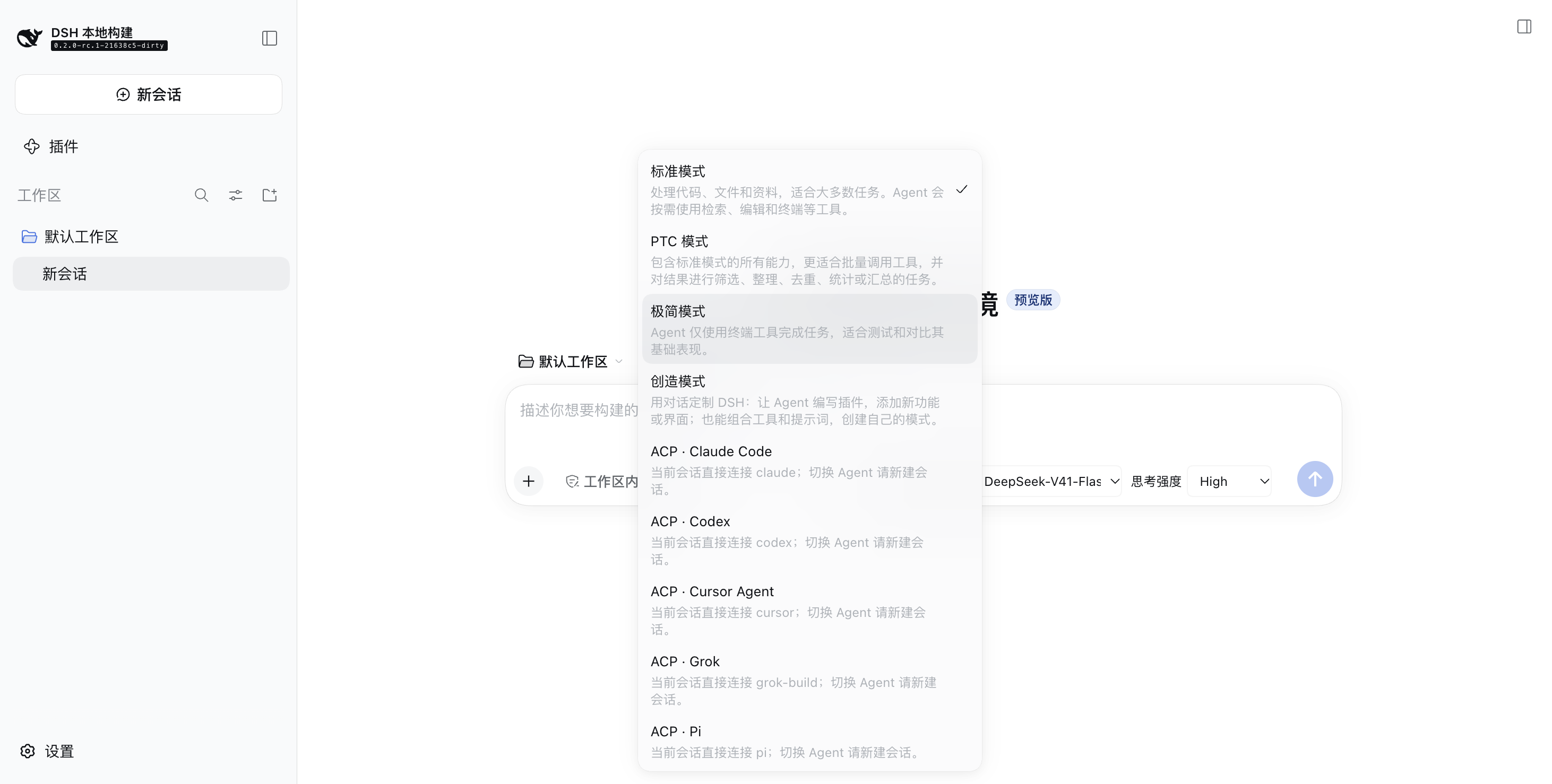
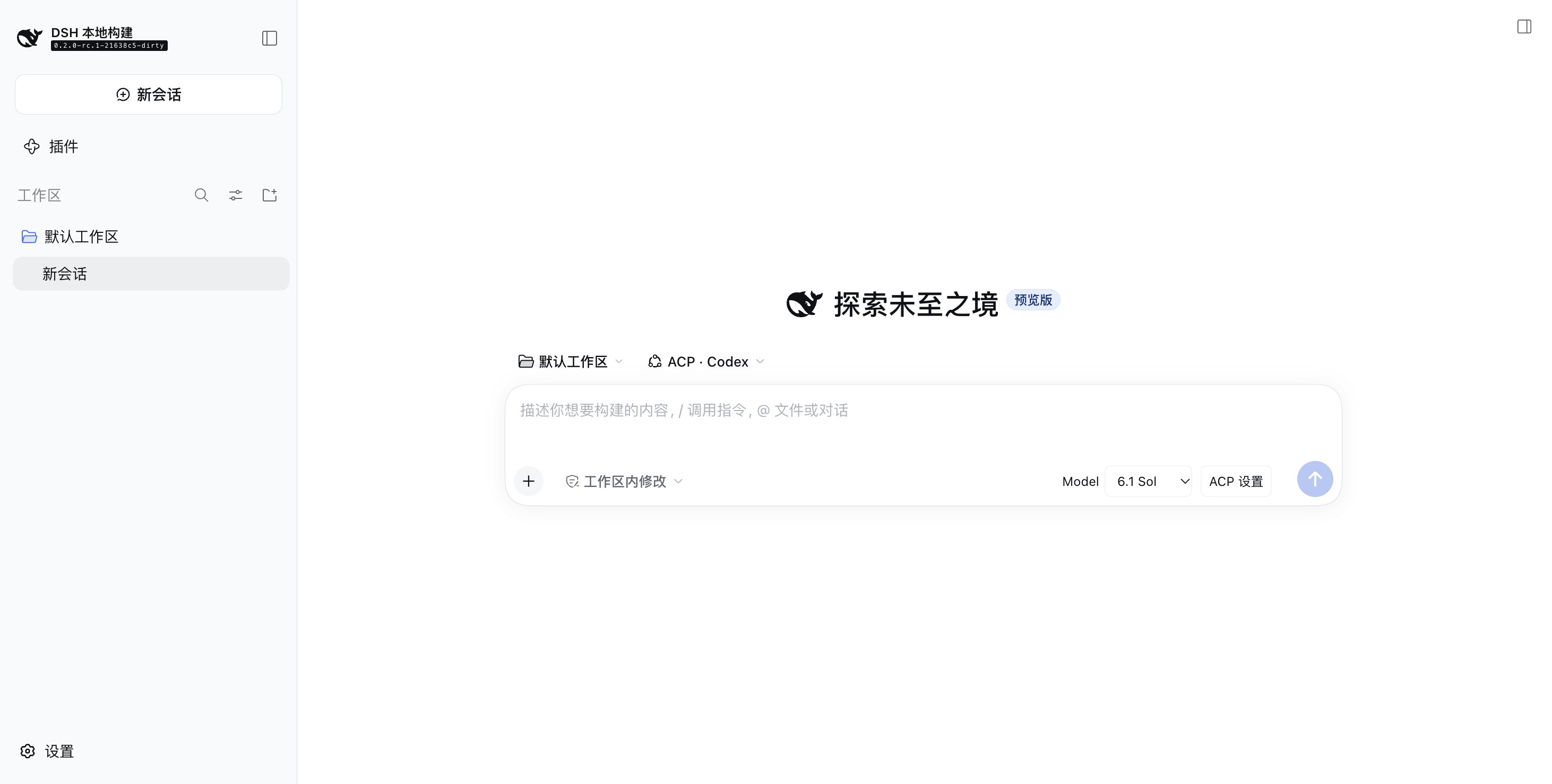
These unmodified screenshots show discovery and native capability loading in that fresh isolated local profile. No model prompt was sent for the UI check. Controls depend on the selected Agent, adapter and account.
Standalone CLI and service
npm install -g @1agents/acp-service@^0.7.0
acp-service --help
acp-service serve --host 127.0.0.1 --port 36812 --no-report
The service uses ACP v1 JSON-RPC 2.0 over WebSocket. DSH is unnecessary for the standalone entry points. A2A delegation is opt-in and disabled by default; its configuration is documented below. Waking a calling system's main Agent after task completion requires that system's receiving host adapter.
Archiving silent DSH sessions
acp-service dsh archive archives DSH sessions that have been idle for a chosen number of days. It is a manual command: it installs no timer into DSH, changes no plugin configuration, and runs only when invoked. Archiving hides a session from the workspace grouping; it never deletes the session or its log, and the session can be restored from DSH's archived list.
acp-service dsh archive --days 7 --dry-run   # list what would be archived
acp-service dsh archive --days 7             # archive it
| Option | Meaning |
|---|---|
| --days <n> | Idle threshold in days; default 7. |
| --url <origin> | DSH Host origin. Repeatable, tried in order. Omitted, the command probes the machine's loopback listeners. |
| --dry-run | Print the plan and change nothing. |
| --include-pinned | Archive pinned sessions too. Pinned sessions are skipped by default. |
| --stop-activity | Allow stopping a session's running work. Running sessions are skipped by default. |
| --json | Machine-readable output. |
How "idle" is measured. Last activity is the later of the Host's own recency (session creation time or its last real user message) and the modification time of the session's durable log file. A cold session whose log was written recently — a tool result, a title rewrite, a compaction — therefore does not count as silent.
Which sessions are skipped. Already archived sessions, sessions with running work (unless --stop-activity), and pinned sessions (unless --include-pinned). A pin is the explicit "keep this visible" signal, so it stays a manual decision.
How it talks to DSH. The command calls the running Host's own workspace service over its Typert RPC (/api/workspace/archiveSession), so the archive stays the Host's durable state. It authenticates as the Host's owner with a browser-session cookie minted from the local credential store ($DSH_HOME/.credentials.yaml), which is the same principal the DSH UI acts as on the machine that owns the Host.
Two Hosts, one DSH home. A dsh web instance and the desktop app can share $DSH_HOME, and each holds the workspace registry in memory while rewriting the whole document on every change. Planning therefore reads the durable registry document, and the command refuses to write through a Host whose registry is missing entries the document records — that Host started before the newer archives were written, and its next write would drop them. Restart that instance so it reloads, then run the command again. Auto-discovery prefers a Host that already matches the document; an explicit --url is always honoured, and the safety check still applies to it.
Bundled usage skill
ACP Service skill is distributed in this npm package and maintained with the source. It covers entry-point selection, ACP CLI/WebSocket sessions, DSH presets and native model controls, A2A delegation, task queries and the durable completion inbox. Detailed examples are included in its references/ directory.
acp-service --skill list
acp-service --skill show acp-service
acp-service --skill export acp-service > acp-service-skill.tar
# Install the complete skill in the current project when wanted:
acp-service --skill install acp-service --agent codex --scope repo
The existing embedded acpx runtime skill remains available. The skill and its references can also be read directly from skills/acp-service/ after installing version 0.6.0 or later.
Service development and API
Version 0.6.0 includes the agent-workflow runtime, CLI, service, DSH plugin, browser controls, skills and licenses. The runtime and service retain their respective ACP SDK versions.
The runtime's per-session launch argv and transient credentials APIs support Provider Profiles. Public runtime APIs and flow authoring are available as @1agents/acp-service/runtime and @1agents/acp-service/flows. The acp-service command forwards runtime commands alongside its serve command.
Run from the monorepo root:
pnpm install --frozen-lockfile
pnpm --filter @scottzx/1acp build
pnpm --filter @1agents/acp-service build
pnpm start:service serve --host 127.0.0.1 --port 36812 --no-report
The default port is 36812. Without --no-report, the service reports to the local DreamMate node. Agent executables and their authentication must be available to the service process. ACP_STATE_DIR overrides the default ~/.1agents/acpx-state directory for runtime records, turn journals and ACP replay data.
Automatic launches now share a device capacity ledger and FIFO queue. Admission checks current available memory immediately before startup, keeps a configurable reserve, and also enforces estimated soft/hard concurrency limits. A2A work stays SUBMITTED (Pending) while resources are unavailable, then starts in queue order; queued work can be canceled. ACP launches, probes and pre-warming use the same memory protection. Native user sessions outside this service continue independently. See device capacity and queue policy for defaults, environment variables, scope and restart behavior.
For npm-backed agents, the service first uses an adapter package installed in its package search roots, then the runtime's adapter executable on PATH or in user-local binary directories. JavaScript adapters run with the service's Node interpreter. Only when an adapter is absent does launch fall back to npx; discovery itself never downloads packages. Installing the native codex CLI does not replace installing the codex-acp adapter.
If startup reports npm ENOTEMPTY inside _npx, upgrade npm and move the affected cache directory aside once no installation is using it, then retry. The diagnostic preserves npm's failing path. This error concerns npm's cache directory replacement rather than macOS device permissions.
The standalone HTTP/WebSocket service does not read standard input and keeps running when it is closed or redirected from /dev/null. Stop the service with SIGINT or SIGTERM; both clean up managed Agent sessions before exiting.
import { serveAcpService } from "@1agents/acp-service";
const service = await serveAcpService({ host: "127.0.0.1", port: 36812, report: false });
// Later: await service.close();
HTTP endpoints:
GET /health: service health and active session/task counts.GET /manifest: DreamMate service discovery, ACP version, custom transport and Agent endpoint paths. Profiles listed here describe registered launch configurations, not a successful installation/authentication probe.GET /services: current service/session counts.
DSH package entry points
DSH reads the package's bundle patch and browser metadata; the CLI uses its bin entry. There is no installation-time mode switch, and both uses can coexist. The package root retains the service API and exposes Cordis metadata plus a lazy apply; merely importing it starts no plugin or process. /service is the service API, while /dsh, /dsh/preset and /dsh/imports provide the typed plugin interfaces. DSH host dependencies are supplied by DSH rather than installed with the CLI.
The plugin starts or reuses a local service when activated. See DSH plugin usage for presets, browser controls, configuration and lifecycle. Before migrating, stop DSH and remove @1agents/dsh-acp, then add the unified package; keep session bindings and preserve custom row configuration. Plugin and preset IDs are unchanged.
DSH A2A
The DSH plugin can expose an A2A 1.0 JSON-RPC agent using @a2a-js/[email protected]. The shared implementation is exported from @1agents/acp-service/a2a; it accepts an A2ABackend and starts no listener itself. This release mounts it on DSH's web server. The standalone acp-service serve command continues to expose ACP.
A2A is enabled by adding a2a to the existing oneagents-acp row's configuration. Set DSH_A2A_TOKEN in the DSH host's environment before startup, then restart DSH:
config:
  serviceMode: auto
  serviceUrl: http://127.0.0.1:36812
  a2a:
    enabled: true
    publicUrl: http://100.125.201.118:3080
    defaultCwd: /home/scott/projects
    defaultAgentPreset: oneagents-acp-codex
    workspaces:
      demo: /home/scott/projects/demo
    pushNotificationOrigins:
      - http://100.100.100.100:9000
The example URLs and directories must match your execution host and notification receiver. publicUrl is the externally reachable DSH origin. tokenEnv can select a different environment variable; token can be configured directly. A missing bearer token rejects activation. Omitting a2a, or setting enabled: false, leaves A2A disabled. DSH's UI login credential does not authenticate A2A calls.
GET /.well-known/agent-card.json provides public discovery. Authenticated clients POST to /a2a with Authorization: Bearer ..., A2A-Version: 1.0 and an A2A JSON request. path can change the JSON-RPC route. Only protocol 1.0 is advertised; v0.3 requests receive a version error.
Submit a text task and return after its DSH session has been created or restored, without waiting for the turn:
{
  "jsonrpc": "2.0",
  "id": "submit-1",
  "method": "SendMessage",
  "params": {
    "message": {
      "messageId": "message-001",
      "role": "ROLE_USER",
      "parts": [{ "text": "检查这个项目的测试失败原因", "mediaType": "text/plain" }]
    },
    "configuration": { "returnImmediately": true },
    "metadata": { "1agents": { "workspace": "demo", "agentPreset": "oneagents-acp-codex" } }
  }
}
The standard response contains result.task.id, result.task.contextId and result.task.metadata["1agents"] with sessionId, canonical cwd and resolved agentPreset. Task IDs and DSH session IDs are distinct. Session preparation failures return a failed Task. The default returnImmediately: false waits for a terminal or input-required state.
Use metadata["1agents"].cwd for an absolute existing directory on the DSH host, or workspace for a configured alias. Supplying both is rejected. Omit location and preset to use host defaults, allowing a fixed-role agent to accept tasks without a project selector. A new context creates a new DSH session; the same directory alone never selects an old session. Retain message.contextId for later tasks in that session; cwd and preset cannot change within a saved context. A completed Task cannot be reopened. A Task requiring input can be continued with its taskId and a new messageId. Active Task follow-up messages are rejected; independent tasks in the same context queue as separate DSH turns.
| Method | Behavior |
| --- | --- |
| GetTask, params { "id": "task-id" } | Current persisted status, history and artifacts. |
| ListTasks | Scoped filtering, pagination and history selection. |
| SubscribeToTask, params { "id": "task-id" } | SSE beginning with the current Task, followed by status/artifact updates. Terminal tasks are queried instead. |
| SendStreamingMessage | Submit and observe through SSE; execution and persistence continue after disconnect. |
| CancelTask, params { "id": "task-id" } | Remove this task's queued prompt or cancel its claimed DSH turn. Other queued prompts remain. |
| Create/Get/List/DeleteTaskPushNotificationConfig(s) | Standard webhook configuration lifecycle. The List method is ListTaskPushNotificationConfigs; the other three use the singular form. |
For completion notifications, add a receiver whose origin appears in pushNotificationOrigins, then include a standard v1 configuration in the send request:
{
  "returnImmediately": true,
  "taskPushNotificationConfig": {
    "url": "http://100.100.100.100:9000/a2a-events",
    "authentication": { "scheme": "Bearer", "credentials": "receiver-token" }
  }
}
The receiver gets A2A StreamResponse JSON (application/a2a+json), including task, artifactUpdate and statusUpdate. Completion is statusUpdate.status.state: "TASK_STATE_COMPLETED"; errors and cancellation use their corresponding standard states. Delivery is ordered per scoped task, has a five-second timeout and refuses redirects. Slow or unavailable receivers do not delay task acceptance or execution. Delivery is best effort without retry or a durable outbox; consumers can reconcile with GetTask. An empty origin list disables push notifications. The calling system owns waking its main agent after receiving a callback.
Tasks, callback configurations and context-to-session mappings live under <DSH_HOME>/plugins/1agents-acp/a2a by default (a2a.stateDirectory overrides it). Records are scoped by tenant and authenticated host credential, written atomically with restricted permissions, and protected against two live owners of the same directory. The .lock directory contains a unique process-owner record; dead owners can be reclaimed without deleting a newly acquired owner's lock. A legacy .lock file is rejected and must only be removed after verifying no instance is running. After a host restart, completed results remain queryable, interrupted nonterminal tasks become TASK_STATE_FAILED, and a new task with the saved contextId restores its DSH session. Interrupted work is never automatically replayed. Plugin unload removes both routes and cancels its own active or queued turns.
Verification covers the official A2A client over real HTTP, SSE, callbacks, disconnection and restart, durable storage, and keyless DSH session execution. Run pnpm --filter @1agents/acp-service test:only and pnpm --filter @1agents/dsh-acp test:only after building. The optional real DSH loop test uses DSH_SOURCE=/absolute/path/DSH; package smoke tests verify the installed tarball's shared export and embedded plugin.
ACP connections
Connect to ws://127.0.0.1:36812/agents/codex, /agents/grok-build, /agents/claude, or another registered Agent name. / selects Codex. Each WebSocket text message contains one UTF-8 JSON-RPC object. Batch messages and the former action/event envelopes are rejected. WebSocket is a custom transport permitted by ACP, not the standard stdio transport.
Initialize before sending session requests:
{
  "jsonrpc": "2.0",
  "id": 1,
  "method": "initialize",
  "params": { "protocolVersion": 1, "clientCapabilities": {} }
}
Create a session using an absolute existing directory:
{
  "jsonrpc": "2.0",
  "id": 2,
  "method": "session/new",
  "params": { "cwd": "/absolute/project", "mcpServers": [] }
}
Use the returned service session ID for subsequent requests. Native Agent IDs are distinct and may appear in _meta["1agents"].agentSessionId; they must not replace the service ID.
{
  "jsonrpc": "2.0",
  "id": 3,
  "method": "session/prompt",
  "params": {
    "sessionId": "returned-session-id",
    "prompt": [{ "type": "text", "text": "Explain this project" }]
  }
}
Output arrives as session/update notifications. The prompt request receives its response only when the turn settles, with a standard stopReason. Runtime failures return JSON-RPC errors. session/cancel is a notification; cancellation settles the original prompt request.
| Method | Behavior |
| ---------------------------- | -------------------------------------------------------------------------------------------------------------------------------------------------------------- |
| session/new | Creates a new persistent session with a server-generated ID. |
| session/load | Attaches an existing session and replays its complete recorded ACP conversation before responding. |
| session/resume | Attaches without replaying conversation history. |
| session/prompt | Runs a turn; ordinary overlapping prompts are rejected as busy. |
| session/cancel | Cancels the current turn; has no RPC response. |
| session/close | Cancels work and releases live resources while retaining persistent history. |
| session/list | Lists this endpoint's bound, resumable sessions, optionally filtered by cwd. Returns the complete list without a next cursor. |
| session/delete | Closes live resources and tombstones the service session so it cannot be resumed or listed. Runtime history retention follows the runtime's deletion behavior. |
| session/set_mode | Selects an advertised native Agent mode. |
| session/set_config_option | Changes an advertised native option and returns the resulting configuration options. |
| session/request_permission | Server-to-client request; the client returns an advertised option ID or a cancelled outcome. |
Methods and content remain subject to the selected Agent's capabilities. The installed runtime supports text followed by image/audio attachments. Resource blocks and text interleaved after attachments are rejected explicitly rather than reordered. Modes/configuration are returned from the Agent, not synthesized as universal choices. Session creation and loading return the original ACP config options, including select tags and grouped choices; loading also republishes the current advertised slash commands even when the runtime emits no new command event.
The service currently advertises no connection authentication methods. Native Agent authentication remains owned by its runtime configuration and the negotiated session authentication extension.
Reconnection and history
A dropped WebSocket does not stop the Agent turn. Reinitialize the new connection and call session/resume or session/load with the same service ID and workspace. A live session has one controlling connection; a new owner displaces the old connection for that session only. SDK stream cancellation and socket closure may arrive in either order; transport cleanup closes the readable stream at most once.
Pending permissions, Grok questionnaires and plan confirmations stay with the session. They are sent as new RPC requests on the new connection, linked internally to the original one-shot operation. Their existing deadlines remain in effect. Late replies from old connections, duplicate replies, expired requests and already-cancelled operations cannot resolve them again.
A prompt RPC interrupted by a transport loss cannot receive its old response on a new connection. Standard clients reload history; 1agents clients additionally reconcile the persistent turn journal through negotiated notifications. Runtime turns continue writing the ACP replay log even while no socket is connected.
ACP bindings and append-only updates live under ACP_STATE_DIR/acp. A service restart restores runtime records and recorded history; it does not recreate vanished JavaScript approval promises. The existing turn journal records interrupted running/queued turns according to runtime recovery policy. An incomplete final log record is reported as an error rather than silently treated as complete history.
Sessions imported from older/native records can resume and use the application history extension. They cannot claim complete session/load replay when no complete ACP log exists; that method returns an explicit error for those sessions.
Negotiated 1agents extensions
Clients opt in using clientCapabilities._meta["1agents"] = { "version": 1 } during initialization. The server advertises its extension version under agentCapabilities._meta["1agents"]. Plain ACP clients can create, prompt, approve tools, cancel and resume without these extensions.
Custom launch/session options are carried only in _meta["1agents"], including systemContext, permissionMode, responsePolicy, explicitly supplied child env, and the trusted provider-profile launch descriptor. Launch argv/environment validation and transient credential handling are preserved from the 1agents provider-profile integration. Credentials are not copied into ACP bindings or transcript metadata.
| Extension | Purpose |
| ---------------------------------------------------------- | ------------------------------------------------------------------------------------------------------------------------------------------------------------------ |
| _1agents/session/import | Explicitly resumes a pre-migration native session ID and returns a new service session ID. |
| _1agents/session/history | Returns the runtime/native history projection used by existing chat views. |
| _1agents/session/permission_mode | Changes the service permission policy, independently of native Agent mode. |
| _1agents/session/cancel_queued | Cancels a queued managed request by its durable request ID. |
| _1agents/session/fork | Uses the runtime's optional fork capability. Imported/forked native history is not advertised as complete ACP replay. |
| _1agents/session/authenticate, _1agents/session/logout | Native session authentication controls. |
| _1agents/sessions/close_all | Closes all managed sessions. |
| _1agents/session/meta | Notification containing native models, modes and other UI capabilities. |
| _1agents/events/<name> | Application notifications such as turn_sync, turn_state, turn_terminal, history_response, session_taken_over, background tasks and interaction timeouts. |
| _x.ai/ask_user_question, _x.ai/exit_plan_mode | Server-to-client requests preserving Grok-specific questionnaire/plan semantics. Clients answer with the corresponding JSON-RPC result. |
Nonstandard metadata is namespaced; standard session/update content is still available without knowing the application view fields. responsePolicy: "summary" suppresses incremental conversation output while preserving the replay log and live permission/questions. The final prompt response carries the summary in _meta["1agents"], and opted-in clients receive turn_complete. Managed turn IDs, idempotency keys and queue state are application extensions, not replacements for JSON-RPC request IDs.
Upgrade from 0.1
Upgrade the service and 1agents Go client together. Old action/event WebSocket clients are not supported by 0.2. The Go internal/acpwire client converts existing chat view messages to standard ACP and negotiated extensions; frontend view state can remain unchanged. It stores the returned service session ID for future reconnects and explicitly imports older native IDs when needed.
The npm @1agents/acp-bridge launcher must use a dependency range that accepts service 0.5 to adopt this release. There is one public package; the DSH plugin is embedded and needs no separate release. Install from the workspace root with pnpm install --frozen-lockfile; build runtime, then service. Development supervision locates services/1acp/packages/service.
Verify
npm run typecheck
npm test
Tests use the official ACP SDK over real WebSockets, cover session lifecycle and permission reconnects, and drive the installed agent-workflow runtime (@scottzx/1acp) through a deterministic external stdio Agent. They require no model API key. Existing real-provider smoke tests in the 1agents backend remain opt-in.
Local harness discovery
GET /agents returns { "agents": [...] }, a fresh local filesystem inventory shared by DSH and 1agents_app. Each entry includes the canonical ACP registry id, display label, native CLI installed, and chat_ready. Legacy app fields (type, capabilities, cc-connect transport, integration status and install guidance) remain available; claude uses the legacy app type claudecode.
Discovery checks PATH, ~/.local/bin, ~/.grok/bin, and installed adapter package launch files. A registered native ACP command is ready when its executable exists. Adapter-backed harnesses are ready when the adapter is installed, or when their native CLI and npx are installed; the latter uses the runtime's existing adapter download behavior when a session launches. Having npx or uvx alone does not expose uninstalled harnesses. Scanning neither executes agents nor downloads packages, and readiness does not verify credentials or model access. Detection-only frameworks remain in the inventory with chat_ready: false. Antigravity is ready only when its official ACP runtime is installed (agy_acp_server.par, or agy_acp_server.exe on Windows), not when the separate agy CLI is present. Keep localharness_external from the same release beside that runtime, or set ANTIGRAVITY_HARNESS_PATH to the helper. Antigravity's fixed-choice questions are still cancelled by the runtime and have to be answered in an interactive client.
The service launcher uses the same local command resolution, including absolute paths to user-local binaries. The catalog originates from 1agents_app's former Go detector; consumers no longer probe their own host or maintain separate detection tables. discoverAgents() is also exported for embedded service consumers and includes local executable paths; the HTTP response omits these paths.
Remote DSH tools and completion inbox
The optional automation listener supports Activepieces scheduled tasks: authenticated occurrence submission, overlap prevention, durable task correlation and completion-processing claims. See the repository's integration guide and configuration examples.
The same package includes acp-service a2a gateway --config /absolute/gateway.json and exports RemoteAgentGateway / serveA2AGateway from @1agents/acp-service/a2a. The gateway calls the standard A2A 1.0 SendMessage, GetTask and CancelTask APIs. Its seven remote_agent_* methods register with the local DreamMate node; an existing dreammate_invoke client can use them without another MCP server. This source change also adds four optional session_* delivery methods described below; installed older versions must be updated before using them.
Create a private configuration file (chmod 600):
{
  "stateDirectory": "/absolute/private/a2a-state",
  "port": 36814,
  "remotes": {
    "wsl-dsh": { "url": "http://your-tailnet-host:3080", "token": "protected-DSH-A2A-token" }
  },
  "callback": {
    "host": "your-local-tailnet-IP",
    "port": 36815,
    "url": "http://your-local-tailnet-IP:36815/a2a-events",
    "token": "separate-protected-callback-token"
  }
}
The callback is optional; configure its exact origin in DSH a2a.pushNotificationOrigins. The tool listener binds only 127.0.0.1; the separate authenticated callback listener exposes only the configured event path. Browser Origin requests cannot invoke local tools. Credentials stay in configuration, outside prompts and tool parameters. Local DreamMate clients are trusted; originSessionId is a routing identifier, not a remote authentication credential.
Discover a2a-gateway, inspect remote_agent_spawn, then call it with:
{
  "remote": "wsl-dsh",
  "originSessionId": "stable-parent-session-id",
  "cwd": "/home/scott/project",
  "agentPreset": "oneagents-acp-codex",
  "prompt": "Read the project README and report its purpose. Do not change files."
}
The returned taskId is available before execution finishes. cwd is an existing absolute path on WSL. Every spawn creates a new A2A context / DSH session even when cwd matches. remote_agent_message takes the previous task ID and prompt, creates a new task in the same context, and keeps that DSH session. remote_agent_get / remote_agent_cancel take remote, originSessionId, and taskId. remote_agent_list and remote_agent_inbox take only originSessionId; after handling a notice, confirm it with remote_agent_ack and its noticeId.
CLI callers use the same methods: pipe a JSON parameters object to acp-service a2a invoke remote_agent_spawn (or any method above). The gateway runs independently of the caller. A durable inbox, stable notice IDs, restart reconciliation and GetTask polling recover completions when a push event is missed. Offline queries return the cached task with stale: true; loss of connectivity never becomes a fabricated task failure. An ambiguous failed SendMessage is not automatically resubmitted, since A2A message IDs alone do not guarantee exactly-once task admission.
The existing webhook path uses notificationTargets, a map of trusted target names to { "url": "...", "token": "..." }, and a notificationTarget name on spawn. Completion or input-required notices carry originSessionId, taskId, contextId, state and result. Delivery uses bearer authentication and a stable Idempotency-Key. Failed delivery retries after reconciliation or restart; any successful HTTP response stops webhook retries, while the notice remains in the inbox until acknowledged. The receiver must durably accept and deduplicate the notice before responding, then own injection into the parent session. HTTP success does not prove that the main model ran.
Existing-session delivery — new in this source change
The gateway now has an optional durable delivery layer for existing Codex and DSH sessions. This change has not been deployed or exercised against real user sessions. Configure named sessionHosts, then bind an originSessionId with session_bind. The Codex adapter runs native codex queue --thread=<UUID> --message=<text> without a shell; the DSH adapter sends the host's Web Remote envelope to /api/session/prompt in queue mode with a stable request ID. These adapters use the hosts' existing queues and do not require a new HTTP receiver.
| Method | Parameters and behavior |
| --- | --- |
| session_bind | originSessionId, host, sessionId; fixes the origin to an existing session on a configured host; the same binding is repeatable, a different target is rejected |
| session_send | originSessionId, messageId, text; persists the message and immediately returns a delivery receipt; a repeated ID must have identical text; the a2a-notice: prefix is reserved |
| session_delivery_get | originSessionId, messageId; reads the delivery receipt |
| session_delivery_resolve | originSessionId, messageId, accepted, note, optional hostReceiptId; resolves only unknown/rejected after checking host acceptance and addressing rejection; false requires evidence of nonacceptance and returns the message to pending |
Use the same methods through acp-service a2a invoke <method> or DreamMate. Receipts contain originSessionId, messageId, host, sessionId, status, attempts, createdAt, updatedAt, and optional nextAttemptAt, hostReceiptId, error, processedAt, resolutionNote. Per-origin FIFO delivery moves through pending, dispatching, retrying, accepted, unknown, or rejected. Ambiguous acceptance becomes unknown; a definite rejection without automatic recovery becomes rejected. Both block later deliveries for that origin and require explicit resolution. A bare DSH HTTP 429/503 does not prove nonacceptance; retry requires an explicit RPC rejection with the matching rpcId and result.ok: false. DSH's stable request ID helps deduplication but does not establish exactly-once delivery or processing.
Host transport IDs are derived deterministically as sha256([originSessionId, messageId]), preventing same-named messages from different origins from sharing a DSH requestId/rpcId. Public methods continue to use the original messageId; hostReceiptId comes from the actual host receipt. If delivery storage fails, further delivery stops and health returns HTTP 503. Repair storage and restart the gateway to recover from durable records; do not resume from uncertain in-memory state. Persisted dispatching records still require unknown-admission reconciliation after restart.
New A2A notices snapshot their delivery route. An already bound origin uses session delivery, ahead of the legacy webhook, with message ID a2a-notice:<noticeId>. The queued notice identifies the task and tells the parent to retrieve its full result through remote_agent_get or remote_agent_inbox. Unbound origins keep the existing webhook/inbox path; adding a binding later does not migrate old notices. accepted means accepted into the host queue, not model execution or business completion. Notices stay in the inbox until remote_agent_ack; acknowledgement records processedAt on the corresponding delivery and prevents a pending notice from being sent later. There is no automatic business acknowledgement.
Codex hosts support executable, remote, cwd, timeoutMs, and remoteAuthTokenEnv; DSH hosts support an origin url, protected headers, and timeoutMs. Keep real DSH Cookie/Authorization values and remote credentials in the private gateway configuration or designated environment, never tool arguments, message text, receipts, or logs. Host authentication is distinct from the remote A2A bearer token. Ordinary MCP access alone still does not supply a binding or configure the host. See the session delivery guide for configuration and recovery.
0.8.0 — DreamMate dependency transition
The public service now targets dreammate-node ^0.15.0 and dreammate-network ^0.5.0. The runtime and DSH plugin remain embedded in this one public package. Update consuming DSH profiles and service installations from the lockfile; do not substitute the older standalone dsh-acp release. This change does not alter stored agent sessions or configured credentials.
0.8.1 — preserve deployed diagnostics and cancellation fixes
Includes the already deployed c055869 branch: structured error provenance, confirmed/unconfirmed cancellation handling, journal ownership, and persisted current-turn diagnostics. This avoids regressing the ERP pilot during the DreamMate 0.15 dependency migration.
统一任务入口与 PPT 交付角色(本地 P0/P1)
A2A 网关增加版本化执行目标目录和任务台账。父任务与子任务都是独立任务;jobId 表示工作,attemptId 表示一次明确派发、继续或返工。executionStatus 展示当前执行轮次,同时列出历史在途/未决轮次。目标探测只读,不调用模型;固定角色拒绝覆盖 cwd/preset,目录范围在执行端用 realpath 复核。
execution_connection_*/execution_target_*管理人工登记的连接和三类目标;管理入口只对可信本机开放,DreamMate 报备注明 local-only。execution_submit接收originSessionId/targetId/input/clientRequestId?,远端派发前持久化任务与执行轮次;重复请求返回原轮次,未知受理不能盲目重派。execution_get/list/events查询来源范围内的状态、结果、父子引用和事件;execution_continue显式创建新执行轮次,保留原后端上下文。remote_agent_*保留原参数、Task 和通知/ack,返回附加 jobId/attemptId;旧 Task 各迁移为独立任务,不按 context 合并。- 可选
binding.driver=ppt_delivery使用独立领域模块推进项目脚本、制作、确定性校验、独立事实/逐页视觉复核及有限返工。父任务等待时仍为 working;它不把阶段调度加入通用台账。 execution_inbox/ack处理领域交付通知,execution_review独立记录绑定具体轮次、结果版本与 digest 的业务接受,decidedBy必填;工作台的“已阅”按钮以人的身份记为accepted。角色通知使用独立execution-notice:标识,不伪造远端 A2A Task。ticket_*是执行者任务上的任务单,存在台账里,每次改动追加一条ticket.*事件(execution_events可读)。宿主用ticket_open/checks/review/revise/close,人或教练用ticket_proposal,执行者用ticket_show/ticket_mark/ticket_submit按正在执行的轮次操作;越权调用直接被拒绝。执行者有三条路,走同一套逻辑,事件里的via记下走的哪条:DSH 原生工具(dsh);DSH 给 ACP 智能体(Grok、Codex)的会话级 MCP 服务oneagents-review(mcp);在执行者自己终端里跑的acp-service ticket pending|mark|submit --job ID(cli,只给 jobId,按该任务当前这一轮执行)。人和教练的命令行:acp-service ticket show|events|proposal --job ID。角色的profile.json可以写training.layers(prompt必有,另可选skills、tools、model)和training.presets;训练tools或skills的角色不能用 ACP 预设跑rsi run。execution_process_requests/execution_process_answer读取和回答任务上的过程请求(执行者超出预设的工具审批、计划),和工作台页面是同一条记录;decidedBy记下是人还是教练(教练写明智能体会话),note写理由。命令行:acp-service process list|answer --job ID,在教练智能体的终端里(Claude Code)运行就记成教练。rsi run等待执行者时发现待处理的过程请求,会立刻在日志里写出编号、请求内容和教练回答用的命令。- 留痕:任务和每一轮记下
initiatedBy(人或教练,acp-service命令按运行环境自动填写,originSessionId仍是访问范围);过程请求的开单、回答和过期写入process.*事件。acp-service trail --job <id>一次列出发起者、各轮配置、审批、结果摘要、验收和子任务。 execution_unwatch记下发起方不再等待任务当前这一轮(等待超时,或发起方自己出错),执行轮次本身不变。工作台把这样的任务显示为“发起方已停止等待”,列在异常里,详情页有“重新查询”按钮,向执行宿主再查一次;任务其实已经结束的,就按结束后的状态显示。rsi run查询状态失败时记一行日志并继续轮询,到这一轮的时限才停止等待,停止时(以及运行中途出错时)会调用它。execution_continue只在任务当前没有轮次在跑时接受(等待输入的轮次除外);还在跑时拒绝,因为排在后面的新轮次会让运行中那一轮的审批进不了工作台,两轮互相等。任务单已停止的任务被继续时,任务单重新打开。execution_rewatch撤销execution_unwatch的记录,工作台详情页对执行失败的任务提供“继续”按钮,走同一个方法,只接受页面发起的请求;PPT 交付、报告和子任务有自己的恢复方式,不显示。ticket_reopen把 stopped 的任务单放回停止前的状态。acp-service rsi run --resume <运行目录>让中途停下的运行接着跑(执行者或质检任务没等到结束,或宿主出错;按规则停止的不行,角色改过也不行):任务还在跑就重新等,失败了就让执行者接着做,已结束就接上后面的检查和质检。任务单停止期间没能标记的那一轮不计打回次数。台账同一运行目录以最后一行为准。
通用 A2A 结果完成后,账本自动生成执行轮次内的 resultRevision(result-1、result-2…)和 resultDigest,由 execution_get 与 remote_agent_get 返回。digest 是规范化 JSON 的 SHA256,覆盖结果正文、结构化回执引用、产物链接和宿主返回的文件大小/SHA256 清单 resultArtifacts,不包含查询时间。没有文件清单时只绑定已返回的结果与链接,不能据此声称校验了文件字节。PPT 交付保留其领域生成的版本与 digest。
相同结果的重复读取与重启不会新增版本;结果变化保存新版本,execution_get/list 的 resultHistory 展示当前轮次的版本快照,历史轮次在 attempts[].resultHistory 中保留,版本变化事件携带版本和 digest。已存在的版本不可覆盖,也不可重新选用已被替代的版本。业务验收只接受当前已完成、结果可用的 attemptId/resultRevision/resultDigest;结果或执行轮次变化后不继承旧验收,原结论留在 acceptanceHistory。网关升级时从已保存的 A2A 完成回执补齐缺失版本,不重跑任务、不新增通知、不自动写业务接受。
状态为 gateway.json v2,首次升级前备份。执行端和网关应使用同一冻结完整安装包;角色策略与人工目标配置保存在受保护部署目录,公共样例见 PPT 交付说明。网关周期向 Node 重报备,Node 暂时不可用不影响直接调用。
本阶段不实现 AP 执行 Provider、AP 投影或通用 DAG 引擎;workflow 可登记但执行明确返回 unsupported。未知受理保持待核对;领域父任务 input_required 后本版本不自动恢复,需要明确处理,不能把超时当作远端已停止。目录策略是执行准入检查,不是操作系统沙箱。通知入队不等于主会话已实际唤醒,真实闭环需另存新轮次证据。