
@3metajun/mstack
v0.5.0
Published
Portable engineering skills for Codex, Claude Code, OpenCode, and pi.


Readme
mstack


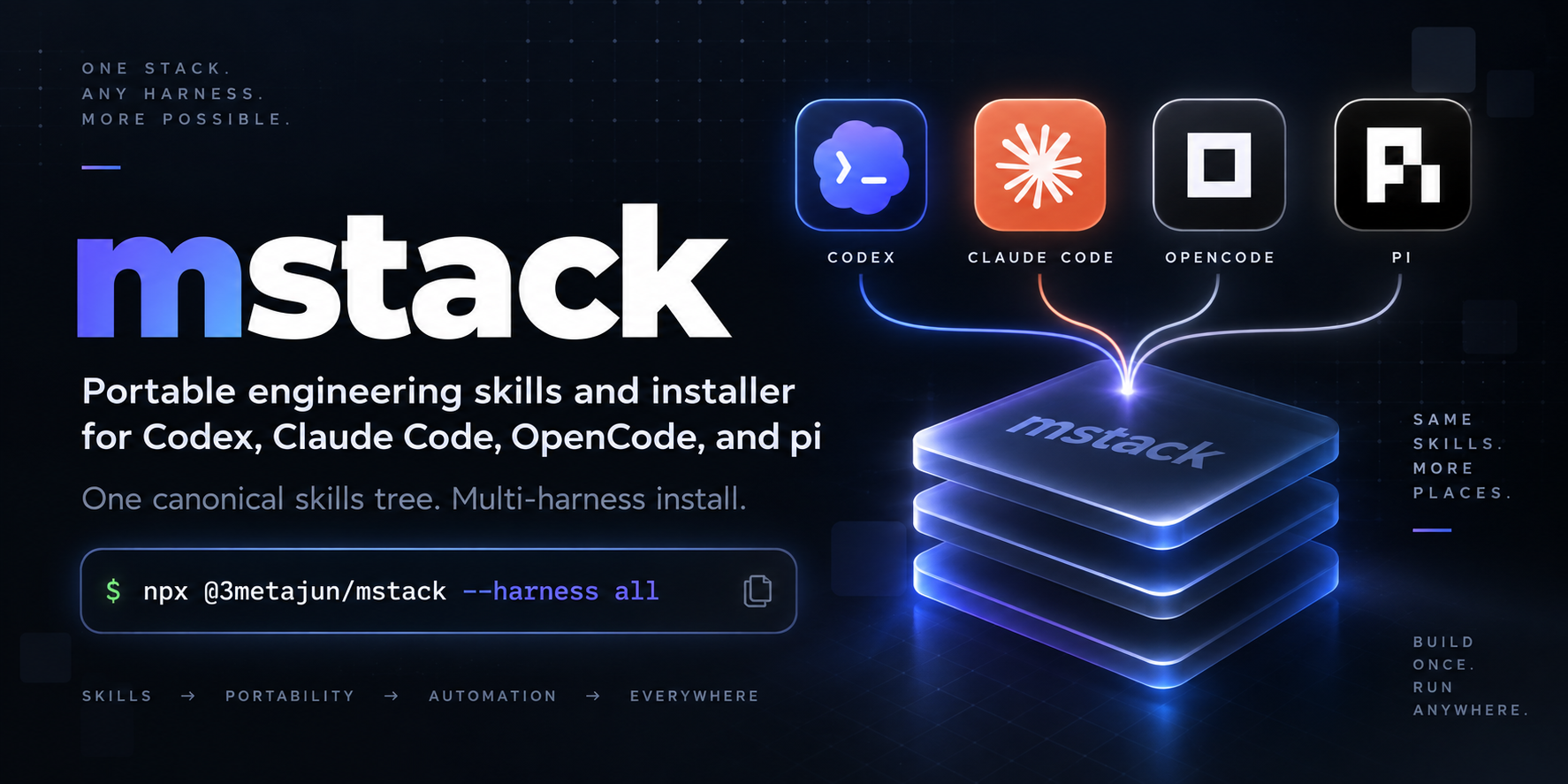
mstack packages portable engineering skills for Codex, Claude Code, OpenCode,
and pi. One canonical skills/ tree feeds every supported harness. The
installer adapts harness metadata at install time, so skill instructions do not
contain harness-specific paths or commands.
The collection started with selected workflows from
pstack and
mattpocock/skills. Source and license
records live in THIRD_PARTY_NOTICES.md.
Install skills
Node.js 18 or newer is required.
To install every skill for every supported harness, run:
npx @3metajun/mstack --harness allTo install skills for selected harnesses, list them with commas:
npx @3metajun/mstack --harness codex,claude
npx @3metajun/mstack --harness opencode,pi
To install selected skills, add --skill:
npx @3metajun/mstack --harness all \
  --skill writing-for-agents,codebase-design,diagnosing-bugs
The installer preserves an existing skill directory. Use --dry-run to inspect
the plan. Use --replace to move existing directories into a timestamped
.harness-skills-backups/ directory outside the skill root. Backups, staged
skills and failed replacements must stay outside discovery roots because
OpenCode also scans hidden subdirectories. Artifact backups stay beside the
artifact target. The installer prints each backup path and retains its contents.
Install optional artifacts
The same installer can copy the portable artifacts that accompany the skills.
By default it installs skills only. Select artifacts explicitly, or use
--no-skills when an artifact-only install is needed:
npx @3metajun/mstack --harness codex --artifact agents,meta-mode-tools
npx @3metajun/mstack --harness all --no-skills --artifact all
The available installable artifacts are:
| Artifact | Default destination |
| --- | --- |
| agents | Codex: $CODEX_HOME/agents/ as TOML; other harnesses: their native agents/ directory as Markdown |
| meta-mode-tools | tools/meta-mode/ beside the resolved skill root; shared consumers use ~/.agents/tools/meta-mode/ |
| guide | docs/guide/ beside the resolved skill root |
Codex skills default to ~/.agents/skills/, while Codex agents default to
~/.codex/agents/. An unset or empty CODEX_HOME uses ~/.codex.
HARNESS_SKILLS_CODEX_DIR relocates skills only; agents follow CODEX_HOME
unless an artifact override is supplied. Codex TOML and Markdown agents must
use separate target directories. Shared targets are allowed only when the
artifact source and output format match.
For SSH installs, both /home/dev/.agents/skills and
/home/dev/.codex/skills map agents to /home/dev/.codex/agents.
For a custom remote layout or remote CODEX_HOME, set
artifacts.agents.codex to that remote agent directory. The installer cannot
infer a remote home from an arbitrary skill path or the local CODEX_HOME.
Artifact destinations can be overridden per harness with
MSTACK_ARTIFACT_<ARTIFACT>_<HARNESS>_DIR, for example
MSTACK_ARTIFACT_AGENTS_CODEX_DIR. Named environments can provide the same
overrides in either shape below (artifact-first is the documented form):
{
  "fleet": {
    "targets": {
      "codex": "C:\\path\\to\\Fleet\\codex\\skills"
    },
    "artifacts": {
      "agents": {
        "codex": "C:\\path\\to\\Fleet\\codex\\agents"
      }
    }
  }
}
benny is intentionally listed in profiles/artifacts.json as a
Cursor-only source and is rejected by the cross-harness installer. It must be
reviewed and copied into a project repository's committed
.cursor/automations/benny/ directory using its own setup instructions.
mstack does not ship portable commands/, hooks/, or settings/ trees:
those are harness- and project-owned configuration surfaces and must be
written or merged explicitly by the user.
Choose installation directories
The default directories are defined in
profiles/harnesses.json:
| Harness | Default directory | Override |
| --- | --- | --- |
| Codex | ~/.agents/skills/ | HARNESS_SKILLS_CODEX_DIR |
| Claude Code | ~/.claude/skills/ | HARNESS_SKILLS_CLAUDE_DIR |
| OpenCode | ~/.agents/skills/ | HARNESS_SKILLS_OPENCODE_DIR |
| pi | ~/.agents/skills/ | HARNESS_SKILLS_PI_DIR |
Codex, OpenCode and pi share one physical copy per skill by default. Updating
through any of these Harnesses updates that shared copy. Claude gets its own
adapter output without a frontmatter name: Claude uses the directory name,
while OpenCode skips that copy. No global Harness settings are changed.
OpenCode and pi agent artifacts retain their native configuration roots.
CLAUDE_CONFIG_DIR, XDG_CONFIG_HOME and PI_CODING_AGENT_DIR still resolve
native roots and legacy migration locations; the latter two no longer move
the default shared skills. Use HARNESS_SKILLS_*_DIR for explicit skill paths.
Set an override to install into a mounted Fleet directory or another local
path. The path must be absolute or start with ~/. Explicit overrides and
named environment targets are not rewritten. Equal targets are combined only
when their selected skill adapters agree; Claude and canonical output cannot
share a target. Keep explicit copies out of overlapping discovery paths.
Migrate an existing installation
Run the new installer locally on the machine that owns the skills:
npx @3metajun/mstack --harness all --migrate --replace --dry-run
npx @3metajun/mstack --harness all --migrate --replace
Migration moves recognized legacy OpenCode and pi copies into backups outside skill discovery. It also moves old installer backup trees and recognized staging leftovers out of discovery. A partial shared update checks the same selected names in all native roots, including Harnesses not named on the command line. Existing Claude copies that need only directory-based identity are adapted from their installed contents, preserving supporting files and body edits. Directly selected skills are replaced from the package, with their original contents backed up.
Ownership comes from an mstack install receipt or known released SKILL.md
content from versions 0.2.0 through 0.4.0. An unrecognized same-name legacy copy
stops migration before writes; inspect and relocate that copy before retrying.
Unselected active skills and unrelated skill names remain in place. Re-running
the migration is safe, and a later failed write rolls back earlier migrations.
Without --migrate, the installer reports legacy copies that would remain
active. Automatic migration requires a default shared local target. For SSH or
mounted custom layouts, run migration on the target machine with its native
paths; SSH --migrate is rejected before connecting. SSH dry-run validates
configured destinations but does not inspect the remote filesystem.
Custom and remote targets
$env:HARNESS_SKILLS_OPENCODE_DIR = 'C:\path\to\fleet\opencode\skills'
npx @3metajun/mstack --harness opencode
For named local or mounted environments, copy
profiles/environments.example.json to
~/.config/mstack/environments.json, replace the paths, and pass the name:
npx @3metajun/mstack --harness opencode --environment fleetSet MSTACK_ENVIRONMENTS_FILE to use another environment file. Each target must
be an absolute path or start with ~/ for local environments.
For a Tailscale, VPS, or Mac mini target, use an SSH environment. The machine
running mstack must have Node.js, ssh, and rsync. The target must expose a
POSIX shell and rsync; it needs the selected Harness CLI only when roles or
live smoke tests will run there:
{
  "fleet-ssh": {
    "transport": "ssh",
    "host": "dev@tailnet-host",
    "shell": "posix",
    "targets": {
      "opencode": "/home/dev/.config/opencode/skills"
    }
  }
}
Put identity and connection options in the SSH host alias when possible. If an
environment supplies them directly, configure both transports because rsync
starts its own SSH process and does not reuse sshArgs:
{
  "sshArgs": ["-i", "/home/dev/.ssh/id_ecdsa.pem"],
  "rsyncArgs": ["-e", "ssh -i /home/dev/.ssh/id_ecdsa.pem"]
}
The same npx @3metajun/mstack --harness opencode --environment fleet-ssh
command stages
locally, transfers with rsync, takes a remote lock, and moves each selected
directory into place. Add --dry-run to print the remote plan without opening
an SSH connection. Windows remotes can still be used through a mounted path;
remote installation currently targets POSIX shells.
Remote lock directories record a timestamped owner. After an interrupted
install, inspect <target-parent>/.mstack.install.lock/owner, verify that no
install is running, remove the lock directory, and retry.
The SSH/rsync path has been verified end to end against a disposable POSIX target, including remote locking, atomic installation, checksum comparison, and cleanup.
Run a configured role
run-role turns a configured role into the selected Harness command. Without
--execute it only prints the plan:
npm run run-role -- --harness opencode --role explorer \
  --prompt "Inspect the repository and do not edit files" \
  --environment fleet-ssh --model auto
Add --execute to run the command. SSH environments pass the prompt through
strict POSIX quoting or a PowerShell encoded command, depending on shell.
Model roles live in ~/.config/mstack/models.json. Each role accepts a model
string. The reviewer role also accepts a non-empty list of unique model strings.
A Harness override replaces the role's whole value. Use /setup-mstack to choose
names reported by your Harness; existing string configurations remain valid.
inherit-parent requests the current chat model. Native delegation can use its
documented inheritance mechanism, but run-role starts a new CLI process and
requires --parent-model <known-parent-model> for that value. auto omits the
model argument and selects the CLI's default, which may be different. Existing
CLI calls that used inherit-parent must add --parent-model, or explicitly
choose --model auto. With no configuration file, the seven roles default to
inherit-parent, so the same choice is required.
For a configured reviewer list, select one entry with --model-index 0 or run
all entries concurrently:
npm run run-role -- --harness codex --role reviewer \
  --file ~/.config/mstack/models.json --prompt "Review this diff" \
  --all-models --read-only --execute
Replace roles.reviewer or overrides.codex.reviewer with a JSON array of the
model names you selected. Add --parent-model <known-parent-model> if an entry
is inherit-parent. Without --execute, fanout prints a JSON array of plans.
Execution returns a JSON array with each model's stdout, stderr, and status,
in configuration order. A string role used with --all-models returns the same
array shape with one entry. Any failure makes the overall exit code nonzero. Output
is buffered up to 16 MiB per stream per worker; larger output fails that worker.
--all-models requires --read-only. Writable workers need individual launches
with separate worktrees. Review the Harness's read-only limits below.
Smoke test Harnesses
Check CLI availability and installed skill files after installation:
npm run smoke-harnesses -- --harness all --require-installedAdd --execute for a live prompt on every available Harness. It uses the CLI
default model unless you supply --model, --parent-model, or a --file with
model choices. An inherited role in that file needs --parent-model. The live
prompt checks a reply marker; it does not prove that the Harness loaded the skill
or completed its workflow. These live calls always use --read-only.
Codex, Claude Code, and pi use CLI-enforced tool restrictions.
OpenCode selects its built-in plan agent, which denies direct edits but still
allows shell commands in OpenCode 1.18; use a disposable checkout when its
prompt-only write boundary is insufficient. A live check also needs that
Harness's credentials and configured model access.
The Claude live path was verified with Claude Code 2.1.267, the Kiro-Pro
configuration, and claude-haiku-4-5-20251001. The check required Claude
Code's native Skill tool to invoke meta-mode and return an exact marker;
the remote fixture and temporary credentials were removed afterward.
Recover recent context
recall includes a history reader in recall/scripts/history.mjs; it also works
when only the skill directory is installed. List session metadata for the active
workspace before selecting a session to read:
node <recall-directory>/scripts/history.mjs list --harness codex --workspace <workspace> --exclude <current-session-id>
node <recall-directory>/scripts/history.mjs read --harness codex --workspace <workspace> --session <session-id> --query parser
The reader supports Codex, Claude Code, OpenCode, and pi, with configured storage
roots, session exclusions, branch selection where available, and bounded text
output. OpenCode exports are sanitized by default; explicitly use --local-text
for private local recovery because sanitization can remove all message text.
See history sources for supported
formats and limits. Tests use disposable sessions; no user transcript is bundled.
The authoring playbook gives
automate-me and reflect a concrete draft, description review, and validation
workflow even when no native skill creator or repository validator is installed.
Repository layout
skills/contains the canonical, harness-neutral skill files.adapters/contains per-harness frontmatter changes.profiles/harnesses.jsondefines supported harnesses and default paths.docs/harness-adapters.mdrecords the official skill and session rules used by each Harness adapter.profiles/artifacts.jsondefines optional artifacts and documents unsupported harness-owned surfaces.profiles/skills.jsondefines the canonical skill inventory.profiles/upstreams.jsonrecords source commits and renamed entries.profiles/models.example.jsongives model-role configuration a portable shape without forcing a provider.agents/contains portable routing and comment-review agents.automations/benny/keeps the optional Cursor automation pack from pstack.docs/guide/contains the adapted upstream workflow guide.tools/meta-mode/contains the optional Bun orchestration and PR watcher tools.scripts/install.mjsstages, validates, and commits an installation.scripts/remote-install.mjsstages and transfers an SSH environment install.scripts/validate.mjschecks inventory, frontmatter, links, and portability.scripts/check-harness-policy.mjsvalidates a business repository's mixed pstack/mstack policy and detects duplicate verification maps..codex-plugin/packages the same skill tree for Codex.
The installer stages every selected skill, applies its adapter, validates the result, and then renames the staged directory into place. It uses a lock per target directory and restores backups if a commit fails.
Included skills
The current bundle contains 50 skills. It includes the 47 entries in the
portable pstack tree and three skills adapted from mattpocock/skills:
- Engineering principles for boundaries, domain modelling, idempotence, verification, sequencing, and type safety.
- Workflows for diagnosis, design review, context recovery, TDD, and agent instruction writing.
create-verification-skillfor generating a project-specific verification workflow.meta-modefor routing a multi-step task through the capabilities available in the current harness.
The bundle includes the pstack workflow and principle names. meta-mode is the
portable replacement for pstack's poteto-mode; it describes capabilities and
uses the current harness's adapter instead of naming one vendor's commands.
Run node scripts/validate.mjs to print the validated skill count.
For a business repository that mixes pstack and mstack, initialize its shared project workflow with the CLI available in mstack 0.4.0 and later:
npx --package @3metajun/[email protected] mstack-policy init --root <project> --app web --check 'node --test' --pstack <exact-pstack-commit>Replace the app, check command, and pstack revision with the project's values.
Initialization exports .harness/check.mjs and its library for committed CI
checks that run without downloading mstack. It leaves the application
contract for /create-verification-skill to create or migrate and prove. See
mixed-Harness adoption for wrapper generation,
receipts, repository protection, and reviewed checker upgrades. Pin the team's
exact package version for initialization and run recording.
To validate and print a user's model configuration, run:
npm run check-models -- --file ~/.config/mstack/models.jsonTo check the complete skill trees against both pinned upstreams, run:
npm run skill-baseline -- --check --source /path/to/pstack --matt-source /path/to/mattpocock-skillsThis checks every file in all 50 skill trees, including references, playbooks,
and scripts. It also checks tools moved out of skill directories. Local
additions and intentional upstream omissions are recorded explicitly. Both
source checkouts must be clean and at their pinned commits. npm test checks
the target files without needing upstream checkouts.
For intentional changes, preview with the same source arguments and --diff,
review the source-to-adaptation patches, then use --write to update
profiles/skill-manifest.json. Commit the baseline with the corresponding
content changes. The hashes detect drift; they do not establish that an adapted
workflow behaves like its source. See the baseline review process.
To compare the pstack inventory and non-skill artifacts, run:
npm run check-upstream -- --source /path/to/pstackThe check applies the renames in profiles/upstreams.json, verifies the
reviewed body digest for every canonical pstack skill, reports the portable
skill count, and reports the state of the agents, Benny automation, guide, and
meta-mode tools. Add --strict to fail when a canonical skill body or
configured artifact is missing, differs, or remains after removal upstream.
Strict mode requires the source to be a clean Git checkout whose HEAD exactly
matches the pinned commit. If you intentionally edit a canonical skill, update
its reviewed target digest in canonicalSkills as part of that review; sync
preserves these entries and does not silently re baseline them.
To preview and apply a transformed refresh of those non-skill artifacts:
npm run sync-upstream -- --source /path/to/pstack
npm run sync-upstream -- --source /path/to/pstack --apply
The sync command is dry-run by default. It transforms pstack and poteto names
to mstack and meta names, preserves adapted agents, and refuses to overwrite
changed source-managed files. --apply requires the same clean, pinned source
checkout as strict checking. It removes files deleted upstream only when their
content still matches the previous manifest. Pass --apply --force after
reviewing a diff when overwriting or removing a locally changed file is
intentional.
All sync commands use one exclusive lock per target, so concurrent --apply,
dry-run, and check-upstream commands are serialized. The lock records the
host, platform, and process start identity. A lock from another runtime (for
example Windows versus WSL), or one whose owner cannot be verified, is left in
place and the command explains how to inspect and remove it after confirming
that no sync is running.
Writes and removals are staged and journaled before the target is changed; an
ordinary failure rolls the whole refresh back. If the process is interrupted,
the next --apply recovers the unfinished transaction before rebuilding the
sync plan. If a user changed a target during an unfinished rollback, mstack
moves that file to .mstack-sync-upstream/recovery/<transaction>/<index>.user
and restores the previous version; the command prints both paths. A
COMMITTED marker is authoritative, so later user edits are preserved while
transaction sidecars are cleaned up. Dry runs and check-upstream refuse to
inspect a target while a sync is active or needs recovery.
On Windows, directory fsync is best-effort because Node cannot portably flush a directory handle. The transaction provides process-crash recovery, but it does not provide a power-loss durability guarantee on that platform. Readers that ignore the sync lock can still observe files changing during the commit.
--apply writes profiles/upstream-manifest.json. Its artifact hashes describe
the transformed upstream baseline, while canonicalSkills records the pinned
source body and reviewed target body for each canonical skill. Files configured with
compareContent: false, including the adapted agents, may intentionally differ
from those hashes. A different checkout can be used as the destination with
--target /path/to/mstack.
Verify changes
Run the complete local check before you commit:
npm testThe check validates the canonical tree and runs installer, context, upstream sync, runtime, and environment tests.
Add a skill
- Add
skills/<name>/SKILL.mdwithnameanddescriptionfrontmatter. - Keep the main file portable. Put harness-specific paths and commands in a reference file.
- Add the skill name to
profiles/skills.json. - Add adapter metadata only when a harness needs it.
- Run
npm testand verify discovery in at least one supported harness.
Use the same name for a skill in the canonical tree, adapters, tests, and docs. This keeps installation and validation data-driven.
License
mstack is released under the MIT License. See
THIRD_PARTY_NOTICES.md for upstream licenses and
source revisions.