
@99percentpeople/pi-thinking-fold
v0.1.11
Published
Fold streaming reasoning into a live tail preview and expand it with Pi's thinking shortcut

Maintainers
 99percentpeople
Readme
@99percentpeople/pi-thinking-fold
Fold long, streaming reasoning blocks into a small live preview in Pi's TUI. The preview follows the latest terminal-visible lines instead of letting a reasoning trace continuously grow upward.
During thinking you see a compact tail preview with a live timer; afterwards
it collapses to Thought for 12.3s. Press Ctrl+T anytime to expand the full
reasoning trace. Behavior is tunable in /99settings (fold depth, while/
after-thinking strategies).
Demo
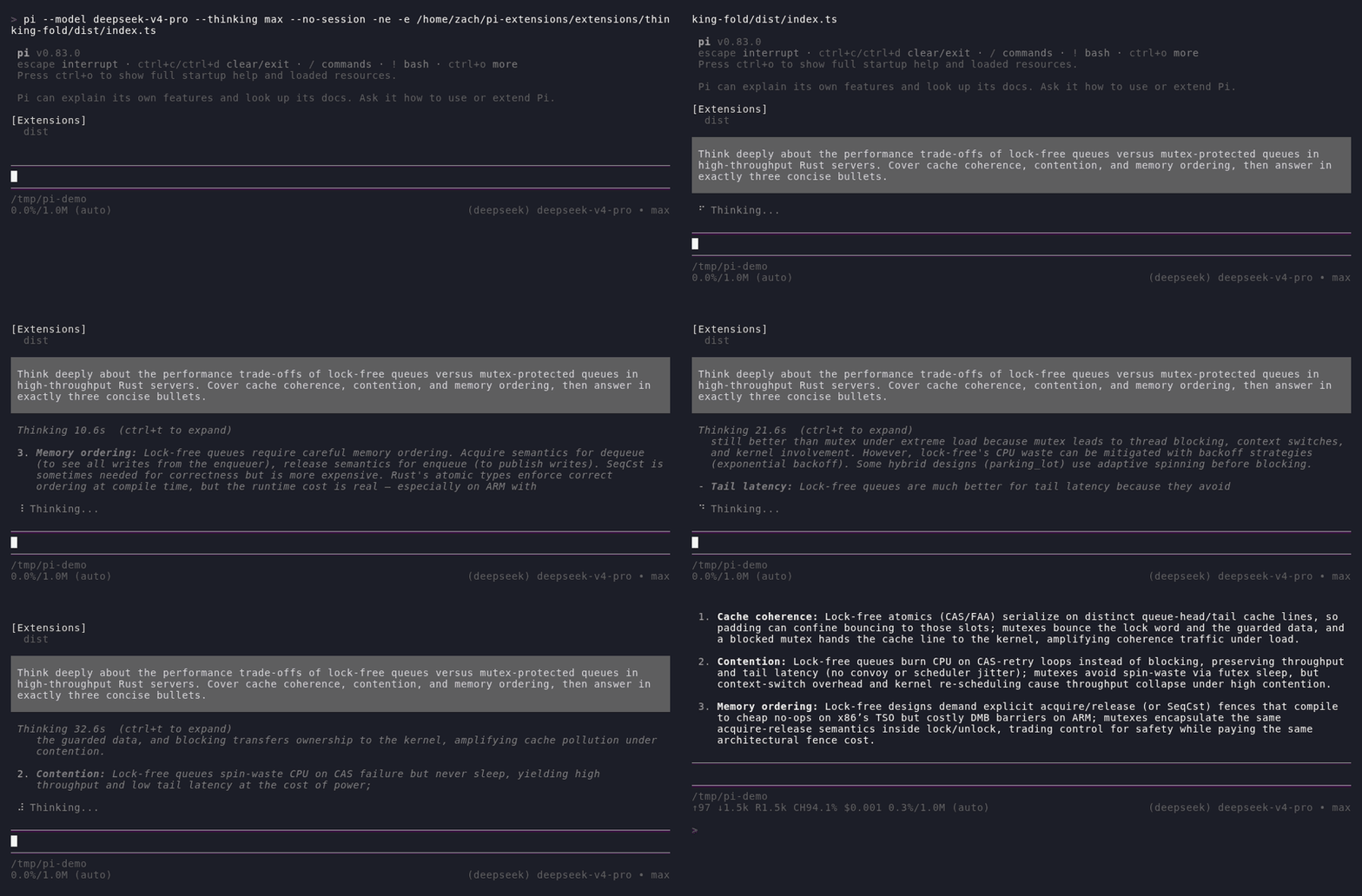
Trace models
A reasoning trace collapses to a stable tail preview with a timer, then to
Thought for Xs (ctrl+t to expand) — no more scroll-storms:
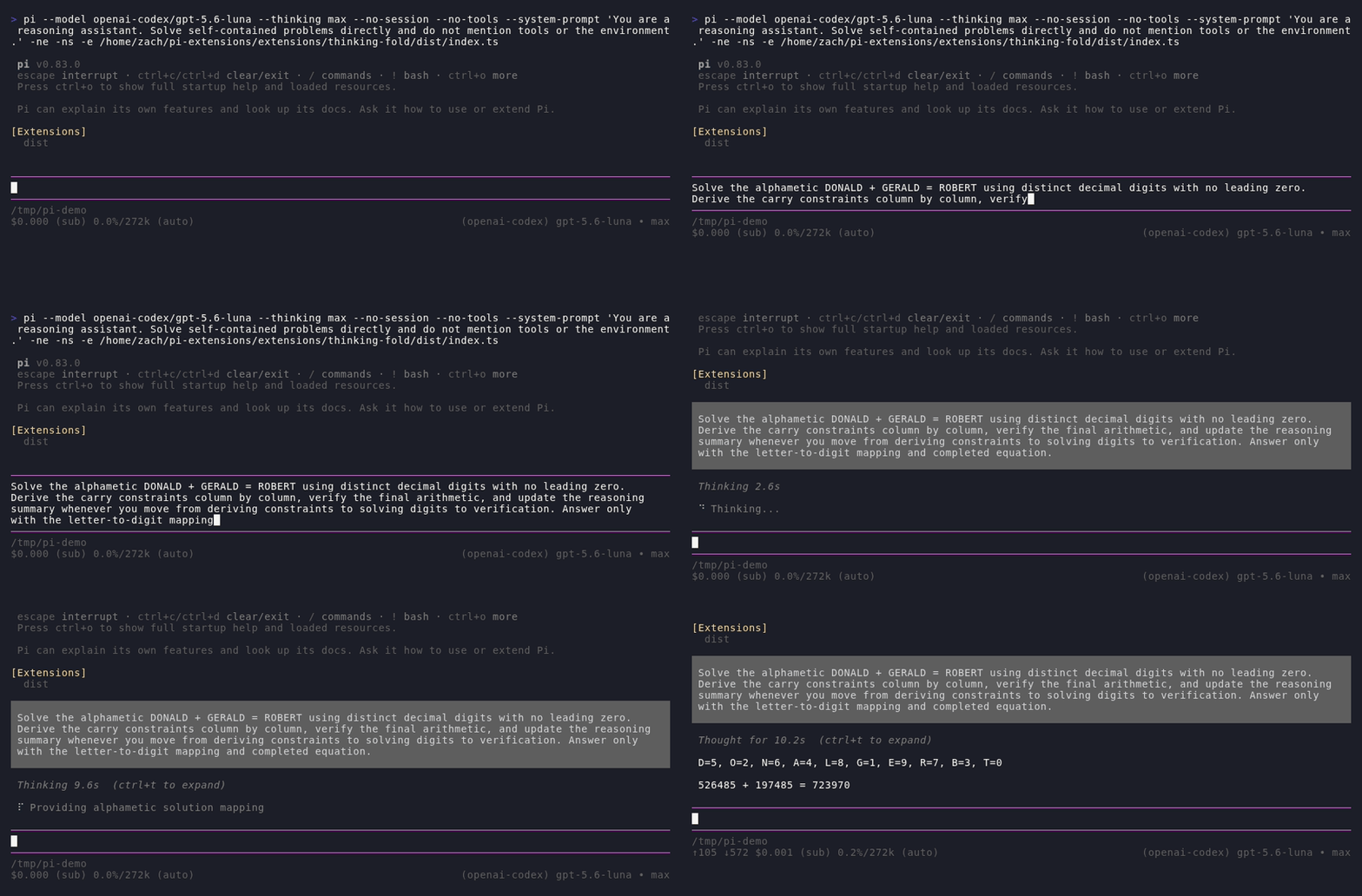
Summary models
A reasoning summary keeps its content folded while the working row shows the latest summary headline, then collapses to the same completed timer:
Behavior
When While thinking is set to preview, the assistant Item contains a
timed header and its latest terminal-visible lines:
Thinking 7.1s  (ctrl+t to expand)
  checking the final branch…
  validating the result…
The cursor working row separately displays the plain status Thinking.... Model
behavior determines whether that row uses a summary headline (for example,
Running focused tests) or Thinking.... With the default auto streaming
behavior, summary content stays hidden while trace content shows a tail preview.
Cursor styling is intentionally outside this package. Install
@99percentpeople/pi-cursor-effect to apply the
optional wave effect to this and Pi's other main working-cursor labels.
The Item timer redraws only once per second. When reasoning finishes, the timer
freezes as soon as answer text or a tool call starts. The default auto
completion behavior hides content for every model, leaving a single line with
precise elapsed time. This also handles OpenAI-compatible providers that delay
their thinking_end event until the entire answer has streamed:
Thought for 12.3s (ctrl+t to expand)Additional behavior:
- The
previewstrategy shows the latest 5 visual lines by default, for traces and summaries alike. - Preview content keeps Pi's native Markdown formatting. Each thinking section is rendered at the current terminal width first, then the preview retains its final terminal-visible rows. Fences, headings, tables, quotes, lists, syntax highlighting, wrapping, and future Markdown behavior therefore need no syntax-specific handling, while the folded height stays fixed as formatted constructs enter or leave the tail window.
- Pi's normalized
thinking_start/thinking_delta/thinking_endevents drive streaming and timing, so model IDs never need per-model adapters. - While thinking defaults to
auto: summaries show only the timer while traces show their latest lines. Explicitcollapseandpreviewoverride that model-aware choice. - After thinking defaults to
auto, which hides completed content for both summaries and traces. Explicitcollapse,preview, andfulloverride it. - An empty Pi
thinking_startstill creates the timed Item. If a provider emits its entire summary immediately beforethinking_end, the cursor keeps that headline visible for at least one second beforeResponding…. - Models that expose neither a trace nor a summary transition directly to the
normal
Responding...working row without an extra availability warning. Ctrl+T(or the configuredapp.thinking.togglebinding) switches between the folded view and complete reasoning blocks. Its expansion hint appears only when content is actually hidden: by acollapsestrategy, or because a thinking block exceeds the configured fold threshold. The chosen state persists across later turns untilCtrl+Tis pressed again. Toggling requests an immediate TUI redraw, including after the conversation has finished or a completed session has been restored. On Pi 0.85+, clicking a thinking block in fullscreen mode toggles the same global state.Ctrl+Okeeps its native Pi behavior and only expands tools and other expandable UI content.
The extension changes display-only message copies. Original assistant messages, reasoning signatures, session persistence, and model context are not modified. No extra session entries are added. After a reload, old durations are reconstructed from Pi's message timestamps and are therefore approximate.
Install
Build and install this checkout as a user-local development package:
bun run build:packages
bun run --cwd extensions/thinking-fold build
pi install ./extensions/thinking-fold
Or test without adding it to settings:
pi -e ./extensions/thinking-fold/index.tsRemove the local package with:
pi remove ./extensions/thinking-foldSettings
Run the shared /99settings menu. It lists installed @99percentpeople
plugins that expose three independent display controls:
- Fold after lines (1–20): maximum terminal-visible lines retained by a
previewdisplay; - While thinking:
auto(hide summaries, preview traces),preview(latest lines), orcollapse(timer only); - After thinking:
auto(hide every model),collapse(timer only),preview(latest lines), orfull(all reasoning text).
Both behavior settings default to auto.
Settings persist globally in:
~/.pi/agent/99extensions.jsonunder the thinking-fold namespace. The model behavior is always resolved from
the built-in model behavior configuration described below; an unmatched model
uses trace. Existing previewLines and autoCollapse settings are migrated
to the equivalent new values when next saved.
Model behavior configuration
model-behaviors.json is the package's single built-in
compatibility table. A rule selects by any combination of case-insensitive
JavaScript regular-expression sources in api, provider, and model:
{
  "version": 1,
  "rules": [
    {
      "id": "responses-summary",
      "api": "responses$",
      "behavior": "summary"
    },
    {
      "id": "deepseek-trace",
      "provider": "^deepseek$",
      "model": "^deepseek-.*$",
      "behavior": "trace"
    }
  ]
}
Patterns are regex source strings without /.../ delimiters; use ^ and $
when a full-field match is required. Invalid expressions fail validation at
startup. Rules with more selectors win, then model is considered more specific
than provider, and provider more specific than api; a later rule wins a
remaining tie.
The built-in table uses conservative API-family baselines:
| API/provider family | Behavior | Basis |
|---|---|---|
| OpenAI-compatible Chat Completions | trace | Pi reads reasoning_content, reasoning, or reasoning_text |
| Anthropic-compatible gateways | trace | Safe fallback because gateway semantics vary |
| Amazon Bedrock Converse | trace | Safe fallback because the model behind reasoningContent varies |
| Mistral Conversations | trace | Pi streams explicit thinking content items |
| pi-messages gateways | trace | Safe fallback for an intentionally generic protocol |
| OpenAI/Azure/Codex Responses | summary | Pi consumes reasoning_summary_text events |
| Google Generative AI/Vertex | summary | Pi consumes Google thought parts |
| First-party Anthropic | summary | Pi requests summarized thinking display |
The conservative Trace rules cover common providers such as OpenRouter, Groq, Together, Fireworks, Cerebras, Hugging Face, Kimi, MiniMax, Moonshot, Qwen, xAI Chat Completions, Z.AI, Xiaomi, NVIDIA, Mistral, and Bedrock through their Pi API adapter. They do not claim that every routed model exposes a raw chain of thought; Trace is chosen because it preserves visible content if an untested backend differs. Provider/model-specific rules can override these API baselines later.
Only the previously exercised OpenAI Responses, Google, and DeepSeek paths have
live model coverage in this repository. The additional families are validated
against Pi 0.82.1 adapter source and static fixtures, not paid provider calls.
The first config version intentionally supports only trace and summary, is
shipped with the package, and has no user override file. This keeps compatibility
data declarative and leaves provider/model names out of rendering code.
Compatibility
Pi currently exports AssistantMessageComponent but does not provide an
extension hook for replacing normal assistant-message rendering. This package
therefore installs a guarded compatibility patch around the component's public
updateContent() method. It lets Pi create its native thinking Markdown
component, then wraps that display-only child so render(width) is evaluated
before its output is folded. The patch prevents duplicates across reloads and
restores the original method during session shutdown.
The package is tested against Pi 0.83.0 and 0.85.1. It supports both direct
thinking Markdown children and the MouseRegion wrappers introduced in 0.85,
and preserves the native isStreaming argument for Markdown transformers.
Shutdown restores native content and mouse handlers on existing components.
If the public component API is missing, the extension disables itself and reports
a warning. If Pi changes only the
internal child layout, an affected message safely falls back to complete native
rendering instead of exposing markers or modifying source content.