
@aeronautic/countermeasures
v0.1.1
Published
Physically based aircraft countermeasures for three.js and React Three Fiber: MTV decoy flares thrown at the cartridge's speed, slowed by their own drag and falling, burning down with the light of a graybody flame worked out from the composition's measure

Maintainers
 romainlg29
Readme
@aeronautic/countermeasures


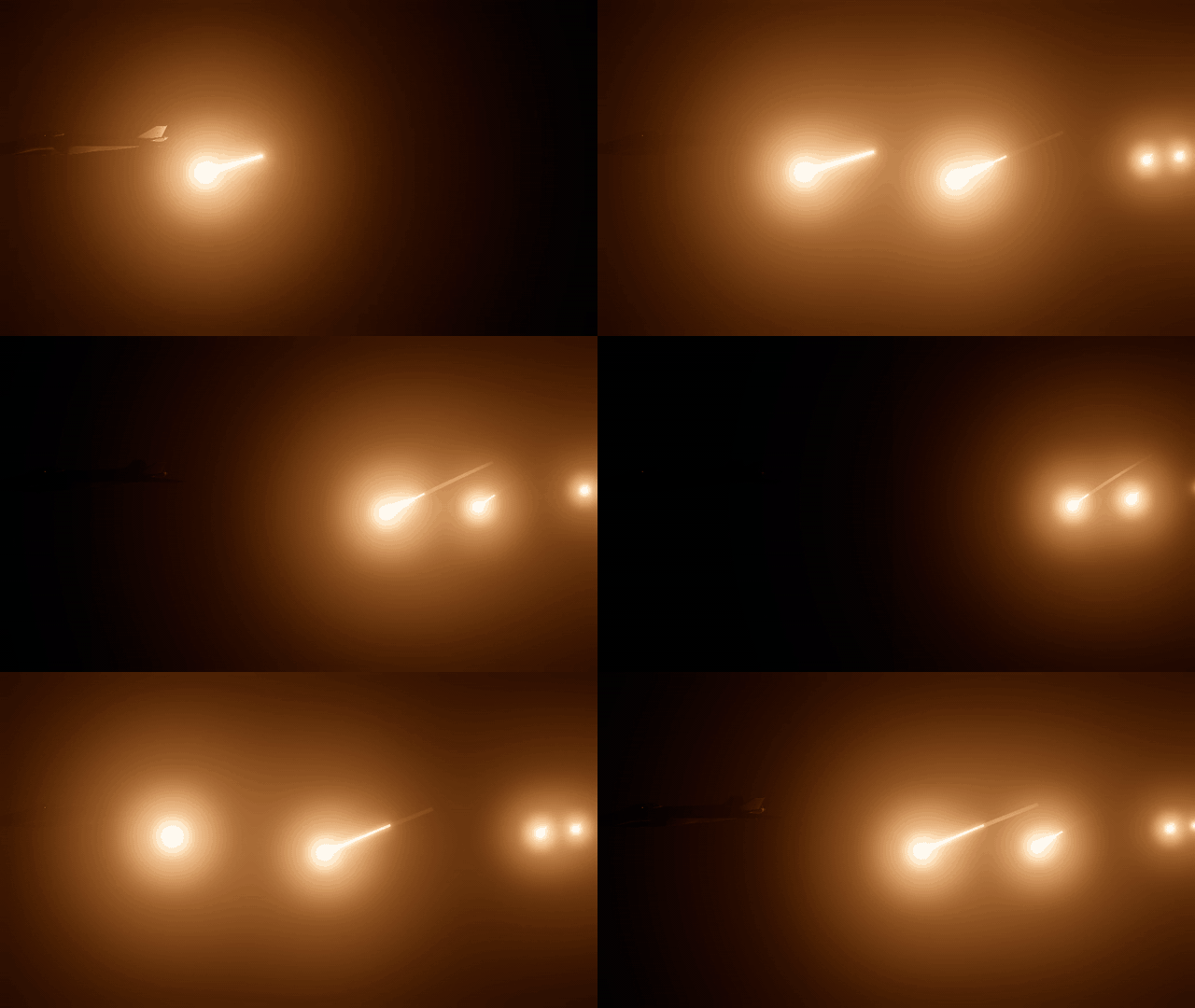
Physically based decoy flares and chaff for React Three Fiber
and three.js, written in TSL for three's WebGPURenderer.
- The grain: an MJU-7 class flare by default, 253 g of magnesium, Teflon and Viton, burning from every face at the composition's measured rate. It is gone when its thinnest side is, in about three seconds.
- The flame: what it radiates follows from what it burns, with the composition's measured efficiency. The flame's temperature, 2100 K, carries that to the eye: about 250,000 cd as it lights, fading as the grain shrinks.
- The airstream: the flame dims as it is swept off the grain, halved at 150 m/s, and what is swept off glows on as a trail behind it, long at release and shrinking as the flare slows. No measured curve is published openly: these numbers are estimates, and dials. Higher up it burns slower, as MTV's rate goes with the pressure, and is swept off less.
- The smoke: 1.13 kg of MgO, MgF₂ and carbon a kilogram burnt, laid along each flare's path, spreading in the air's turbulence, and lit by the flames, the sun and the sky.
- The flight: thrown down at the cartridge's 30 m/s, then slowed by its own drag, a tumbling block's, from the aircraft's speed within a second, falling behind and below.
- Chaff: an RR-178 class cartridge, 88,775 m of aluminised glass fibre, 117 g. The airstream tears it into a cloud in a fifth of a second; it stays where it formed, falling at a fifth of a metre a second as one-mil chaff is measured to, and spreading as the smoke does. Its fibres' shadow and aluminium light it, and each fibre, a mirror cylinder, glints: where the cloud thins it glitters. Falling, its fibres level out, and seen where the sun's reflection would be it flashes.
- Programs: bursts and salvos, the dispensers taking turns, of flares or chaff.
- Glare from the flame's real luminance and the exposure: the eye's own scatter (CIE 146), dimmed and reddened by the day's haze. The brightest flares light the scene.
None of it is drawn to a size or a timer by eye; the few estimates are said to be.
Docs · Live example on the docs' fighter · Under takram's atmosphere
Install
pnpm add @aeronautic/countermeasures @aeronautic/core three@~0.186The same peer dependencies as the other packages: @aeronautic/core, three
0.186.x, plus react 19 and @react-three/fiber 9 (or 10) for
@aeronautic/countermeasures/react. It needs a WebGPURenderer, which falls
back to WebGL 2 by itself. In R3F, gl={webgpu_gl()} from
@aeronautic/core/react makes one.
Quick start
<Countermeasures> is a group where the aircraft's reference point sits. Put
it inside the model, say where the dispensers are, and fire it:
import { Countermeasures } from "@aeronautic/countermeasures/react";

// Positions in the model's frame, metres. Each throws down unless told
const AIRFRAME = {
  dispensers: [{ at: [-1, -0.57, 5] }, { at: [1, -0.57, 5] }],
} as const;

export const Jet = ({ fired }: { fired: number }) => (
  <group>
    <JetModel />
    <Countermeasures
      airframe={AIRFRAME}
      flight={{ airspeedMPerS: 250 }}
      fire={fired}
    />
  </group>
);
fire lets the program go each time it changes. The ref holds the
countermeasures themselves: fire(), release(dispenser, payload), stop(),
clear(). Inside a <FlightProvider> from @aeronautic/core the airspeed,
the angles, the altitude and the air's density are the shared flight's.
The flames are in candela and the scene's light in cd/m²: look.exposure is
the number one cd/m² is drawn as, EV100 8 by default.
The dials
Each is a physical quantity in SI units:
airframe: the dispensers, positions or the model's nodes, and which way each throws.flare: the grain's size, mass, density and burn rate, the energy it radiates per kilogram, the flame's temperature and emissivity, its drag and its ejection speed.chaff: the dipoles' total length, diameter, cut and density, their reflectance, the throw and the bloom.program:burst,burstIntervalS,salvo,salvoIntervalS,alternate,payload:"flare"or"chaff".flight:airspeedMPerS,angleOfAttackRad,sideslipRad.air:altitudeM,visibilityMandturbulenceM2PerS3.look: the exposure, the observer's age and eyes, and the sun and sky that light the smoke.
How it works
- The grain. A block a × b × c burning from every face at rate r is (a − 2rt) × (b − 2rt) × (c − 2rt) at t. MTV1 burns at 3.86 mm/s (Debnath et al., CEJEM 2025), so the MJU-7's 22.6 mm side is gone in 2.9 s.
- The flame. Its intensity in the 1.8–2.6 µm band is what it burns a second times MTV1's measured 179 J/(g sr). As a graybody at 2100 K, its luminance over its radiance in that band turns that into candela, and the band's intensity over its radiance is the flame's area.
- The flight. A tumbling block shows a quarter of its surface to the flow (Cauchy), with a cube's drag coefficient, 1.05 (Hoerner). At 250 m/s near sea level that is about 770 m/s²; once slowed it falls at 28 m/s. Flares are laid in the air, so a turning aircraft leaves them behind.
- The smoke. λ = ṁ Y / v a metre of path, spreading as σ² = σ₀² + ½ ε t³ (Richardson), its depth κ λ / (√(2π) σ). Lit once, by Henyey and Greenstein's phase. Its optics are estimates.
- Chaff. Its fibres stop light with their shadow, π d L / 4, 1.77 m², and reflect 0.91 of it, every way alike. It blooms to the size US patent 4,653,403 gives, 1.75 × 11 m at 244 m/s, then falls with Lamb's drag on a cylinder in Oseen's flow. The fibres whose axis is square to the half way between the sun and the eye glint, a Poisson count of them a pixel. Falling, they level out within a few degrees, as the flow's torque and the eddies balance, and the share of mirror facing the half way sets the light: a flash at the sun's reflection. Its throw, its fibres' tumbling and their tilt are estimates.
- Glare. CIE 146's glare spread function times the illuminance at the
eye, through the haze: the same as
@aeronautic/lights, from@aeronautic/core.
What it leaves out
- Altitude's effect on the flame's temperature: 2100 K everywhere.
- The flame's shape at the grain: a disc of its area.
- The smoke's own shadow, and light it scatters more than once.
- Chaff's fibres' bending and flutter, and what it returns to a radar.
License
MIT © Romain Le Gall