
@agentdx/agentdx
v0.5.0
Published
A local-first tool that shows you the real picture of your AI coding agents — tokens, tools, models, and errors across Claude Code, Cowork, Codex, Cursor, Antigravity, VS Code (Copilot), Continue.dev, and opencode. 100% local: no accounts, no telemetry.

Maintainers
 agentdxhq
Readme
AgentDX
See what your AI coding agents are actually doing.
A small, local-first tool built by a developer who wanted an honest picture of how the different agentic coding tools — Claude Code, Codex, Cursor, Antigravity — really behave: where the tokens go, which one ships, where the errors pile up. It reads logs your agents already write and shows you the reality. Runs entirely on your machine; nothing ever leaves.

Install
npx @agentdx/agentdxOr install once and call it by name:
npm install -g @agentdx/agentdx
agentdx
Homebrew: coming soon.
Screenshots
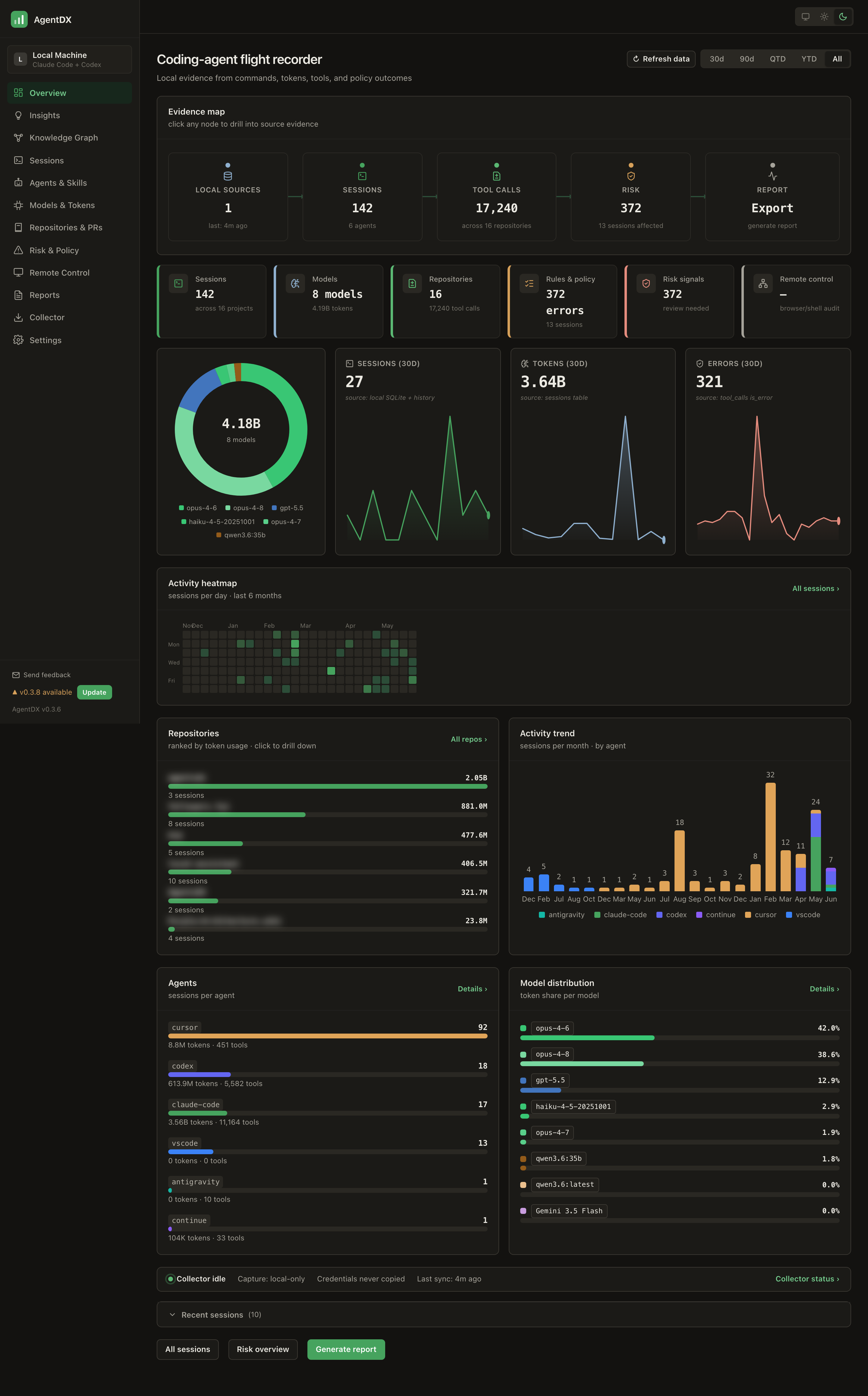
One npx @agentdx/agentdx and the dashboard opens on your own machine — no account, no upload.
Overview — the flight recorder at a glance
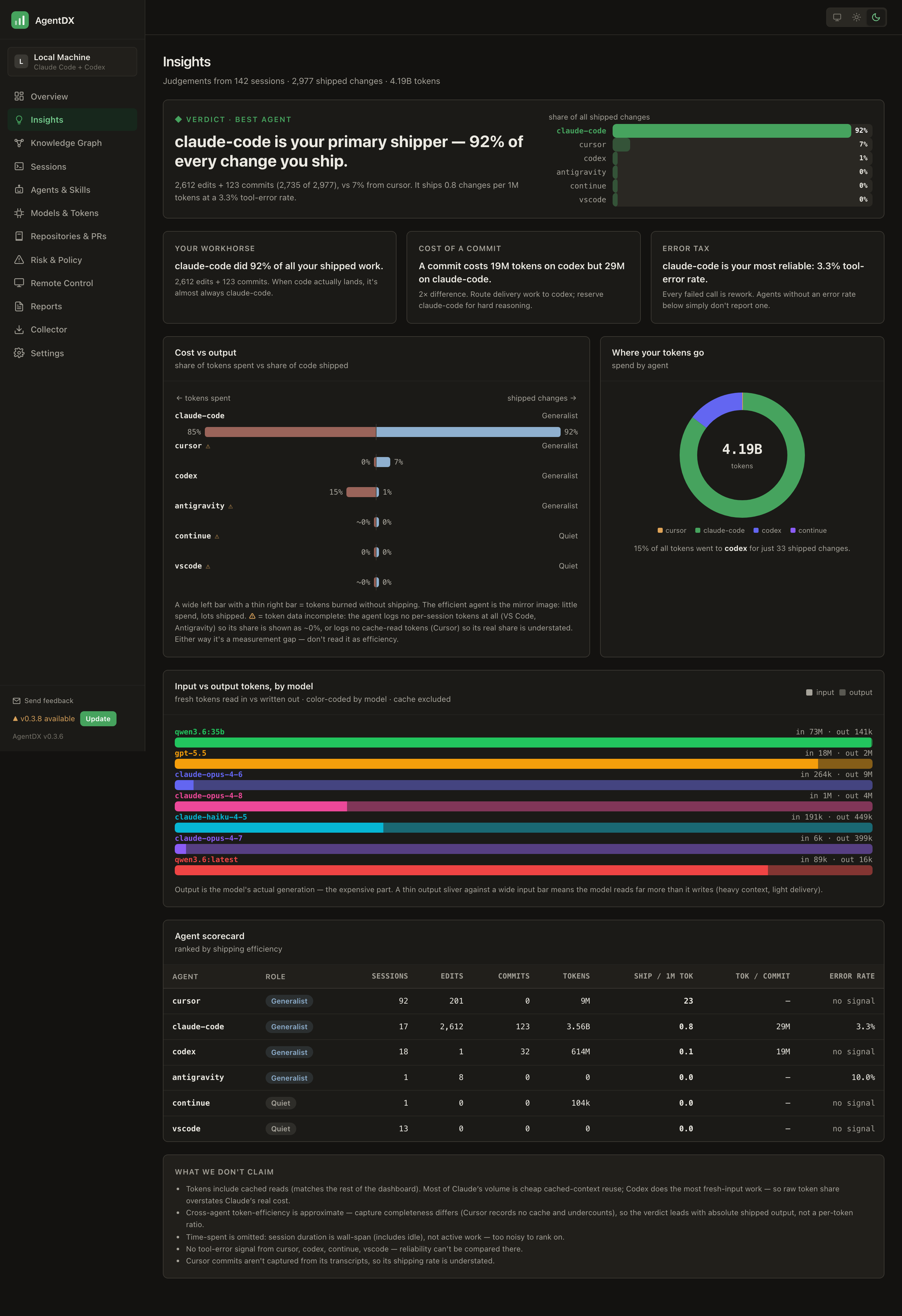
Insights — judgements, not just numbers ("which agent actually ships?")
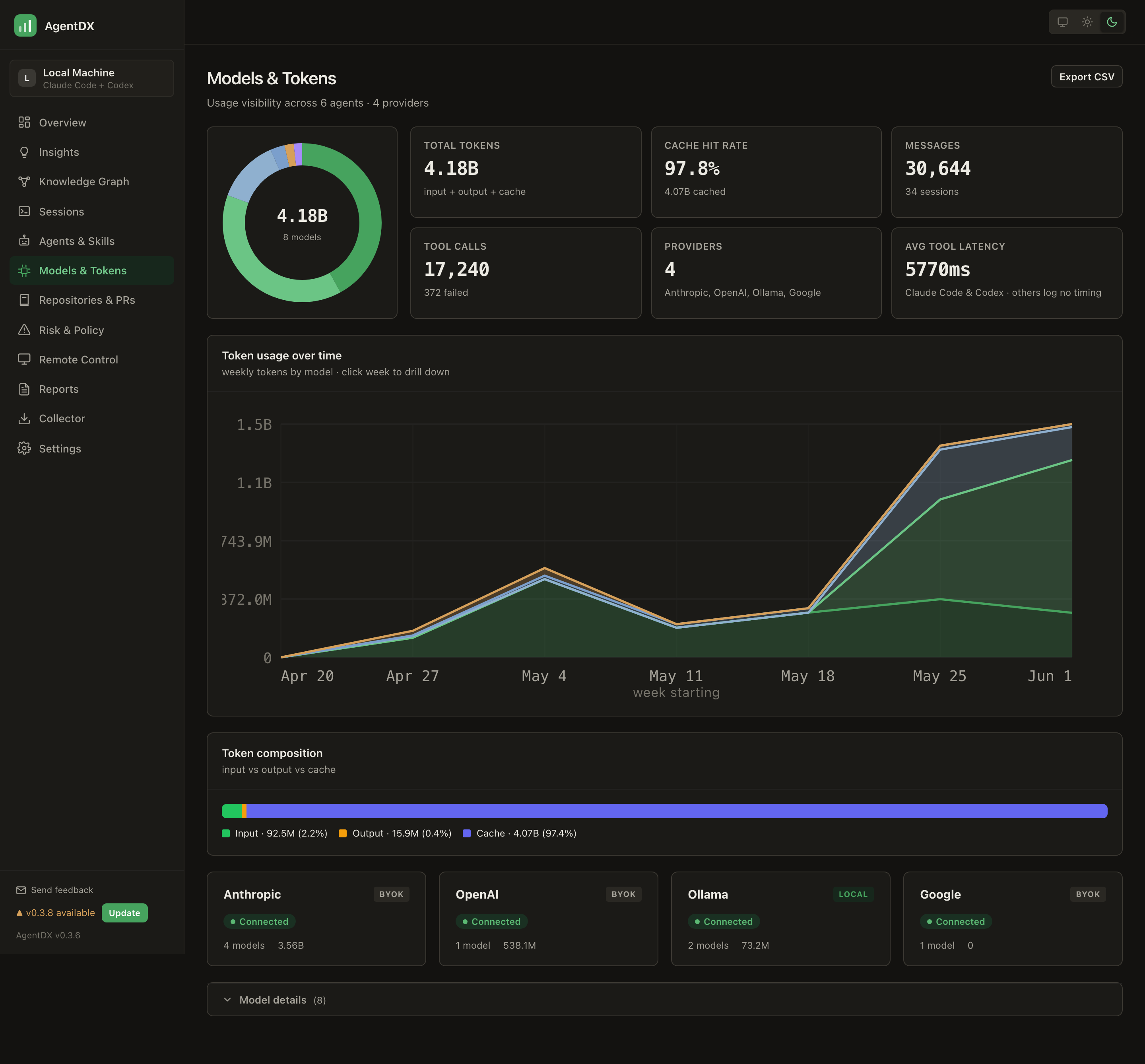
Models & Tokens — spend, cache hit rate, input vs output
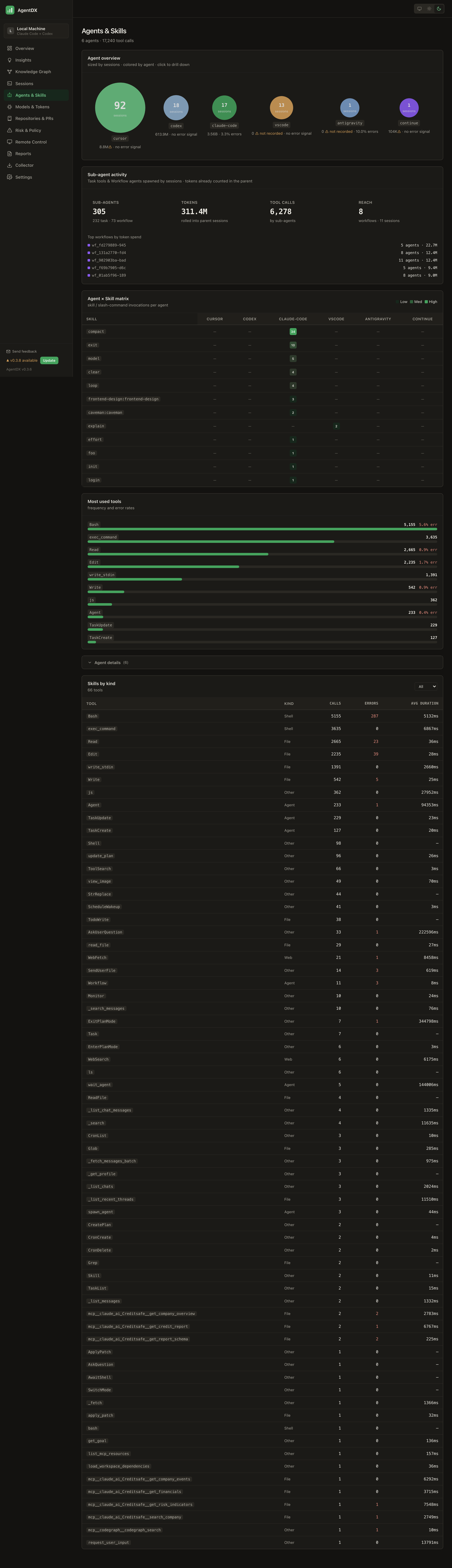
Agents & Skills — every agent, every tool, side by side
What It Does
AgentDX is a free tool that reads the local logs your AI coding agents already write, stores everything in a single SQLite database on your machine, and serves a dashboard so you can see tokens burned, tools called, models used, and errors hit across every agent — and judge which one actually ships. One command, no accounts, no uploads, no telemetry. Nothing ever leaves your computer.
Supported Agents
| Agent | Source | Status |
|---|---|---|
| Claude Code | ~/.claude/projects/ | Stable |
| Cowork (Claude app) | Claude desktop local agent mode | Stable |
| Cursor | ~/.cursor/projects/ | Stable |
| Codex | ~/.codex/ | Stable |
| Antigravity | ~/.gemini/antigravity/ | Stable |
| VS Code (Copilot) | VS Code chat sessions | Stable |
| Continue.dev | ~/.continue/sessions/ | Stable |
| opencode | ~/.local/share/opencode/opencode.db | Stable |
AgentDX reads local logs and artifacts. It never intercepts live traffic or modifies agent behavior.
Quick Start
# 1. Collect session data from all installed agents
npx @agentdx/agentdx collect

# 2. Start the dashboard
npx @agentdx/agentdx serve

# Or do both in one command
npx @agentdx/agentdx
The dashboard opens at http://localhost:3002. (After npm install -g @agentdx/agentdx you can drop the npx @agentdx/ prefix and just run agentdx.)
CLI Commands
Shown with npx @agentdx/agentdx; once installed globally, just use agentdx.
| Command | Description |
|---|---|
| agentdx | Collect data from all agents, then start the dashboard |
| agentdx collect | Collect session data only (no dashboard) |
| agentdx serve | Start the dashboard only (no collection) |
| agentdx watch | Collect, serve, and re-collect on an interval (default: 5 min) |
| agentdx finops | Cross-agent cost report — spend by repo / model / agent / day (--period, --by, --json, --csv) |
| agentdx check | Agent diff for a commit range — AI/human split, cost, risk surface (--base, --head, --format text\|markdown\|json\|sarif). Non-blocking. See docs/ci |
| agentdx statusline | One-line baseline meter for a repo; pipe Claude Code's statusLine JSON on stdin |
| agentdx status | Show database stats: sessions, messages, tool calls, tokens, models |
| agentdx import <file> | Import sessions from a portable JSONL export |
Privacy
AgentDX is local-first. No telemetry, no analytics, no accounts, no uploads — your sessions, prompts, code, tokens, and repo names never leave your machine. Data lives in a single SQLite file at ~/.agentdx/agentdx.db, which you fully control and can delete anytime. The one outbound request is a read-only update check against the public npm registry (just the latest version number — nothing about you is sent); ignore it and the tool works the same offline.
Full details in PRIVACY.md.