
@ajoslin103/schematic
v1.0.0
Published
A FabricJS library, facilitating working above coordinate planes
Downloads
56

Maintainers
 ajoslin103
Readme
Schematic
A lightweight Fabric.js library for working with canvas objects on an interactive coordinate grid.
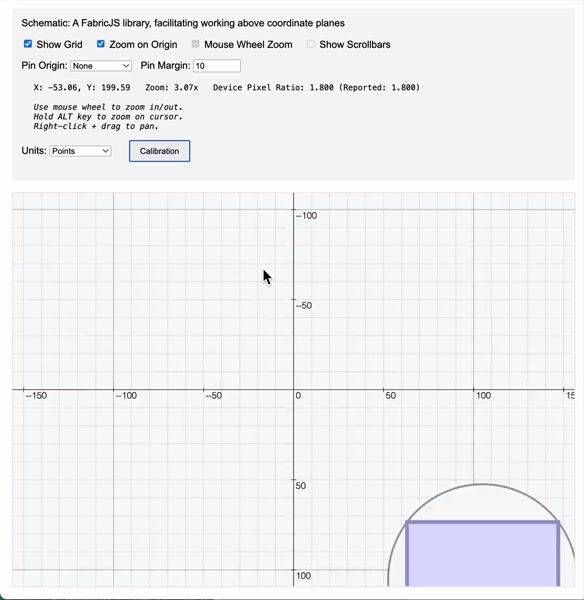
Features
- Interactive coordinate grid with pan, zoom, and configurable units (points, imperial, metric)
- Built on Fabric.js v6+ – full access to Fabric's powerful canvas API
- Mouse/touch interactions – wheel zoom, right-click panning, optional origin pinning
- TypeScript support with full type definitions
- Flexible architecture – use high-level
Schematicor low-levelMapAPI - Debug system with granular logging categories
- Zero dependencies (except Fabric.js peer dependency)
Architecture
Your App → Schematic → Map → Fabric Canvas
                       ↓
                     Grid (renders behind objects)
Core Components
Schematic – Main entry point with event system and interaction controls
Map – Manages Fabric canvas lifecycle and grid synchronization
Grid – Renders coordinate grid, axes, and labels beneath Fabric objects
Base – Shared configuration foundation for all components
Installation
npm install @ajoslin103/schematic fabric
# or
yarn add @ajoslin103/schematic fabric
Requirements:
- Fabric.js
^6.7.1(peer dependency) - Modern browser with ES6+ support
Package exports:
- ESM:
dist/schematic.esm.js - CommonJS:
dist/schematic.cjs.js - UMD:
dist/schematic.umd.js - TypeScript types:
dist/types/index.d.ts
Quick Start
Basic Usage
import { Schematic } from '@ajoslin103/schematic';
import * as fabric from 'fabric';

const container = document.getElementById('canvas-container');
const schematic = new Schematic(container, {
  gridEnabled: true,
  units: 'points',
  zoomDebounceDelay: 200
});

// Access the Fabric canvas
const canvas = schematic.fabricCanvas;

// Configure zoom behavior
schematic.setZoomLimits(0.1, 10);
schematic.setZoom(1);

// Add Fabric objects
const rect = new fabric.Rect({
  left: 100,
  top: 100,
  width: 200,
  height: 150,
  fill: '#4CAF50'
});
canvas.add(rect);
TypeScript
import { Schematic, SchematicOptions } from '@ajoslin103/schematic';
import { Rect } from 'fabric';

const container = document.getElementById('canvas-container');
if (!container) throw new Error('Container not found');

const options: SchematicOptions = {
  gridEnabled: true,
  units: 'imperial',
  mouseWheelZoom: true,
  zoomOnCenter: false
};

const schematic = new Schematic(container, options);

// Configure
schematic.setZoomLimits(0.1, 10);
schematic.setShowGrid(true);
schematic.setUnits('metric');

// Add objects with type safety
const rect = new Rect({
  left: 50,
  top: 50,
  width: 100,
  height: 100,
  fill: 'rgba(255, 99, 71, 0.8)'
});
schematic.fabricCanvas.add(rect);
Event Handling
// Listen to zoom events
schematic.on('zoom:change', (data) => {
  console.log('Zoom changed:', data.zoom);
});

schematic.on('zoom:completed', (data) => {
  console.log('Zoom completed:', data.zoom);
});

// Listen to pan events
schematic.on('pan:completed', (data) => {
  console.log('Pan completed:', data);
});

// Grid visibility changes
schematic.on('grid:change', (data) => {
  console.log('Grid visibility:', data.enabled);
});
Advanced Configuration
// Pin origin to corner (locks grid to viewport)
schematic.setOriginPin('TOP_LEFT', 15);
// Options: 'TOP_LEFT', 'TOP_RIGHT', 'BOTTOM_LEFT', 'BOTTOM_RIGHT', 'CENTER', 'NONE'

// Reset view to initial state
schematic.resetView();

// Toggle grid visibility
schematic.setShowGrid(false);

// Change units dynamically
schematic.setUnits('metric'); // 'points' | 'imperial' | 'metric'

// Control zoom behavior
schematic.setZoomOnCenter(true); // Zoom around center vs mouse position
API Reference
Schematic Class
Constructor:
new Schematic(container: HTMLElement, options?: SchematicOptions)Properties:
fabricCanvas– Fabric.js Canvas instancemapInstance– Underlying Map instancegridEnabled– Grid visibility statezoomOnCenter– Zoom around center vs mouseunits– Current unit system
Methods:
setZoom(zoom: number)– Set zoom levelsetZoomLimits(min: number, max: number)– Clamp zoom rangesetShowGrid(enabled: boolean)– Toggle grid visibilitysetOriginPin(pin: string, margin: number)– Pin origin to cornersetUnits(units: 'points' | 'imperial' | 'metric')– Change unitssetZoomOnCenter(enabled: boolean)– Control zoom anchorresetView()– Reset to initial viewon(event: string, callback: Function)– Subscribe to eventoff(event: string, callback?: Function)– Unsubscribeemit(event: string, data: any)– Emit custom event
Events:
zoom– Zoom in progresszoom:change– Zoom changedzoom:completed– Zoom finishedpan:move– Pan in progresspan:completed– Pan finishedgrid:change– Grid visibility changedview:reset– View reset triggered
Map Class (Low-level)
Constructor:
new Map(container: HTMLElement, options?: BaseOptions)Methods:
setZoom(zoom: number)– Set zoomonResize(width: number, height: number)– Handle resizeupdate()– Force grid syncreset()– Reset viewport
Grid Class
Properties:
visible– Grid visibilityunits– Unit systemstep– Grid step sizescale– Grid scale
Methods:
setUnits(units: string)– Change unitsshow(visible?: boolean)– Show/hide gridrender()– Force redraw
Debug Logging
The library includes a centralized debug system that allows you to control console output by category. By default, all debug logging is disabled for production use.
Enable all debug output
const schematic = new Schematic(container, {
  debug: true  // Enable all debug categories
});
Enable specific categories
const schematic = new Schematic(container, {
  debug: {
    schematic: true,  // Schematic-level operations
    events: true,     // Mouse/interaction events
    grid: false,      // Grid rendering
    map: false,       // Map updates
    units: false,     // Unit conversions
    calibration: false // Calibration tools
  }
});
Runtime control
// Enable a category at runtime
schematic.debug.enable('events');

// Disable a category
schematic.debug.disable('grid');

// Enable all
schematic.debug.enable('all');

// Check if enabled
if (schematic.debug.isEnabled('units')) {
  console.log('Units debug enabled');
}
Interactions
Mouse:
- Scroll wheel – Zoom in/out (with configurable limits)
- Alt/Option + scroll – Zoom around cursor position
- Right-click + drag – Pan canvas (or Ctrl+Left on macOS)
- Left-click – Select/interact with Fabric objects
Programmatic:
setZoom(),setZoomLimits()– Control zoomsetOriginPin()– Lock origin to viewport cornerresetView()– Return to initial state
Development
Setup:
git clone https://github.com/ajoslin103/schematic.git
cd schematic
npm install
Scripts:
npm run dev– Start dev server with live reloadnpm run build– Build all bundles (CJS, ESM, UMD) + typesnpm run watch– Watch mode for developmentnpm run serve– Serve demo files
Project Structure:
src/
├── core/          # Schematic, Base, Debug, Constants
├── map/           # Map class
├── grid/          # Grid rendering
├── geometry/      # Point utilities
├── components/    # Calibration tools
└── lib/           # Helper functions
Notes
- Grid renders in Fabric's
before:renderphase and never mutates Fabric objects - Grid Y-axis is inverted for display; Fabric world coordinates remain standard
- Integer snapping enabled by default for object positioning
- TypeScript definitions included for full IDE support
Credits
Built on the foundation of IndoorJS by Mudin.
License
MIT © Allen Joslin