
@alyibrahim/claude-statusline
v1.6.2
Published
Rich statusline for Claude Code — model, context bar, real-time token tracking, git branch, rate limits, and session stats. Rust binary, ~5ms startup.

Maintainers
 alyibrahim
Readme




A rich, fast statusline for Claude Code — shows model, git branch, context usage, rate limits, session cost, and split input/output token counts after every response.
Runs as a compiled Rust binary (~5ms startup vs ~100ms for Node.js). Zero shell dependencies. One install command.

Install
npm install -g @alyibrahim/claude-statuslineDone. The statusline configures itself automatically. Restart Claude Code to see it.
If auto-setup didn't run:
claude-statusline setup
Plugin install (Claude Code marketplace): Search for claude-statusline in the Claude Code plugin browser. The plugin auto-configures during installation. To get the native Rust binary after a plugin install, run:
claude-statusline download-binary
claude-statusline setup
What you get
Line 1 — Model name · Effort level · Active subagents · Current task · Directory (branch +commits) · Context bar
Line 2 — Weekly token usage · 5h usage · Reset countdown (Pro/Max) — or — Session cost (API key) · Session tokens X↓ Y↑
| Feature | Details |
|---|---|
| Context bar | Normalized to usable % — accounts for the auto-compact buffer |
| Rate limits | Shows 5h and weekly usage with color-coded thresholds |
| Session cost | Displayed only for API key users, hidden for subscribers |
| Session tokens | Real-time via JSONL offset caching — split input/output display (X↓ Y↑), formatted as k or M for large counts |
| Active agents | Counts running subagents from your ~/.claude/todos/ directory |
| Effort level | Reads CLAUDE_CODE_EFFORT_LEVEL env var or settings.json |
| Git branch | Detected automatically, silently absent if not a git repo |
| Session commits | Shows +N next to the branch for commits made during the current session |
| Directory label | Displays as ~/parent/dir so you always know which project you're in |
| Terminal wrapping | Lines wrap to fit terminal width — reads COLUMNS or stdout.columns automatically |
Session History
Track token usage, cost, and duration across every Claude Code session. Choose between a terminal-native TUI or a browser dashboard — your preference is saved automatically.
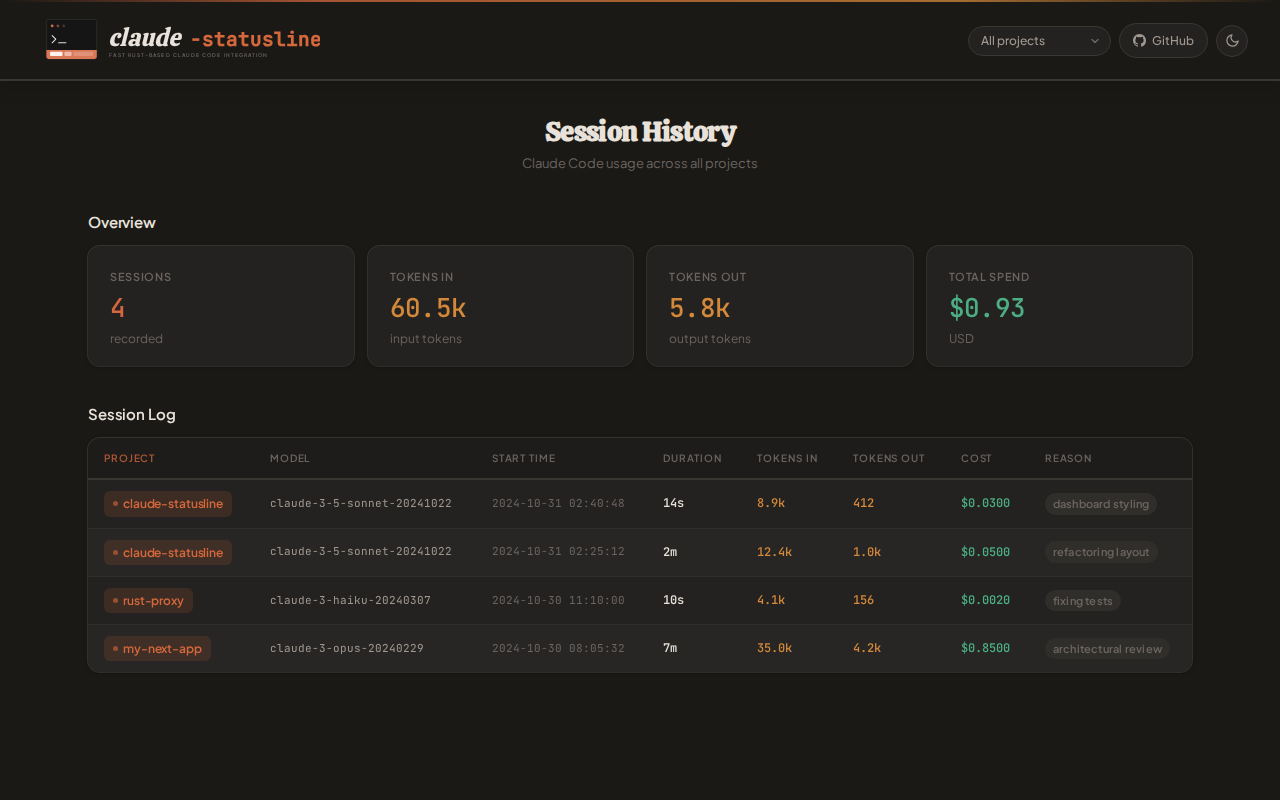
Session history is enabled by default on setup. Each session records:
| Field | Details | |---|---| | Project | Directory name and path | | Model | Which Claude model was used | | Tokens | Input and output counts | | Cost | USD cost (API key users) | | Duration | Session length in seconds | | Exit reason | How the session ended |
Commands:
claude-statusline history                   # Open dashboard in saved mode (default: web)
claude-statusline history --mode terminal   # Switch to terminal TUI (persisted)
claude-statusline history --mode web        # Switch to browser dashboard (persisted)
claude-statusline enable-history            # Enable session tracking
claude-statusline disable-history           # Disable session tracking
Data is stored at ~/.claude/statusline-history.jsonl.
Claude Code slash commands
Commands are also available directly inside Claude Code as slash commands:
/history/history-enable/history-disable/history-mode <web|terminal>/download-binary
Project contributors get these from the repo at .claude/commands/.
Global npm installs copy them to ~/.claude/commands/ automatically.
Plugin installs include them via the plugin's commands/ directory.
Terminal TUI
--mode terminal opens an interactive full-screen dashboard directly in your terminal — no browser required. Requires the native Rust binary (falls back to web dashboard with a warning if unavailable).
┌─ claude-statusline history ──────────────────────────────────────────────┐
│ Sessions: 42   Tokens: 8.3M   Cost: $12.47                               │
└──────────────────────────────────────────────────────────────────────────┘
┌──────────────────────────────────────────────────────────────────────────┐
│ Filter: [All Projects ▾]                                                 │
└──────────────────────────────────────────────────────────────────────────┘
┌──────────────────────────────────────────────────────────────────────────┐
│  Project              Model               Started          Dur   Tok   Cost│
│                                                                           │
│> my-web-app           claude-sonnet-4-6   2026-04-02 14:  32m   842k  $2.14│
│  cli-tool             claude-opus-4-6     2026-04-01 09:  1h4m  1.2M  $5.60│
│  data-pipeline        claude-haiku-4-5    2026-03-31 17:  18m   220k  $0.44│
│  my-web-app           claude-sonnet-4-6   2026-03-30 11:  45m   990k  $2.89│
│  api-server           claude-sonnet-4-6   2026-03-29 08:  2h1m  2.1M  $8.33│
│                                                                           │
└──────────────────────────────────────────────────────────────────────────┘
┌──────────────────────────────────────────────────────────────────────────┐
│ up/down or j/k: move   f: filter   Enter: apply   Esc: close   q: quit   │
└──────────────────────────────────────────────────────────────────────────┘
Press f to open the project filter popup:
              ┌─ Filter by Project ──────────┐
              │ ██ All Projects ██           │
              │   api-server                 │
              │   cli-tool                   │
              │   data-pipeline              │
              │   my-web-app                 │
              └──────────────────────────────┘
Rows are color-coded by exit reason: green = normal, yellow = interrupted, orange = pending.
Web Dashboard
--mode web (the default) opens a browser-based dashboard with project filtering and light/dark theme toggle.
Realtime Renderer
An optional background process that maintains a persistent Unix socket per terminal, enabling terminal-resize awareness and faster state access. Disabled by default.
Enable by setting the environment variable (add to your shell profile to persist):
export CLAUDE_STATUSLINE_REALTIME=1Accepted values: 1, true, TRUE.
When enabled, the native binary auto-spawns a renderer process the first time it runs in a terminal session. The renderer listens on a Unix socket and persists state to ~/.claude/statusline-state-{tty}.json. It exits automatically on session_end or when explicitly stopped.
Terminal identification
Each terminal gets its own renderer, identified by a TTY slug derived in priority order from:
CLAUDE_STATUSLINE_TTY— set this explicitly for a stable, human-readable slugTERM_SESSION_ID— used automatically by terminal emulators that set itpid-{PID}— fallback, changes on each shell restart
Commands:
claude-statusline realtime-status   # Show renderer state and paths for current terminal
claude-statusline realtime-stop     # Request renderer shutdown for current terminal
The realtime renderer is Unix-only. On Windows, the feature flag is silently ignored.
Platform support
Pre-built Rust binaries are available for Linux x64/arm64, macOS x64/arm64, and Windows x64. All Linux distributions (Ubuntu, Arch, Fedora, etc.) are supported. Any other platform falls back to the JS implementation automatically — no action needed.
Plugin installs skip npm install, so the binary is not downloaded automatically. Run claude-statusline download-binary once to get it.
See PLATFORMS.md for the full compatibility guide, per-platform install instructions, and feature availability table.
Why this one
| | claude-statusline | Others |
|---|---|---|
| Startup time | ~5ms (Rust binary) | ~100ms (Node.js cold-start every prompt) |
| Shell dependencies | None | Require jq, bc, or ccusage |
| API calls | None — reads Claude's stdin directly | Poll OAuth endpoint, risk rate limits |
| Subscription-aware | Shows usage/resets for Pro/Max, cost for API | Treat everyone as API user |
| Context bar | Usable % after auto-compact buffer | Raw remaining % |
| Subagent counter | Counts active agents from todos dir | — |
| Session tokens | Real-time via JSONL offset cache, split I/O (X↓ Y↑) | Stale stdin snapshot or none |
| Session commits | Tracks git commits made this session | — |
| Session history | Terminal TUI + browser dashboard, per-project filtering, zero dependencies | — |
Requirements
- Node.js ≥16 — for install/uninstall scripts only (not needed at runtime on supported platforms)
- git — optional, enables branch display
Uninstall
claude-statusline uninstall
npm uninstall -g @alyibrahim/claude-statusline
Always run
claude-statusline uninstallfirst — it removes thestatusLineentry from~/.claude/settings.jsonbefore the files are deleted.
npm uninstall -g @alyibrahim/claude-statusline also removes the four history slash command files installed by this package from ~/.claude/commands/, without touching other custom commands.
Notes
- Settings are written only to the
statusLinekey — all other~/.claude/settings.jsonkeys are untouched - Respects
$CLAUDE_CONFIG_DIRif set - Switched Node versions on an unsupported platform? Re-run
claude-statusline setup
License
MIT