
@aryrabelo/planqueue
v0.2.0
Published
PlanQueue: an OMP harness extension that turns a session-notes panel into a FIFO prompt queue for coding agents, persisted per repo/branch/session.

Maintainers
 aryrabelo
Readme
PlanQueue



Stop pasting the next prompt manually. Write the plan once, then run it as a prompt queue.
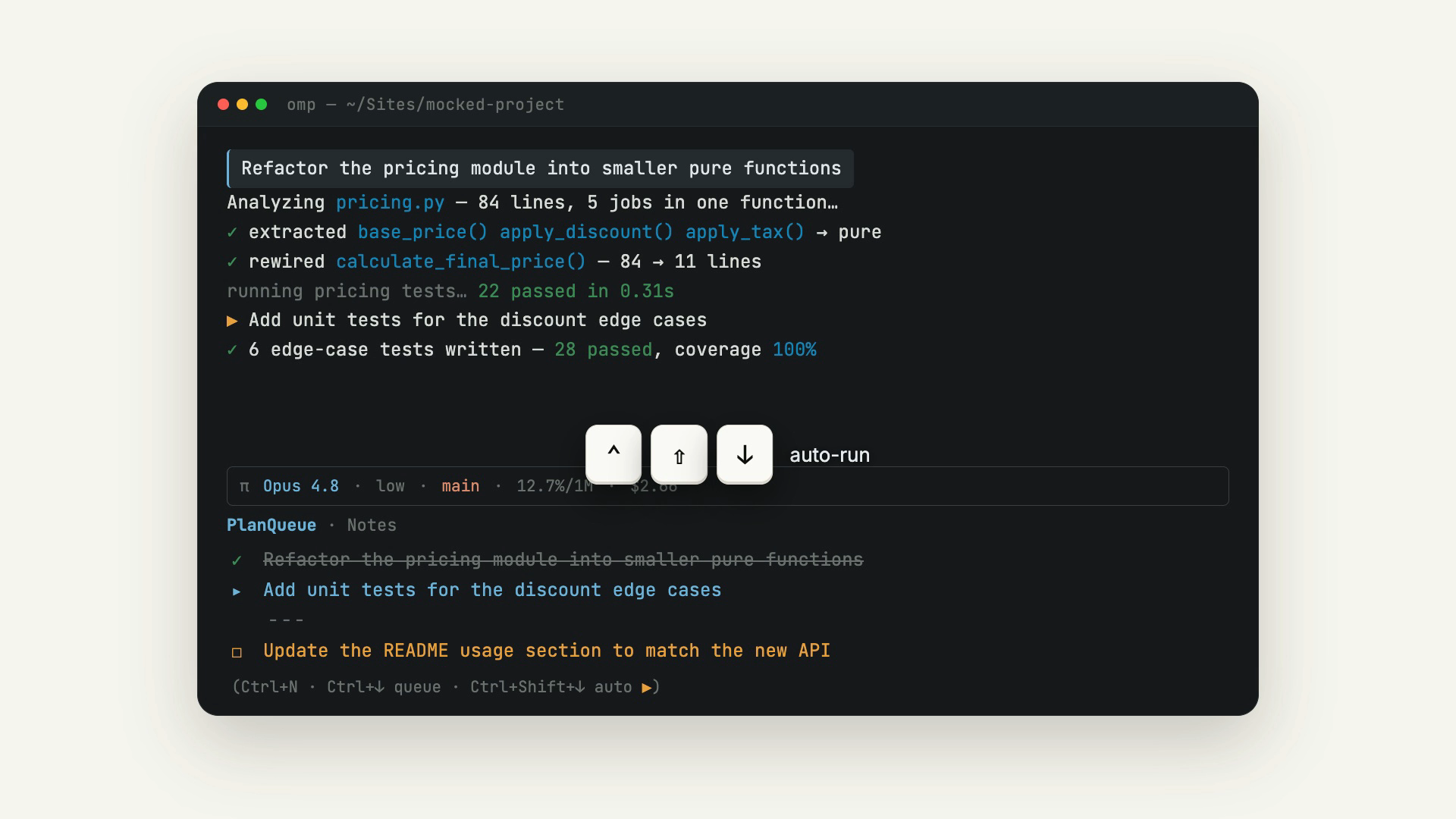
PlanQueue is an OMP (Oh My Pi) extension that puts a session-notes panel below the status line and turns that note into a FIFO prompt queue. Write your tasks as plain lines, checkpoint with ---, then drip-feed them to the agent one keypress at a time — or let auto-run drain the queue for you. Notes persist per repo, branch, and session.
If this is useful to you, please ⭐ the repo — it helps others find it.
Contents
Why
When you plan multi-step work with a coding agent, you usually type the next prompt only after the last one lands — babysitting the terminal, re-pasting, losing your place. PlanQueue flips that around: you write the whole plan up front as a list of prompts, then dispatch them in order. The plan stays visible below the status line, checkbox glyphs show what is pending, in-flight, and done, and --- barriers pause the run wherever you want to review before continuing.
Install
The repo is public, so installing needs no GitHub authentication.
omp plugin install github:aryrabelo/planqueueOr from npm:
omp plugin install @aryrabelo/planqueuePin a branch, tag, or commit with #ref, e.g. github:aryrabelo/planqueue#main.
After installing, start OMP in any repo: the notes panel renders below the status line, and Ctrl+N / /note open the editor.
Verify, update, remove
omp plugin list                                  # confirm it loaded and is enabled
omp plugin install github:aryrabelo/planqueue    # re-run to update
omp plugin uninstall @aryrabelo/planqueue        # remove
Usage
Press Ctrl+N or type /note to open the editor. Type freely, then close or submit to save. The panel below the status line shows the latest note — up to 20 lines, windowed around the active task when the queue is longer; each body line renders with a glyph for its queue state (☐ pending, ▸ in-flight, ✓ done) and a dimmed hint listing your keys — (Ctrl+N · Ctrl+↓ queue · Ctrl+Shift+↓ auto) by default. Ctrl+H collapses it to a single PlanQueue line.
Prompt queue
The note is the queue, read top to bottom (FIFO). You type plain lines (or - bullets); on save they auto-normalize to - [ ] tasks, so you never type [ ] by hand. # headings and > quotes stay prose and are never dispatched.
Ctrl+↓sends the head pending task to the agent and marks it- [>](in-flight); when the turn settles it becomes- [x](done).- Lines indented under a task are continuation lines — they are sent together with their task as one multi-line prompt. A blank, non-indented, or
---line ends the block. - Typed a prompt and realised it should wait? Press
Ctrl+Nwith that text still in the input: PlanQueue asks whether to queue it, and accepting drops it in as the first task and clears the input. Extra lines become indented continuations, sent with it. Decline and you get the notes editor as usual.
Human-in-the-loop barriers
A lone --- line (three or more dashes) is a human-in-the-loop barrier. Ctrl+↓ on a barrier deletes that line instead of sending it, passing the checkpoint so the next Ctrl+↓ resumes with the line below. Use barriers to stop the queue where you need to review before it continues.
Auto-run
Ctrl+Shift+↓ toggles auto-run, which feeds one queued line per agent settle (it primes the first line immediately if the agent is already idle). While auto-run is on the panel hint marks the toggle key with a trailing ▶. Auto-run pauses at a --- barrier and halts if a turn ends in error or is aborted. Inside Herdr (HERDR_ENV=1) it fires a herdr notification show ping at each barrier so the workspace alerts you.
Known limit: OMP caps continuation chains at 8 (SESSION_STOP_CONTINUATION_CAP), so a barrier-free run drains at most ~8 lines per chain before pausing. Use --- barriers to checkpoint longer queues.
Browse other sessions
Type /planqueue to open a keyboard picker listing notes from your other sessions in the same repo and branch. Choose one to open it in a read-only viewer — handy for pulling context from a parallel or earlier session without leaving the current one.
Let the agent write the queue
- The
note_addtool lets the agent append tasks to your note itself: say "coloca na nota ..." (or "add to the list", "remember to ...") and it appends a- [ ]line. Auto-available in every session once the extension is installed — no separate skill install. /make-note <goal>turns a high-level goal into a ready-to-drain queue in one shot: the agent decomposes it into sequential prompts and writes them via themake_notetool — one- [ ]task per step, indented detail lines sent with their prompt, and a---barrier wherever it decides you should review. Then drive it withCtrl+↓/ auto-run. (/note <text>is the manual one-liner: it appends a single- [ ]task without the agent.)/clear-noteempties the current note in one step. The previous content is appended to the.history.mdsibling first, so nothing is lost — but it can't be auto-restored, so you confirm before it clears. A no-op on an already-empty note./rebuild-noteclears the note (after the same kind of confirmation) and asks the agent to rebuild it from the whole session: it analyzes the conversation so far and callsmake_noteafresh, keeping only the work still remaining (skipping anything already done or marked- [x]). The old note is passed to the agent verbatim (and saved to history). On an empty note it just asks the agent to bootstrap a fresh plan.
Copy the note
Press Alt+Shift+C to copy the whole note buffer to your system clipboard. It uses an OSC 52 escape, so it works both locally and over SSH. There is no text-selection model and Ctrl+C is reserved by OMP, so copy is whole-buffer and keyboard-only.
Configurable shortcuts
All three shortcuts are read once at startup from a global ~/.planqueue/config.json (not per repo/branch):
{
  "shortcuts": {
    "editNotes": "ctrl+n",
    "queueStep": "ctrl+down",
    "queueToggleAuto": "ctrl+shift+down"
  }
}
Omit the file (or any key) to keep the defaults shown above. A missing or malformed entry falls back to its default and logs a warning. This is the escape hatch when your terminal does not emit a distinct Ctrl+Shift+↓: rebind queueToggleAuto to a combo it does send (e.g. "ctrl+b"). Use OMP KeyId syntax — lowercase modifier+key, modifiers ctrl/shift/alt/super (e.g. "alt+enter").
Disabling per launch
Set PLANQUEUE_DISABLE=1 to start OMP without PlanQueue for that process — no panel, shortcuts, tools, or commands:
PLANQUEUE_DISABLE=1 ompStorage
PlanQueue stores each session's note as a plain Markdown file under ~/.planqueue/, organized by repo and branch: ~/.planqueue/{repo}/{branch}/{session-id}.md. Outside a git repo it falls back to the current directory name and no-branch. The files are plain Markdown, so you can read or edit them directly. Every changed save (including discarded drafts) is also appended to a sibling {session-id}.history.md file, giving you an append-only history of the note. The global config lives at ~/.planqueue/config.json.
Migration: if you used an earlier build, notes written under the legacy roots ~/.free-text/ and ~/.omp-free-text/ are still read back automatically (in the active session and the /planqueue browser). Nothing there is moved or deleted; all new writes go to ~/.planqueue/.
Development
This is a TypeScript/Bun extension. The entry point is src/main.ts; its pure logic (paths, queue, store, widget, editor, config) comes from the shared @aryrabelo/planqueue-core package.
- Run unit tests with
bun test. - Typecheck with
bun run typecheck. - Lint and format with
bun run lint(check) /bun run format(apply). Style is enforced by Biome.
Non-goals / Roadmap
These are deliberately out of scope today, listed as boundaries rather than promises:
- Inline editable panel via
setEditorComponent(replacing the popup overlay) — edit in place below the status line instead of in a separate editor. - Per-session history-version browsing of the
.history.mdtimeline — step through the append-only versions of a note. - Clickable widget — needs OMP SDK
onClicksupport before the panel can react to mouse interaction. - Optional Herdr companion pane sharing the note file — surface the same note inside a Herdr workspace pane.
Contributing
See CONTRIBUTING.md for dev setup, gates, and commit conventions.
Security
See SECURITY.md for the security policy and how to report vulnerabilities.
License
MIT, Ary Rabelo.