
@ashusevim/markdown-processor
v2.3.0
Published
marcus — a zero-dependency Markdown to HTML CLI and library that verifies its own output: safe-by-default escaping, line-numbered diagnostics for CI, and LLM-artifact repair

Maintainers
 codingashishdev
Readme
Markdown Processor (marcus)
A zero-dependency Markdown → HTML CLI and library for Node.js — the converter that verifies its own output.
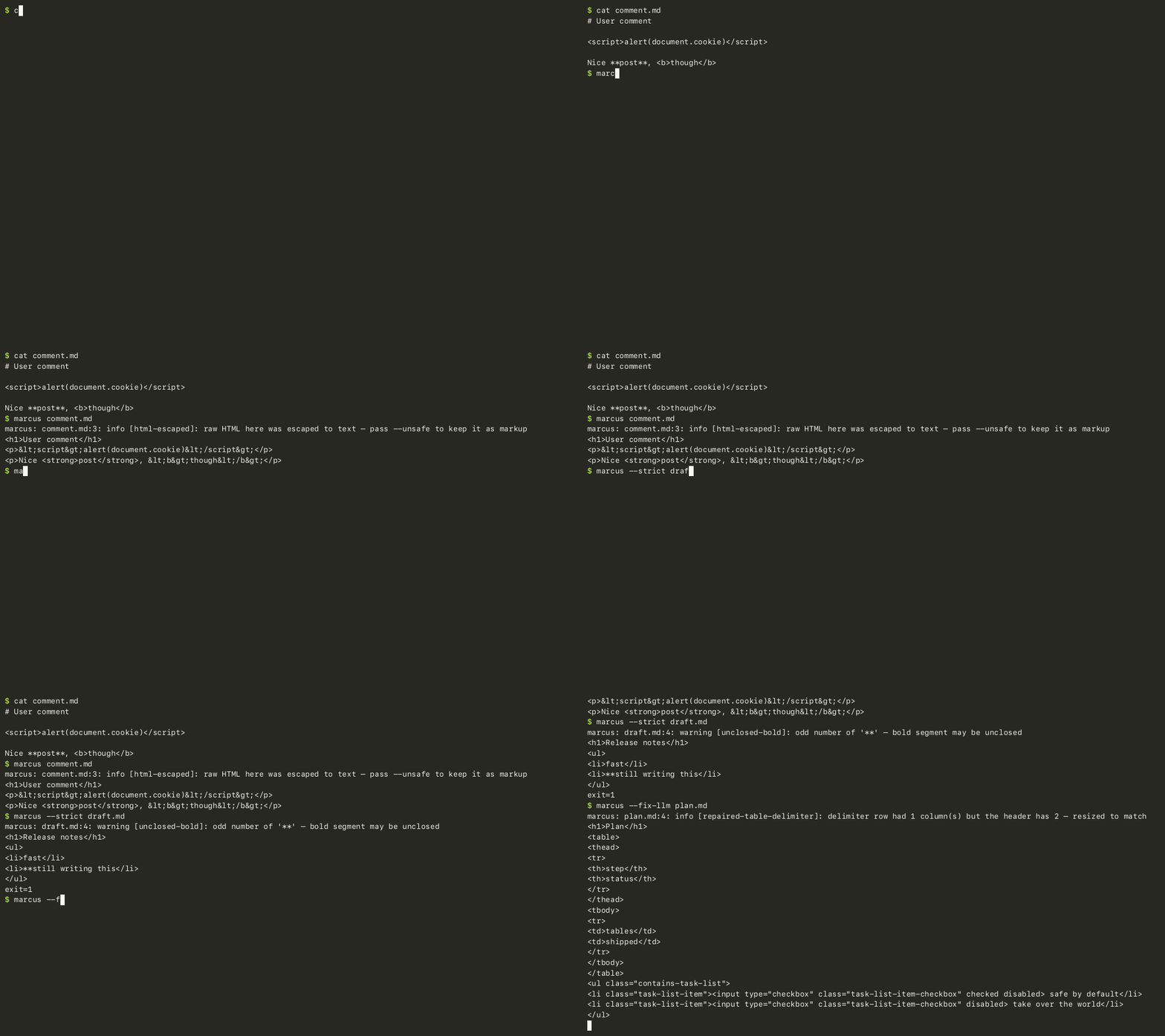
Pandoc tells you nothing. Marked trusts everything. marcus checks the input, escapes untrusted HTML by default, and reports everything it changes.
Install
npm install -g @ashusevim/markdown-processor # exposes `marcus`Requires Node.js >= 20. No runtime dependencies.
Usage
marcus file.md                # HTML on stdout
cat notes.md | marcus         # stdin (implicit with no file argument)
marcus a.md b.md              # multiple files, in order
marcus --strict docs/*.md     # CI gate: exit 1 if warnings are found
marcus --report json doc.md   # machine-readable report instead of HTML
llm | marcus --fix-llm        # repair known LLM artifacts, logging each one
Why marcus
Safe by default. Raw HTML from users, scrapers or models is escaped to visible text, so a
<script>can't execute.--unsafepasses it through for trusted documents. Most converters do the opposite and leave you to "sanitize it yourself".It tells you the truth. Render-affecting problems come back as line-numbered diagnostics instead of silently wrong HTML:
marcus: draft.md:4: warning [unclosed-bold]: odd number of '**' — bold segment may be unclosedRepairs LLM slop on the record.
--fix-llmfixes the well-documented artifacts and logs every repair as aninfoissue, so nothing is rewritten behind your back.Tiny and auditable. A few hundred dependency-free lines; the CLI is a thin wrapper around a pure parser you can import.
Options
| Option | Description |
|---|---|
| -h, --help · -V, --version | help and version |
| - · -- | read stdin explicitly · treat the rest as file names |
| --strict | exit 1 on warning-level issues (CI gate) |
| --report json | JSON report (html, issues, stats) instead of HTML |
| -q, --quiet | don't mirror issues to stderr |
| --unsafe | pass raw HTML through unescaped (trusted input) |
| --fix-llm | repair LLM artifacts before parsing, logging each repair |
Exit codes: 0 success · 1 unreadable file or --strict warnings · 2 usage error.
Diagnostics
Two severities: warning means the output probably doesn't match your intent (and --strict fails on it); info is a repair or unsupported-syntax notice, which never fails a build.
| Code | Problem |
|---|---|
| unclosed-fence · unclosed-inline-code · unclosed-bold · unclosed-strikethrough | a delimiter is never closed, so everything after it renders wrong |
| heading-skip | heading level jumps (e.g. h1 → h4), breaking the outline |
| list-interrupted · mixed-list-markers | implicit list boundary, or marker style changed mid-list |
| table-ragged | a table row has more cells than the header — the extras are dropped |
| frontmatter-unsupported · html-escaped | --- frontmatter (renders as <hr>) · raw HTML neutralized by safe mode |
| repaired-* | what --fix-llm changed (heading space, frontmatter fence, proved, table delimiter) |
Reports are deterministic — identical input produces byte-identical output (no timestamps), so they can be cached and diffed:
{
  "tool": "marcus", "version": "2.3.0",
  "files": [{ "file": "doc.md", "html": "…", "words": 5, "headings": [] }],
  "issues": [{ "file": "doc.md", "line": 5, "code": "unclosed-fence", "severity": "warning", "message": "…" }],
  "stats": { "files": 1, "words": 5, "readingTimeMinutes": 1, "warnings": 1, "infos": 0, "repairs": 0 }
}
Library
import { parseMarkdown, parseMarkdownDetail } from "@ashusevim/markdown-processor";

parseMarkdown("# hi");                     // '<h1>hi</h1>'
const { html, issues, headings, words } = parseMarkdownDetail(source, { fixLlm: true });
Syntax
CommonMark-style blocks and GFM extensions: ATX headings, thematic breaks, blockquotes (parsed recursively), ordered/unordered lists nested to any depth, task lists (- [x]), GFM pipe tables with :---/:-:/---: alignment, fenced code with language classes, and inline code (including multi-backtick spans), bold/italic/strikethrough, links, angle autolinks and images. A leading BOM and CRLF/CR line endings are normalized.
Limitations
- No footnotes or setext headings yet.
- Frontmatter is not parsed; it renders as a thematic break and is reported as
info. - Safe mode is escape-all, not an allowlist sanitizer. Pipe
--unsafeoutput through a dedicated sanitizer if you need fine-grained control. - Task-list checkboxes are inert (
disabled) by design. - Lists render tight: a blank line between items doesn't force
<p>wrappers, and a blank line inside an item only wraps the paragraphs that follow it.
Development
npm test        # builds, then runs the node:test suite (165 tests)
npm run build   # tsc → dist/
src/parse.ts is the whole parser and diagnostics engine (no I/O, no deps) — that's the library. src/cli.ts is the argument/stdin/exit-code wrapper. docs/demo.sh regenerates the demo GIF:
asciinema rec -q --overwrite --cols 124 --rows 32 -c "bash docs/demo.sh" docs/demo.cast
.tools/agg --font-size 14 --theme monokai docs/demo.cast docs/demo.gif
License
ISC