
@askeleven/do-not-contact
v0.1.0
Published
One do-not-contact list for every channel. A STOP by text, an email unsubscribe or a "remove me" reply blocks that person everywhere. Stores keyed hashes, never addresses. Library, CLI and MCP server. Zero dependencies.
Downloads
331


Readme
do-not-contact
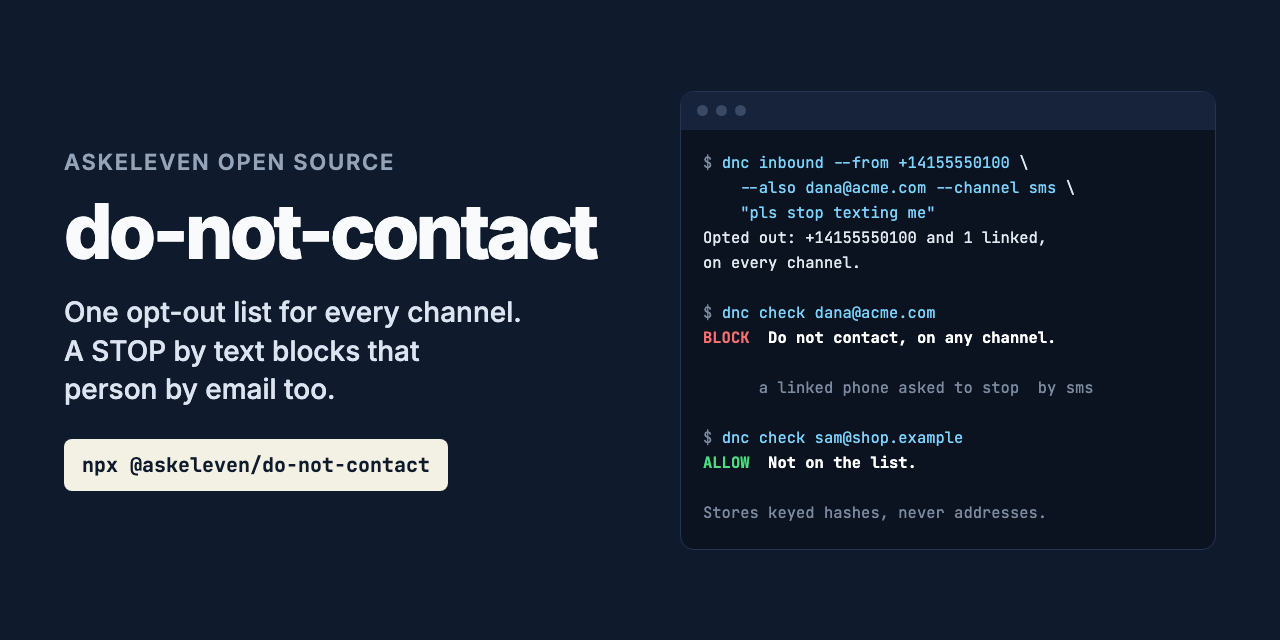
One do-not-contact list for every channel. A STOP by text blocks that person by email too.
export DNC_LIST=dnc.jsonl DNC_SECRET=$(npx @askeleven/do-not-contact secret)

npx @askeleven/do-not-contact inbound --from +14155550100 --also [email protected] --channel sms "pls stop texting me"
npx @askeleven/do-not-contact check [email protected]
BLOCK Do not contact, on any channel.
2026-10-16 14:00 UTC a linked phone asked to stop by smsEvery channel keeps its own opt-out list. The SMS provider knows Dana texted STOP. The email platform does not, so the follow-up goes out by email the next morning. A person would remember that Dana asked to be left alone. An agent working through a lead list, reaching for whichever channel answers, will not, unless something tells it.
do-not-contact is that something: one list, every channel. It reads inbound messages for STOP, unsubscribe and "please remove me", remembers which addresses and numbers belong to the same person, and answers one question before any message goes out: may I contact this person? A library for your code, a CLI for your pipelines, and an MCP server for your agents.
It stores keyed hashes, never an address, a number or a word of anyone's message. Zero dependencies. No network.
What it does
| Someone | What happens |
|---|---|
| Texts STOP, UNSUBSCRIBE, CANCEL, END, QUIT, REVOKE or OPT OUT | Blocked on every channel, with every identifier you know for them |
| Writes "please remove me from your list", "stop texting me", "don't email me", "how do I unsubscribe" | Blocked on every channel |
| Says "wrong number" | That number is blocked. Whoever you thought it belonged to is not, because it was not theirs |
| Texts START or UNSTOP | The opt-out made from that number is lifted |
| Opts out by text, then opts back in by email | Still blocked. Opting back in has to come from where they opted out |
| Asks on a call, in person, on a form | optout records it, with how they asked |
| Writes "don't call me before 9am" or "don't stop sending updates" | Nothing. They did not ask to stop |
One person, many identifiers. Whenever you record an opt-out with more than one
identifier, or link them, they are joined. A check of any one of them finds the person,
and a block on any one blocks all of them. Linking never lifts a block; it only spreads one.
Your own quoted message is not their opt-out. "Reply STOP to opt out" in the quote under their reply is ignored. Only what they wrote counts.
What it does not do
It does not send anything, or stop anything being sent. It answers the question. Your code, or your agent, has to ask it before every message, and listen.
It does not know who someone is. It links identifiers you give it together. It never looks anyone up.
It does not read every language. The keywords and phrases are English. A message it does
not recognise records nothing; record those with optout.
It is not legal advice. The FCC's 2025 revocation rule treats stop, quit, end, revoke, opt out, cancel and unsubscribe as valid ways to revoke consent to texts, and allows "any reasonable means". CAN-SPAM requires honoring email opt-outs. This tool honors them immediately, everywhere, which is stricter than either. Whether that is enough for you is for your lawyer.
It blocks transactional messages too. An opt-out blocks everything, receipts and appointment reminders included, until the person opts back in. If you must send those, that is a decision for your code to make on purpose, not one the list makes for you.
For agents: MCP server
claude mcp add do-not-contact -e DNC_SECRET=... -- npx -y @askeleven/do-not-contact mcp --list ~/dnc.jsonlClaude Desktop, Cursor, and other clients that take a JSON config:
{
  "mcpServers": {
    "do-not-contact": {
      "command": "npx",
      "args": ["-y", "@askeleven/do-not-contact", "mcp", "--list", "/path/to/dnc.jsonl"],
      "env": { "DNC_SECRET": "...", "DNC_DEFAULT_COUNTRY": "1" }
    }
  }
}
It serves three tools:
check_contactwith every email, phone and id the agent has for someone. A check that cannot run says "do not contact this person yet", never "allowed".record_inboundfor every message the agent receives, with the sender and any other identifiers it knows for them.record_opt_outfor when someone asks any other way.
The server tells the model to check before every message, call or invite; never to contact a blocked person on any channel; and not to look for another address or number to reach them.
There is no tool to opt anyone back in. An agent that could lift a block could talk itself past one. Opting back in is for people, with the CLI or the library.
In a test run, Claude Haiku was given two inbound messages: "pls stop texting me" by SMS from Dana, whose email was on file, and "Yes, send the quote over" from Sam. It recorded both, checked both, and declined to email Dana: "The block covers every channel, so I won't email [email protected] or any other address for her."
CLI
do-not-contact check <identifier...>
do-not-contact inbound --from <identifier> [--also <identifier>]... <text|file|->
do-not-contact optout <identifier...> [--channel <name>] [--how <words>]
do-not-contact optin <identifier...> --source <proof>
do-not-contact link <identifier...>
do-not-contact filter <file.csv> [--blocked <file>] [--unchecked <file>]
do-not-contact stats
do-not-contact mcp
do-not-contact secret
dnc is the same command, shorter. An identifier is an email address, a phone number, or
namespace:value for anything else (slack:U024BE7LH, crm:48213).
check exits 0 when allowed, 1 when blocked, and 2 when it could not check. A 2 is
not permission. So it gates a send:
dnc check "$TO" && ./send "$TO" message.txtfilter checks a whole CSV. It finds the email and phone columns by name, writes the rows
you may contact to standard output, and leaves out rows it could not check: no contact
details, or ones it cannot read.
$ dnc filter leads.csv --blocked blocked.csv > leads-ok.csv
412 may be contacted, 9 blocked, 3 could not be checked (left out). Email columns: Email. Phone columns: Mobile.
optin needs --source: the proof they asked, such as a message id or a form submission.
As a library
import { openList } from '@askeleven/do-not-contact'

const dnc = openList('dnc.jsonl', { secret: process.env.DNC_SECRET, defaultCountry: '1' })

// Every inbound message, on every channel:
await dnc.inbound(sms.from, sms.body, { channel: 'sms', also: { email: lead.email } })

// Before every outbound message:
const { allowed, blocks } = await dnc.check({ email: lead.email, phone: lead.phone })
if (allowed) await mailer.send(message)check(contact), checkMany(contacts), inbound(from, text, { channel, also, source }),
optOut(contact, { channel, how, source }), optIn(contact, { source }),
link(contact) and stats(). A contact is { email, phone, id }, each a string or a
list. detectOptOut(text) is exported on its own: it returns opt_out, opt_in,
wrong_number or none, and the words that decided it.
Wire your providers' own opt-out events in too: an unsubscribe link, a spam complaint, a
carrier STOP your SMS provider handled itself. Each is an optOut with how set to
unsubscribe_link, complaint or whatever names it.
The list
An append-only JSONL file. Each line is one opt-out, opt-in or link, written and synced to disk before the call returns:
{"type":"opt_out","at":"2026-10-16T14:00:00.000Z","keys":["p:6f1e...","e:a90c..."],"from":"p:6f1e...","channel":"sms","how":"phrase","source":"agent"}Keys, not addresses. Each identifier is normalized, so [email protected] and
[email protected] are the same, and (415) 555-0100 is +14155550100. Then it is stored as
an HMAC-SHA256 under your secret. Without the secret, a key cannot be turned back into an
address or a number, even by trying every phone number there is. So the list can be backed
up, shared between systems that hold the secret, and kept after someone asks you to erase
their data, which is what a do-not-contact list is for.
Keep the secret. The list is only as useful as the secret: lose it, and nothing on the list can be checked again. Open a list with a different secret and it refuses, rather than quietly finding no one on it.
Normalizing blocks more, never less. A "+tag" is dropped from every address, and dots
from Gmail addresses. On the rare server where dana+a and dana+b are different people,
both are blocked. For a list of people who asked you to stop, that is the safe error.
Numbers without a country code need --country (or DNC_DEFAULT_COUNTRY). Without one,
check refuses rather than guess, and filter leaves the row out.
Privacy
Nothing leaves your machine. There is no network code. The list holds no addresses, numbers or message text.
Requirements
Node 20 or newer. No dependencies.
Why we built it
AskEleven runs AI employees that email and text candidates and customers for small businesses, often the same person on more than one channel. When someone says stop on one, they mean all of them. It works with send-guard and sms-guard, which check the message; this checks the person.
Contributing
Issues and pull requests welcome, especially:
- Opt-outs it misses, and ordinary messages it mistakes for opt-outs, with the text. These matter most.
- Keywords and phrases in other languages.
- Providers' opt-out webhooks: how to map them to
optOut.
Run the tests with npm test. They use a fixed clock and temporary files.
License
MIT. See LICENSE.