
@ason-format/ason
v2.0.0-preview
Published
ASON (Aliased Serialization Object Notation) - Token-optimized JSON compression for LLMs. Reduces tokens by 20-60% while maintaining perfect round-trip fidelity.
Downloads
113

Maintainers
 seanluis47
Readme
ASON 2.0 - Aliased Serialization Object Notation




Token-optimized JSON serialization for Large Language Models. Reduces tokens by 20-60% with perfect round-trip fidelity. ASON 2.0 uses smart compression: sections, tabular arrays, and reference deduplication.
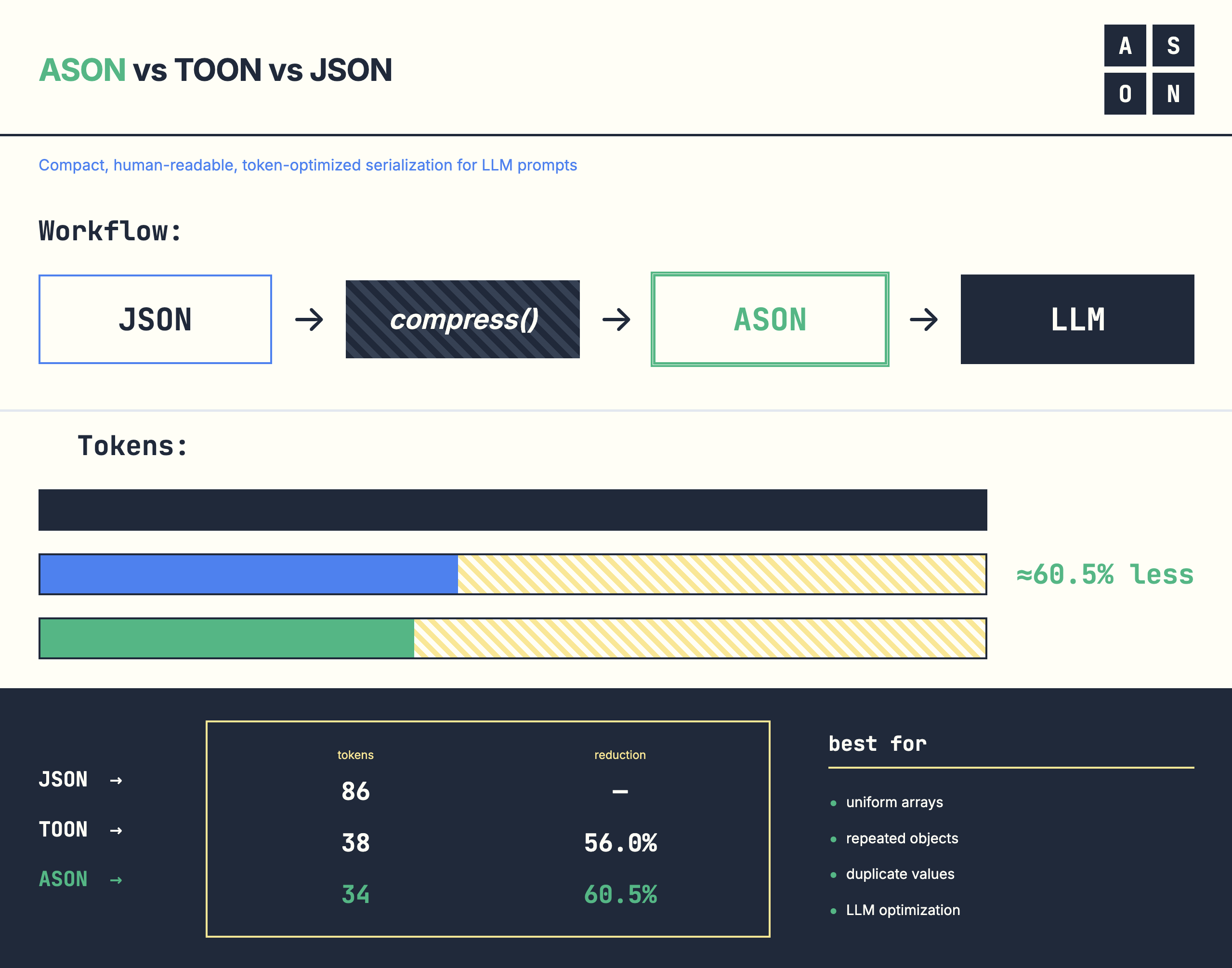
Table of Contents
- Why ASON 2.0?
- Quick Start
- Features
- Installation
- CLI Usage
- API Usage
- ASON 2.0 Format
- Compression Techniques
- Use Cases
- API Reference
- Documentation
- Contributing
- License
Why ASON 2.0?
LLM tokens cost money. Standard JSON is verbose and token-expensive. ASON 2.0 reduces token usage by 20-60% while maintaining 100% lossless round-trip fidelity.
Before (JSON - 59 tokens)
{
  "users": [
    { "id": 1, "name": "Alice", "email": "[email protected]" },
    { "id": 2, "name": "Bob", "email": "[email protected]" }
  ]
}
After (ASON 2.0 - 23 tokens, 61% reduction)
users:[2]{id,name,email}
1|Alice|[email protected]
2|Bob|[email protected]
What's New in ASON 2.0?
- ✅ Sections (
@section) - Organize related objects, save tokens on deep structures - ✅ Tabular Arrays (
key:[N]{fields}) - CSV-like format for uniform arrays - ✅ Semantic References (
$email,&address) - Human-readable variable names - ✅ Pipe Delimiter - More token-efficient than commas
- ✅ Lexer-Parser Architecture - Robust parsing with proper AST
- ✅ Zero Configuration - Smart analysis detects patterns automatically
Quick Start
npm install @ason-format/asonimport { SmartCompressor } from '@ason-format/ason';
const compressor = new SmartCompressor();
const data = {
users: [
{ id: 1, name: "Alice", email: "[email protected]" },
{ id: 2, name: "Bob", email: "[email protected]" }
]
};
// Compress
const ason = compressor.compress(data);
console.log(ason);
// Output:
// users:[2]{id,name,email}
// 1|Alice|[email protected]
// 2|Bob|[email protected]
// Decompress (perfect round-trip)
const original = compressor.decompress(ason);
// Returns: { users: [{ id: 1, name: "Alice", ... }] }Features
- ✅ 20-60% Token Reduction - Saves money on LLM API calls
- ✅ 100% Lossless - Perfect round-trip fidelity
- ✅ Fully Automatic - Zero configuration, detects patterns automatically
- ✅ Sections - Organize objects with
@sectionsyntax - ✅ Tabular Arrays - CSV-like format
key:[N]{fields}for uniform arrays - ✅ Semantic References -
$var,&obj,#Nfor deduplication - ✅ TypeScript Support - Full
.d.tstype definitions - ✅ ESM + CJS - Works in browser and Node.js
- ✅ Robust Parser - Lexer → AST → Compiler architecture
Installation
# npm
npm install @ason-format/ason

# yarn
yarn add @ason-format/ason

# pnpm
pnpm add @ason-format/ason
CLI Usage
Command-line tool for converting between JSON and ASON formats.
Basic Commands
# Compress JSON to ASON
npx ason input.json -o output.ason

# Decompress ASON to JSON
npx ason data.ason -o output.json

# Show compression stats
npx ason input.json --stats

# Pipe from stdin
echo '{"name": "Ada"}' | npx ason
cat data.json | npx ason > output.ason
CLI Options
| Option | Description |
|--------|-------------|
| -o, --output <file> | Output file (stdout if omitted) |
| -e, --encode | Force encode mode (JSON → ASON) |
| -d, --decode | Force decode mode (ASON → JSON) |
| --delimiter <char> | Field delimiter: | (pipe), , (comma), \t (tab) |
| --indent <number> | Indentation spaces (default: 1) |
| --stats | Show token count and savings |
| --no-references | Disable reference detection |
| --no-sections | Disable section organization |
| --no-tabular | Disable tabular array format |
| -h, --help | Show help |
CLI Examples
# Show detailed stats
npx ason data.json --stats

# Output:
# 📊 COMPRESSION STATS:
# ┌─────────────────┬──────────┬────────────┬──────────────┐
# │ Format          │ Tokens   │ Size       │ Reduction    │
# ├─────────────────┼──────────┼────────────┼──────────────┤
# │ JSON            │ 59       │ 151 B      │ -            │
# │ ASON 2.0        │ 23       │ 43 B       │ 61.02%       │
# └─────────────────┴──────────┴────────────┴──────────────┘
# ✓ Saved 36 tokens (61.02%) • 108 B (71.52%)

# Use pipe delimiter (more efficient)
npx ason data.json --delimiter "|" -o output.ason

# Disable specific features
npx ason data.json --no-tabular --no-references
API Usage
Basic Usage
import { SmartCompressor, TokenCounter } from '@ason-format/ason';

// Create compressor
const compressor = new SmartCompressor();

// Compress data
const data = {
  id: 1,
  name: "Alice",
  email: "[email protected]"
};

const ason = compressor.compress(data);
const original = compressor.decompress(ason);

// Compare token usage
const stats = TokenCounter.compareFormats(data, JSON.stringify(data), ason);
console.log(`Saved ${stats.reduction_percent}% tokens`);
Configuration
const compressor = new SmartCompressor({
  indent: 1,                     // Indentation spaces (default: 1)
  delimiter: '|',                 // Field delimiter (default: '|')
  useReferences: true,            // Enable $var deduplication (default: true)
  useSections: true,              // Enable @section (default: true)
  useTabular: true,               // Enable [N]{fields} arrays (default: true)
  minFieldsForSection: 3,         // Min fields for @section (default: 3)
  minRowsForTabular: 2,           // Min rows for tabular (default: 2)
  minReferenceOccurrences: 2      // Min occurrences for $var (default: 2)
});
TypeScript Support
import { SmartCompressor, TokenCounter } from '@ason-format/ason';

interface User {
  id: number;
  name: string;
  email: string;
}

const compressor = new SmartCompressor();
const users: User[] = [
  { id: 1, name: "Alice", email: "[email protected]" },
  { id: 2, name: "Bob", email: "[email protected]" }
];

const compressed: string = compressor.compress({ users });
const decompressed: any = compressor.decompress(compressed);
ASON 2.0 Format
1. Sections (@section)
Organize related properties (saves tokens with 3+ fields):
// JSON
{
  "customer": {
    "name": "John",
    "email": "[email protected]",
    "phone": "+1-555-0100"
  }
}

// ASON 2.0
@customer
 name:John
 email:[email protected]
 phone:"+1-555-0100"
2. Tabular Arrays ([N]{fields})
CSV-like format for uniform data:
// JSON
{
  "items": [
    { "id": 1, "name": "Laptop", "price": 999 },
    { "id": 2, "name": "Mouse", "price": 29 }
  ]
}

// ASON 2.0
items:[2]{id,name,price}
1|Laptop|999
2|Mouse|29
3. Semantic References ($var)
Deduplicate repeated values:
// JSON
{
  "customer": { "email": "[email protected]" },
  "billing": { "email": "[email protected]" }
}

// ASON 2.0
$def:
 $email:[email protected]
$data:
@customer
 email:$email
@billing
 email:$email
4. Nested Objects
Indentation-based structure:
// JSON
{
  "order": {
    "customer": {
      "address": {
        "city": "NYC"
      }
    }
  }
}

// ASON 2.0 (dot notation)
order.customer.address.city:NYC

// Or with sections
@order
 customer:
  address:
   city:NYC
Compression Techniques
Token Savings by Feature
| Feature | Best For | Token Reduction | |---------|----------|-----------------| | Tabular Arrays | Uniform arrays (3+ items) | ~60% | | Sections | Objects with 3+ fields | ~30% | | References | Repeated values/objects | ~50% | | Dot Notation | Deep nested objects | ~20% | | Inline Objects | Small objects (≤5 fields) | ~15% | | Schema Dot Notation | Nested objects in tables | ~40% | | Array Fields | Arrays in table rows | ~25% |
Advanced Optimizations (New in 2.0)
1. Inline Compact Objects
Small objects (≤5 properties, primitives only) are serialized inline without spaces:
// JSON
{ "id": 1, "attrs": { "color": "red", "size": "M" } }

// ASON 2.0
id:1
attrs:{color:red,size:M}
2. Dot Notation in Tabular Schemas
Nested objects are flattened in table schemas:
// JSON
[
  { "id": 1, "price": { "amount": 100, "currency": "USD" } },
  { "id": 2, "price": { "amount": 200, "currency": "EUR" } }
]

// ASON 2.0
[2]{id,price.amount,price.currency}
1|100|USD
2|200|EUR
3. Array Fields in Schemas
Arrays of primitives marked with [] suffix:
// JSON
[
  { "id": 1, "tags": ["electronics", "sale"] },
  { "id": 2, "tags": ["clothing"] }
]

// ASON 2.0
[2]{id,tags[]}
1|[electronics,sale]
2|[clothing]
4. Combined Optimizations
All optimizations work together:
// JSON
[
  { "id": 1, "profile": { "age": 30, "city": "NYC" }, "tags": ["admin"] },
  { "id": 2, "profile": { "age": 25, "city": "LA" }, "tags": ["user", "premium"] }
]

// ASON 2.0
[2]{id,profile.age,profile.city,tags[]}
1|30|NYC|[admin]
2|25|LA|[user,premium]
When ASON 2.0 Works Best
✅ Highly Effective:
- Uniform arrays (user lists, product catalogs)
- Repeated values (emails, addresses)
- Structured data (orders, records)
- Mixed nested structures
⚠️ Less Effective:
- Non-uniform arrays (mixed types)
- Single-occurrence values
- Very deeply nested unique objects
Use Cases
1. Reduce LLM API Costs
import { SmartCompressor } from '@ason-format/ason';
import OpenAI from 'openai';

const compressor = new SmartCompressor();
const openai = new OpenAI();

const largeData = await fetchDataFromDB();
const compressed = compressor.compress(largeData);

// Saves 20-60% on tokens = direct cost reduction
const response = await openai.chat.completions.create({
  messages: [{
    role: "user",
    content: `Analyze this data:\n\n${compressed}`
  }]
});
2. Optimize RAG Context
// Compress documents for RAG systems
const documents = [/* ... large dataset ... */];
const compressed = compressor.compress({ documents });

// Fit more context in limited token window
const context = `Context: ${compressed}`;
3. Compact API Responses
app.get('/api/data', (req, res) => {
  const data = getDataFromDB();

  if (req.query.format === 'ason') {
    return res.send(compressor.compress(data));
  }

  res.json(data);
});
4. Efficient Storage
// Save to Redis/localStorage with less space
localStorage.setItem('cache', compressor.compress(bigObject));

// Retrieve
const data = compressor.decompress(localStorage.getItem('cache'));
API Reference
SmartCompressor
Constructor
new SmartCompressor(options?: CompressorOptions)Options:
interface CompressorOptions {
  indent?: number;                   // Indentation spaces (default: 1)
  delimiter?: string;                // Field delimiter (default: '|')
  useReferences?: boolean;           // Enable references (default: true)
  useSections?: boolean;             // Enable sections (default: true)
  useTabular?: boolean;              // Enable tabular (default: true)
  minFieldsForSection?: number;      // Min fields for @section (default: 3)
  minRowsForTabular?: number;        // Min rows for tabular (default: 2)
  minReferenceOccurrences?: number;  // Min for $var (default: 2)
}
Methods
compress(data: any): string
Compresses JSON data to ASON 2.0 format.
const ason = compressor.compress({ id: 1, name: "Alice" });decompress(ason: string): any
Decompresses ASON 2.0 back to JSON.
const data = compressor.decompress(ason);compressWithStats(data: any): CompressResult
Compresses and returns detailed statistics.
const result = compressor.compressWithStats(data);
console.log(result.reduction_percent); // e.g., 45.2
validateRoundTrip(data: any): ValidationResult
Validates compress/decompress round-trip.
const result = compressor.validateRoundTrip(data);
if (!result.valid) {
  console.error('Round-trip failed:', result.error);
}
TokenCounter
Static Methods
estimateTokens(text: string): number
Estimates token count using approximation (uses gpt-tokenizer if available).
const tokens = TokenCounter.estimateTokens('Hello world');compareFormats(data: any, json: string, ason: string): ComparisonResult
Compares token usage between formats.
const stats = TokenCounter.compareFormats(data, jsonStr, asonStr);
console.log(stats.reduction_percent);
Returns:
interface ComparisonResult {
  original_tokens: number;
  compressed_tokens: number;
  reduction_percent: number;
  bytes_saved: number;
}
Documentation
- 🎮 Interactive Playground - Try ASON 2.0 in your browser
- 📚 Full Documentation - Complete guide
- 📊 Benchmarks - Performance comparisons
- 🔧 Tokenizer Tool - Test token efficiency
- 💻 GitHub Repository - Source code
Benchmarks
Real-world token reduction on various datasets:
| Dataset | JSON Tokens | ASON 2.0 Tokens | Reduction | |---------|-------------|-----------------|-----------| | User List (uniform) | 247 | 98 | 60.3% ✅ | | E-commerce Order | 293 | 148 | 49.5% ✅ | | Shipping Record | 164 | 107 | 34.8% ✅ | | Analytics Data | 307 | 235 | 23.5% ✅ | | Nested Structure | 186 | 165 | 11.3% ✅ |
Average: 35.9% token reduction
See full benchmarks for detailed comparisons.
Contributing
Contributions are welcome! See CONTRIBUTING.md
License
MIT © 2025 ASON Project Contributors
ASON 2.0: Compress More. Pay Less. 🚀