
@backtest-kit/pg
v0.0.4
Published
backtest-kit persistence on PostgreSQL (TypeORM) + Redis cache, with atomic ON CONFLICT upserts and a Pgpool-II replica cluster for dev.

Maintainers
 tripolskypetr
Readme
🐘 @backtest-kit/pg
PostgreSQL + Redis persistence for backtest-kit. Swaps the default file storage for a production backend — durable, queryable, atomic, with O(1) cached reads — in one
setup()call and zero strategy-code changes.
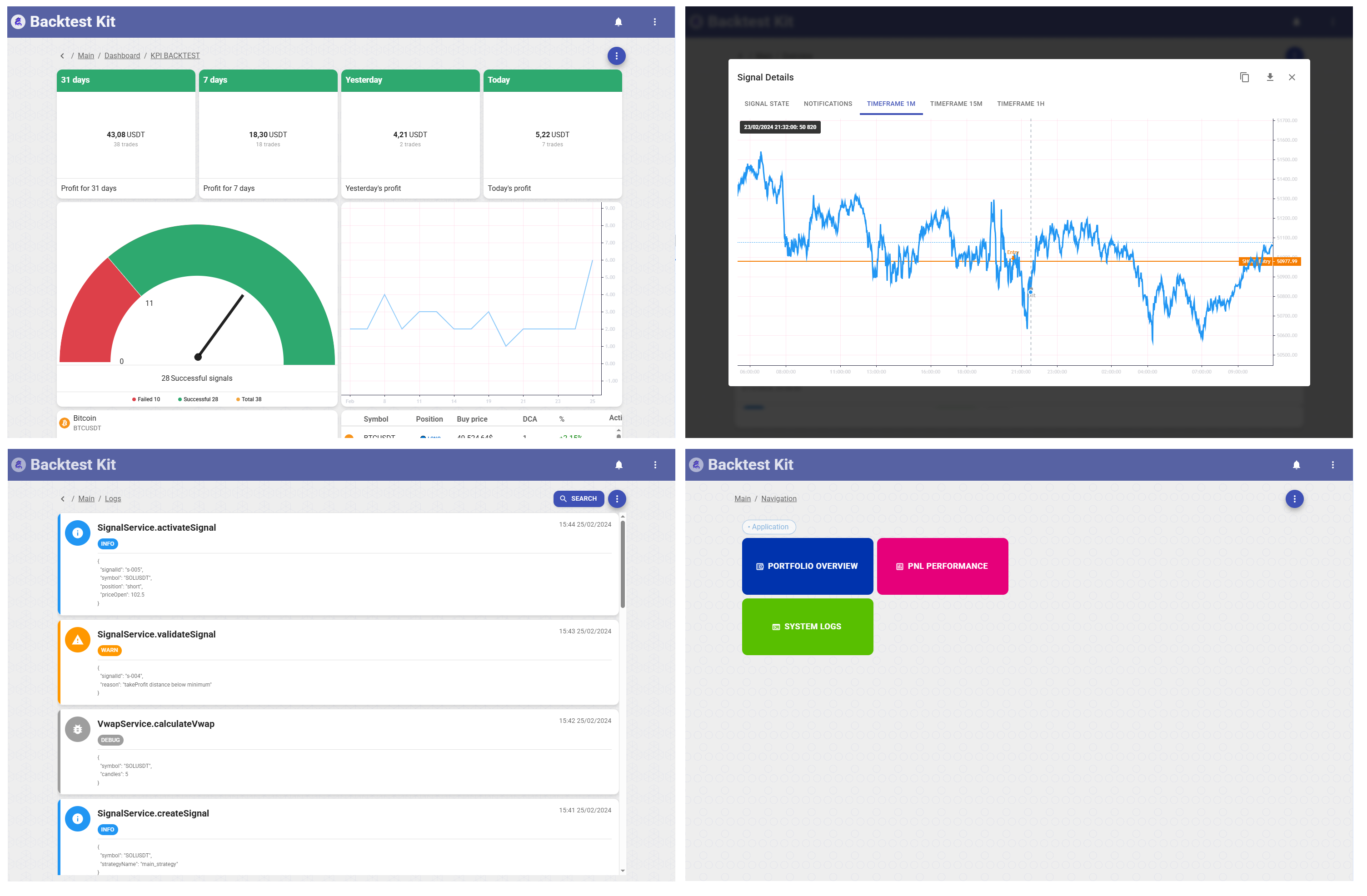



📚 Docs · 🌟 Reference implementation · 🐙 GitHub
npm install @backtest-kit/pg backtest-kit typeorm pg ioredis reflect-metadataimport { setup } from '@backtest-kit/pg';
setup(); // reads connection settings from env; call once before any trading operationThat single call reimplements all 16 of backtest-kit's IPersist*Instance contracts against PostgreSQL (source of truth) with a Redis O(1) read cache. Your strategy code does not change.
Why
The single-node atomicity illusion. On a lone Postgres node all concurrency is arbitrated internally by row locks and MVCC, so even a sloppy write followed by a separate SELECT looks correct — the read hits the very process that just committed. Add read replicas and the illusion breaks: a follow-up SELECT can be routed to an async replica that has not yet received the commit, silently returning stale data. This package tunes every operation for Pgpool to squeeze out maximum throughput while shedding needless locking. The returned row seeds a Redis-first id cache: O(1) per read.
Pgpool-II fans the read load across the cluster. A backtest fires thousands of context-keyed reads per second across parallel symbols. Writes still serialize on the primary (where the atomic upsert keeps its read-after-write guarantee), while the read-heavy hot path scales horizontally with every replica you add.
Up to ~4× faster than the MongoDB adapter. On an Apple M2, simulating one minute of market data costs 35–40 ms through the single-node MongoDB adapter but only ~10 ms through this Postgres + Pgpool cluster — the replicas absorb the read fan-out that otherwise bottlenecks a single node. Your strategy code doesn't change; only the wall-clock time to grind through a backtest does.
- 🗄️ PostgreSQL backend — all 16
IPersist*Instancecontracts implemented with TypeORM. - ⚡ O(1) reads via Redis — one
GET+ one primary-key lookup, no B-tree scans on the hot path. - 🔒 Atomic writes —
INSERT … ON CONFLICT DO UPDATE … RETURNING *guarantees read-after-write with no race. - 🛡️ Look-ahead protection — decision-affecting adapters store the simulation
when. - 🪦 Soft delete — Measure / Interval / Memory carry a
removedflag instead of being deleted (audit trail). - 🔌 Zero strategy changes — drop
setup()into your entry point; everything else stays the same.
Configuration
import { setup } from '@backtest-kit/pg';
setup({
  CC_POSTGRES_CONNECTION_STRING: 'postgres://backtest:secret@postgres:5432/mydb',
  CC_REDIS_HOST: 'redis', CC_REDIS_PORT: 6379, CC_REDIS_PASSWORD: 'secret',
});
| Variable | Default | Description |
|----------|---------|-------------|
| CC_POSTGRES_CONNECTION_STRING | postgres://backtest:mysecurepassword@localhost:5432/backtest-pro | PostgreSQL connection string |
| CC_REDIS_HOST | 127.0.0.1 | Redis host |
| CC_REDIS_PORT | 6379 | Redis port |
| CC_REDIS_USER | (empty) | Redis username |
| CC_REDIS_PASSWORD | (empty) | Redis password |
Values passed to setup() / setConfig() always take precedence over env vars. Within the CLI, put setup() in config/setup.config.ts — when present, the CLI skips its default file-adapter registration and your config owns persistence.
API reference
| Export | Description |
|--------|-------------|
| setup(config?) | Configure and register all 16 adapters in one call. Reads env when config omitted. |
| install() | Register adapters only — when config was already applied via setConfig/env. |
| setConfig(config) | Override individual connection parameters at runtime. |
| getConfig() | The current merged configuration (env + any setConfig overrides). |
| setLogger(logger) | Replace the internal logger with your own implementation. |
| getPostgres() | The connected TypeORM DataSource (lazy singleton). |
| getRedis() | The connected ioredis instance (lazy singleton). |
The 16 adapters
Each adapter covers one persistence slot in backtest-kit. The unique index is the compound key PostgreSQL enforces at the storage engine.
| Adapter | Table | Unique index |
|---------|------------|--------------|
| Candle | candle-items | exchangeName + symbol + interval + timestamp |
| Signal | signal-items | symbol + strategyName + exchangeName |
| Strategy | strategy-items | symbol + strategyName + exchangeName |
| Schedule | schedule-items | symbol + strategyName + exchangeName |
| Risk | risk-items | riskName + exchangeName |
| Partial | partial-items | symbol + strategyName + exchangeName + signalId |
| Breakeven | breakeven-items | symbol + strategyName + exchangeName + signalId |
| Storage | storage-items | backtest + signalId |
| Notification | notification-items | backtest + notificationId |
| Log | log-items | entryId |
| Measure | measure-items | bucket + entryKey |
| Interval | interval-items | bucket + entryKey |
| Memory | memory-items | signalId + bucketName + memoryId |
| Recent | recent-items | symbol + strategyName + exchangeName + frameName + backtest |
| State | state-items | signalId + bucketName |
| Session | session-items | strategyName + exchangeName + frameName |
- Candle is immutable — first write wins; subsequent writes to the same
(exchangeName, symbol, interval, timestamp)are silently ignored via a no-opDO UPDATEthat never touches the OHLCV columns (historical OHLCV never changes). - All others use
DO UPDATE SET payload = EXCLUDED.payload— each write replaces the previous value. - Measure / Interval / Memory soft-delete —
removeMeasureData/removeIntervalData/removeMemoryDatasetremoved = truerather than deleting; listings filter onremoved = false, keeping a full audit trail.
How it works
Every domain is two layers: a DbService (PostgreSQL) and a CacheService (Redis). Reading state for a context key asks Redis for the Postgres id first; a hit is two O(1) ops, a miss falls back to an indexed findOne and backfills Redis.
read signal for (BTCUSDT, my_strategy, binance)
  ├─ Redis GET → hit  → Postgres findByFilter({ id })   ← O(1) + O(1)
  └─ Redis GET → miss → Postgres findByFilter(filter) → Redis SET → return
After every write the Redis entry is refreshed in the same call, so write-then-read always hits the cache.
backtest-kit requires that once write*Data() returns, the next read*Data() sees the new value. Every write is one INSERT … ON CONFLICT … RETURNING round-trip:
const { raw } = await repo
  .createQueryBuilder()
  .insert()
  .values({ symbol, strategyName, exchangeName, payload })
  .orUpdate(["payload"], ["symbol", "strategyName", "exchangeName"])
  .returning("*")
  .execute();
await signalCacheService.setSignalId(raw[0]);
The conflict target matches the unique compound index, so PostgreSQL serializes any concurrent duplicate insert at the storage engine — the loser takes the DO UPDATE branch instead of throwing; the returned row is written straight to Redis, making the next read O(1) on fresh data.
Adapters whose data influences decisions (Risk, Partial, Breakeven, Recent, State, Session, Memory, Interval) store when: bigint — the simulation timestamp in ms — alongside the payload, so backtest-kit can verify no read returns data written at a future simulation time. Measure is exempt because it caches LLM / external-API responses, where look-ahead bias is not meaningful.
Internal architecture (complete source map)
Public surface — functions/setup.ts (setup/install/setLogger), config/params.ts (setConfig/getConfig), index.ts re-exports + getPostgres/getRedis.
Adapter classes (classes/Persist*Instance.ts, 16) — each implements one backtest-kit IPersist*Instance contract and delegates to its domain DbService: PersistCandleInstance, PersistSignalInstance, PersistStrategyInstance, PersistScheduleInstance, PersistRiskInstance, PersistPartialInstance, PersistBreakevenInstance, PersistStorageInstance, PersistNotificationInstance, PersistLogInstance, PersistMeasureInstance, PersistIntervalInstance, PersistMemoryInstance, PersistRecentInstance, PersistStateInstance, PersistSessionInstance.
Service layer (lib/services/):
base/—PostgresService(lazy TypeORMDataSource),RedisService(lazy ioredis),LoggerService.db/— one*DbServiceper domain: the TypeORM entity schemas, unique compound indexes, andINSERT … ON CONFLICT … RETURNINGupsert logic.cache/— one*CacheServiceper domain (CandleCacheService,SignalCacheService,BreakevenCacheService,IntervalCacheService,LogCacheService,MeasureCacheService,MemoryCacheService,NotificationCacheService,PartialCacheService,RecentCacheService, …): Redisidmapping for O(1) lookups.
Shared primitives (lib/common/) — BaseCRUD (the upsert/read/remove pattern every DbService reuses) and BaseMap (the Redis key-mapping pattern every CacheService reuses).
DI & config — lib/core/{di,provide,types}.ts (IoC container wiring Db/Cache/base services), lib/index.ts (container bootstrap), config/{postgres,redis,params}.ts (connection builders + merged params), interfaces/Logger.interface.ts.
🤝 Contribute
Fork / PR on GitHub.
📜 License
MIT © tripolskypetr