
@chkp/management-logs-mcp
v1.4.10
Published
Management Logs MCP server for Check Point products


Keywords
Readme
Check Point Management Logs MCP Server
What is MCP?
Model Context Protocol (MCP) servers expose a structured, machine-readable API for your enterprise data—designed for AI-powered automation, copilots, and decision engines. By delivering a clear, contextual slice of your security environment, MCP lets you query, analyze, and optimize complex systems without building custom SDKs or parsing raw exports.
Why MCP for Logs?
Managing logs across diverse enforcement points can involve thousands of entries and complex data, making analysis, auditing, and optimization slow and error-prone. MCP changes this by exposing log management data in a modular, context-rich format, ready for AI systems to consume. This enables AI to use your log data with precision—so you can ask real-world questions and get structured, actionable answers instantly.
Use with other MCPs for Best Results
While the Logs MCP work well on it's own, and will enable to read logs and derive great insights, it is best used in combination with other Check Point MCP servers (found in this repo), enabling you to correlate logs with current system configuration and status.
Features
- Query and visualize connection logs
- View Audit and monitoring logs
Management API Version
This server supports Management API v2.1 (R82.10+). It is generally compatible with earlier versions; some parameters may not be available on older management servers.
Demo
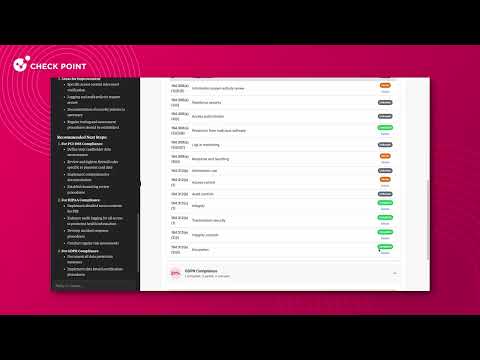
Example Use Cases
Dropped Connection Analysis
“Create a visualization of all the drops in my system in the last 24 hours. The visualization needs to be interactive, able to pivot the information by interesting factors. If you see potential attacks and issue, make sure they can be derived from the visualization.”
→ Returns a detailed report of dropped connections, that is interactive and has interesting insights.
Network Probing Investigation
“Show me the hidden attack patterns: Which source IPs are using legitimate services as stepping stones to probe our network, and create a timeline visualization of how their behavior evolved over the past 30 days?”
→ Create a report of suspicious source IPs that try to probe the network on legitimate ports.
Policy Audit Research
“Show me our 'configuration drift detective story': Compare our current gateway configurations against our security policies from 6 months ago, identify where we've become more permissive without explicit policy changes, and highlight potential shadow IT or policy creep.”
→ Compares current policy state with past changes, looking for potential overly permissive changes.
⚠️ Performance Notice
Log data volumes can be very large. Running extensive queries may impact the performance of your management server. Please use with caution.
Configuration Options
📊 Anonymous Usage Statistics: Check Point collects anonymous usage statistics to help improve this MCP server. To opt out, set
TELEMETRY_DISABLED=trueor use--no-telemetryflag.
This server supports two main modes of authentication:
1. Smart-1 Cloud (API Key)
Authenticate to Check Point Smart-1 Cloud using an API key.
- How to generate an API key:
In your Smart-1 Cloud dashboard, go to Settings → API & SmartConsole and generate an API key.
Copy the key and the server login URL (excluding the/loginsuffix) to your client settings.
Set the following environment variables:
API_KEY: Your Smart-1 Cloud API keyS1C_URL: Your Smart-1 Cloud tenant "Web-API" URL
2. On-Prem Management (API Key or Username/Password)
Configure your management server to allow API access:
To use this server with an on-premises Check Point management server, you must first enable API access.
Follow the official instructions for Managing Security through API.Authenticate to the Security Management Server using either an API key or username/password:
- Follow the official instructions: Managing Administrator Accounts (Check Point R81+)
- When creating the administrator, assign appropriate permissions for API access and management operations.
- You can authenticate using an API key (recommended for automation) or username/password credentials.
Set the following environment variables:
MANAGEMENT_HOST: IP address or hostname of your management serverPORT: (Optional) Management server port (default: 443)API_KEY: Your management API key (if using API key authentication)USERNAME: Username for authentication (if using username/password authentication)PASSWORD: Password for authentication (if using username/password authentication)
Client Configuration
Prerequisites
Download and install the latest version of Node.js if you don't already have it installed.
You can check your installed version by running:
node -v      # Should print "v20" or higher
nvm current  # Should print "v20" or higher
Supported Clients
This server has been tested with Claude Desktop, Cursor, GitHub Copilot, and Windsurf clients.
It is expected to work with any MCP client that supports the Model Context Protocol.
Note: Due to the nature of amount of logs generate in the system, using this server may require a paid subscription to the model provider to support token limits and context window sizes.
For smaller models, you can reduce token usage by limiting the number of enabled tools in the client.
Smart-1 Cloud Example
{
  "mcpServers": {
    "management-logs": {
      "command": "npx",
      "args": ["@chkp/management-logs-mcp"],
      "env": {
        "API_KEY": "YOUR_API_KEY",
        "S1C_URL": "YOUR_S1C_URL" // e.g., https://xxxxxxxx.maas.checkpoint.com/yyyyyyy/web_api
      }
    }
  }
}
On-Prem Management Example
{
  "mcpServers": {
    "management-logs": {
      "command": "npx",
      "args": ["@chkp/management-logs-mcp"],
      "env": {
        "MANAGEMENT_HOST": "YOUR_MANAGEMENT_IP_OR_HOST_NAME",
        "MANAGEMENT_PORT": "443", // optional, default is 443
        "API_KEY": "YOUR_API_KEY", // or use USERNAME and PASSWORD
        "USERNAME": "YOUR_USERNAME", // optional
        "PASSWORD": "YOUR_PASSWORD"  // optional
      }
    }
  }
}
Set only the environment variables required for your authentication method.
Configuring the Claude Desktop App
Using a Bundled MCPB (formerly DXT)
- Download the MCPB file: 📥 management-logs.mcpb
- Open Claude Desktop App → Settings → Extensions
- Drag the MCPB file and configure per the instructions.
Or Configure Manually
For macOS:
# Create the config file if it doesn't exist
touch "$HOME/Library/Application Support/Claude/claude_desktop_config.json"

# Open the config file in TextEdit
open -e "$HOME/Library/Application Support/Claude/claude_desktop_config.json"
For Windows:
code %APPDATA%\Claude\claude_desktop_config.jsonAdd the server configuration:
{
  "mcpServers": {
    "management-logs": {
      "command": "npx",
      "args": ["@chkp/management-logs-mcp"],
      "env": {
        // Add the configuration from the above instructions
      }
    }
  }
}
VSCode
Enter VSCode settings and type "mcp" in the search bar. You should see the option to edit the configuration file. Add this configuration:
{
  ...
  "mcp": {
    "inputs": [],
    "servers": {
      "management-logs": {
        "command": "npx",
        "args": [
          "@chkp/management-logs-mcp"
        ],
        "env": {
          "MANAGEMENT_HOST": "YOUR_MANAGEMENT_IP_OR_HOST_NAME",
          "MANAGEMENT_PORT": "443",  // optional, default is 443
          "API_KEY": "YOUR_API_KEY", // or use USERNAME and PASSWORD
          "USERNAME": "YOUR_USERNAME", // optional
          "PASSWORD": "YOUR_PASSWORD" // optional
        }
      }
    }
  },
  ...
}
Windsurf
Enter Windsurf settings and type "mcp" in the search bar. You should see the option to edit the configuration file. Add the configuration as Claude Desktop App.
Cursor
Enter Cursor settings and click on "MCP Servers" in the left menu. You should see the option to add a new MCP Server. Add the configuration as Claude Desktop App.
HTTP Transport
By default, this server uses stdio transport, which is the standard mode for MCP clients like Claude Desktop and Cursor. For hosted or multi-user deployments, an HTTP transport (MCP Streamable HTTP) is also available.
Security notice before you continue: The HTTP server has no built-in authentication and no TLS. Any client that can reach the port can establish a session, and credentials travel in cleartext. Only use HTTP transport behind an authenticated reverse proxy (nginx, Caddy, a cloud load balancer) that terminates TLS and enforces authentication. If you are running the server on the same machine as your MCP client, use the default stdio transport — it has none of these concerns.
Starting the server in HTTP mode
MCP_TRANSPORT_TYPE=http MCP_TRANSPORT_PORT=3000 npx @chkp/management-logs-mcp
# or
npx @chkp/management-logs-mcp --transport http --transport-port 3000
The server exposes:
POST/GET/DELETE /mcp— MCP protocol endpointGET /health— server status (active session count, version)
Connecting an MCP client
Point your MCP client at http://<host>:3000/mcp. Example for Claude Desktop (claude_desktop_config.json):
{
  "mcpServers": {
    "management-logs": {
      "url": "http://localhost:3000/mcp"
    }
  }
}
Development
Prerequisites
- Node.js 20+
- npm 10+
Setup
# Install all dependencies
npm install
Build
# Build all packages
npm run build
Running Locally
You can run the server locally for development using MCP Inspector or any compatible MCP client.
node FULL_PATH_TO_SERVER/packages/management-logs/dist/index.js --s1c-url|--management-host --api-key|--username|--password⚠️ Security Notice
- Authentication keys and credentials are never shared with the model. They are used only by the MCP server to authenticate with your Check Point management system.
- Only use client implementations you trust. Malicious or untrusted clients could misuse your credentials or access data improperly.
- Management data is exposed to the model. Ensure that you only use models and providers that comply with your organization's policies for handling sensitive data and PII.
📊 Telemetry and Privacy
Anonymous Usage Statistics: Check Point collects anonymous usage statistics to improve this MCP server. Only tool usage patterns and anonymous identifiers are collected—no credentials, policies, or sensitive data.
Opt-Out: Set TELEMETRY_DISABLED=true environment variable or use the --no-telemetry flag to disable telemetry collection.