
@cmdop/sdk
v1.1.0
Published
Typed Node SDK for CMDOP — spawns the baked-in cmdop-core Go binary and speaks protobuf over stdio (machines, fleets, tunnels, schedules, keys, and machine AI ask streaming).


Readme
@cmdop/sdk (Node)
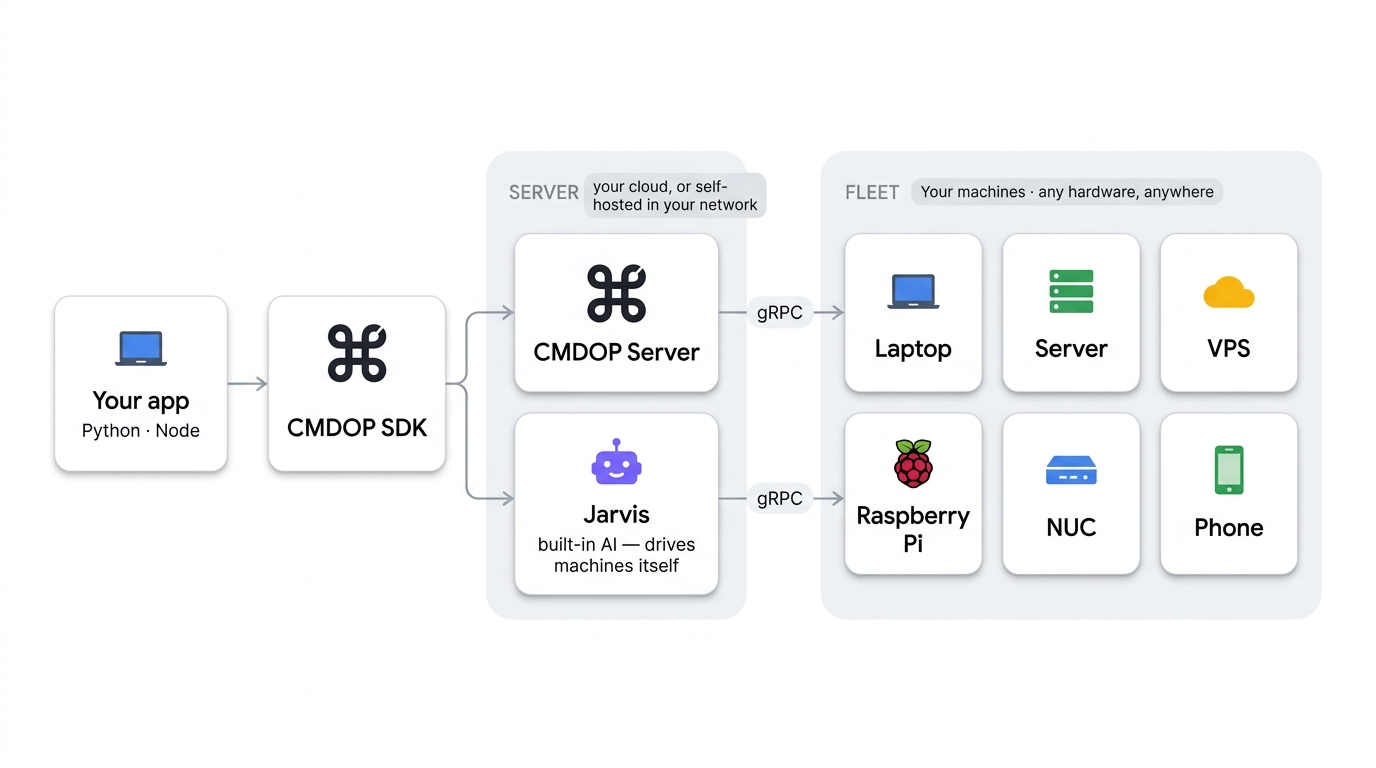
Typed Node SDK for CMDOP — manage your machines, fleets, tunnels, and schedules, stream a machine's AI agent, and drive the skills marketplace, all from typed TypeScript.
📚 Docs: docs.cmdop.com · SDK · Bots · Connect
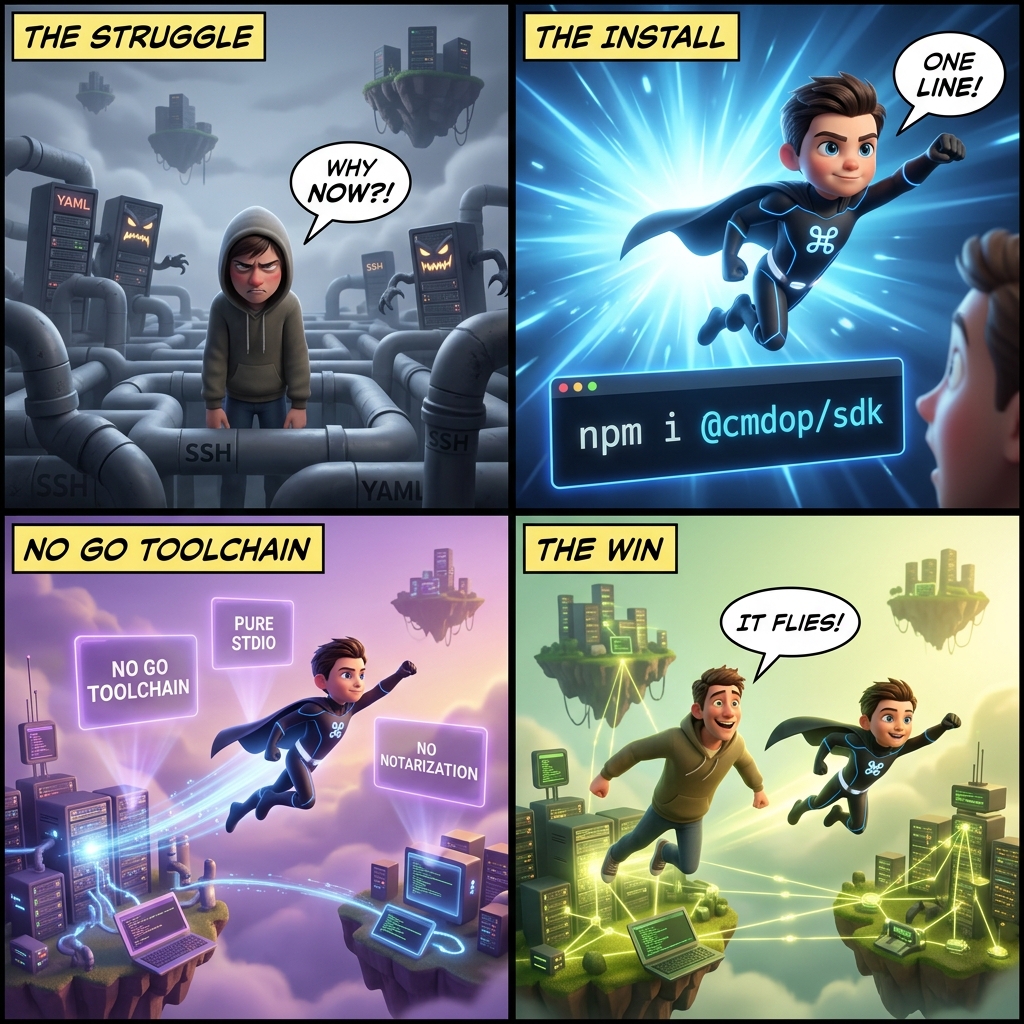
- One install, zero dependencies —
npm i @cmdop/sdkis everything. No native build step, nooptionalDependencies, nothing fetched on first run. - Works anywhere, offline-ready — a single self-contained package runs the same on macOS, Linux, and Windows, including air-gapped hosts.
- Typed end to end — full TypeScript types for every resource and response, with one clean async streaming API for live agent output.
Install
npm i @cmdop/sdk # or: pnpm add @cmdop/sdk / yarn add @cmdop/sdkESM + CJS, Node ≥ 18.
Quick start
import { Client } from "@cmdop/sdk";

const c = new Client({ token: "..." });        // or Client.fromEnv()

const page = await c.machines.list({ presence: "online" });
for (const m of page.items) console.log(m.hostname, m.presence);

const text = await c.machines.ask(machineId, "uptime").collect();
console.log(text);

await c.close();                                // release resources
await using c = new Client(...) works too (Symbol.asyncDispose).
Namespaces
The same surface as the relay, mirrored exactly by the Python SDK (camelCase here, snake_case there):
| Namespace | Methods |
|---|---|
| machines | list · get · update · disable · info · spend · ask · messages · clearMessages · activeSession |
| fleets | list · get · create · update · disable |
| fleets.members | list · add · setRole · remove |
| fleets.machines | list · attach · detach |
| tunnels | open · close · list · get · sessions |
| schedules | list · get · create · update · delete · trigger · runs |
| keys | list · issue · revoke |
| skills | list · get · my · install · star · versions · reviews · create · update · delete · publish · publishStatus · categories · tags |
List endpoints also expose iter(...) (an async generator over every item,
following cursors) and pages(...) (an async generator over each page).
Two planes, one client.
machines / fleets / tunnels / schedules / keysuse your relay token (CMDOP_TOKEN); theskillsmarketplace uses your platform API key (CMDOP_API_KEY). Set whichever you need — the client routes each call to the right plane for you.
Streaming: machines.ask()
ask() returns an AskStream — an async iterable of typed frames with pin() /
confirm() / collect():
const stream = c.machines.ask(machineId, "df -h", { sessionId: "s1" });
for await (const frame of stream) {
  if (frame.type === "event") {
    process.stdout.write(String((frame.payload as { delta?: string })?.delta ?? ""));
  } else if (frame.type === "pin_required") {       // machine asked for its connect PIN
    await stream.pin(frame.challengeId, "1234");
  } else if (frame.type === "confirm_required") {    // a dangerous plan awaits approval
    await stream.confirm(frame.token, true);
  } else if (frame.type === "pin_denied") {
    console.log("PIN rejected:", frame.reason);
  } else if (frame.type === "done") {
    console.log("\n->", frame.text);
  }
}

// one-shot: drain to the final text
const text = await c.machines.ask(machineId, "uptime").collect();
Connection PIN. If a machine requires a PIN, pass it upfront — the SDK is headless, so there's no prompt to answer:
const text = await c.machines.ask(machineId, "uptime", { pin: "1234" }).collect();A wrong PIN throws PinDeniedError; an unverified one throws PinTimeoutError
(both extend PermissionError, non-retryable). The reactive stream.pin(...)
callback above is for interactive use (a human at a prompt). The relay never
stores the PIN — it forwards it once to the target, which verifies it locally.
Frame types: event · done · error · confirm_required · pin_required ·
pin_denied. An error outcome throws AgentStreamError.
Environment variables
| Var | Meaning | Default |
|---|---|---|
| CMDOP_TOKEN | relay Bearer token (machines/fleets/…) | — (required for relay ops) |
| CMDOP_BASE_URL | relay REST root | https://cloud.cmdop.com |
| CMDOP_API_KEY | platform UserAPIKey (for skills) | — (required for skills) |
| CMDOP_API_BASE_URL | platform REST root | https://api.cmdop.com |
| CMDOP_FLEET_ID | default fleet for fleet-scoped ops | none |
| CMDOP_TIMEOUT_MS | per-call timeout | 30000 |
Precedence is always explicit option > env var > default. Pass a string to the
constructor (new Client("token")) as a shorthand for { token }.
Error handling
Every failure surfaces as a typed error carrying a stable code (all extend
CmdopError):
import {
  AuthError, PermissionError, NotFoundError, ConflictError,
  ValidationError, RateLimitError, ServerError, ConnectionError,
  TimeoutError, UnavailableError, AgentStreamError, CmdopError,
} from "@cmdop/sdk";

try {
  await c.machines.get("missing-id");
} catch (e) {
  if (e instanceof NotFoundError) { /* ... */ }
  else if (e instanceof CmdopError) {
    if (e.retryable) { /* true on TimeoutError — safe to retry */ }
    console.log(e.code, e.message);
  }
}
ConnectionError covers a lost connection mid-call (pending promises reject);
TimeoutError (a retryable subclass) is a deadline/handshake timeout;
UnavailableError means the relay is up but the target agent/machine is offline.
AgentStreamError is the streaming-ask error outcome.
Links
- Docs → docs.cmdop.com
- SDK → cmdop.com/sdk · Bots → cmdop.com/bots · Connect → cmdop.com/connect
@cmdop/sdkon npm · source