
@codihaus/fetchpipe
v0.2.0
Published
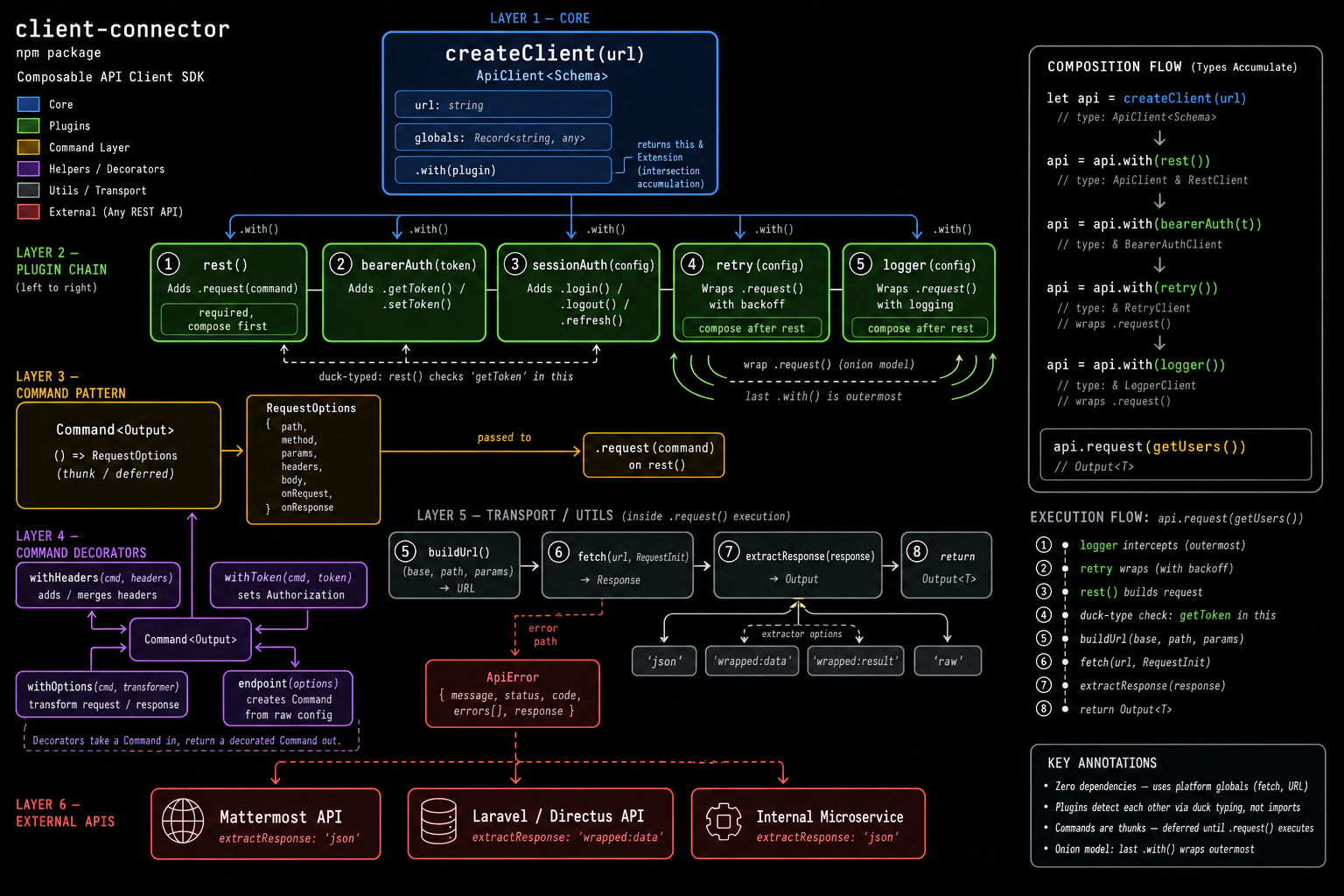
Composable, zero-dependency API client SDK foundation


Readme
fetchpipe
Composable, zero-dependency API client foundation. Build type-safe clients for any REST API by plugging together small, focused modules.
Why
Every new project, you rewrite the same fetch wrapper, token management, retry logic, error handling. Or you reach for axios — then wrap it with another layer for auth, interceptors, error formatting.
fetchpipe gives you a single composable foundation that works with any REST API. No framework lock-in, no backend assumptions.
Compose only what you need. No retry? Don't add it. Need session auth instead of bearer? Swap the plugin. Each plugin is independent and tree-shakeable.
Type-safe by design. Each .with() accumulates types through TypeScript intersections — your IDE knows exactly what methods are available based on which plugins you composed. No casting, no as any.
Commands separate "what" from "when". Define requests as reusable thunks, decorate them without mutation, execute when ready. Build an SDK for your team's API in minutes.
Runs everywhere. Uses platform globals (fetch, URL) — browser, Node, Deno, Bun, React Native. Inject a mock fetch for tests.
| | raw fetch | axios | fetchpipe | |---|---|---|---| | Auth management | DIY | Interceptor | Built-in plugins | | Retry | DIY | DIY | Built-in plugin | | Type inference | No | No | Auto via compose | | Bundle size | 0 | ~13KB | ~3KB | | Extensible | Hard | Interceptors | Plugin system |
Install
npm install @codihaus/fetchpipeQuick Start
import { createClient, rest, bearerAuth, type Command } from '@codihaus/fetchpipe'

const api = createClient('https://api.example.com')
  .with(rest())
  .with(bearerAuth('my-token'))

const getUsers = (): Command<User[]> => () => ({
  path: '/users',
  method: 'GET',
})

const users = await api.request(getUsers())
Plugins
rest(config?)
Core plugin. Adds .request(command).
createClient(url).with(rest({
  extractResponse: 'json',            // return parsed JSON (default)
  extractResponse: 'wrapped:data',    // unwrap { data: ... }
  extractResponse: 'raw',             // return raw Response
  extractResponse: (res) => { ... },  // custom extractor
  credentials: 'include',
  onRequest: (init) => init,          // global request hook
  onResponse: (data, init) => data,   // global response hook
}))
bearerAuth(token)
Static or dynamic bearer token.
// Static
.with(bearerAuth('my-api-key'))

// Dynamic — called on every request
.with(bearerAuth(async () => await getTokenFromVault()))

// Methods: api.getToken(), api.setToken(token)
sessionAuth(config?)
Full auth lifecycle — login, auto-refresh, logout. All paths configurable.
.with(sessionAuth({
  loginPath: '/auth/login',
  refreshPath: '/auth/refresh',
  logoutPath: '/auth/logout',
  autoRefresh: true,
  msRefreshBeforeExpires: 30000,
  storage: memoryStorage(),       // or custom AuthStorage
}))

await api.login({ email: '[email protected]', password: 'secret' })
await api.request(protectedCommand())  // token auto-attached
await api.logout()
retry(config?)
Exponential backoff. Must compose after rest().
.with(retry({
  maxRetries: 3,       // default
  baseDelay: 300,      // ms, default
  maxDelay: 10000,     // ms, default
  retryOn: (error, attempt) => error.status >= 500,
  onRetry: (error, attempt, delayMs) => metrics.inc('retry'), // observability — exceptions swallowed
  jitter: true,        // full jitter (0..delay) to avoid thundering-herd; or (delay) => number
  sleep: (ms) => Promise.resolve(),   // inject for deterministic tests (default: setTimeout)
}))
Default retryOn retries status >= 500 and NETWORK_ERROR. Opt into timeouts:
retryOn: (e) => isApiError(e) && (e.code === 'TIMEOUT' || e.code === 'NETWORK_ERROR' || (e.status ?? 0) >= 500)timeout(config?)
Bounds each request in time via a fresh AbortController per attempt. Compose after rest() and — for a fresh timeout on every retry — before retry().
createClient(url)
  .with(rest())
  .with(timeout({ ms: 10_000 }))   // default for every request
  .with(retry({ retryOn: (e) => isApiError(e) && e.code === 'TIMEOUT' }))

// Per-command override:
await api.request(withOptions(cmd(), {}))          // or set timeoutMs on the command:
const slowCmd = (): Command<T> => () => ({ path: '/report', timeoutMs: 60_000 })
On timeout, throws ApiError with code: 'TIMEOUT'. A caller-supplied RequestOptions.signal is combined with the timeout signal (whichever fires first wins); a caller abort surfaces as code: 'ABORTED'.
logger(config?)
Request/response logging. Must compose after rest().
.with(logger({ logRequest: true, logResponse: true, logErrors: true }))Command Decorators
import { withHeaders, withToken, withOptions, endpoint } from '@codihaus/fetchpipe'

withHeaders(cmd, { 'X-Custom': 'value' })    // inject headers
withToken(cmd, 'override-token')              // override auth
withOptions(cmd, init => ({ ...init, signal: AbortSignal.timeout(5000) }))
endpoint({ path: '/raw', method: 'POST' })   // command from raw options
Plugin Composition
const api = createClient(url)
  .with(rest())            // innermost — actual fetch
  .with(bearerAuth(token)) // any order — discovered via duck typing
  .with(retry())           // wraps .request()
  .with(logger())          // wraps outermost (onion model)
Rules:
rest()first — provides.request()- Auth plugins — any position, adds
getToken()discovered at runtime - Wrapping plugins — after
rest(), last.with()wraps outermost
Custom Plugins
const timing = () => <Schema>(client: ApiClient<Schema>) => {
  const original = (client as any).request
  return {
    async request<T>(cmd: Command<T>): Promise<T> {
      const t = performance.now()
      try { return await original.call(this, cmd) }
      finally { console.log(`${(performance.now() - t).toFixed(1)}ms`) }
    },
  }
}
Platform Globals
createClient(url, {
  globals: { fetch: customFetch, URL: customURL, logger: customLogger },
})
Error Handling
import { isApiError } from '@codihaus/fetchpipe'

try {
  await api.request(cmd())
} catch (err) {
  if (isApiError(err)) {
    err.message   // first error message
    err.status    // HTTP status
    err.code      // stable taxonomy (see below)
    err.errors    // error details array
    err.response  // raw Response
    err.body      // bounded snippet of the raw error body
  }
}
err.code taxonomy
Part of the public (semver-relevant) contract — switch on it in retryOn or when mapping to domain errors.
| code | meaning |
|---|---|
| HTTP_ERROR | non-2xx response with status set |
| NETWORK_ERROR | fetch rejected (DNS, connection reset, TLS...) |
| TIMEOUT | aborted by the timeout() plugin |
| ABORTED | aborted by a caller-supplied signal |
| PARSE_ERROR | extractor failed on a 2xx body (invalid JSON etc.) |
Custom error bodies — extractError
Provider APIs put the actionable message in the error body. rest({ extractError }) builds the ApiError from any non-2xx response:
.with(rest({
  extractError: (response, body) => ({
    message: (body as any)?.error?.message ?? response.statusText,
    status: response.status,
    code: 'HTTP_ERROR',
  }),
}))
The default already reads JSON message / error.message, falls back to statusText, and preserves errors[].
Composition Recipes
Order matters. A short cookbook:
// Bounded time, fresh timeout per retry attempt
createClient(url).with(rest()).with(timeout({ ms: 10_000 })).with(retry())
// why: retry wraps timeout wraps rest → each attempt gets a new AbortController

// Log every attempt (including retries)
createClient(url).with(rest()).with(logger()).with(retry())
// why: retry is outermost, so logger sits inside it and sees each try

// Log only the final outcome
createClient(url).with(rest()).with(retry()).with(logger())
// why: logger is outermost, retry is transparent to it

// Refresh-then-retry on 401 exactly once
createClient(url)
  .with(rest())
  .with(sessionAuth({ autoRefresh: true }))
  .with(retry({ maxRetries: 1, retryOn: (e) => isApiError(e) && e.status === 401 }))
Real-World Examples
// Mattermost — raw JSON responses
const mm = createClient('https://mm.example.com/api/v4')
  .with(rest({ extractResponse: 'json' }))
  .with(bearerAuth(token))

// Laravel — wrapped { data: ... }
const api = createClient('https://app.example.com/api')
  .with(rest({ extractResponse: 'wrapped:data' }))
  .with(sessionAuth({ credentials: 'include' }))
  .with(retry({ maxRetries: 2 }))

// Internal microservice
const svc = createClient('http://user-service.internal:3000')
  .with(rest())
  .with(bearerAuth(async () => await getServiceToken()))
  .with(retry({ maxRetries: 5, retryOn: (err) => err.status === 503 }))
  .with(logger())
API Reference
| Export | Type | Description |
|--------|------|-------------|
| createClient(url, opts?) | Factory | Create base client |
| rest(config?) | Plugin | REST transport — .request() |
| bearerAuth(token) | Plugin | Static/dynamic bearer auth |
| sessionAuth(config?) | Plugin | Login/refresh/logout lifecycle |
| retry(config?) | Plugin | Exponential backoff retry |
| timeout(config?) | Plugin | Per-attempt request timeout |
| logger(config?) | Plugin | Request/response logging |
| memoryStorage() | Utility | In-memory token storage |
| endpoint(opts) | Helper | Command from raw options |
| withHeaders(cmd, h) | Decorator | Add headers |
| withToken(cmd, t) | Decorator | Override auth token |
| withOptions(cmd, fn) | Decorator | Transform RequestInit |
| ApiError | Class | Structured API error |
| isApiError(err) | Guard | Type guard for ApiError |
Requirements
- Node.js >= 18 (or any runtime with
fetch+URL) - TypeScript >= 5.0
License
MIT