
@daromsart/daroms-speed-app
v0.5.2
Published
Expo + Tamagui v3 + Supabase mobile framework built for Claude Code: theme, components, data, modules, daroms CLI and a low-token AI layer to ship an app a day.

Maintainers
 daroms
Readme
Daroms Speed App
English · Français


An idea in the morning, the app on your phone by evening.
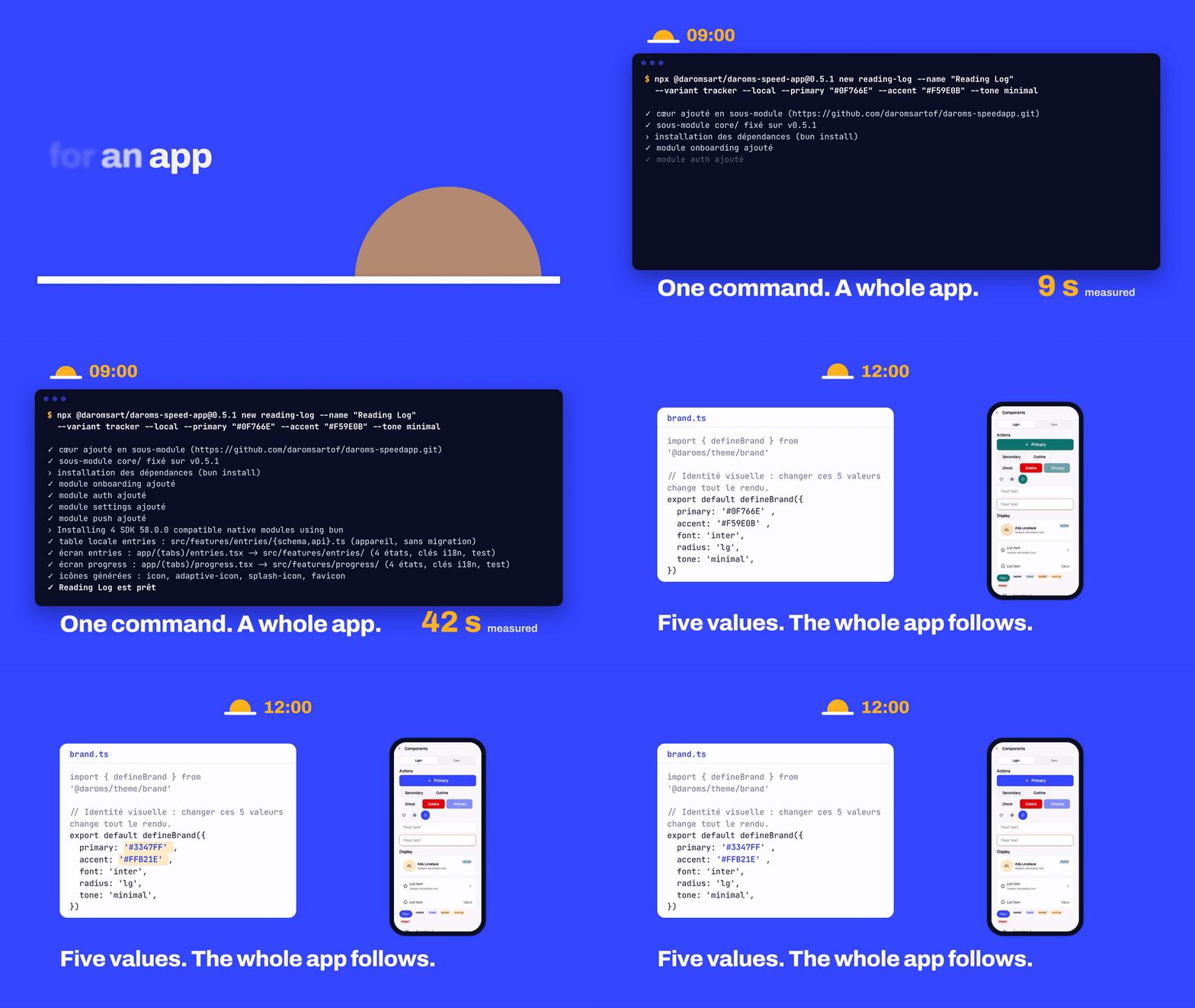
Real output from a demo app: the app was created in 42 s (measured). Watch the full 50 s demo.
An Expo + Tamagui + Supabase mobile framework built for Claude Code. The core ships the theme, components, data layer, modules and store publishing; your app only writes what is specific to it, under rules checked on every file.
- Generate before writing: screens, tables and modules come from deterministic templates, no AI involved. Claude only fills in what is specific.
- One brand, one theme: 5 values in
brand.tsproduce OKLCH palettes, light and dark themes, radii, spacing and springs. - Enforced rules: hard-coded color, Supabase inside a component, text outside i18n: a hook rejects the write and says what to do instead.
- Opt-in modules: auth, payments, push, AI chat, photos, maps... one command each.
- Low token cost: a short always-loaded core, rules loaded only for the files being touched, a component catalog instead of sources, and mechanical steps run in fresh-context Sonnet or Haiku subagents.
Full documentation: https://daromsartof.github.io/daroms-speedapp/en/
The documentation site starts in English with the home, installation and tutorial pages; guides and reference are in French for now. The AI layer (skills, rules) and CLI messages are in French; Claude understands prompts in any language.
Create an app
Requirements: Bun >= 1.3, Node >= 22.18, Git, Python 3, and Expo Go on your phone.
npx @daromsart/daroms-speed-app new my-app --name "My app" --variant list-detail
cd my-app
cp .env.example .env    # Supabase URL and public key
bun daroms dev          # scan the QR code with Expo Go
Global command: npm install -g @daromsart/daroms-speed-app, then daroms new my-app. The CLI runs on Bun.
daroms new copies the template, adds the core in core/, writes brand.ts and app.manifest.ts, enables the variant's modules, generates tables and screens, icons and splash, installs dependencies, syncs the AI layer into .claude/ and makes the first commit. core/ is a git submodule pinned to the installed version; if the core repository is unreachable, it is a copy of the core shipped in this package.
No Supabase to start with: --local keeps data on the device, behind the same hooks.
With Claude Code
Open Claude Code in the app, then:
/daroms-day An app to track my reading habits| Time | Skills | Result |
|---|---|---|
| Morning | /daroms-idea, /daroms-new | app.spec.md brief, app created, QR preview |
| Noon | /daroms-inspire, /daroms-brand, /daroms-design, /daroms-data | Dribbble, Pinterest and Mobbin references and a chosen direction, brand and icon, wireframes, Supabase tables with RLS |
| Afternoon | /daroms-screen, /daroms-module, /daroms-check, /daroms-polish | screens, modules, checks, UX polish |
| Evening | /daroms-store, /daroms-build, /daroms-submit | FR/EN store listing, EAS build, TestFlight and internal track, then app.cost.md: what the app cost in tokens and dollars |
22 skills, 3 subagents (designer, reviewer, store) and 6 hooks (sync, context router, rule checks, typecheck, .env protection, token stats). The ECC method is built in: ecc-tdd-workflow, ecc-security-review, ecc-accessibility and ecc-typescript-patterns, vendored in the core and mapped to daroms commands by daroms-ecc. Details: skills, hooks.
Example: a table and its screen
bun daroms g table books --fields "title:text, author:text?, pages:int=0"
bun daroms g screen books --tab --icon BookOpen --title "Livres" --title-en "Books"
bun daroms db push
The first command writes the migration (owner RLS on all 4 operations), the zod schema and the useBooks, useBook, useCreateBook, useUpdateBook, useDeleteBook hooks. The second writes the route, the screen with its 4 states, FR/EN strings, the test and the tab. The screen is filled with @daroms/ui:
// src/features/books/BooksScreen.tsx
import { useT } from '@daroms/i18n'
import { Header, ListItem, QueryView, Screen } from '@daroms/ui'
import { BookOpen } from '@daroms/ui/icons'

import { useBooksScreen } from './hooks'

export default function BooksScreen() {
  const t = useT()
  const { query } = useBooksScreen()
  return (
    <Screen header={<Header title={t('books.title')} large />}>
      <QueryView query={query} empty={{ icon: BookOpen, title: t('books.emptyTitle') }}>
        {(books) => books.map((book) => <ListItem key={book.id} title={book.title} subtitle={book.author ?? undefined} chevron />)}
      </QueryView>
    </Screen>
  )
}
What's in the package
| Folder | Content |
|---|---|
| packages/ | @daroms/theme (theme from brand.ts), @daroms/ui (32 components, 102 Lucide icons, CATALOG.md), @daroms/data (Supabase, queries, errors, local tables), @daroms/lib (formatting, dates, zod, storage, haptics), @daroms/i18n, @daroms/app (providers, gates, modules, layouts), @daroms/config |
| modules/ | auth, onboarding, settings, payments (RevenueCat), push, analytics, ai-chat (streaming Claude), camera (Supabase Storage), maps |
| template/ | starter app and 5 variants: list-detail, tracker, ai-chat, social, shop (plus blank) |
| generators/ | screen, table and module templates |
| cli/ | the daroms command |
| _ai/ | AI layer: core instructions, rules, skills, agents, hooks, context zones |
The @daroms/* packages are TypeScript sources linked through a Bun workspace from core/, with no build step.
Commands
| Command | Purpose |
|---|---|
| new <slug> | create an app (--variant, --local, --primary, --accent, --tone, --modules...) |
| dev | Expo server and QR code (Expo Go, or --dev-client) |
| doctor | Node, .env, manifest, i18n, rules, TypeScript, ESLint, expo-doctor |
| g screen \| feature \| table \| module | generate |
| module add \| remove \| list | modules |
| shot <route> | visual check: errors and overflows first, screenshot when useful |
| test, e2e | jest-expo, Maestro |
| assets | icon, adaptive icon, splash, favicon from one SVG |
| inspire <url...> | inspiration previews (image or page) in .daroms/inspiration/ for Claude to look at |
| cost | the app's tokens and price (Anthropic API rates) by step, model and session, written to app.cost.md |
| db new \| push \| types \| reset | Supabase migrations and types |
| build, submit, update | EAS: builds, stores, OTA updates |
All options: CLI reference.
Documentation
- Tutorial: your app in a day
- Installation
- Guides (French): screen, table, module, forms, brand, publishing
- Reference (French): components, manifest, tokens, rules
- For agents:
llms.txt,llms-full.txt, and every page as Markdown (.mdsuffix)
Versions
The core follows semantic versioning; breaking changes only ship in major versions (CHANGELOG.md in the package). Updating an app: guide (French).
Developing the core
git clone https://github.com/daromsartof/daroms-speedapp.git daroms-speed-app
cd daroms-speed-app && bun install
bun run check                     # tsc, eslint, jest, CLI tests, hook tests
bun run docs:dev                  # documentation site (docs/)
bun daroms release-core minor     # version, changelog, tag; git push --follow-tags publishes to npm
Details: Developing the core (French).
License
MIT, full text in the package's LICENSE file.