
@ddd-ts-kit/eslint-plugin
v0.19.0
Published
AST-accurate ESLint rules for DDD and Clean Architecture in TypeScript: layer and context isolation, domain purity, clean code ordering.

Maintainers
 gbourgeat
Readme
English · Français
@ddd-ts-kit/eslint-plugin
AST-accurate ESLint rules for the architecture of docs/ARCHITECTURE.md: layer and context boundaries, purity of the domain and the application, clean code ordering, layout and file shape, tactical DDD shapes, ports as abstract classes, scheduled jobs, and the declarations of a declared-style project. Flat config only, ESLint 9 and 10.
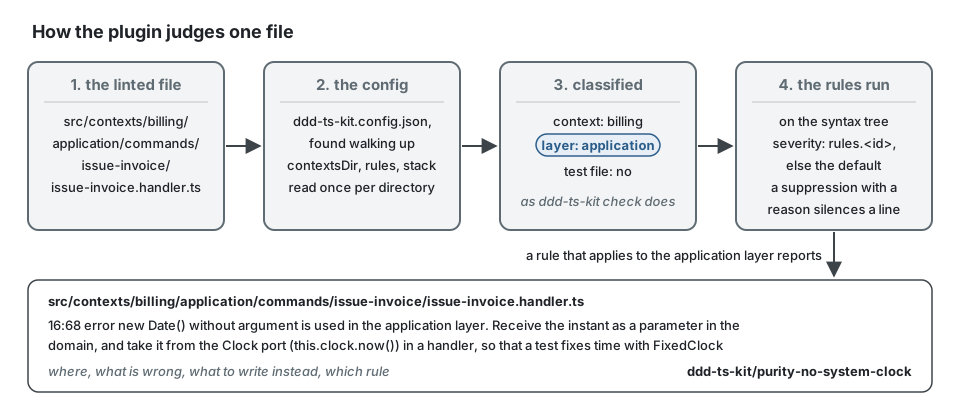
Every rule reads ddd-ts-kit.config.json (docs/CONFIG.md), found by
walking up from the linted file, and classifies the file into context and layer exactly like
ddd-ts-kit check does. It also reads stack.style there: see The two styles.
Install
npm i -D @ddd-ts-kit/eslint-plugin eslint @eslint/js typescript-eslint@stylistic/eslint-plugin (5.x) comes with the plugin as a dependency: the presets use it for the
layout rules, and nothing has to be installed for it.
Use
import { dddTsKit } from '@ddd-ts-kit/eslint-plugin';

export default dddTsKit({ tsconfigRootDir: import.meta.dirname });
dddTsKit(options) returns a complete flat config array:
| Layer of the config | Content |
|---|---|
| ddd-ts-kit/ignores | what is never linted: see ignores below |
| @eslint/js recommended | the baseline of ESLint |
| typescript-eslint strictTypeChecked and stylisticTypeChecked | with projectService (ddd-ts-kit/type-information), and without type checking on JavaScript files (ddd-ts-kit/javascript); strict and stylistic when typeChecked is false |
| ddd-ts-kit/clean-code | the standard rules backing section 6 of the architecture reference (below) |
| ddd-ts-kit/architecture | every rule of this plugin, at the severity of rules.<id> in ddd-ts-kit.config.json, else at its default, the two layout rules of @stylistic/eslint-plugin at the severity of rules."clean/blank-lines" and curly at the severity of rules."clean/braces" (default error) |
| ddd-ts-kit/scripts | curly on .js, .mjs and .cjs files, at the severity of rules."clean/braces": a branch reads the same in a script |
| ddd-ts-kit/inner-layers | no-param-reassign with props in domain/ and application/: no output argument |
| ddd-ts-kit/aggregates | prefer-readonly off in aggregates and entities, whose state is replaced by intention methods |
| ddd-ts-kit/tests | a lighter set on *.spec.ts, *.test.ts, the test/ directory of each context and the root test/: any and ! warn, the no-unsafe-* rules off, type assertions allowed |
| Option | Default | Meaning |
|---|---|---|
| tsconfigRootDir | the working directory | directory of the tsconfig and of ddd-ts-kit.config.json |
| typeChecked | true | add the rules that read types; false is faster and needs no tsconfig |
| allowDefaultProject | ['*.config.ts', '*.config.mts'] | files outside the tsconfig still linted with types |
| ignores | none | added to dist, coverage, node_modules, reports, *.d.ts, and clients/*/src when ddd-ts-kit.config.json has "sdk" (the clients the CLI generates) |
Blocks are applied in this order, and a later block wins for the files it matches. A block of your own goes after the helper:
import { dddTsKit } from '@ddd-ts-kit/eslint-plugin';

export default [
  ...dddTsKit({ tsconfigRootDir: import.meta.dirname, ignores: ['src/generated/**'] }),
  // a rule the kit does not enable: purity/no-environment refuses console in domain/ and application/ only
  { files: ['src/**/*.ts'], rules: { 'no-console': 'error' } },
];
To compose a config by hand, the plugin is the default export, with two presets that hold only
its own rules, the three typescript-eslint rules they delegate to, the two layout rules of
@stylistic/eslint-plugin and curly, without type information:
import dddTsKit from '@ddd-ts-kit/eslint-plugin';

export default [...dddTsKit.configs.recommended]; // or configs.strict: every rule at error
The standard rule sets of the helper are exported as standardRules (escapeHatch, cleanCode,
typedCleanCode, kitConventions, layout, braces). standardRules.braces holds curly for
clean/braces; standardRules.layout holds the two
@stylistic/* rules of clean/blank-lines at error; a config
composed by hand registers the plugin under @stylistic next to them:
import stylistic from '@stylistic/eslint-plugin';
import dddTsKit, { standardRules } from '@ddd-ts-kit/eslint-plugin';

export default [{ files: ['**/*.ts'], plugins: { 'ddd-ts-kit': dddTsKit, '@stylistic': stylistic }, rules: standardRules.layout }];
Changing a severity
The severity of a rule of the kit is written once, in ddd-ts-kit.config.json, where both
tools read it:
{
  "rules": {
    "clean/function-size": "error",
    "test/no-mocks": "off"
  }
}
// instead of: a severity in eslint.config.mjs, which `ddd-ts-kit check` never sees
export default [...dddTsKit(), { rules: { 'ddd-ts-kit/test-no-mocks': 'off' } }];"off" in the config silences the rule even where an ESLint config enables it. Raising a
severity is free; lowering one under its default (off, or warn for an error rule) is a
deviation, and ddd-ts-kit check asks for its decision record: see
Deviations.
A report, and what to write instead
Every message says what is wrong, what to write instead, and the rule. A handler that reads the
system clock, in src/contexts/billing/application/commands/issue-invoice/issue-invoice.handler.ts:
// instead of
import type { IdGenerator } from '@ddd-ts-kit/kernel';
import { Invoice } from '@/contexts/billing/domain/aggregates/invoice.aggregate.js';
import type { InvoiceRepository } from '@/contexts/billing/domain/repositories/invoice.repository.js';
import type { IssueInvoice } from '@/contexts/billing/application/commands/issue-invoice/issue-invoice.command.js';

export class IssueInvoiceHandler {
  constructor(
    private readonly invoices: InvoiceRepository,
    private readonly ids: IdGenerator,
  ) {}

  async execute(command: IssueInvoice): Promise<string> {
    const id = this.ids.next();

    await this.invoices.save(Invoice.issue(id, command.customerId, new Date()));

    return id;
  }
}
is reported, by npx eslint src:
src/contexts/billing/application/commands/issue-invoice/issue-invoice.handler.ts
  16:68  error  new Date() without argument is used in the application layer. Receive the instant as a parameter in the domain, and take it from the Clock port (`this.clock.now()`) in a handler, so that a test fixes time with FixedClock  ddd-ts-kit/purity-no-system-clock
The fix the message names: the Clock port, which a spec fixes with FixedClock.
import { AuthorizedCommand, Clock, IdGenerator, type Actor } from '@ddd-ts-kit/kernel';

// the command, the aggregate and its repository port, in their own files
declare class IssueInvoice extends AuthorizedCommand<string> {
  readonly customerId: string;
  constructor(actor: Actor, customerId: string);
}
declare class Invoice {
  static issue(id: string, customerId: string, issuedAt: Date): Invoice;
}
declare abstract class InvoiceRepository {
  abstract save(invoice: Invoice): Promise<void>;
}

// write: the instant comes from a port
export class IssueInvoiceHandler {
  constructor(
    private readonly invoices: InvoiceRepository,
    private readonly clock: Clock,
    private readonly ids: IdGenerator,
  ) {}

  async execute(command: IssueInvoice): Promise<string> {
    const id = this.ids.next();

    await this.invoices.save(Invoice.issue(id, command.customerId, this.clock.now()));

    return id;
  }
}
When the code is right and the rule is not, the deviation is recorded, not hidden: see the suppression comment in Settings.
Rules
Ids are those of docs/ARCHITECTURE.md; the ESLint name replaces the
slash by a dash (one exception: clean-function-ceiling, the part of clean/function-size that
is an error whatever the configured limit). strict sets every rule to error.
| Id | ESLint name | Holds | Default | Implementation |
|---|---|---|---|---|
| layer/domain-purity | ddd-ts-kit/layer-domain-purity | domain/ imports only its own domain, the shared kernel and the allowed packages; never @ddd-ts-kit/aspects, audit, redis, scheduling, sentry or tracing, even allowed, nor @ddd-ts-kit/kernel/declarations in the declared style | error | custom |
| layer/application-inward | ddd-ts-kit/layer-application-inward | application/ never imports infrastructure/, presentation/, a framework, a driver or a package applying a concern from outside (@ddd-ts-kit/aspects, audit, redis, scheduling, sentry, tracing); @ddd-ts-kit/kernel/declarations is always allowed in the declared style | error | custom |
| layer/presentation-no-infrastructure | ddd-ts-kit/layer-presentation-no-infrastructure | presentation/ never imports infrastructure/ | error | custom |
| layer/infrastructure-no-presentation | ddd-ts-kit/layer-infrastructure-no-presentation | infrastructure/ never imports presentation/ | error | custom |
| context/published-language-only | ddd-ts-kit/context-published-language-only | another context is imported only through its published-language/ | error | custom |
| context/declared-relationship | ddd-ts-kit/context-declared-relationship | such an import needs the upstream declared in the config | error | custom |
| context/published-language-is-a-contract | ddd-ts-kit/context-published-language-is-a-contract | published-language/ imports only its allow-list and other published languages | error | custom |
| language/declared-vocabulary | ddd-ts-kit/language-declared-vocabulary | a value of a closed vocabulary the project declares (an object as const with the union type of its name, a permission set) is read through it, never written again as a string, under "stack.literals": "named"; tests and published languages excluded | error | custom |
| naming/business-name | ddd-ts-kit/naming-business-name | a variable, parameter, property, destructured or loop binding of domain/, application/ and the shared kernel is named after its concept, never target, data, item or another generic word (words, allow, businessNames of the config); fixable where the initializer names the concept | error | custom |
| purity/no-system-clock | ddd-ts-kit/purity-no-system-clock | no new Date(), Date.now(), Date(), performance.now() in domain/ and application/ | error | custom |
| purity/no-ambient-randomness | ddd-ts-kit/purity-no-ambient-randomness | no Math.random, crypto.randomUUID, id library in domain/ and application/ | error | custom |
| purity/no-environment | ddd-ts-kit/purity-no-environment | no process.env, console, fetch, file system or network module in domain/ and application/ | error | custom |
| clean/stepdown | ddd-ts-kit/clean-stepdown | static factories, public members, then private ones; a function above the functions it calls | error | custom |
| clean/function-size | ddd-ts-kit/clean-function-size | at most 3 parameters (constructors exempt) and 30 lines of code (configurable, never above 100) | warn | custom |
| clean/function-size (ceiling) | ddd-ts-kit/clean-function-ceiling | no function longer than 100 lines of code, describe callbacks and module files included | error | custom |
| clean/no-flag-argument | ddd-ts-kit/clean-no-flag-argument | no boolean parameter on a public method of the domain or on execute | warn | custom |
| clean/no-commented-out-code | ddd-ts-kit/clean-no-commented-out-code | no comment that parses as code | error | custom |
| clean/no-noise-comment | ddd-ts-kit/clean-no-noise-comment | no banner, journal, closing-brace label, empty tag, ownerless TODO, comment repeating a name | warn | custom |
| clean/no-escape-hatch | ddd-ts-kit/clean-no-escape-hatch | no type assertion outside mappers, infrastructure and the declared adapterGlobs, no eslint-disable without reason | error | custom, plus 3 standard rules (below) |
| clean/no-hash-private | ddd-ts-kit/clean-no-hash-private | a class member is private, never #name; fixable | error | custom |
| clean/one-export-per-file | ddd-ts-kit/clean-one-export-per-file | one exported class, interface or function per source file, with the types of its signature, the file named after it; entry files only re-export | error | custom |
| clean/file-size | ddd-ts-kit/clean-file-size | no file over 350 lines, tests included | error | custom |
| clean/no-magic-number | ddd-ts-kit/clean-no-magic-number | no number literal in domain/ and application/ but 0, 1, -1, an index, a type and the initializer of a module constant or a static readonly, under "stack.literals": "named" | error | custom |
| clean/blank-lines | two @stylistic/* rules (standardRules.layout) | a blank line before every return and between logical blocks, around a method; fixable | error | standard |
| clean/braces | curly (standardRules.braces) | every if, else, for, while and do has braces; fixable | error | standard |
| clean/formatted | none: Biome (npm run format:check) | every file is laid out by the formatter, at a line width of 120 | none | formatter |
| domain/aggregate-encapsulation | ddd-ts-kit/domain-aggregate-encapsulation | aggregates and entities: no public constructor, no public mutable property, no setter | error | custom |
| domain/value-object-immutability | ddd-ts-kit/domain-value-object-immutability | value objects: every property readonly, no setter, no write to this | error | custom |
| domain/value-object-class | ddd-ts-kit/domain-value-object-class | under "stack.values": "classes": a value object file exports one class extending ValueObject, private or protected constructor, static factories, no function nor object literal; no exported function of domain/ or of the shared kernel answers a record of data | error | custom |
| domain/no-generic-error | ddd-ts-kit/domain-no-generic-error | no throw new Error(...) in domain/ and application/ | error | custom |
| errors/through-factory | ddd-ts-kit/errors-through-factory | under "stack.refusals": "factories", no new of a class imported from domain/errors/: a refusal is built by a static factory of its concept class | error | custom |
| errors/constructor-not-public | ddd-ts-kit/errors-constructor-not-public | under "stack.refusals": "factories", an error class of domain/errors/ has no public constructor, declared or inherited from DomainError | error | custom |
| errors/factory-name | ddd-ts-kit/errors-factory-name | under "stack.refusals": "factories", a factory is not named create, make, of or error1, and its code is its name in constant case, alone or with the name of the concept | error | custom |
| application/handler-shape | ddd-ts-kit/application-handler-shape | a *.handler.ts exports one class whose single public method is execute | error | custom |
| presentation/controller-shape | ddd-ts-kit/presentation-controller-shape | a *.controller.ts carrying @Controller exports one class whose single public method is handle | error | custom |
| presentation/controller-delegates | ddd-ts-kit/presentation-controller-delegates | a controller is given the bus of its method, a request mapper and a serializer, nothing else | error | custom |
| presentation/guard-at-the-edge | ddd-ts-kit/presentation-guard-at-the-edge | a *.guard.ts imports nothing from domain/ or infrastructure/, no repository, no unit of work, no command bus | error | custom |
| presentation/shared-cache-varies | ddd-ts-kit/presentation-shared-cache-varies | a public cache policy of a route, a controller or a route group that knows its caller names in vary what its answer depends on | error | custom |
| application/command-query-separation | ddd-ts-kit/application-command-query-separation | nothing under application/queries calls save, delete, publish on a dependency | warn | custom |
| domain-events/dispatched-on-save | ddd-ts-kit/domain-events-dispatched-on-save | no pullEvents() in application/ and infrastructure/; no DomainEventDispatcher imported, listed as a dependency or received by a constructor in application/commands, application/queries and a repository adapter | error | custom |
| domain-events/transactional-before-commit | ddd-ts-kit/domain-events-transactional-before-commit | a class carrying @DomainEventHandler without phase: 'after-commit' depends on no Cache, Lock, RateLimiter, JobScheduler or EventBus of the kernel and on nothing imported from infrastructure/, another context, the platform or a package other than @ddd-ts-kit/kernel and @ddd-ts-kit/auth; an after-commit handler does not depend on IntegrationEventPublisher. The adapters of an application/ports/ port and the phase of an explicit-style handler are held by the CLI checker | error | custom |
| event-sourcing/state-in-apply | ddd-ts-kit/event-sourcing-state-in-apply | an event-sourced aggregate changes its state only in its apply methods (apply<Fact>, restore), and an apply method records no event | error | custom |
| event-sourcing/past-tense | ddd-ts-kit/event-sourcing-past-tense | the events an event-sourced aggregate imports from domain/events/ are named in the past tense | error | custom |
| event-sourcing/store-behind-repository | ddd-ts-kit/event-sourcing-store-behind-repository | no EventStore, SnapshotStore, CheckpointStore, EventSourcedRepository, EventSerializer, CatchUpSubscription in domain/ and application/: the aggregate goes through its repository | error | custom |
| event-sourcing/projection-never-appends | ddd-ts-kit/event-sourcing-projection-never-appends | a projection names no event store, and one fed by the store no repository: it never appends to a stream | error | custom |
| event-sourcing/upcaster-required | ddd-ts-kit/event-sourcing-upcaster-required | defineStoredEvent names the type of its data, declared in the file, and a version above 1 has an upcaster from each version below (the lock of recorded shapes: ddd-ts-kit check) | error | custom |
| test/no-mocks | ddd-ts-kit/test-no-mocks | no vi.mock, vi.fn, vi.spyOn, their jest twins or a mocking library in a context's tests | warn | custom |
| events/name-format | ddd-ts-kit/events-name-format | event names follow <context>.<aggregate>.<fact> in kebab-case | error | custom |
| events/outbox-required | ddd-ts-kit/events-outbox-required | no broker client and no concrete bus in domain/ and application/; a publisher depends on the IntegrationEventPublisher port | error | custom |
| events/consumer-idempotent | ddd-ts-kit/events-consumer-idempotent | a consumer is declared with a consumer name and a processed-event store, never by a bare subscribe; in the declared style @IntegrationEventHandler writes its consumer as a string literal | error | custom |
| context/extractable | ddd-ts-kit/context-extractable | no schema or table of another context, no exported mutable state, nothing of another context wired in the module and, in the declared style, no port of another context imported by a role file | error | custom |
| authz/declared | ddd-ts-kit/authz-declared | a registered command or query says .requires(...) or .public(), or its class carries @Requires or @Public (required on every message of the declared style), a route declares security, an authorized message forwards its actor | error | custom |
| authz/in-application | ddd-ts-kit/authz-in-application | no role test in presentation/, no authorization in infrastructure/, no actor, session, execution context or rights in domain/; in the declared style Requires, Public, Policy and the Access port stay in application/ | error | custom |
| authz/actor-explicit | ddd-ts-kit/authz-actor-explicit | no ExecutionScope, ActorContext (type or value: the class is the token) or AsyncLocalStorage, no read of the ambient context, no stampCreation, stampUpdate or tenantScopeOf in domain/ and application/ | error | custom |
| authz/fields-by-schema | ddd-ts-kit/authz-fields-by-schema | no test on the roles of the actor, comparison with a role or isAdmin under application/queries/: a field reserved to some callers is marked with withFieldAccess | error | custom |
| aspects/outside-in | ddd-ts-kit/aspects-outside-in | @ddd-ts-kit/aspects/decorators is imported only in infrastructure/ and in the platform | error | custom |
| tracing/platform-only | ddd-ts-kit/tracing-platform-only | @ddd-ts-kit/tracing and @opentelemetry/* are imported only by the platform directory, main.ts and apps/ | error | custom |
| standard/no-parallel-interface | ddd-ts-kit/standard-no-parallel-interface | no declared ILogger, UserContext, PaginatedResult, CronJob, ErrorTracker and the like next to the standard interfaces of the kernel (standardInterfaces in the config) | warn | custom |
| governance/recorded-deviation | ddd-ts-kit/governance-recorded-deviation | every suppression names its rules and points to ADR-<number> after -- | error | custom |
| declarations/role-declared | ddd-ts-kit/declarations-role-declared | declared style only: a role file exports a class carrying the decorator of its role, the consumer and name of a declaration are string literals, domain/ carries no declaration decorator | error | custom |
| declarations/constructor-injection | ddd-ts-kit/declarations-constructor-injection | declared style only: a class whose decorator lists no dependency types each constructor parameter by one class, with no ?, default value, rest or destructuring; under stack.dependencies: signature a decorator carries no list (a list that repeats the constructor is removed by the fix, one that differs is reported) | error | custom |
| ports/abstract-class | ddd-ts-kit/ports-abstract-class | a port (domain/repositories/*.repository.ts, application/ports/*.port.ts) is an abstract class with abstract members only, never an interface | error | custom |
| ports/implements-never-extends | ddd-ts-kit/ports-implements-never-extends | an adapter (@Repository, @Gateway, @Adapter, bind(Port).toClass(Class)) implements its port and never extends it | error | custom |
| ports/no-token-constant | ddd-ts-kit/ports-no-token-constant | a dependency is named by its port class: no token helper, symbol, string or constant, no token file | error | custom |
| ports/no-concrete-dependency | ddd-ts-kit/ports-no-concrete-dependency | a dependency list names nothing imported from infrastructure/ or test/fakes/, and no constructor parameter of a declared class that lists nothing is typed by such a class | error | custom |
| ports/value-import | ddd-ts-kit/ports-value-import | a port named in a dependency list or given to bind is not a type-only import; fixable | error | custom |
| scheduling/job-triggers-use-case | ddd-ts-kit/scheduling-job-triggers-use-case | a job lives in application/scheduling/*.job.ts, implements ScheduledJob, sends a command, and touches neither a repository nor the model | error | custom |
| scheduling/job-name | ddd-ts-kit/scheduling-job-name | a job is named <context>.<job-name> by a string literal, and its systemActor carries that name | error | custom |
| lifecycle/status-through-machine | ddd-ts-kit/lifecycle-status-through-machine | in an aggregate that imports its state machine, the status is written only from the machine (next, start) or copied from a status already read | error | custom |
| process/sends-commands-only | ddd-ts-kit/process-sends-commands-only | a process manager of application/processes/ imports no aggregate, entity, repository, domain service, port or infrastructure: it changes the world through the commands it decides | error | custom |
| schema/presentation-only | ddd-ts-kit/schema-presentation-only | under stack.schemas: shared, a schema of the HTTP contract lives in presentation/ of its context or of the shared kernel: the shared kernel imports no validation library outside presentation/, and no domain, application, infrastructure or published language imports a file of presentation/ of the shared kernel | error | custom |
| imports/alias-only | ddd-ts-kit/imports-alias-only | a file of the project is imported by its alias (@/..., $test/..., $scripts/...), never by a relative path, the same directory included; no . or .. segment in an alias path; fixable | error | custom |
| imports/extension | ddd-ts-kit/imports-extension | an import of a file of the project ends as importExtension of the config says: no extension under none, .js under js; fixable | error | custom |
domain/* and application/* ids are added by this plugin: the shape of a class needs a syntax
tree, so the CLI checker has no equivalent. The domain-events/* ids are not among them: both tools
hold them, and of domain-events/transactional-before-commit the checker alone holds what one file
does not show (where the adapters of an application/ports/ port live, the phase an explicit-style
module file registers a handler in).
The two styles
stack.style in ddd-ts-kit.config.json says how the contexts of the project are written:
explicit, every binding is written in <context>.module.ts; declared, each class says what
it is with a decorator of @ddd-ts-kit/kernel/declarations and there is no module file. A
config that does not say is explicit, and an explicit-style project is judged exactly as before
the declared style existed.
| Rule | Added in a declared-style project |
|---|---|
| authz/declared | an exported class of a *.command.ts or *.query.ts file carries @Requires(...) or @Public() |
| authz/in-application | Requires, Public and Policy are not imported in presentation/ or infrastructure/, nor the ports Access and PolicyAccess in infrastructure/ |
| layer/application-inward | @ddd-ts-kit/kernel/declarations is allowed whatever applicationAllowedPackages says |
| layer/domain-purity | @ddd-ts-kit/kernel/declarations is refused in domain/ |
| events/consumer-idempotent | @IntegrationEventHandler writes its consumer as a non-empty string literal |
| context/extractable | a role file imports nothing from a port file of another context |
| declarations/role-declared | the whole rule |
One thing holds in both styles: a message class carrying @Requires or @Public is declared,
so a module that registers it without .requires(...) or .public() is not reported.
A decorator is read from the syntax tree and counts when its name is imported from
@ddd-ts-kit/kernel/declarations in the file, under an alias ({ Repository as Repo }) or a
namespace (declarations.Repository) too. Two checks look at a class of another file (the
message a module registers, the class given to toClass): the import is resolved
like any other, the file is read from disk and parsed without types, and nothing is concluded
when it cannot be. stack.assembly (barrel or discovery) is read with the style; no rule of
this plugin depends on it, since the barrel is a fact of the project that ddd-ts-kit check
holds (declarations/barrel-current).
Standard rules instead of custom ones
Where a standard rule fully covers a part of the architecture reference, the presets enable it and this plugin does not reimplement it.
| Architecture reference | Standard rule | Enabled by |
|---|---|---|
| clean/no-escape-hatch: explicit any | @typescript-eslint/no-explicit-any | recommended, strict, dddTsKit() |
| clean/no-escape-hatch: non-null assertion | @typescript-eslint/no-non-null-assertion | recommended, strict, dddTsKit() |
| clean/no-escape-hatch: @ts-ignore, @ts-nocheck, undescribed @ts-expect-error | @typescript-eslint/ban-ts-comment | recommended, strict, dddTsKit() |
| section 6, command or query and promises | @typescript-eslint/no-floating-promises, no-misused-promises | dddTsKit() with types |
| section 6, specific errors, exhaustive decisions | @typescript-eslint/switch-exhaustiveness-check, no-unnecessary-condition | dddTsKit() with types |
| section 6, immutability | @typescript-eslint/prefer-readonly | dddTsKit() with types |
| section 6, types | @typescript-eslint/consistent-type-imports | dddTsKit() |
| section 6, small functions | complexity (10, warn), max-depth (3, warn), no-else-return | dddTsKit() |
| section 6, no output argument | no-param-reassign (props in domain/ and application/) | dddTsKit() |
| section 6, no surprise | eqeqeq | dddTsKit() |
| section 6, layout (clean/blank-lines) | @stylistic/padding-line-between-statements, lines-between-class-members | recommended, strict, dddTsKit() |
| section 6, layout (clean/braces) | curly (all) | recommended, strict, dddTsKit() |
max-params, max-lines-per-function and max-lines are deliberately not enabled:
clean-function-size exempts constructors and module files and reads limits from the config,
clean-file-size exempts generated files, which the standard rules cannot do, and both would
report the same thing twice. Layout is the opposite case: clean/blank-lines is entirely held by
@stylistic/eslint-plugin and clean/braces by curly, and this plugin writes no rule for them.
Where a token goes (indentation, quotes, line breaks, the padding of a block) is not linted at
all: the formatter of the project, Biome, owns it (clean/formatted), and no @stylistic rule
that would fight it is enabled.
Where the kit and typescript-eslint strict disagree
dddTsKit() changes ten strict rules, each for a stated reason, so that freshly generated code
is not reported for following the conventions of the kit:
| Rule | Setting | Reason |
|---|---|---|
| require-await | off | a port is asynchronous by contract; an in-memory adapter has nothing to await |
| no-unnecessary-type-arguments | off | the id type of an aggregate is part of its declaration |
| consistent-type-definitions | off | props are type aliases, states and options are interfaces |
| no-empty-object-type | interfaces allowed | interface SessionExtensions {} is left open for declaration merging |
| no-extraneous-class | empty classes and decorated classes allowed | a domain service or a fake starts empty; a class that carries a decorator is a declaration, whatever its body |
| no-unused-vars | args: 'none' | an adapter implements the whole signature of its port |
| dot-notation | index signatures allowed | process.env['PORT'] |
| no-confusing-void-expression, restrict-template-expressions, restrict-plus-operands | arrow shorthand, numbers and booleans allowed | not coercion bugs |
Settings
settings['ddd-ts-kit'] replaces what is read from disk, for tests and editors:
| Key | Meaning |
|---|---|
| config | the content of ddd-ts-kit.config.json, as an object |
| rootDir | the project root, when config is given (default: the working directory) |
| filename | posix path relative to the root, used instead of the real file name |
ruleTester.run('layer-domain-purity', rule, {
  valid: [],
  invalid: [
    {
      code: "import { z } from 'zod';",
      settings: { 'ddd-ts-kit': { config: {}, filename: 'src/contexts/billing/domain/aggregates/invoice.aggregate.ts' } },
      errors: [{ messageId: 'package' }],
    },
  ],
});
The config file is read once per directory and per process: restart the ESLint server of the
editor after changing ddd-ts-kit.config.json.
Two things work as with the CLI checker: rules.<id>: "off" in the config silences the rule
even when the ESLint config enables it, and // ddd-ts-kit-disable-next-line <id> -- <reason>
silences one line for both tools. A suppression without a reason silences nothing, and
governance/recorded-deviation asks that the reason point to a decision record (ADR-<number>):
// instead of: a reason that points to no decision
// ddd-ts-kit-disable-next-line clean/no-flag-argument -- kept for now
cancel(force: boolean): void {
12:3 error `ddd-ts-kit-disable-next-line clean/no-flag-argument` on line 12 silences a rule without pointing to a decision. Fix the diagnostic; if the deviation is deliberate, record it with `ddd-ts-kit generate adr` (reason, scope, condition for removing it) and end the comment with `-- ADR-<number>: <reason>` ddd-ts-kit/governance-recorded-deviation// write: the decision record says why, for what scope and until when
// ddd-ts-kit-disable-next-line clean/no-flag-argument -- ADR-0007: the legacy import sends a flag until 2027
cancel(force: boolean): void {The id is the one of the architecture reference (clean/no-flag-argument), not the ESLint name,
and npx ddd-ts-kit generate adr writes the record. eslint-disable comments are held the same
way, by clean/no-escape-hatch and governance/recorded-deviation.
With ddd-ts-kit check
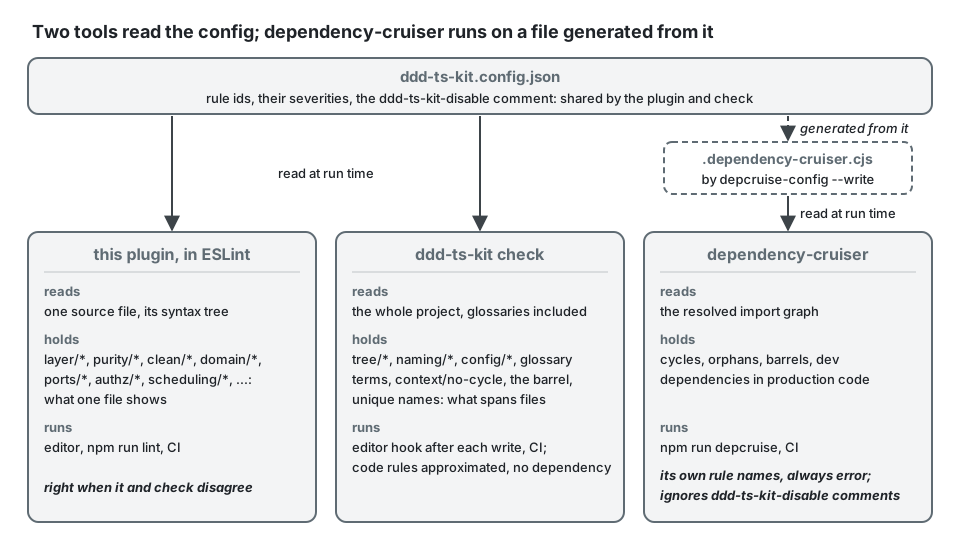
Two tools, one set of ids, no overlap of authority. A third, dependency-cruiser, does not read the config: it runs on a file generated from it, with its own rule names.
| Concern | Authority | Why |
|---|---|---|
| imports and boundaries (layer/*, context/published-language-only, context/declared-relationship, context/published-language-is-a-contract), purity/*, clean/*, test/no-mocks, events/name-format, domain/*, application/*, the code side of events/outbox-required, events/consumer-idempotent, context/extractable, authz/*, aspects/outside-in, tracing/platform-only, domain-events/dispatched-on-save, domain-events/transactional-before-commit on a declared class, event-sourcing/* (but the lock of event-sourcing/upcaster-required), standard/no-parallel-interface, declarations/role-declared, ports/*, scheduling/* (but the uniqueness of job names), language/declared-vocabulary, errors/through-factory, errors/constructor-not-public, errors/factory-name, presentation/*, lifecycle/*, process/*, schema/presentation-only, imports/alias-only, imports/extension and governance/recorded-deviation | this plugin | it reads the syntax tree: no false positive from a string or a comment, shadowing and arrow functions are understood |
| the tree (tree/closed, tree/context-doc), names and files (naming/* but the code side of naming/business-name, which this plugin reads on the syntax tree and fixes, test/spec-required, test/builder-required), the language (language/glossary-term, language/no-technical-name), error codes (errors/code-unique, errors/known-code), imports/alias-declared, schema/no-duplicate-shape, the config (config/*, context/no-cycle), events/defined-in-published-language, composition/only-in-module, declarations/barrel-current, unique consumer names and job names, one declared class per role file, of domain-events/transactional-before-commit the adapters of an application/ports/ port and the phase of an explicit-style handler, the config side of the ids above (stack.events, lowered severities, that a decision record exists) | ddd-ts-kit check | they judge the project, the glossary and files that are not sources; ESLint judges one source at a time |
| the real dependency graph (barrels, cycles, orphans, dev dependencies in production code) | dependency-cruiser, configured by the .dependency-cruiser.cjs that ddd-ts-kit depcruise-config --write generates from the config | it resolves modules instead of classifying paths |
The CLI keeps approximating the code-level rules with regular expressions, without dependency: it is the guard that runs in an editor hook after each write. When both report the same id, fix the code once; when they disagree, this plugin is right and the checker is to be fixed. A test of this package pins the classification of files and imports against the CLI on the same sample paths.
TypeScript 7
typescript-eslint needs the JavaScript API of the compiler, which the native TypeScript 7 does
not ship (typescript-eslint 8.71 requires typescript <6.1). Keep both:
{
  "devDependencies": {
    "typescript": "~6.0.3",
    "@typescript/native": "npm:typescript@~7.0.2"
  },
  "scripts": {
    "typecheck": "node node_modules/@typescript/native/bin/tsc -p tsconfig.json --noEmit",
    "lint": "eslint ."
  }
}
typescript 6 serves the tools that read sources through the compiler API (ESLint,
dependency-cruiser); the native 7 compiles and type-checks. Call the native compiler by its
path: both packages declare a tsc binary and npx tsc picks one of them.
Development
node node_modules/@typescript/native/bin/tsc -b packages/eslint-plugin
npx vitest run packages/eslint-plugin
Rules are tested with @typescript-eslint/rule-tester wired to Vitest
(test/support/rule-tester.ts). A rule comes with valid and invalid cases, a message that says
what to do instead, and a page in docs/rules/. The package is held by its own rules through the
root eslint.config.mjs: one export per file, files named after their export, the layout rules.