
@ddd-ts-kit/nats
v0.19.0
Published
NATS JetStream provider for integration events: acknowledged publishing with message deduplication for the outbox relay, one durable consumer per consumer, explicit acknowledgement, bounded redelivery and a dead-letter subject.

Maintainers
 gbourgeat
Readme
English · Français
@ddd-ts-kit/nats
The integration event provider for NATS JetStream: an EventBus of the kernel that publishes
to a stream and waits for its acknowledgement, with the event id as message id so the stream
drops a relay retry, and consumes from one durable pull consumer per consumer and event type
with explicit acknowledgement, a bounded number of delayed redeliveries and a dead-letter
stream. It is the JetStream equivalent of the "queue brokers" row of the strategy table of
docs/ARCHITECTURE.md, and it passes eventBusContract of @ddd-ts-kit/testing.
npm i @ddd-ts-kit/nats @ddd-ts-kit/events @nats-io/transport-node @nats-io/jetstreamTested with @nats-io/transport-node and @nats-io/jetstream 3.4 against NATS Server 2.15
started with -js, on Node 24. Core NATS has no persistence: only JetStream fits the ports.
The client
The modular client of the NATS project: @nats-io/transport-node for the connection,
@nats-io/jetstream for streams and consumers. Both are at 3.4.0 (published 2026-05-13),
pure JavaScript, 1.7 MB installed with their three dependencies, without install script, and
downloaded about 400 000 and 300 000 times a week. The legacy nats package (2.29) still
receives fixes, but it is the previous line of the client; nothing made it necessary.
Composition root
Handlers never see this package. They publish to the outbox; the relay publishes to NATS;
each consuming context listens through the bus under its own name. The bus is given to the
application as two ports of the kernel: IntegrationEventPublisher stays the outbox, and
EventSubscribers hands each context the subscriber of its own consumer name.
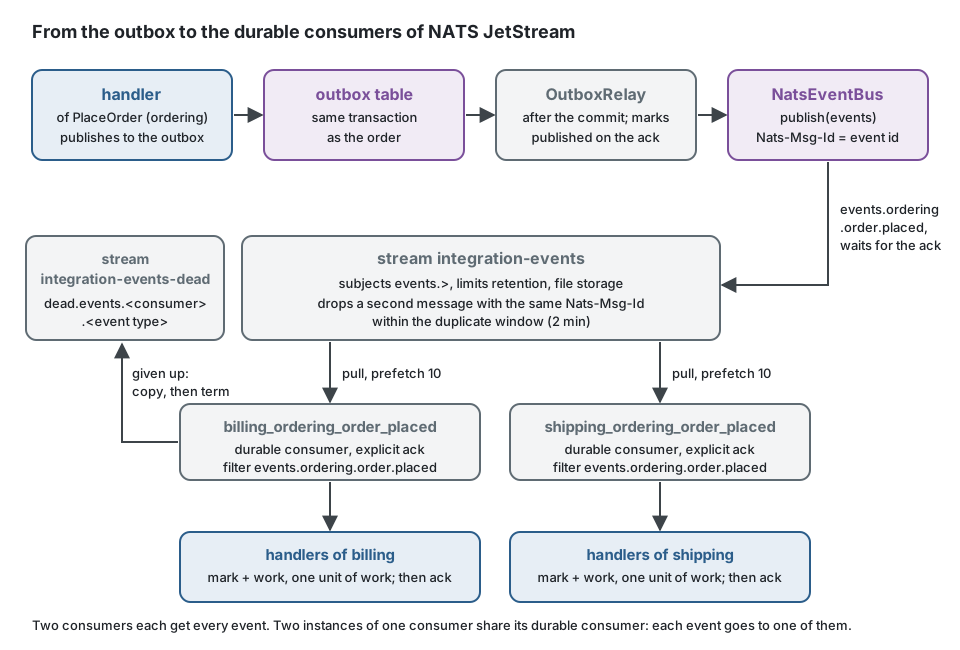
init --broker nats writes this wiring in the platform of the project: the bus is built by
platform/events/create-event-provider.ts, platform/platform.module.ts rebinds
EventSubscribers on it, and main.ts gives it, traced, to the outbox relay. By hand, the
same thing reads:
// platform/messaging.module.ts
import { defineContextModule } from '@ddd-ts-kit/di';
import { EventSubscribers, IntegrationEventPublisher, type Logger, type Metrics } from '@ddd-ts-kit/kernel';
import { OutboxPublisher, OutboxStore } from '@ddd-ts-kit/events';
import { NatsEventBus } from '@ddd-ts-kit/nats';

declare const config: { readonly natsUrl: string };
declare const logger: Logger;
declare const metrics: Metrics;

export const bus = new NatsEventBus({
  connection: config.natsUrl, // or a list, or options of the client, or a factory opening a new connection
  stream: 'integration-events', // the default
  subjectPrefix: 'events', // the default: events go to events.<event type>
  replicas: 3, // default 1
  retry: { maxAttempts: 5, delayMs: 5_000 }, // the defaults
  prefetch: 10, // the default
  onFailure: (failure) => logger.warn('event bus failure', { ...failure }), // codes only, never an error message
  // The label `outcome` of the kernel is success or failure: the four outcomes of a delivery take another name.
  onDelivery: ({ consumer, outcome }) => metrics.counter('event_deliveries_total').increment({ consumer, status: outcome }),
});

export const messagingModule = defineContextModule({
  name: 'messaging',
  register(builder) {
    // Publishing side: handlers write to the outbox, in the transaction of the command.
    builder.rebind(IntegrationEventPublisher).toClass(OutboxPublisher, [OutboxStore]);
    // Consuming side: one subscriber per consuming context, named after it.
    builder.rebind(EventSubscribers).toValue({ forContext: (name) => bus.forConsumer(name) });
  },
});
import { Command, CommandBus, systemActor, type Actor, type IntegrationEvent } from '@ddd-ts-kit/kernel';
import { IntegrationEventHandler } from '@ddd-ts-kit/kernel/declarations';
import { defineIntegrationEvent, type PayloadOf } from '@ddd-ts-kit/events';
import { zodSchema } from '@ddd-ts-kit/validation/zod';
import { z } from 'zod';
// contexts/ordering/published-language: the contract billing listens to.
export const orderPlaced = defineIntegrationEvent({
type: 'ordering.order.placed',
version: 1,
payload: zodSchema(z.object({ orderId: z.string() })),
});
// contexts/billing/application/commands/issue-invoice/issue-invoice.command.ts
export class IssueInvoice extends Command {
constructor(
readonly actor: Actor,
readonly orderId: string,
) {
super();
}
}
// contexts/billing/application/integration/handlers/invoice-on-order-placed.integration-handler.ts
@IntegrationEventHandler(orderPlaced, { consumer: 'billing.invoice-on-order-placed' })
export class InvoiceOnOrderPlacedIntegrationHandler {
constructor(private readonly commands: CommandBus) {}
// Nobody is calling: the handler acts as a system actor named after its consumer.
readonly actor = systemActor('billing.invoice-on-order-placed');
async handle(event: IntegrationEvent<PayloadOf<typeof orderPlaced>>): Promise<void> {
await this.commands.execute(new IssueInvoice(this.actor, event.payload.orderId));
}
}// main.ts
import { contextModule, createApplication, kernelModule, type ContextModule, type DeclaredSource } from '@ddd-ts-kit/di';
import { Clock } from '@ddd-ts-kit/kernel';
import { OutboxRelay, OutboxStore } from '@ddd-ts-kit/events';
import type { NatsEventBus } from '@ddd-ts-kit/nats';
// In a project: import { bus, messagingModule } from '@/platform/messaging.module';
declare const bus: NatsEventBus;
declare const messagingModule: ContextModule;
declare const persistenceModule: ContextModule;
declare const orderingDeclarations: DeclaredSource;
declare const billingDeclarations: DeclaredSource;
const app = createApplication({
modules: [
kernelModule(),
persistenceModule,
messagingModule,
contextModule('ordering', orderingDeclarations),
contextModule('billing', billingDeclarations),
],
});
// The relay target is the bus. A record is marked published when the stream acknowledged it.
const relay = new OutboxRelay({ store: app.resolve(OutboxStore), publisher: bus, clock: app.resolve(Clock) });
await app.start(); // subscribes the handler of billing on bus.forConsumer('billing')
await bus.assertTopology(); // fail at startup, not at the first message
relay.start({ intervalMs: 500 });
process.on('SIGTERM', async () => {
await relay.stop(); // the tick in progress finishes
await app.stop(); // the handlers are unsubscribed
await bus.close(); // consumers stop, handlers in progress finish and acknowledge
});persistenceModulebindsOutboxStore, and rebindsUnitOfWorkandProcessedEventStoreto the database: see the README of the persistence adapter. A declared integration event handler is subscribed on the subscriber of its own context (forContextreceives the name of its module), and sinceUnitOfWorkandProcessedEventStoreare bound, its idempotency mark and its work commit in one unit of work: a redelivery is deduplicated, a failure leaves nothing behind.- Without an outbox the bus is the event bus of the kernel module, and handlers publish
straight to the broker:
kernelModule({ eventBus: bus, eventSubscribers: () => ({ forContext: (name) => bus.forConsumer(name) }) }). - Without a container the same objects are wired by hand:
bus.forConsumer('billing')is anIntegrationEventSubscriber, to give tosubscribeAllandconsumeof@ddd-ts-kit/events. A bus built without theconsumeroption has no name to give its durable consumers, sobus.subscribe(...)throwsConsumerNameRequiredError: name the consuming context instead.
import { consume, defineIntegrationEvent, subscribeAll } from '@ddd-ts-kit/events';
import type { ProcessedEventStore, UnitOfWork } from '@ddd-ts-kit/kernel';
import { NatsEventBus } from '@ddd-ts-kit/nats';
import { zodSchema } from '@ddd-ts-kit/validation/zod';
import { z } from 'zod';

declare const processed: ProcessedEventStore; // the store of the persistence adapter
declare const unitOfWork: UnitOfWork; // the transaction of the database
declare function issueInvoice(orderId: string): Promise<void>;

const orderPlaced = defineIntegrationEvent({
  type: 'ordering.order.placed',
  version: 1,
  payload: zodSchema(z.object({ orderId: z.string() })),
});

const bus = new NatsEventBus({ connection: 'nats://127.0.0.1:4222' });

// Instead of: bus.subscribe(orderPlaced.type, handler), which throws ConsumerNameRequiredError here.
// Write: the subscriber of one consuming context, whose name its durable consumers carry.
export const billing = subscribeAll(bus.forConsumer('billing'), [
  consume(orderPlaced, { consumer: 'billing.invoice-on-order-placed', processed, unitOfWork }, async (event) => {
    await issueInvoice(event.payload.orderId);
  }),
]);

await bus.assertTopology(); // creates billing_ordering_order_placed, then consumespublish(events)resolves only when the stream acknowledged every message of the batch as stored and rejects otherwise (PUBLISH_NOT_ACKNOWLEDGED,BROKER_UNAVAILABLE,EVENT_BUS_CLOSED). Nothing is buffered for later: the outbox is the buffer.- Each message carries the header
Nats-Msg-Id= the event id. The stream drops a second message with the same id inside its duplicate window (duplicateWindowMs, two minutes by default, set when the stream is created) and still acknowledges it: a relay that retries a publication whose acknowledgement was lost does not create a second message. The window covers a retry, not a replay hours later: consumers still deduplicate. - A consumer name is required to subscribe:
bus.forConsumer('billing')gives anIntegrationEventSubscriberfor one context on the shared connection (a modular monolith has several), and theconsumeroption names the onebus.subscribeworks for (a service that is a single context). - Tracing is put around both sides from outside, as with any provider:
tracedPublisher(bus)as the relay target, and on the consuming side the instrumentation of the kernel module (kernelModule({ instrumentation: traceApplication() })), which gives each declared handler one spanprocess <consumer>per attempt.tracedSubscriber(bus.forConsumer(name))is for a composition withoutkernelModule. The bus carriestraceparentandcorrelationIduntouched, in the envelope and in the message headers. - The correlation makes the round trip. Publish through
scopedPublisher(publisher, scope)of the kernel: a declared handler (orconsume(definition, { ..., scope }, handler)by hand, or a callback wrapped withinEventScope) runs in an execution context whosecorrelationIdis the one of the request that published, whosecausationIdis the event, and a redelivery runs in the same one. - A context extracted to its own service keeps its consumer name and so its durable consumers: nothing changes on the server.
Topology
bus.describeTopology() returns the streams and the durable consumers as data, for a review
or a generated document; bus.assertTopology() creates them, idempotently. The bus also
creates them on every new connection. For forConsumer('billing') subscribed to
ordering.order.placed:
| Object | Name | Properties |
|---|---|---|
| events stream | integration-events | subjects events.>, limits retention, file storage, replicas, duplicate window 2 min |
| subject | events.ordering.order.placed | <subjectPrefix>.<event type>: the type is several subject tokens, matched in full by the filter |
| durable consumer | billing_ordering_order_placed | pull, filter subject above, explicit acknowledgement, deliver all, ack_wait = ackWaitMs (30 s), max_deliver = 2 x retry.maxAttempts |
| dead-letter stream | integration-events-dead | subjects dead.events.>, same storage and replicas |
| dead-letter subject | dead.events.billing.ordering.order.placed | dead.<subjectPrefix>.<consumer>.<event type>: one per consumer and type |
A durable name holds neither dot nor wildcard: every character of the consumer name and of
the type outside [A-Za-z0-9_-] becomes _.
A message is the envelope as JSON (id, type, version, occurredAt, payload,
traceparent, correlationId, tenantId) with the headers Nats-Msg-Id (the event id),
x-event-type, x-event-version, traceparent, x-correlation-id and x-tenant-id. Any NATS
client can consume it.
Two consumers of one type have a durable consumer each and both receive every event. Two instances of one consumer pull from the same durable consumer: each event goes to one of them.
An existing stream is never altered: the bus accepts a stream of the same name whatever its
limits, so retention, maximum age and size are yours to set on it. An existing durable
consumer takes the ack_wait and the max_deliver of the bus that declares it.
Ordering
None. The stream keeps the publication order, but a consumer handles prefetch messages at
once, competing instances interleave, and a redelivery comes back after the messages that
followed. Carry a version in the payload, or use the Kafka provider when the order of an
aggregate matters.
Retry and dead-letter behaviour
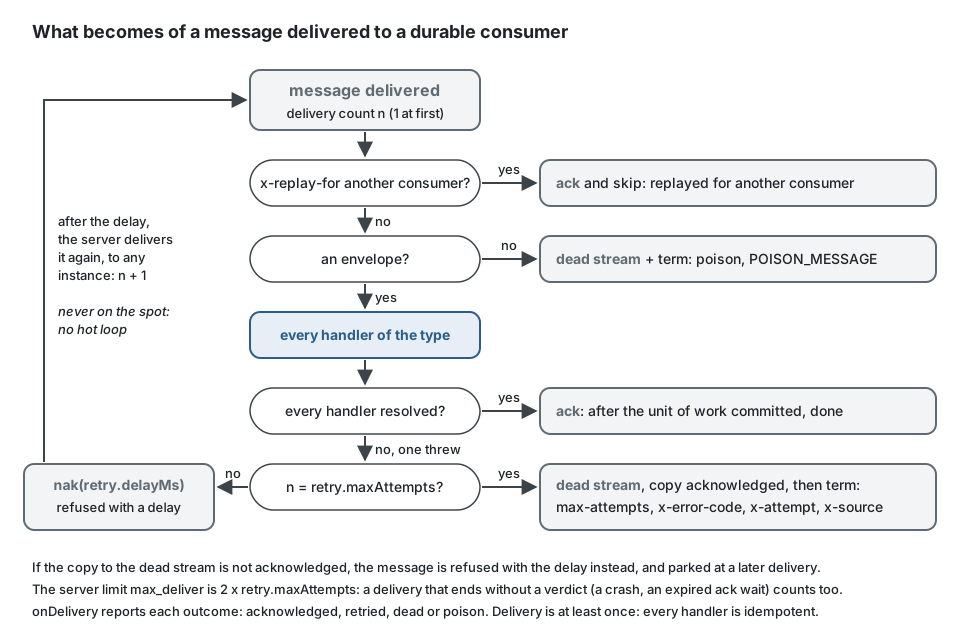
- A message is acknowledged after every handler subscribed to its durable consumer
resolved. A declared
@IntegrationEventHandler(orconsumeof@ddd-ts-kit/eventsby hand) commits its work and its idempotency mark in one unit of work: the acknowledgement then follows that commit, and a redelivery is deduplicated. - When a handler throws, the bus refuses the message with a delay (
nakwithretry.delayMs): the server delivers it again after that delay, to any instance. The attempt number is the delivery count of the server. No hot loop. - At the
retry.maxAttempts-th failed delivery the bus publishes a copy to the dead-letter subject, withx-dead-reason: max-attempts,x-error-code,x-attemptandx-source(<stream>/<sequence>), waits for the acknowledgement of the dead-letter stream, then terminates the original (term). If the copy cannot be stored the message is refused with the delay instead, and parked at a later delivery. - A message whose body is not an envelope (unparseable, without
id,type,versionoroccurredAt, or with atenantIdthatisTenantIdof the kernel refuses) is poison: it goes straight to the dead-letter stream withx-dead-reason: poisonandx-error-code: POISON_MESSAGE, and no handler sees it. - Only codes travel:
x-error-codeis thecodeof the error or its class name. The message of an error is never logged, reported or attached, because it may quote payload data.
Why an explicit copy and not the advisory. When a message reaches max_deliver the
server stops delivering it and emits $JS.EVENT.ADVISORY.CONSUMER.MAX_DELIVERIES. That
advisory is a core NATS message: lost if nobody listens at that instant, it carries a stream
sequence and no failure code, and the message itself stays in the stream where no consumer
will read it again. The bus knows the failure code and knows it is the last attempt, so it
parks the message itself, with an acknowledged publication.
Why max_deliver is twice maxAttempts. The delivery count also grows when a delivery
ends without a verdict: a process killed mid-handler, an acknowledgement wait that expired,
a connection cut. With max_deliver equal to maxAttempts, such a delivery could use the
last one, and the server would then drop the message from the consumer silently. The bus
parks at maxAttempts; the server limit is a backstop above it. A message that exhausts
even that stays in the stream, undelivered: the advisory above is the alert to have.
Delivery is at least once. The copy-then-terminate order means a crash in between delivers
the message again and parks it again: the dead-letter stream keeps one copy, because the copy
has a message id of its own (<durable>.<sequence>).
On a lost connection the client reconnects by itself and its pull consumers resume: streams
and durable consumers live on the server, nothing has to be declared again. While the server
is away publish rejects at once with BROKER_UNAVAILABLE, and a publication in flight
rejects after publishTimeoutMs (5 s by default) with PUBLISH_NOT_ACKNOWLEDGED, so the
outbox relay keeps the records and retries them. Messages that were being handled are
delivered again after ackWaitMs. The bus opens the first connection itself, with an
exponential backoff (reconnect, 200 ms doubling up to 30 s), and a new one if the client
ever gives up.
Credentials. The URL or the options of connection are held by the function that opens the connection, in no field. A NatsEventBus that is logged, spread or
serialised shows NatsEventBus [connection concealed] and nothing else: its fields are not enumerable,
and toJSON and util.inspect answer that name. The failures it reports are codes. What the
client library itself shows when one of its own objects is inspected is not in the hands of
this package: do not log those.
What a handler is told. Next to the event, each handler receives the delivery
(EventDelivery of the kernel): { attempt, maxAttempts, system: 'nats', destination, consumer },
where destination is the subject and consumer the durable consumer
(billing_ordering_order_placed). Handlers of the application ignore it; @ddd-ts-kit/tracing reads it
to make one CONSUMER span per attempt and to mark the redeliveries and the attempt after which
the event is buried. The bus names itself messagingSystem: 'nats', and traceparent travels in
the envelope and as a real header, intact across a retry.
Operations
What to watch:
| Signal | Where | Meaning |
|---|---|---|
| outbox stats() (pending, failed, dead) | the outbox store | the publishing side: see @ddd-ts-kit/events |
| num_pending of <consumer>_<type> | server (nats consumer info, the exporter) | the consumer lags or is stopped |
| num_ack_pending of the same | server | handled now or waiting for a redelivery; a plateau means a handler that keeps failing |
| messages in <stream>-dead, per subject | server (nats stream subjects <stream>-dead) | the dead-letter depth: must be 0, alert on anything else |
| $JS.EVENT.ADVISORY.CONSUMER.MAX_DELIVERIES.<stream>.> | server | a message the bus could not park before the server gave up on it |
| onDelivery counted by outcome | this bus | rate of retried, dead, poison against acknowledged |
| onFailure with kind: 'connection' | this bus | disconnections (CONNECTION_LOST) and requests the server refused (JETSTREAM_<code>) |
| bus.deliveriesInFlight | this bus | handlers running now; stuck above 0 means a handler that hangs |
With an error tracker, DeadLetterReports of the kernel turns onFailure into reports of the
events given up, and of those only: onFailure: (failure) => reports.onFailure(failure), and
reports.observing(bus.forConsumer(name)) as the subscriber of each context, so that a report
carries what the handler threw. init wires it when the project has one.
Replaying dead messages, once the cause is fixed:
import type { NatsEventBus } from '@ddd-ts-kit/nats';

declare const bus: NatsEventBus;

// Up to 100 messages billing gave up on for this type, oldest first.
const replayed = await bus.replayDead({ consumer: 'billing', type: 'ordering.order.placed' }, 100);
console.log(`${String(replayed)} message(s) replayed`);
It moves up to that many messages of that consumer from the dead-letter stream back to the
subject they came from, oldest first, each with an acknowledged copy before it is deleted
from the dead-letter stream, and with the header x-replay-for naming the durable consumer.
The other consumers of this kit acknowledge and skip a message marked for someone else; a
consumer written without this kit sees the event a second time and must deduplicate. The
copy is a new message: its delivery count starts again. Look at x-dead-reason and
x-error-code first: replaying a poison message only kills it again.
To stop a consumer for good, delete its durable consumers: unsubscribing leaves them, and a
stream with interest retention would keep their messages for ever.
Limits
- No ordering, see above.
- One delay. The wait is the same for every attempt. The
backofflist of a JetStream consumer is not used: it applies to expired acknowledgement waits, not to refusals. - A handler must finish within
ackWaitMs(30 s by default). Beyond it the server delivers the message to another instance while the first still runs. The bus sends no in-progress signal: raiseackWaitMsabove the worst case of the handlers. - The duplicate window is short and belongs to the stream: two minutes unless the stream was created otherwise, and an existing stream keeps its own. It absorbs a relay retry, not a record revived from the dead state of the outbox an hour later.
- Retention is
limits, without limits: the events stream grows until you set a maximum age or size on it. Do not switch it toworkqueue: two consumers could no longer both get every event. Withinterest, every durable consumer must exist before the first publication it cares about. - A consumer created after a publication receives it (deliver policy
all, as long as the stream retained it): a new consuming context replays the retained history of its types. - A redelivery runs every handler of the durable consumer again, those that succeeded included, when several handlers of one consumer subscribe to the same type. Each must be idempotent.
- A batch is not atomic. When
publishrejects, some events of the batch may have been stored. The relay publishes one by one and retries; the stream deduplicates, then consumers. - An event no consumer listens to is stored anyway: there is no equivalent of
onUnroutable. - Two names that differ only by a replaced character collide:
billing.euandbilling_euare the same durable consumer. replayDeadreads the dead-letter stream directly, which needsallow_directon it: the bus sets it on the stream it creates; set it yourself on one you created.- A connection factory must open a new connection at each call and should keep the
reconnection of the client unlimited (
maxReconnectAttempts: -1, what the bus sets when it is given a URL); the bus closes what it opened. - Closing while the server is away does not wait for the acknowledgements in flight to be sent: those messages are delivered again.
Not verified by the test suite: a cluster of several servers (replicas above 1, leader
election, a stream that loses its quorum), TLS and authentication, an acknowledgement wait
that expires during a handler, a consumer process killed mid-handler, the MAX_DELIVERIES
path beyond the bus limit, a durable consumer or a stream deleted while the bus runs (the bus
then reopens its connection and declares everything again; the path is not exercised),
interest retention, servers older than 2.15, and the WebSocket transport.
Other providers
@ddd-ts-kit/rabbitmq and @ddd-ts-kit/kafka implement the same two ports and pass the same
contract suite. The three share the envelope, the header names (traceparent,
x-correlation-id, x-event-version, x-attempt, x-error-code, x-dead-reason), the
option names (consumer, retry, reconnect, onFailure, onDelivery) and the methods
(forConsumer, assertTopology, describeTopology, replayDead, close).
Testing
The suites need a real server and are skipped without DDD_TS_KIT_TEST_NATS_URL:
docker run -d --rm --name ddd-ts-kit-test-nats -p 127.0.0.1:4222:4222 nats:2.15.0-alpine -js
DDD_TS_KIT_TEST_NATS_URL=nats://127.0.0.1:4222 npx vitest run packages/nats
docker rm -f ddd-ts-kit-test-nats
They run the contract suite on file and on memory storage, then the behaviours of this
provider, one suite per behaviour (publishing, with the deduplication inside and outside
the duplicate window, consuming, correlation, retries, dead-letters, topology,
connection-loss through a TCP relay the test cuts, closing) and the whole chain from the
outbox to an idempotent consumer. Every test works on streams of its own and
deletes them.