
@ddd-ts-kit/typeorm
v0.19.0
Published
TypeORM adapters for the kernel ports: unit of work, transactional outbox store, processed-event store, PostgreSQL event store.

Maintainers
 gbourgeat
Readme
English · Français
@ddd-ts-kit/typeorm
TypeORM adapters of the kernel and events ports: a unit of work that repositories never see,
the transactional outbox store, the processed-event store, their tables as EntitySchema
objects, and one database schema per bounded context. Same pieces as @ddd-ts-kit/drizzle, for
projects on TypeORM.
npm i @ddd-ts-kit/typeorm typeorm pgEverything here uses EntitySchema, not decorated classes: no reflect-metadata import, no
experimentalDecorators, and rows stay plain objects that a mapper turns into aggregates.
PostgreSQL first; see Dialect coverage for MySQL and SQLite.
Where it sits in an application
Nothing here is imported from domain/ or application/. A handler depends on the repository
port of its domain; the adapter of that port, in infrastructure/, runs its statements on the
TypeOrmContext; the platform builds the unit of work once and binds it.
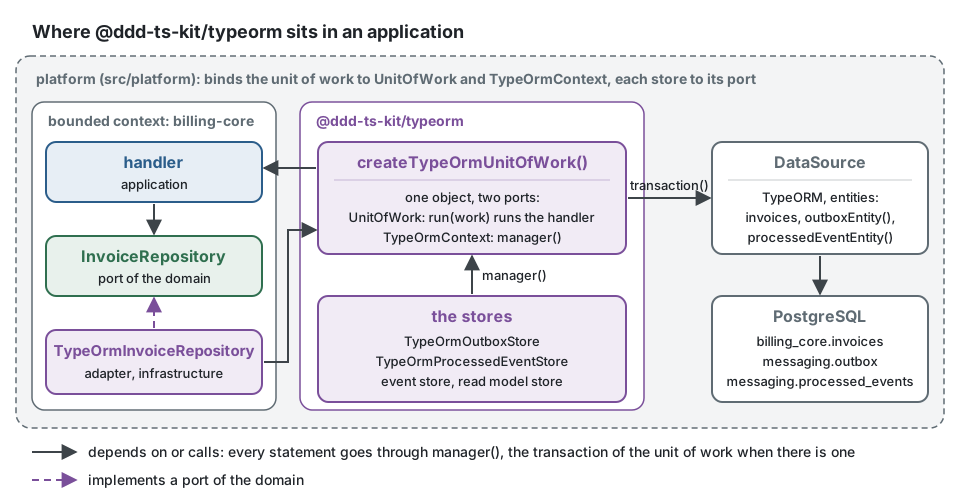
The one idea to keep: every statement goes through manager(). Inside a unit of work it
is the transactional EntityManager of that unit of work, so the row of the aggregate, the
outbox record of the event it published and the processed-event mark of a consumer commit or
roll back together. Outside one (a query, a script) it is dataSource.manager.
Schema
The tables are EntitySchema objects: add them to the entities of the data source and
typeorm migration:generate writes their DDL into a migration of your project.
// platform/database/schema.ts
import { outboxEntity, processedEventEntity, schemaNameOf } from '@ddd-ts-kit/typeorm';

export const outbox = outboxEntity({ schema: 'messaging' }); // messaging.outbox
export const processedEvents = processedEventEntity({ schema: 'messaging' });

// contexts/billing-core/infrastructure/persistence/invoice-row.schema.ts
import { EntitySchema } from 'typeorm';

export interface InvoiceRow {
  id: string;
  amount: number;
  status: 'draft' | 'issued';
  version: number;
}

export const invoices = new EntitySchema<InvoiceRow>({
  name: 'Invoice',
  tableName: 'invoices',
  schema: schemaNameOf('billing-core'), // billing_core
  columns: {
    id: { type: 'text', primary: true },
    amount: { type: 'int' },
    status: { type: 'text' },
    version: { type: 'int' },
  },
});
Options of both factories: schema (none: the default schema of the connection), dialect
(postgres by default, mysql, sqlite: it picks the JSON and timestamp column types),
tableName, and name, the entity name. The entity name defaults to OutboxRecord or
ProcessedEvent, suffixed with the schema (OutboxRecord_messaging), so each context can
register an outbox of its own in the same data source.
outbox is indexed for the relay (pending records by next attempt, partial index on
PostgreSQL and SQLite); processed_events has (consumer, event_id) as its primary key.
TypeORM does not create schemas: create them in the migration (CREATE SCHEMA IF NOT EXISTS).
Composition root
createTypeOrmUnitOfWork(dataSource) gives one object that is two ports: the kernel
UnitOfWork, and TypeOrmContext, the handle repositories and stores run their queries on.
Bind it to both:
// platform/database/persistence.module.ts
import { DataSource } from 'typeorm';
import { defineContextModule } from '@ddd-ts-kit/di';
import { IntegrationEventPublisher, ProcessedEventStore, UnitOfWork } from '@ddd-ts-kit/kernel';
import { OutboxPublisher, OutboxStore } from '@ddd-ts-kit/events';
import {
  createTypeOrmUnitOfWork,
  TypeOrmContext,
  TypeOrmOutboxStore,
  TypeOrmProcessedEventStore,
} from '@ddd-ts-kit/typeorm';

export const dataSource = new DataSource({
  type: 'postgres',
  url: process.env.DATABASE_URL,
  entities: [outbox, processedEvents, invoices],
});
const unitOfWork = createTypeOrmUnitOfWork(dataSource);

export const persistenceModule = defineContextModule({
  name: 'persistence',
  register(builder) {
    builder.rebind(UnitOfWork).toValue(unitOfWork);
    builder.bind(TypeOrmContext).toValue(unitOfWork);
    builder
      .bind(OutboxStore)
      .toFactory((resolve) => new TypeOrmOutboxStore(resolve(TypeOrmContext), { entity: outbox }));
    builder
      .rebind(ProcessedEventStore)
      .toFactory((resolve) => new TypeOrmProcessedEventStore(resolve(TypeOrmContext), { entity: processedEvents }));
    builder.rebind(IntegrationEventPublisher).toClass(OutboxPublisher, [OutboxStore]);
  },
  onStart: async () => {
    await dataSource.initialize();
  },
  onStop: () => dataSource.destroy(),
});
// main.ts
const app = createApplication({ modules: [kernelModule(), persistenceModule, contextModule('billing', billingDeclarations)] });
const relay = new OutboxRelay({ store: app.resolve(OutboxStore), publisher: broker, clock: app.resolve(Clock) });
relay.start({ intervalMs: 500 });List the module after kernelModule(): rebind replaces its in-memory defaults. The command
bus of the kernel module runs every command in the bound UnitOfWork; handlers do not know it.
contextModule of @ddd-ts-kit/di turns the declared classes of a context into its module.
A project written by the CLI holds the same wiring in two files:
platform/database/persistence-over.ts builds the unit of work and the two stores once, and
platform/platform.module.ts binds them, the outbox publisher being given to
kernelModule({ eventPublisher }).
Pass to a store the very entity the data source registers. Without entity, a store uses
outboxEntity() or processedEventEntity(), which TypeORM matches by name with the default
entity in the default schema; the class is then bound directly:
builder.bind(OutboxStore).toClass(TypeOrmOutboxStore, [TypeOrmContext]),
builder.rebind(ProcessedEventStore).toClass(TypeOrmProcessedEventStore, [TypeOrmContext]).
unitOfWork.run(work) opens dataSource.transaction and keeps the transactional
EntityManager in an AsyncLocalStorage; a nested run joins the outer transaction (no
savepoint). Because append uses the current manager, an event published by a handler that
then fails is rolled back with the business write: that is the whole point of the outbox.
createTypeOrmUnitOfWork(dataSource, 'REPEATABLE READ') sets the isolation level.
run is built on withinUnitOfWork of the kernel. The domain events of the aggregates saved
inside it wait until work has returned, then are dispatched inside the transaction, before
the commit: their handlers see every save, and what they write commits or rolls back with it.
If work, a handler or the commit fails, nothing is left: no row, no outbox record, no handler
run after the commit. Handlers declared after-commit run once the transaction has committed.
A nested run joins the unit of work in progress: one dispatch, at the end of the outermost.
A run called directly (a consumer, a script) has the same timing as a command.
unitOfWorkContract of @ddd-ts-kit/testing/contracts proves it, with a deferred constraint
for the commit that fails; on a real PostgreSQL (DDD_TS_KIT_TEST_DATABASE_URL) it also proves
that the rows of a before-commit handler are invisible from another connection and visible
to the after-commit handlers. The README of @ddd-ts-kit/kernel draws this timeline
(Domain events and the unit of work).
TypeOrmContext is an abstract class, so it is its own injection token. A project with two
data sources gives each a class of its own (export abstract class Ledger extends TypeOrmContext {}
in platform/database/) and binds each to its unit of work.
Repository
The port lives in the domain, the adapter in infrastructure. A repository receives the context,
never a transaction: manager() is the transactional manager of the unit of work when there
is one and dataSource.manager otherwise.
// contexts/billing-core/domain/repositories/invoice.repository.ts
import { Repository } from '@ddd-ts-kit/kernel';

export abstract class InvoiceRepository extends Repository<Invoice> {}
// contexts/billing-core/infrastructure/persistence/type-orm-invoice.repository.ts
import { Repository } from '@ddd-ts-kit/kernel/declarations';
import { insertIgnoringConflict, optimisticUpdate, TypeOrmContext } from '@ddd-ts-kit/typeorm';
@Repository(InvoiceRepository)
export class TypeOrmInvoiceRepository implements InvoiceRepository {
constructor(private readonly context: TypeOrmContext) {}
async findById(id: string): Promise<Invoice | undefined> {
const row = await this.context.manager().findOneBy(invoices, { id });
if (row === null) {
return undefined;
}
const invoice = Invoice.rehydrate(row);
invoice.version = row.version;
return invoice;
}
async save(invoice: Invoice): Promise<void> {
const manager = this.context.manager();
await optimisticUpdate(invoice, async ({ expected, next }) => {
const row = { ...invoice.state, version: next };
if (expected === 0) {
return (await insertIgnoringConflict(manager, invoices, row)) ? 1 : 0;
}
const updated = await manager.update(invoices, { id: invoice.id, version: expected }, row);
return updated.affected ?? 0;
});
}
}In the explicit style, without the decorator, the same binding is one line of
<context>.module.ts:
builder.bind(InvoiceRepository).toClass(TypeOrmInvoiceRepository, [TypeOrmContext]).
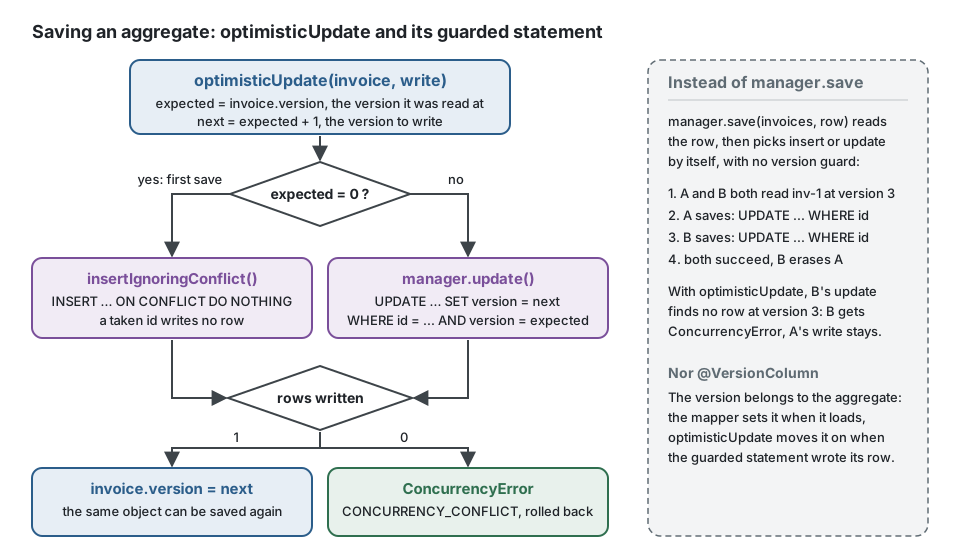
optimisticUpdate gives the version to expect and the version to write, raises a
ConcurrencyError (a DomainError with code CONCURRENCY_CONFLICT) when the guarded
statement wrote no row, and moves invoice.version on otherwise. insertIgnoringConflict
inserts unless the key exists and says whether it did; unlike a caught unique violation it
leaves the surrounding PostgreSQL transaction usable. Do not use manager.save for an
aggregate: it reads before writing and decides by itself between insert and update, which
defeats the version guard. TypeORM's own @VersionColumn is not used for the same reason: the
version belongs to the aggregate.
// Instead of: a read, then an insert or an update chosen by TypeORM, with no version guard
await manager.save(invoices, { ...invoice.state, version: invoice.version + 1 });

// Write: the guarded statement, which writes no row when another transaction saved first
await optimisticUpdate(invoice, async ({ expected, next }) => {
  // a first save (expected 0) inserts with insertIgnoringConflict instead, as in the repository above
  const updated = await manager.update(invoices, { id: invoice.id, version: expected }, { ...invoice.state, version: next });

  return updated.affected ?? 0;
});
What optimisticUpdate does with the count the write answers, on its own:
import { ConcurrencyError, optimisticUpdate } from '@ddd-ts-kit/typeorm';

// What a repository hands to optimisticUpdate: the aggregate, and a write that answers how many rows it wrote.
const invoice = { id: 'inv-1', version: 3 }; // read at version 3

await optimisticUpdate(invoice, async ({ expected, next }) => {
  // expected = 3: the guard of the UPDATE (WHERE id = 'inv-1' AND version = 3)
  // next = 4: the version the row is written with
  return expected === 3 && next === 4 ? 1 : 0;
});
// invoice.version is now 4: the same aggregate can be saved again

try {
  // Another transaction saved inv-1 in between: the guarded UPDATE matches no row.
  await optimisticUpdate(invoice, async () => 0);
} catch (error) {
  if (error instanceof ConcurrencyError) {
    console.log(error.code); // CONCURRENCY_CONFLICT; invoice.version is still 4
  }
}
The command that saved fails with that error and its unit of work rolls back: nothing it wrote stays, and the caller reads the aggregate again before it retries.
Audit columns, tenant scoping and pages
The standard persistence shapes of the kernel, on TypeORM. auditColumns(dialect?) and
tenantColumn() are column options to spread into the columns of an EntitySchema: their
properties are those of the kernel AuditStamp and TenantScoped, so a stamp spreads into an
insert as it is, and the columns have the same names in every project (created_at,
created_by, updated_at, updated_by, tenant_id), which is what lets a dashboard, an
export or the audit package be written once.
import type { AuditStamp, TenantScoped } from '@ddd-ts-kit/kernel';
import { auditColumns, schemaNameOf, tenantColumn } from '@ddd-ts-kit/typeorm';

interface InvoiceRow extends VersionedInvoice, TenantScoped, AuditStamp {}

export const invoices = new EntitySchema<InvoiceRow>({
  name: 'Invoice',
  tableName: 'invoices',
  schema: schemaNameOf('billing-core'),
  columns: {
    id: { type: 'text', primary: true },
    amount: { type: 'int' },
    status: { type: 'text' },
    version: { type: 'int' },
    ...tenantColumn(),
    ...auditColumns(),
  },
  indices: [{ name: 'invoices_tenant_amount_idx', columns: ['tenantId', 'amount', 'id'] }],
});
import { Clock, ExecutionScope, stampCreation, stampUpdate, tenantScopeOf } from '@ddd-ts-kit/kernel';
import { Repository } from '@ddd-ts-kit/kernel/declarations';
@Repository(InvoiceRepository)
export class TypeOrmInvoiceRepository implements InvoiceRepository {
constructor(
private readonly context: TypeOrmContext,
private readonly scope: ExecutionScope,
private readonly clock: Clock,
) {}
async findById(id: string): Promise<Invoice | undefined> {
const row = await this.context.manager().findOneBy(invoices, { id, ...tenantScopeOf(this.scope) });
return row === null ? undefined : InvoiceMapper.toDomain(row);
}
async save(invoice: Invoice): Promise<void> {
await optimisticUpdate(invoice, async ({ expected, next }) => {
const state = { ...InvoiceMapper.toRow(invoice), version: next };
return expected === 0 ? this.insert(state) : this.update(state, expected);
});
}
private async insert(state: VersionedInvoice): Promise<number> {
const row = { ...state, ...tenantScopeOf(this.scope), ...stampCreation(this.scope, this.clock) };
return (await insertIgnoringConflict(this.context.manager(), invoices, row)) ? 1 : 0;
}
private async update(state: VersionedInvoice, expected: number): Promise<number> {
const guarded = { id: state.id, version: expected, ...tenantScopeOf(this.scope) };
const row = { ...state, ...stampUpdate(this.scope, this.clock) };
return (await this.context.manager().update(invoices, guarded, row)).affected ?? 0;
}
}TypeORM's @CreateDateColumn and @UpdateDateColumn are not used: they take the time of the
database server, not of the Clock, and know nothing of who acts.
A search query takes the kernel PageRequest and answers a Page, in both variants:
// contexts/billing-core/application/ports/invoice-queries.port.ts
export abstract class InvoiceQueries {
  abstract search(request: PageRequest<'amount'>): Promise<Page<InvoiceSummary>>;
}
// contexts/billing-core/infrastructure/persistence/type-orm-invoice-queries.reader.ts
import { LessThan, MoreThan, type FindOptionsWhere } from 'typeorm';
import { ExecutionScope, encodeCursor, pageOf, tenantScopeOf } from '@ddd-ts-kit/kernel';
import { Repository } from '@ddd-ts-kit/kernel/declarations';
@Repository(InvoiceQueries)
export class TypeOrmInvoiceQueries implements InvoiceQueries {
constructor(
private readonly context: TypeOrmContext,
private readonly scope: ExecutionScope,
) {}
async search(request: PageRequest<'amount'>): Promise<Page<InvoiceSummary>> {
return request.kind === 'offset' ? this.byOffset(request) : this.byCursor(request);
}
private async byOffset(request: OffsetPageRequest<'amount'>): Promise<Page<InvoiceSummary>> {
const [rows, total] = await this.context.manager().findAndCount(invoices, {
where: tenantScopeOf(this.scope),
order: totalOrder(directionOf(request)),
take: request.limit,
skip: request.offset,
});
return pageOf(rows.map(toSummary), { total });
}
private async byCursor(request: CursorPageRequest<'amount'>): Promise<Page<InvoiceSummary>> {
const direction = directionOf(request);
const tenant = tenantScopeOf(this.scope);
const rows = await this.context.manager().find(invoices, {
where: request.cursor === undefined ? tenant : beyond(positionOf(request.cursor), direction, tenant),
order: totalOrder(direction),
take: request.limit + 1,
});
const items = rows.slice(0, request.limit);
const last = items.at(-1);
const more = rows.length > request.limit && last !== undefined;
return pageOf(items.map(toSummary), more ? { nextCursor: encodeCursor({ amount: last.amount, id: last.id }) } : {});
}
}
const directionOf = (request: PageRequest<'amount'>) => request.sort[0]?.direction ?? 'asc';
// The primary key follows the sort field, in the same direction: the order is total.
const totalOrder = (direction: SortDirection) => ({ amount: direction, id: direction });
// The rows after a position, as a tuple comparison. A list of conditions is an OR in TypeORM,
// so each alternative restates the tenant.
function beyond(
{ amount, id }: { amount: number; id: string },
direction: SortDirection,
tenant: TenantScoped,
): FindOptionsWhere<InvoiceRow>[] {
const past = direction === 'asc' ? MoreThan : LessThan;
return [
{ ...tenant, amount: past(amount) },
{ ...tenant, amount, id: past(id) },
];
}positionOf(cursor) decodes with decodeCursor and checks that amount is a number and id
a string, raising InvalidPageRequestError otherwise.
A read adapter over the database is declared with @Repository, as the ones the CLI
generates: its kind is repository. Declared with @Adapter it would be external, and a
generated platform puts a retry and a time limit around every external and gateway
adapter, which a statement of the unit of work must not get.
The rules these examples hold, and that the tests of this package check on a real database:
- Audit columns are filled by the adapter, never by the aggregate:
stampCreation(scope,
clock)
on insert,stampUpdate(scope, clock)on update, which leavescreated_atandcreated_byalone. The actor is the one of the execution scope: the user of the request, orsystem:<consumer>for a consumed event. - The tenant is part of every statement: written on insert, and in the condition of every
read and every update, the version guard included. A row of another tenant is not found, and
an update aimed at it writes nothing, which
optimisticUpdatereports as aConcurrencyError. Work that names no tenant raisesNoCurrentTenantErrorbefore any SQL. - A list has a total order. The primary key follows the sort field, in the same direction,
as a tie-breaker: rows equal on the sort field otherwise have no defined order, and a page
could repeat or skip one of them. The index covers
(tenant_id, <sort field>, id). - A cursor is a position, not a page number: the sort value and the id of the last row,
written by
encodeCursor, compared as a tuple (`amount > :amount OR (amount = :amount AND id:id)
). One row more thanlimitis fetched to know whether a page follows, so no count is needed, and a row inserted before the cursor does not shift the next page as it does with an offset. A cursor comes back from a client:decodeCursor` refuses what it did not write, and the adapter checks the types of the position before they reach a statement. - An offset page answers
total, a cursor pagenextCursor. Offer the offset form for small, browsable lists and the cursor form for anything that grows.
Criteria
criteriaToTypeOrm(builder, plan, { alias }) adds a criteria plan of the kernel to a
SelectQueryBuilder on the entity of a read model: the filters and the scope of the actor,
the keyset of a cursor page, the total order ended by the tie-breaker, the window.
predicateToTypeOrm(builder, predicate, { alias }) adds the filters alone, for a count. The
fields of the read model are the properties of the entity (properties renames those that
differ). Every value is a named parameter; the only text composed is alias.property with an
operator of a closed list, both from the adapter. A text search is LIKE :p ESCAPE :e with
%, _ and \ escaped.
// infrastructure/persistence/type-orm-appointment-queries.reader.ts
async search(criteria: ScopedCriteria<AppointmentRow>): Promise<Page<AppointmentRow>> {
  const plan = planCriteria(appointmentCriteria, criteria);

  if (plan.empty) {
    return pageOfPlan(plan, []);
  }

  const builder = this.context.manager().createQueryBuilder(appointmentList, 'row');

  return pageOfPlan(plan, await criteriaToTypeOrm(builder, plan, { alias: 'row' }).getMany());
}
A cursor page is fetched one row longer than asked, which is how pageOfPlan knows whether
another follows; an offset page takes its total from predicateToTypeOrm(...).getCount(). A
field declared nullable is ordered NULLS LAST ascending and NULLS FIRST descending. Two
criteria in one query take distinct parameter names with the parameters option.
Strings. A text column is ordered and compared by range in the collation of the column;
criteria order strings by code point. Declare the text columns that are sorted or compared
with gt, lt or between with collation: 'C': the index then serves the sort, and the
order is the same as in the fake. Decimals are a numeric column and a string in the
row; they read back in the scale of the column. Instants are timestamptz and a Date.
An integer is integer: a bigint comes back as a string from the driver.
Read models
// infrastructure/persistence/appointment-list.schema.ts
export const appointmentList = new EntitySchema<AppointmentRow & ReadModelStamps>({
  name: 'AppointmentRow',
  tableName: 'appointment_list',
  schema: 'scheduling',
  columns: {
    id: { type: 'text', primary: true },
    status: { type: 'text' },
    startsAt: { name: 'starts_at', type: 'timestamp with time zone', precision: 3 },
    ...readModelColumns(), // last_event_id, last_event_at, last_event_version, deleted
  },
});

// infrastructure/persistence/type-orm-appointment-list.repository.ts
@Repository(AppointmentList)
export class TypeOrmAppointmentList extends TypeOrmReadModelStore<AppointmentRow> implements AppointmentList {
  constructor(context: TypeOrmContext) {
    super(context, { entity: appointmentList, definition: appointmentCriteria });
  }
}
Every write goes through TableReadModelStore of the kernel: a row is written only if its
event is newer than the one it holds, on the executor of the unit of work, so the row and the
processed-event mark commit together. A removed row stays in the table with deleted set:
a query of your own on the table leaves those rows out, and so does a unique index
(WHERE NOT deleted). store.table is what ProjectionRebuild takes; the rebuild is
PostgreSQL only (a copy <table>__rebuild made LIKE ... INCLUDING ALL, the keys written
meanwhile in <table>__touched, the swap by rename in one transaction) and its guarantees
and limits are in the README of @ddd-ts-kit/kernel (Rebuild). The store passes
criteriaContract and readModelStoreContract of @ddd-ts-kit/testing/contracts, on PGlite
and on PostgreSQL 18.
Criteria and read models were never run on MySQL or SQLite.
The table is written through its entity; the copy of a rebuild, which has none, is written by column through the same query builder.
Outbox and idempotency
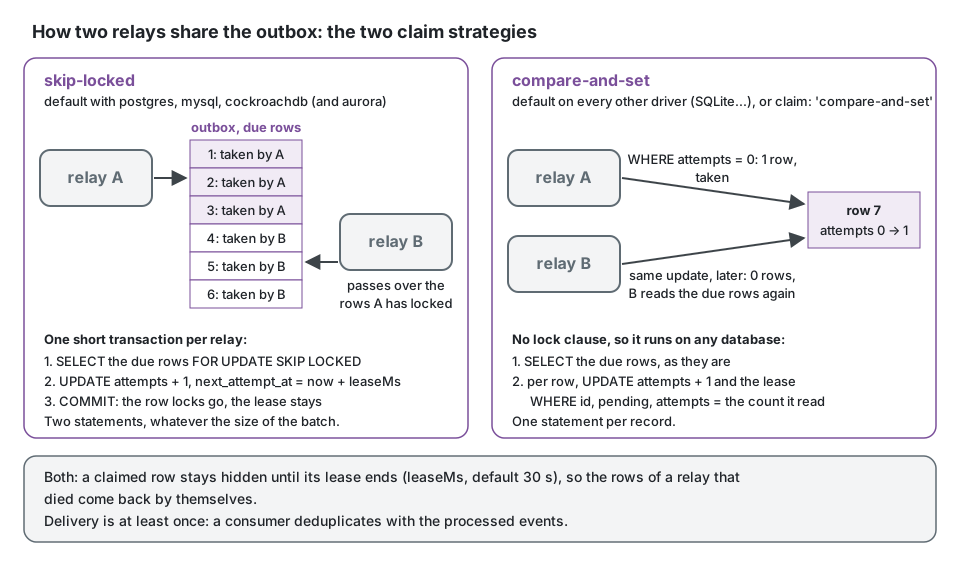
TypeOrmOutboxStore.claimBatchselects the due rowsFOR UPDATE SKIP LOCKED(setLock('pessimistic_write').setOnLocked('skip_locked')) and leases them in the same short transaction by pushingnext_attempt_atforward (leaseMs, default 30 s), so several relays share the work without waiting for each other, and the records of a relay that died come back when the lease expires. Delivery is at least once and, by default, unordered:ordering: 'per-key'ofOutboxRelay, given akeyOf(typically the aggregate id), keeps the records of one key in order, with a single relay (Ordering per key).- Where the database has no
SKIP LOCKED(SQLite), or when you passclaim: 'compare-and-set', the claim reads the due rows and takes each one with an update guarded by the attempt count it read: same guarantee, no lock clause, one statement per record. The default isskip-lockedfor thepostgres,aurora-postgres,cockroachdb,mysqlandaurora-mysqldrivers,compare-and-setfor every other one. TypeOrmProcessedEventStore.markProcessedis an insert ignoring the conflict on(consumer, event_id). Run the consumer inside the unit of work: the mark then commits with the effects of the handler, and disappears with them if it fails.
The options of the outbox store, and the relay that reads it:
import { OutboxRelay } from '@ddd-ts-kit/events';
import type { Clock, IntegrationEventPublisher } from '@ddd-ts-kit/kernel';
import { outboxEntity, TypeOrmOutboxStore, type TypeOrmUnitOfWork } from '@ddd-ts-kit/typeorm';

// From the composition root: createTypeOrmUnitOfWork(dataSource), the broker adapter, the clock.
declare const unitOfWork: TypeOrmUnitOfWork;
declare const broker: IntegrationEventPublisher;
declare const clock: Clock;

export const outbox = outboxEntity({ schema: 'messaging' }); // the entity the data source registers

const store = new TypeOrmOutboxStore(unitOfWork, {
  entity: outbox,
  leaseMs: 60_000, // a record claimed by a relay that died is due again after one minute
  claim: 'compare-and-set', // instead of the default of the driver, e.g. on MySQL 5.7
});

const relay = new OutboxRelay({ store, publisher: broker, clock });

relay.start({ intervalMs: 500 });
A consumer on the processed-event store: consume of @ddd-ts-kit/events runs the mark and
the handler in one unit of work (Consume idempotently).
import { z } from 'zod';
import { consume, defineIntegrationEvent } from '@ddd-ts-kit/events';
import { zodSchema } from '@ddd-ts-kit/validation/zod';
import { processedEventEntity, TypeOrmProcessedEventStore, type TypeOrmUnitOfWork } from '@ddd-ts-kit/typeorm';

// From the composition root and the context: the unit of work, and what the consumer does.
declare const unitOfWork: TypeOrmUnitOfWork;
declare function issueInvoice(orderId: string): Promise<void>;

// The declaration of the producer, in its published language.
const orderPlaced = defineIntegrationEvent({
  type: 'ordering.order.placed',
  version: 1,
  description: 'An order was placed by a customer.',
  payload: zodSchema(z.object({ orderId: z.string() })),
});

const processed = new TypeOrmProcessedEventStore(unitOfWork, {
  entity: processedEventEntity({ schema: 'messaging' }),
});

// The mark in messaging.processed_events and the writes of issueInvoice commit in one transaction:
// a redelivery is skipped, and an event whose handler threw is handled again when it comes back.
export const invoiceOnOrderPlaced = consume(
  orderPlaced,
  { consumer: 'billing.invoice-on-order-placed', processed, unitOfWork },
  async (event) => {
    await issueInvoice(event.payload.orderId);
  },
);
Event store
const dataSource = new DataSource({ type: 'postgres', entities: [...eventStoreEntities({ schema: 'scheduling' })] });

const { events, snapshots, checkpoints, subjectKeys } = createTypeOrmEventSourcing(unitOfWork, { schema: 'scheduling' });
eventStoreEntities declares the tables as EntitySchemas, so typeorm migration:generate
creates them with the columns of eventStoreTablesSql of the kernel. The stores never load them
as entities. The stores of createTypeOrmEventSourcing refuse a data source that is not
PostgreSQL: their first statement throws a TypeError that names its type.
Each statement runs on the executor of the context: an append joins the transaction of the
unit of work, so the stream and the outbox records its events publish commit together
(eventStoreUnitOfWorkContract). Appends take the head of the store, a row locked until their
transaction ends: positions are given in commit order, without gaps, and two appends never run
side by side, whatever their streams. PostgreSQL only. The stores are the ones of the kernel
(PostgresEventStore and its companions), held to eventStoreContract here; how an
event-sourced aggregate uses them: the README of @ddd-ts-kit/kernel, section
Event sourcing.
Dialect coverage
What follows is about this package. The CLI generates for PostgreSQL only: init --orm typeorm
refuses --database mysql and --database sqlite.
| Database | Status |
|---|---|
| PostgreSQL | Covered by the automated suite: contract suites of @ddd-ts-kit/testing, repository contract, rollback, nested unit of work, concurrent claims. It runs on PGlite served over the PostgreSQL wire protocol by default, and on a real server when DDD_TS_KIT_TEST_DATABASE_URL is set (last run: PostgreSQL 18). |
| MySQL 8 | Not in the automated suite. The outbox and processed-event contract suites and the rollback of append were run once by hand against MySQL 8.4 with mysql2, entities built with dialect: 'mysql', with skip-locked and compare-and-set. |
| SQLite | Not in the automated suite. The same suites were run once by hand with the better-sqlite3 driver, entities built with dialect: 'sqlite'. No SKIP LOCKED: the claim is compare-and-set. No schemas: leave schema out and name the tables per context. |
| MariaDB, CockroachDB, SQL Server, Oracle, MongoDB | Never run. |
Limits
- Tested with TypeORM 1.1. The peer range is
^1.0.0: TypeORM 0.3 is not accepted. - An
EntitySchemais static: the column types depend on thedialectyou pass, not on the data source it is registered in. - A JSON
nullpayload is stored as SQLNULLand read back asnull. - On MySQL 5.7 there is no
SKIP LOCKED: passclaim: 'compare-and-set'. synchronize: trueis for tests. In production the tables come from your migrations.- By default ordering is not guaranteed, not even per aggregate: a failed event is retried
later while its successors go out.
ordering: 'per-key'ofOutboxRelay, given akeyOf, orders the records of one key, with a single relay running. WithoutkeyOfnothing is ordered.
Testing an adapter
The unit of work of this package passes unitOfWorkContract, and its stores
outboxStoreContract and processedEventStoreContract, of @ddd-ts-kit/testing/contracts. Hold your repositories to repositoryContract the same way,
next to their in-memory fake. The tests of this package need no container:
npx vitest run packages/typeorm
DDD_TS_KIT_TEST_DATABASE_URL=postgresql://user:password@localhost:5432/postgres npx vitest run packages/typeorm
With the variable set, each spec file creates a database of its own on that server and drops it afterwards, and the tests that need two real connections (a relay passing over rows locked by another one) run instead of being skipped.
See also
- Persistence: choosing an ORM, and what each adapter package verified
- Aggregates: optimistic concurrency, seen from the domain
- The transactional outbox: why the outbox record commits with the business write
- Delivery and idempotency: at least once, and what a consumer does about it
@ddd-ts-kit/drizzle: the same pieces on Drizzle, the default persistence of the kit