
@ekaone/llm-gate
v0.1.0
Published
Lightweight LLM budget & token guard. Prevents Denial of Wallet attacks with a circuit-breaker state machine.
Downloads
29

Maintainers
 ekaone
Readme
@ekaone/llm-gate
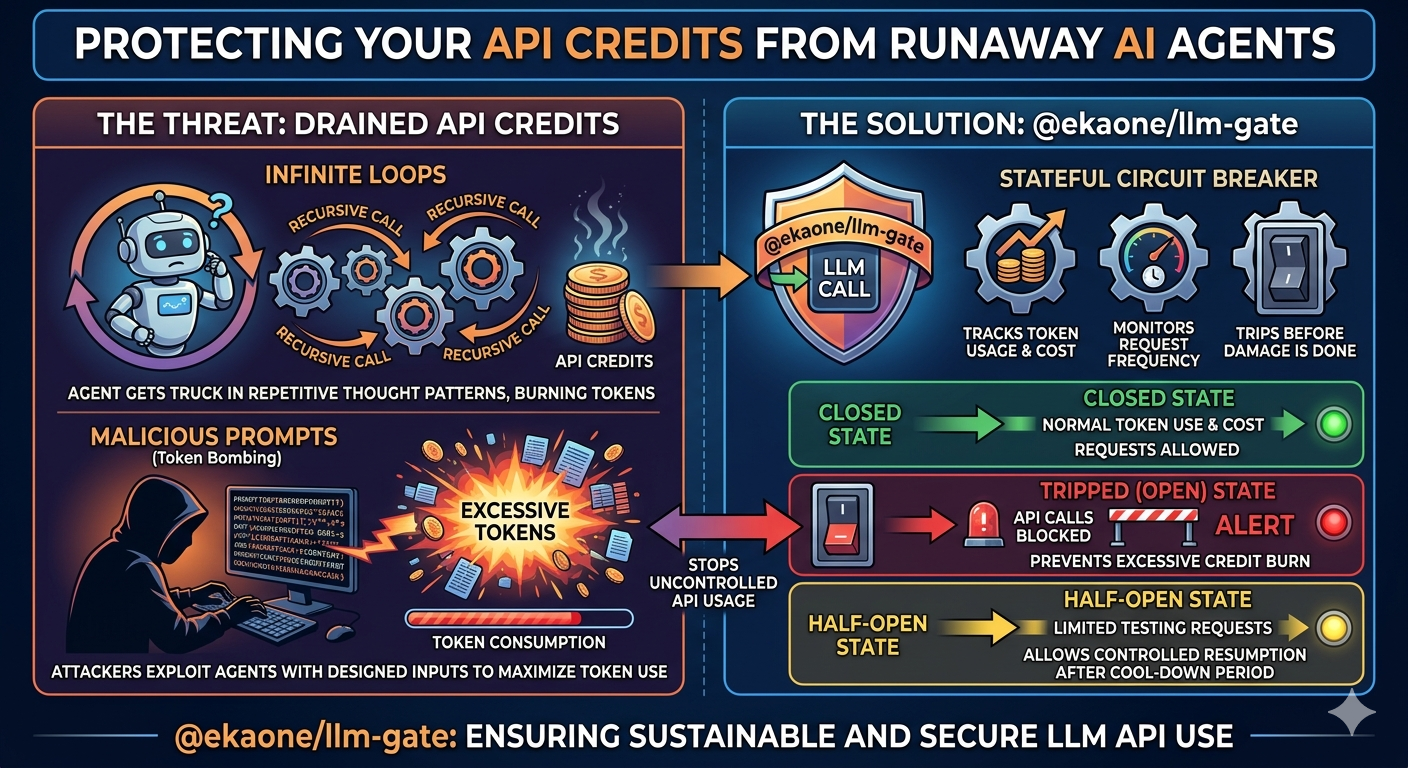
Lightweight LLM budget & token guard. Prevents Denial of Wallet attacks with a zero-dependency circuit-breaker state machine.
Why
AI agents can silently burn through your API credits if they enter infinite loops or receive malicious prompts designed to trigger excessive token consumption. @ekaone/llm-gate wraps every LLM call with a stateful circuit breaker that tracks token usage, cost, and request frequency — then trips before the damage is done.
OPEN ──(80% threshold)──► THROTTLED ──(100% limit)──► TRIPPED
 ▲                                                        │
 └──────────────────(windowMs elapsed)───────────────────┘
Install
npm install @ekaone/llm-gatepnpm install @ekaone/llm-gateyarn install @ekaone/llm-gateQuick Start
import { createGate } from "@ekaone/llm-gate"

const gate = createGate({
  maxTokens:   50_000,   // trip at 50k tokens per window
  maxBudget:   0.10,     // trip at $0.10 USD per window
  maxRequests: 100,      // trip at 100 requests per window
  windowMs:    60_000,   // 1 minute sliding window

  onThrottled: (status) => console.warn("⚠️  Approaching limit", status.tokens),
  onTripped:   (status) => console.error("🚫 Gate tripped!", status.reason),
  onReset:     (status) => console.log("✅  Gate reset, window fresh"),
})

// After every LLM response — feed usage back into the gate
gate.record({
  model:        "claude-sonnet-4-20250514",
  inputTokens:  312,
  outputTokens: 89,
})

// Before the next LLM call — check the gate
const status = gate.check()
if (!status.allowed) {
  console.log(`Blocked. Resets at ${status.resets.toLocaleTimeString()}`)
}

// Or throw-style for agent pipelines
gate.guard() // throws BudgetExceededError if TRIPPED
API
createGate(options)
Creates a new gate instance. At least one of maxTokens, maxBudget, or maxRequests is required.
const gate = createGate(options: GateOptions): GateInstanceGateOptions
| Option | Type | Default | Description |
|---|---|---|---|
| maxTokens | number | — | Max total tokens (input + output) per window |
| maxBudget | number | — | Max cost in USD per window |
| maxRequests | number | — | Max LLM calls per window |
| windowMs | number | 60_000 | Window duration in milliseconds |
| throttleAt | number | 0.8 | Fraction of limit that triggers THROTTLED (0.0–1.0) |
| pricing | PricingTable | built-in | Custom model pricing — merged over defaults |
| onThrottled | (status) => void | — | Fires once on entry to THROTTLED state |
| onTripped | (status) => void | — | Fires once on entry to TRIPPED state |
| onReset | (status) => void | — | Fires when window resets or reset() is called |
gate.record(usage)
Feed token usage from an LLM response back into the gate. Call this after every successful LLM response.
gate.record({
  model:        "claude-sonnet-4-20250514",
  inputTokens:  312,
  outputTokens: 89,
})
For convenience, use the built-in adapters to map provider responses directly:
import { fromAnthropic, fromOpenAI, fromResponse } from "@ekaone/llm-gate"

// Anthropic
gate.record(fromAnthropic(anthropicResponse))

// OpenAI
gate.record(fromOpenAI(openaiResponse))

// Auto-detect provider from response shape
gate.record(fromResponse(anyResponse))
gate.check()
Returns the current GateStatus — never throws.
const status = gate.check()

// status.state     → "OPEN" | "THROTTLED" | "TRIPPED"
// status.allowed   → boolean
// status.reason    → string | null
// status.tokens    → { used, remaining, limit }
// status.budget    → { used, remaining, limit }
// status.requests  → { used, remaining, limit }
// status.resets    → Date
Example status when TRIPPED
{
  state:    "TRIPPED",
  allowed:  false,
  reason:   "token_limit_exceeded",
  tokens:   { used: 51_200, remaining: 0,    limit: 50_000 },
  budget:   { used: 0.094,  remaining: 0.006, limit: 0.10  },
  requests: { used: 87,     remaining: 13,    limit: 100   },
  resets:   Date <2026-03-20T09:01:00Z>
}
gate.guard()
Check and throw BudgetExceededError if the gate is TRIPPED. Ideal for agent pipelines where you want to bail early.
try {
  gate.guard()
  const response = await llm.call(prompt)
  gate.record(fromAnthropic(response))
} catch (err) {
  if (err instanceof BudgetExceededError) {
    console.log(err.reason)    // "token_limit_exceeded"
    console.log(err.resets)    // Date
    console.log(err.snapshot)  // full GateStatus at time of trip
  }
}
gate.snapshot()
Read-only view of current state. Identical to check() but semantically signals "I'm just observing."
const snap = gate.snapshot()gate.reset()
Manually reset the gate to OPEN and clear all counters. Useful for new user sessions or test teardown.
gate.reset()Built-in Adapters
Tree-shakeable — only bundled if imported.
import { fromAnthropic } from "@ekaone/llm-gate"  // Anthropic only
import { fromOpenAI }    from "@ekaone/llm-gate"  // OpenAI only
import { fromResponse }  from "@ekaone/llm-gate"  // auto-detect
Custom Pricing
The built-in pricing table covers common Anthropic and OpenAI models. Override or extend it via the pricing option:
const gate = createGate({
  maxBudget: 1.00,
  pricing: {
    "my-fine-tuned-model": {
      inputPerToken:  0.000005,
      outputPerToken: 0.000015,
    },
  },
})
Custom entries are merged over the defaults — you only need to specify models you want to override.
Real Use Cases
1. Autonomous agent loop guard
const gate = createGate({
  maxTokens: 200_000,
  maxBudget: 0.50,
  onTripped: (s) => alertOps("Agent loop detected", s),
})

while (agentHasWork()) {
  gate.guard()                          // bail if budget blown
  const res = await agent.step()
  gate.record(fromAnthropic(res))
}
2. Per-user session budget
const sessions = new Map<string, ReturnType<typeof createGate>>()

function getGate(userId: string) {
  if (!sessions.has(userId)) {
    sessions.set(userId, createGate({
      maxTokens: 20_000,
      windowMs:  24 * 60 * 60 * 1000,  // 24h
    }))
  }
  return sessions.get(userId)!
}

// In your chat handler
const gate = getGate(req.userId)
const status = gate.check()
if (!status.allowed) {
  return res.status(429).json({
    error: "Daily limit reached",
    resets: status.resets,
  })
}
3. Multi-step RAG pipeline
const gate = createGate({ maxTokens: 10_000, maxRequests: 5 })

const retrieved  = await retrieve(query);         gate.record(fromAnthropic(retrieved))
const reranked   = await rerank(retrieved);       gate.record(fromAnthropic(reranked))
const summarized = await summarize(reranked);     gate.record(fromAnthropic(summarized))

gate.guard()  // only answer if still within budget
const answer = await answer(summarized, query);   gate.record(fromAnthropic(answer))
4. Dev/test budget cap
// vitest setup
import { createGate } from "@ekaone/llm-gate"

export const testGate = createGate({
  maxBudget: 0.05,  // $0.05 max spend per test run
  onTripped: () => { throw new Error("Test suite exceeded LLM budget!") }
})
How Token Counting Works
@ekaone/llm-gate does not tokenize text. It reads the usage field that every LLM provider returns in the response — this is the authoritative count from the model itself.
You set maxTokens: 50_000
         ↓
LLM call happens  (gate doesn't intercept this)
         ↓
API returns usage → { input_tokens: 312, output_tokens: 89 }
         ↓
gate.record(...)  → tokensUsed += 312 + 89 = 401
         ↓
gate.check()      → 401 < 50_000 → OPEN ✅
This means the gate cannot prevent a single oversized request — it stops the next call after the limit is hit. This is a deliberate tradeoff: no tokenizer dependency, works across all providers, zero overhead.
TypeScript
Fully typed. All types are exported:
import type {
  GateOptions,
  GateInstance,
  GateStatus,
  GateMetric,
  CircuitState,
  TripReason,
  ThrottleReason,
  UsageRecord,
  ModelPricing,
  PricingTable,
} from "@ekaone/llm-gate"
License
MIT © Eka Prasetia
Links
⭐ If this library helps you, please consider giving it a star on GitHub!