
@eyrad4/ng2-daterangepicker
v5.1.8
Published
ng2-daterangepicker -------------------


Readme
ng2-daterangepicker
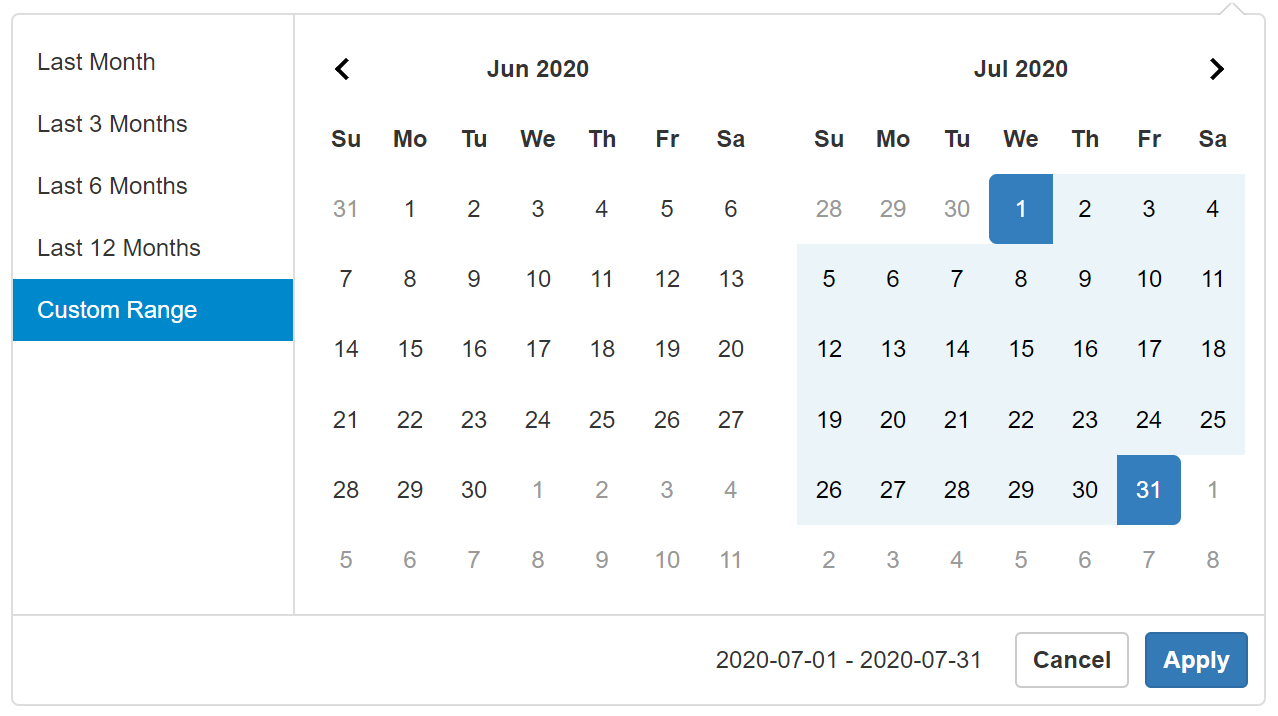
This library targets Angular 20+. It ships a standalone directive (DaterangepickerComponent) and the vendored date-range picker source as a jQuery-free TypeScript class (DateRangePicker). Moment.js stays as the only runtime peer dependency.
Version history
- 5.0.0 — Angular 9 → 20 upgrade. Standalone directive;
@angular/build:application(esbuild) builder;ng-packagr20; ESLint-ready. TheDaterangepickerNgModule was removed — importDaterangepickerComponentdirectly. - 4.0.0 — jQuery removed. Vendored picker rewritten in TypeScript with native DOM APIs and
CustomEvent.momentis the only runtime peer. - 3.x — Angular 9 support, last jQuery-based release.
Installation
Use your preferred package manager
npm install ng2-daterangepicker
yarn add ng2-daterangepicker
ng add ng2-daterangepicker
peerDependencies
Please note and install the following peerDependencies if necessary for your setup
"peerDependencies": {
  "moment": "^2.24.0"
}
Update tsconfig.json
Update tsconfig.json file in your project root to allow syntectic default imports
"allowSyntheticDefaultImports": trueUsage
Add the daterangepicker stylesheet to angular.json. The library no longer
requires jQuery — only Moment.js as a peer dependency.
{
  "styles": [
    "node_modules/ng2-daterangepicker/assets/daterangepicker.css"
  ]
}
Import the standalone directive
Import DaterangepickerComponent directly into your standalone component's imports array:
import { Component } from '@angular/core';
import { DaterangepickerComponent } from 'ng2-daterangepicker';

@Component({
  selector: 'app-root',
  standalone: true,
  imports: [DaterangepickerComponent],
  templateUrl: './app.component.html'
})
export class AppComponent {}
For NgModule-based apps (if you still have any), standalone directives are usable in imports: []:
@NgModule({
  imports: [DaterangepickerComponent]
})
export class AppModule {}
Use the daterangepicker directive in your component by passing in options {} and consuming the selected event. Directive can be added to inputs, buttons or any other html element.
Component Template
<input type="text" name="daterangeInput" daterangepicker [options]="options" (selected)="selectedDate($event, daterange)" />Component
export class AppComponent {

  public daterange: any = {};

  // see original project for full list of options
  // can also be setup using the config service to apply to multiple pickers
  public options: any = {
    locale: { format: 'YYYY-MM-DD' },
    alwaysShowCalendars: false,
  };

  public selectedDate(value: any, datepicker?: any) {
    // this is the date  selected
    console.log(value);

    // any object can be passed to the selected event and it will be passed back here
    datepicker.start = value.start;
    datepicker.end = value.end;

    // use passed valuable to update state
    this.daterange.start = value.start;
    this.daterange.end = value.end;
    this.daterange.label = value.label;
  }
}
Using Multiple Instances
You can pass global settings that can be overloaded by the options object in the daterangepicker instances. Use the DaterangepickerConfig service to do so. The service provider is set in the daterangepicker module.
import { DaterangepickerConfig } from 'ng2-daterangepicker';

@Component({
    selector:'my-app',
    template:'<h3>Component Template</h3>'
})
export class AppComponent {

    constructor(private daterangepickerOptions: DaterangepickerConfig) {
        this.daterangepickerOptions.settings = {
            locale: { format: 'YYYY-MM-DD' },
            alwaysShowCalendars: false
        };
    }
}
Daterangepicker methods
You can programmatically update the startDate and endDate in the picker using the setStartDate and setEndDate methods. You can access the Date Range Picker object and its functions and properties through the datePicker property of the directive using @ViewChild.
import { Component, AfterViewInit, ViewChild  } from '@angular/core';
import { DaterangePickerComponent } from 'ng2-daterangepicker';

@Component({
    selector:'my-app',
    template:'<h3>Component Template</h3>'
})
export class AppComponent {

    @ViewChild(DaterangePickerComponent)
    private picker: DaterangePickerComponent;

    public updateDateRange() {
        this.picker.datePicker.setStartDate('2017-03-27');
        this.picker.datePicker.setEndDate('2017-04-08');
    }
}
Using Daterangepicker Events
You can bind to the events fired by the daterangepicker. All events will emit an object containing the event fired and the datepicker object.
{
    event: {},
    picker: {}
}
Available events
Below is the list of events that you can bind into.
Visit the original site for detailed options and documentation http://www.daterangepicker.com/#options
cancelDaterangepicker
applyDaterangepicker
hideCalendarDaterangepicker
showCalendarDaterangepicker
hideDaterangepicker
showDaterangepicker
Below is a sample usage. You can have multiple methods and implement only the events you want.
Create methods that will be called by the events in your component and bind to fired events in the component's template.
@Component({
    selector: 'my-app',
    template: `<input type="text" name="daterangeInput" daterangepicker [options]="options" (selected)="selectedDate($event)"
    (cancelDaterangepicker)="calendarCanceled($event)"
    (applyDaterangepicker)="calendarApplied($event)"
    />`,
})
export class AppComponent {

    public daterange: any = {};

    private selectedDate(value: any) {
        daterange.start = value.start;
        daterange.end = value.end;
    }

    // expected output is an object containing the event and the picker.
    // your method can be named whaterver you want.
    // you can add multiple params to the method and pass them in the template
    public calendarCanceled(e:any) {
        console.log(e);
        // e.event
        // e.picker
    }

    public calendarApplied(e:any) {
        console.log(e);
        // e.event
        // e.picker
    }
}
Notes
- This package ports the original Daterangepicker by Dan Grossman for use in Angular. The picker source is vendored under
src/lib/vendor/and has been rewritten in TypeScript with native DOM APIs — jQuery is no longer required. Moment.js is still used for date math. - Angular 9 support starts with
Version 3.xof this package.
Contributing
Development server
Run ng serve for a dev server. Navigate to http://localhost:4200/. The app will automatically reload if you change any of the source files.
Code scaffolding
Run ng generate component component-name to generate a new component. You can also use ng generate directive|pipe|service|class|guard|interface|enum|module.
Build Development
Run ng build to build the project. The build artifacts will be stored in the dist/ directory. Use the --prod flag for a production build.
Build Package
Run ng build ng2-daterangepicker to build the project. The build artifacts will be stored in the dist/ directory.
Publishing
After building your library with ng build ng2-daterangepicker, go to the dist folder cd dist/ng2-daterangepicker and run npm publish.
Running unit tests
Run ng test ng2-daterangepicker to execute the unit tests via Karma.
Further help
To get more help on the Angular CLI use ng help or go check out the Angular CLI README.