
@fedeghe/interval
v1.0.38
Published
A really simple function to provide a better timing to replace the setInterval


Readme


interval (v. 1.0.38)
A really simple tool meant to replace setInterval.
It provides a stable interval execution and introduces some additional functionalities.
install
> yarn add @fedeghe/interval import and use basically as setInterval
const interval = require('@fedeghe/interval')

interval(
    ({ cycle, at }) => console.log(`cycle #${cycle} ${at}`),
    100
).run()
but we can for example plan the end and hook a function there:
interval(
    ({ cycle, at }) => console.log(`cycle #${cycle}: (${at})`),
    100
)
.endsIn(1e3)
.onEnd(({ at }) => console.log(`ENDED at ${at}`))
.run(({ at }) => console.log(`STARTED at ${at}`));
getting
STARTED at 1679946525631
cycle #0: 1679946525738 // distance from target : 7
cycle #1: 1679946525831 // " 0
cycle #2: 1679946525932 // " 1
cycle #3: 1679946526031 // " 0
cycle #4: 1679946526132 // " 0
cycle #5: 1679946526232 // " 0
cycle #6: 1679946526332 // " 0
cycle #7: 1679946526431 // " 1
cycle #8: 1679946526532 // " 0
cycle #9: 1679946526633 // " 1
ENDED at 1679946526637   // end 6
as You can see the distance between each contiguous tick is quite good, but more importantly ont the long run it does nto diverge.
IMPORTANT: when using endsIn to set the interval horizont be sure to invoke run after and not before endsIn
more examples:
var interval = require('../source/index'),
    start, end;
interval(function ({ cycle, elapsed, effective, progress, remaining }) {
    console.log(JSON.stringify({ cycle, remaining, elapsed, effective, progress }));
}, 50)
    .onStart(({ at }) => console.log(`start 1 (${at})`))
    .onStart(({ at }) => console.log(`start 2, add more really needed (same at ${at})`))
    .onTune(({ at }) => console.log(`tuning at ${at}`))
    .onPause(({ elapsed, effective }) => console.log('pausing', { elapsed, effective }))
    .onResume(({ elapsed, effective }) => console.log('resuming', { elapsed, effective }))
    .onEnd(function ({ progress }) {
        end = +new Date();
        console.log(`Ended in ${end - start} ms (${progress}%)`);
    })
    .at(230, ({ i }) => i.pause(true))
    .at(430, ({ i }) => i.resume())
    .at(600, ({ i }) => i.tune(600))
    .at(900, ({ i }) => i.tune(500))
    .at(1050, ({ i }) => i.tune(-300))
    .endsIn(1000)
    .run(({ at }) => {
        start = at;
        console.log('The very first start, wins over others onStart');
    });
and the output is similar to
The very first start, wins over others onStart
start 1 (1682288747176)
start 2, add more really needed (same at 1682288747176)
{"cycle":0,"remaining":939,"elapsed":61,"effective":61,"progress":6.1}
{"cycle":1,"remaining":899,"elapsed":101,"effective":101,"progress":10.1}
{"cycle":2,"remaining":849,"elapsed":151,"effective":151,"progress":15.1}
{"cycle":3,"remaining":799,"elapsed":201,"effective":201,"progress":20.1}
pausing { elapsed: 230, effective: 230 }
resuming { elapsed: 431, effective: 431 }
{"cycle":5,"remaining":749,"elapsed":450,"effective":251,"progress":25.1}
{"cycle":6,"remaining":699,"elapsed":500,"effective":301,"progress":30.1}
{"cycle":7,"remaining":648,"elapsed":551,"effective":352,"progress":35.2}
tuning at 1682288747777
{"cycle":8,"remaining":1198,"elapsed":601,"effective":402,"progress":25.125}
{"cycle":9,"remaining":1148,"elapsed":651,"effective":452,"progress":28.25}
{"cycle":10,"remaining":1099,"elapsed":700,"effective":501,"progress":31.313}
{"cycle":11,"remaining":1048,"elapsed":751,"effective":552,"progress":34.5}
{"cycle":12,"remaining":998,"elapsed":801,"effective":602,"progress":37.625}
{"cycle":13,"remaining":949,"elapsed":850,"effective":651,"progress":40.688}
tuning at 1682288748077
{"cycle":14,"remaining":1398,"elapsed":901,"effective":702,"progress":33.429}
{"cycle":15,"remaining":1348,"elapsed":951,"effective":752,"progress":35.81}
{"cycle":16,"remaining":1299,"elapsed":1000,"effective":801,"progress":38.143}
tuning at 1682288748227
{"cycle":17,"remaining":948,"elapsed":1051,"effective":852,"progress":47.333}
{"cycle":18,"remaining":898,"elapsed":1101,"effective":902,"progress":50.111}
{"cycle":19,"remaining":848,"elapsed":1151,"effective":952,"progress":52.889}
{"cycle":20,"remaining":798,"elapsed":1201,"effective":1002,"progress":55.667}
{"cycle":21,"remaining":749,"elapsed":1250,"effective":1051,"progress":58.389}
{"cycle":22,"remaining":698,"elapsed":1301,"effective":1102,"progress":61.222}
{"cycle":23,"remaining":649,"elapsed":1350,"effective":1151,"progress":63.944}
{"cycle":24,"remaining":598,"elapsed":1401,"effective":1202,"progress":66.778}
{"cycle":25,"remaining":548,"elapsed":1451,"effective":1252,"progress":69.556}
{"cycle":26,"remaining":498,"elapsed":1501,"effective":1302,"progress":72.333}
{"cycle":27,"remaining":448,"elapsed":1551,"effective":1352,"progress":75.111}
{"cycle":28,"remaining":398,"elapsed":1601,"effective":1402,"progress":77.889}
{"cycle":29,"remaining":346,"elapsed":1653,"effective":1454,"progress":80.778}
{"cycle":30,"remaining":295,"elapsed":1704,"effective":1505,"progress":83.611}
{"cycle":31,"remaining":249,"elapsed":1750,"effective":1551,"progress":86.167}
{"cycle":32,"remaining":198,"elapsed":1801,"effective":1602,"progress":89}
{"cycle":33,"remaining":148,"elapsed":1851,"effective":1652,"progress":91.778}
{"cycle":34,"remaining":99,"elapsed":1900,"effective":1701,"progress":94.5}
{"cycle":35,"remaining":48,"elapsed":1951,"effective":1752,"progress":97.333}
Ended in 2000 ms (100%)
API
interval(ticking ƒn, tick)
requires a ticking function and ms integer to know the execution period: ƒn will be invoked every ms milliseconds;
returns an interval instance where the following methods are available:
run(ƒn)to start it, optionally accepts a function that will be called once started passing to it some infoendsIn(ms)to plan a stop after ms millisecondsend()meant to be called in.atto force a stoppause(_slide_)meant to be called in.at- invoke it with no parameter to just pause the ticking notifications
- pass
truewhen invoking it to pause the notifications and to move forward the planned end accordingly; in case the interval does not have a planned end then the slide parameter will have no effect.
resume()meant to be called in.atto resume it manually from a pausetune(ms)meant to be called in.at, requireendsIn
live add or removemsmilliseconds to the event horizont depending on the sign; clearly enough if one removed more than the remainder the interval will stop immediately; in case the interval does not have a planned end then thetunehas no effect.at(ms, ƒn)aftermsmilliseconds executeƒnpassing some infogetStatus()get some info
then few hooks are available to observe relevant events:
onErr(ƒn)to pass a function that will handle any thrown err; ƒn will be invoked receiving{error, i}(whereiis the interval instance)onEnd(ƒn)to pass a function that will be called whenendwill be called; ƒn will be invoked receiving some infoonStart(ƒn, _first_)to pass a function that will be called whenrunwill be called; ƒn will be invoked receiving some info; optionally one can passtrueas second parameter so this will become the first function invoked at start.onPause(ƒn)to pass a function that will be called whenpauseis called; ƒn will be invoked receiving some infoonResume(ƒn)to pass a function that will be called whenresumeis called; ƒn will be invoked receiving some infoonTune(ƒn)to pass a function that will be called whentuneis called; ƒn will be invoked receiving some info with additionallyms
some info consists in a object containing:
at: the epoch of the eventcycle: an integer containing the currect cycle of notificationelapsed: the elapsed time (pauses included)effective: the elapsed time (pauses excluded)remaining: the remaining timeprogress: the progress percentage (float, precision 3)status: the status of the instance among['init', 'running', 'paused', 'ended', 'error']
Sliding pauses
Sliding pauses make sense only in case the end of the interval is defined, thus only when endsIn is invoked.
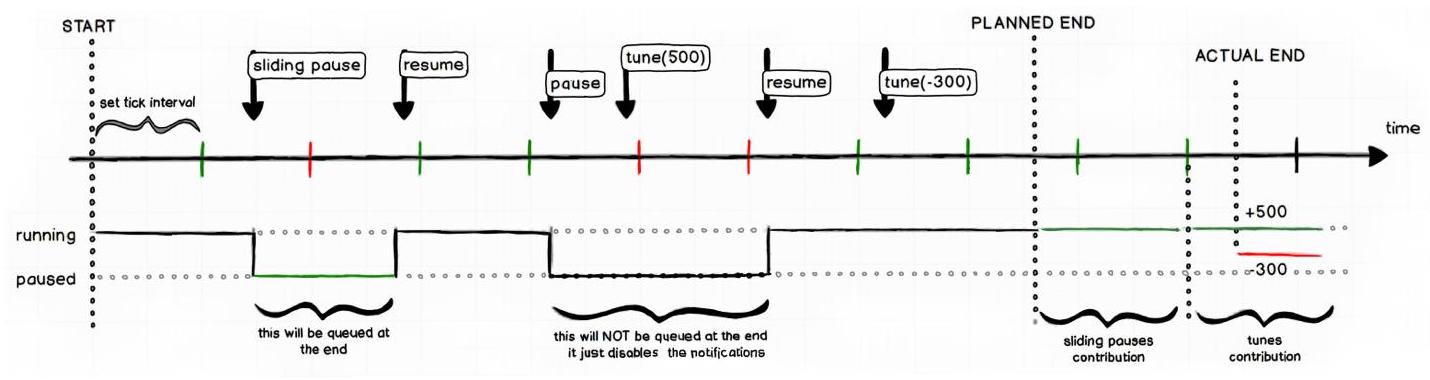
here the end is set calling endsIn, then we trigger two different pauses:
- a sliding pause:
pauses the ticking notifications until resumed, assuming the pause lasts forTP1ms the planned end will be slided forward accounting it. - a default pause: it just pauses the ticking notifications without updating the planned end.
Why? ... just cause setInterval is badly divergent!
I tried some environments and looks like all shows time warping (+) to some extent.
Just to summarize a bit, a metric of how bad the setInterval behave could be the first iteration that overlaps.
Using an interval of 100ms for example the incident occurs already at the 30th cycle: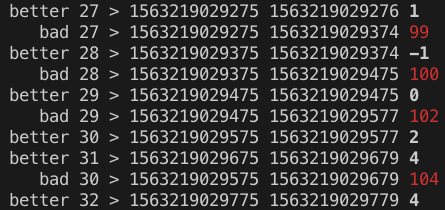
you can try it by yoursef in your node environment simply running:
> yarn compare 200
// for example, or passing any integer interval in ms
// you have to stop it manually (+c) or wait one hour 🤣let args = process.argv.slice(2),
start = +new Date(),
i1 = 0,
i2 = 0,
increment = parseInt(args[0], 10) || 100;
const interval = require('./../dist/index.js'),
int = interval(() => {
const now = +new Date(),
precise = ++i1 * increment + start;
let diff = (now - precise);
console.log(`better ${i1} > ${precise} ${now} \x1b[1m%s\x1b[0m`, `${diff}`);
}, increment).run(),
intervalW = setInterval(() => {
const now = +new Date(),
precise = ++i2 * increment + start;
let diff = (now - precise);
console.log(` bad ${i2} > ${precise} ${now} \x1b[31m%s\x1b[0m`, `${diff}`);
}, increment);
// stop anyway after one hour in case no ctrl+c
setTimeout(() => {
int.clear();
clearInterval(intervalW);
}, 3600000 * 1);