
@geoapify/react-geocoder-autocomplete
v3.1.0
Published
React component for the Geoapify Geocoder Autocomplete field

Maintainers
 geoapify
Readme
React Geocoder Autocomplete

The React Geocoder Autocomplete component integrates the core @geoapify/geocoder-autocomplete library into React. It provides an easy-to-use React wrapper for the Geoapify Geocoding Autocomplete API, allowing developers to add advanced, localized, and flexible address search functionality to their applications.
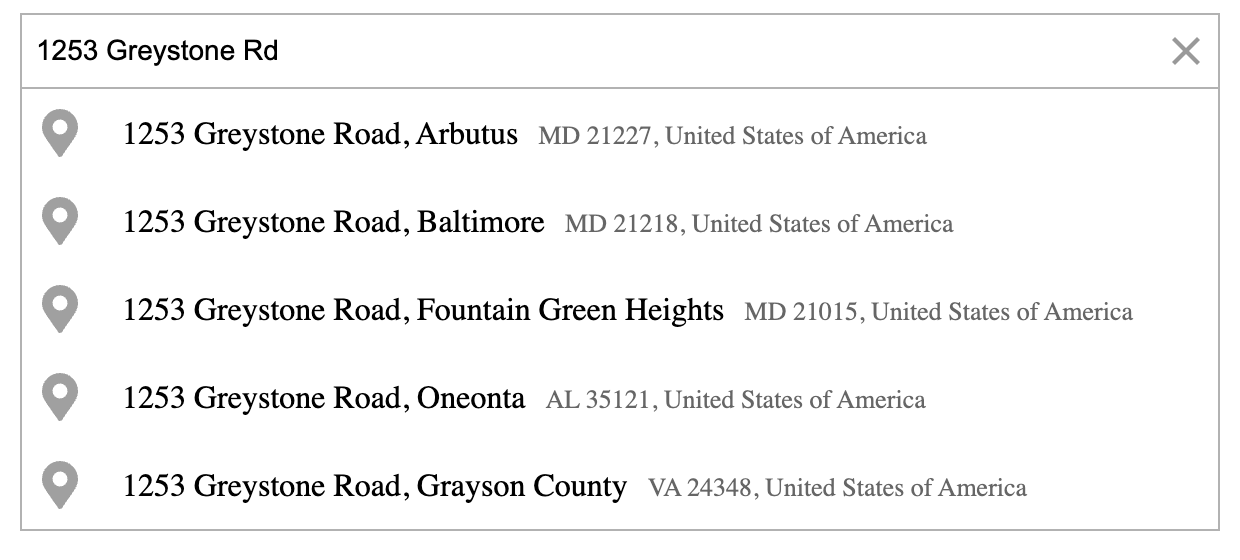
Table of Contents
Features
- Simple React integration with a ready-to-use component.
- Fast, responsive incremental search with built-in debounce.
- Localized suggestions with support for multiple languages and country filters.
- Flexible configuration: biasing, filtering, and bounding boxes.
- Customizable design: easily style or theme your component.
- Accessible with keyboard navigation and ARIA support.
- Rich results including coordinates, structured address, and metadata.
- Compatible with React 19.
Quick Start
You'll need a Geoapify API key to use the component.
- Register for a free account at myprojects.geoapify.com.
- Create a project to obtain your API key.
- You can start for free — Geoapify offers a generous Freemium plan.
1. Install
npm install @geoapify/geocoder-autocomplete @geoapify/react-geocoder-autocomplete
# or
yarn add @geoapify/geocoder-autocomplete @geoapify/react-geocoder-autocomplete
Get a Geoapify API key: https://myprojects.geoapify.com
2. Import styles and components
Import the CSS style file from @geoapify/geocoder-autocomplete and the React components from @geoapify/react-geocoder-autocomplete:
import '@geoapify/geocoder-autocomplete/styles/minimal.css';
import {
  GeoapifyContext,
  GeoapifyGeocoderAutocomplete
} from '@geoapify/react-geocoder-autocomplete';
Themes: minimal, round-borders, minimal-dark, round-borders-dark.
3. Add GeoapifyContext
Wrap your component with the GeoapifyContext and provide your API key:
<GeoapifyContext apiKey="YOUR_GEOAPIFY_API_KEY">
  {/* Your components go here */}
</GeoapifyContext>
Tip: Store your API key in your framework's client-side environment configuration (for example, import.meta.env.VITE_GEOAPIFY_KEY in Vite). Client-side API keys are visible in the browser, so configure suitable key restrictions in your Geoapify project.
4. Use the component
Basic:
<GeoapifyGeocoderAutocomplete />With events and common options:
<GeoapifyGeocoderAutocomplete
  placeholder="Search for an address"
  lang="en"
  limit={8}
  addDetails={true}
  placeSelect={onPlaceSelected}
  suggestionsChange={onSuggestionsChange}
/>
const onPlaceSelected = (feature) => {
console.log('Selected:', feature?.properties?.formatted);
};
const onSuggestionsChange = (list) => {
console.log('Suggestions:', list);
};Compatibility
| @geoapify/react-geocoder-autocomplete | React Version | | ------------------------------------- | -------------------- | | 1.0.x – 1.1.x | >= 16.8.0 | | 1.2.x – 1.3.x | >= 17.0.0 | | 1.4.x – 1.5.x | >= 18.0.0 | | 2.0.x – 2.2.x | >= 18.0.0, <= 19.x.x | | 3.0.x – 3.1.x | >= 19.0.0, <= 19.x.x |
If you prefer to use the library directly without React bindings, check the Standalone Usage section.
Documentation
Full documentation — including configuration options, detailed examples, and migration instructions — is available online at:

On the documentation site you'll find:
- A guided Quick Start to get the component running in minutes.
- A complete API Reference coverage of all props and callbacks.
- A dedicated Examples section with real-world scenarios (filters, biasing, category search, hooks).
- Guides for Standalone Usage of the underlying
@geoapify/geocoder-autocompletelibrary.
The component includes many options for configuration and customization. Below are the most commonly used properties that cover typical address autocomplete use cases:
| Property | Direction | Description |
| --------------------- | --------- | --------------------------------------------------------------------------------- |
| placeholder | Prop | Sets the placeholder text for the input field. |
| type | Prop | Defines the type of location to search for — e.g. city, locality, street, or amenity. |
| lang | Prop | Sets the language of suggestions and results. |
| limit | Prop | Limits the number of suggestions displayed. |
| debounceDelay | Prop | Adds a short delay before sending requests, improving performance. |
| filterByCountryCode | Prop | Restricts search results to selected countries. |
| biasByProximity | Prop | Prioritizes results near a specific location (latitude/longitude). |
| addDetails | Prop | Returns detailed information such as boundaries and place metadata. |
| skipIcons | Prop | Hides icons in the suggestion list for a minimal look. |
| placeSelect | Callback | Triggered when a user selects an address from suggestions. |
| suggestionsChange | Callback | Emits updated suggestions while typing. |
| onUserInput | Callback | Fires on each user input change. |
Examples
1. Basic Address Search
<GeoapifyContext apiKey="YOUR_API_KEY">
  <GeoapifyGeocoderAutocomplete
    placeholder="Search for an address"
    placeSelect={onPlaceSelected}
  />
</GeoapifyContext>
const onPlaceSelected = (place) => {
console.log('Selected place:', place?.properties?.formatted);
};Used properties:
placeholder, placeSelect
2. Restrict Results to Specific Country
<GeoapifyContext apiKey="YOUR_API_KEY">
  <GeoapifyGeocoderAutocomplete
    filterByCountryCode={['us']}
    placeSelect={onPlaceSelected}
  />
</GeoapifyContext>
Restricts suggestions to a list of countries using ISO country codes.
Used properties:
filterByCountryCode, placeSelect
3. Limit Search to Area (Berlin Example)
<GeoapifyContext apiKey="YOUR_API_KEY">
  <GeoapifyGeocoderAutocomplete
    filterByRect={{ lon1: 13.0884, lat1: 52.3383, lon2: 13.7611, lat2: 52.6755 }}
    placeSelect={onPlaceSelected}
  />
</GeoapifyContext>
This configuration restricts search results to the Berlin area.
Used properties:
filterByRect, placeSelect
4. Bias Results by User Location
import { useState, useEffect } from 'react';

const [userLocation, setUserLocation] = useState(null);

useEffect(() => {
  navigator.geolocation.getCurrentPosition((pos) => {
    setUserLocation({
      lon: pos.coords.longitude,
      lat: pos.coords.latitude
    });
  });
}, []);
<GeoapifyContext apiKey="YOUR_API_KEY">
<GeoapifyGeocoderAutocomplete
biasByProximity={userLocation}
placeSelect={onPlaceSelected}
/>
</GeoapifyContext>Prioritizes nearby results without strictly limiting the search area.
Used properties:
biasByProximity, placeSelect
5. Using Hooks for Custom Input and Suggestions
<GeoapifyContext apiKey="YOUR_API_KEY">
  <GeoapifyGeocoderAutocomplete
    preprocessHook={preprocessInput}
    suggestionsFilter={filterSuggestions}
  />
</GeoapifyContext>
const preprocessInput = (value) => {
return `${value}, Berlin`;
};
const filterSuggestions = (suggestions) => {
return suggestions.filter(s => s.properties.result_type === 'street');
};Used properties:
preprocessHook, suggestionsFilter
6. Add Details for Selected Place
<GeoapifyContext apiKey="YOUR_API_KEY">
  <GeoapifyGeocoderAutocomplete
    addDetails={true}
    placeholder="Search for a city"
    placeSelect={onPlaceSelected}
  />
</GeoapifyContext>
Adds boundary or geometry data (where available) to the selected feature.
Used properties:
addDetails, placeSelect
7. Enable Category (POI) Search
<GeoapifyContext apiKey="YOUR_API_KEY">
  <GeoapifyGeocoderAutocomplete
    addCategorySearch={true}
    showPlacesByCategoryList={true}
    placesByCategoryFilter={{
      circle: { lon: 13.405, lat: 52.52, radiusMeters: 5000 }
    }}
    onPlaceByCategorySelect={onPoiSelected}
  />
</GeoapifyContext>
const onPoiSelected = ({ place, index }) => {
console.log('Selected POI:', place.properties.name, 'at index', index);
};Enables category-based search and displays nearby Points of Interest (POIs) below the input. The circle filter restricts results to five kilometers around central Berlin.
Used properties:
addCategorySearch, showPlacesByCategoryList, placesByCategoryFilter, onPlaceByCategorySelect
8. Show Loading Indicator While Searching
import { useState } from 'react';

const [loading, setLoading] = useState(false);

<div className="autocomplete-wrapper">
   <GeoapifyContext apiKey="YOUR_API_KEY">
    <GeoapifyGeocoderAutocomplete
      onRequestStart={() => setLoading(true)}
      onRequestEnd={() => setLoading(false)}
      placeSelect={onPlaceSelected}
    />
  </GeoapifyContext>

  {loading && <div className="loading-spinner">Loading...</div>}
</div>
Used properties:
onRequestStart, onRequestEnd
9. Clear Selection
<GeoapifyContext apiKey="YOUR_API_KEY">
  <GeoapifyGeocoderAutocomplete
    onClear={onClear}
    placeholder="Search address"
  />
</GeoapifyContext>
const onClear = (item) => {
console.log('Selection cleared:', item);
};Used properties:
onClear
10. Combine Filters and Bias
<GeoapifyContext apiKey="YOUR_API_KEY">
  <GeoapifyGeocoderAutocomplete
    filterByCountryCode={['de']}
    biasByProximity={{ lon: 13.405, lat: 52.52 }}
    addDetails={true}
    placeSelect={onPlaceSelected}
  />
</GeoapifyContext>
Combines multiple parameters — country restriction, local bias, and detailed output — for refined search results.
Used properties:
filterByCountryCode, biasByProximity, addDetails, placeSelect
Learn More
- Geoapify Geocoding API Docs
- Place Details API Docs
- Geoapify API Playground
- Geoapify Address Autocomplete Overview
- @geoapify/geocoder-autocomplete on npm — includes more live demos and examples.
Contributions and Support
We welcome feedback, bug reports, and feature suggestions to improve the library.
Contributing
If you'd like to contribute:
- Fork the repository on GitHub.
- Create a feature branch (
git checkout -b feature/your-feature-name). - Make your changes and ensure the code follows React and TypeScript best practices.
- Submit a pull request with a clear description of your changes.
Before contributing, please review the existing issues and documentation to avoid duplicates.
Reporting Issues
If you encounter a bug or unexpected behavior, please open an issue on GitHub. When submitting an issue, include:
- A short description of the problem
- Steps to reproduce
- Expected vs. actual results
- React and package versions
Getting Support
- Visit the Geoapify Developer Portal for API documentation.
- Check the official documentation site for guides and examples.
- For general questions, contact the Geoapify support team via [email protected].