
@hardmachinelabs/index-ai-validator
v0.2.0
Published
Free, experimental CLI that makes a website's agent-facing layer testable: validates the index-ai AI Manifest, Agent Index, and clean endpoints.

Maintainers
 jordach
Readme
@hardmachinelabs/index-ai-validator
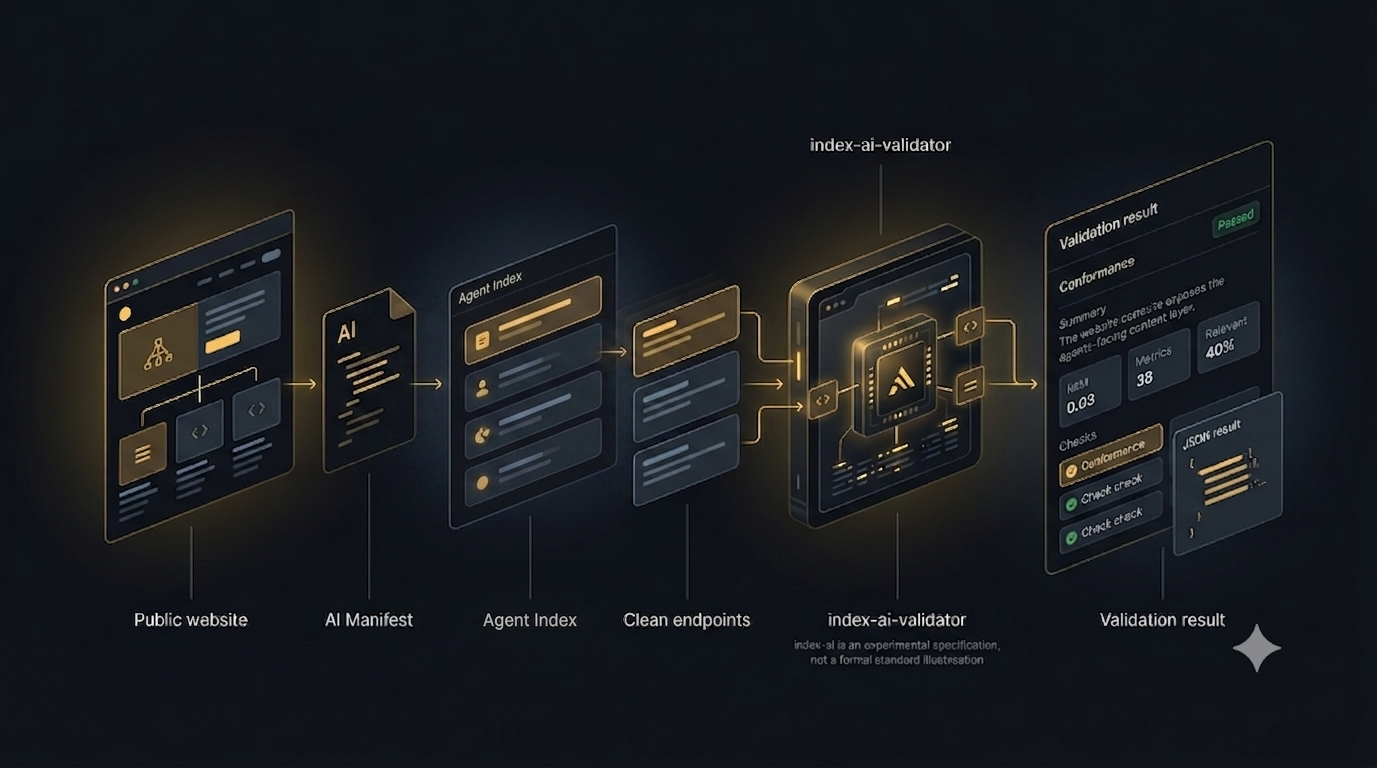
Is your website readable by AI agents? Most sites are built for browsers — HTML, scripts, navigation, layout. Agents have to read that browser-first HTML to understand you. @hardmachinelabs/index-ai-validator checks whether your site also exposes a clean, structured layer built for agents — and makes that layer testable from your terminal.
Point it at a public URL. It checks whether the site exposes the files and clean endpoints an agent needs to understand it without scraping rendered HTML: the AI Manifest, the Agent Index, clean Markdown or plain-text endpoints, and the declared content size of each node. It also flags obvious secret or private-infrastructure leaks in that public agent-facing content.
It is a free, experimental developer CLI. It provides the index-ai binary and the validateIndexAi() TypeScript entrypoint, and it validates index-ai Level 1 and Level 2a.
Naming:
- Repository:
index-ai-validator - Package:
@hardmachinelabs/index-ai-validator - CLI binary:
index-ai - Specification validated:
index-ai
It is a developer validator, not a production certification, legal compliance tool, traffic guarantee, SEO ranking tool, security audit, or vulnerability scanner.
Designed for CI and local audits: deterministic output, stable JSON, standalone HTML reports, and a small runtime dependency surface.
Installation / run with npx
The npm package is published under the HardMachine Labs scope. The CLI binary remains index-ai.
Run without installing:
npx @hardmachinelabs/index-ai-validator https://example.comOr with pnpm:
pnpm dlx @hardmachinelabs/index-ai-validator https://example.comLocal install:
pnpm add -D @hardmachinelabs/index-ai-validator
pnpm exec index-ai https://example.com
Requires Node.js 20 or newer.
CLI Usage
index-ai <url> [options]Examples:
index-ai https://example.com
index-ai https://example.com --json
index-ai https://example.com --strict
index-ai https://example.com --fail-on-warn
index-ai https://example.com --strict-security
index-ai https://example.com --allow-private-hosts
index-ai https://example.com --no-exit-code
index-ai https://example.com --timeout 10000
index-ai https://example.com --max-concurrency 5
index-ai https://example.com --html report.html
| Option | Required | Default | Description |
| --- | ---: | --- | --- |
| <url> | Yes | - | Target website URL. Must use http or https. |
| --json | No | false | Prints stable machine-readable JSON to stdout. |
| --verbose | No | false | Includes passing checks in human output. |
| --strict | No | false | Makes SHOULD-level warnings fail the global verdict. |
| --strict-security | No | false | Upgrades private infrastructure findings from warn to fail. |
| --fail-on-warn | No | false | Makes any warning fail the global verdict. |
| --no-exit-code | No | false | Returns exit code 0 for validation failures only. |
| --timeout <ms> | No | 10000 | Request timeout in milliseconds. |
| --max-concurrency <n> | No | 5 | Maximum concurrent clean endpoint checks. |
| --allow-private-hosts | No | false | Allows private/local hosts for trusted local development. |
| --html <path> | No | - | Writes a standalone local HTML report to a .html file. |
JSON output
Use JSON mode for CI and machine ingestion:
index-ai https://example.com --jsonIn JSON mode, stdout contains only JSON. Normal validation results do not use
stderr. Usage, configuration, or runtime errors before a validation result use
stderr and exit with code 2.
Example shape:
{
  "schema_version": "0.1",
  "target": "https://example.com",
  "generated_at": "2026-06-12T00:00:00.000Z",
  "duration_ms": 42,
  "conformance": "level-2a",
  "passed": true,
  "summary": {
    "pass": 12,
    "warn": 0,
    "fail": 0,
    "total": 12
  },
  "metrics": {
    "manifest_found": true
  },
  "checks": []
}
The real metrics object contains the implemented validator counters. The real
checks array contains check objects with stable codes, severity, messages,
and fixes where available.
HTML report
Use --html <path> when a local, shareable human review report is useful:
index-ai https://example.com --html report.htmlThe HTML report is optional. It is generated from the same ValidationResult
as the human and JSON output, and it does not change validation semantics or
exit codes.
HTML reports include a CI Verdict, Readiness score, and recommended next steps.
The readiness score is report-only and does not affect passed,
conformance, JSON output, or exit codes.
JSON remains the automation format. When JSON and HTML are combined, stdout still contains JSON only:
index-ai https://example.com --json --html report.htmlThe HTML report is not certification, legal compliance, a traffic guarantee, SEO ranking guarantee, security audit, or vulnerability scan.
Human output
Without --json, the CLI prints a deterministic summary-first report:
index-ai validation result

Target: https://example.com
Duration: 42 ms
Conformance: level-2a
Passed: true

Summary:
- pass: 12
- warn: 0
- fail: 0
- total: 12
Failures and warnings are shown with check codes and fixes where available.
Passing checks are shown only with --verbose.
Exit codes
| Code | Meaning |
| ---: | --- |
| 0 | A validation result exists and passed is true. |
| 1 | A validation result exists and passed is false. |
| 2 | No validation result exists because usage, configuration, or runtime setup failed. |
--no-exit-code changes validation failures from exit code 1 to exit code
0. It does not hide usage, configuration, or runtime errors that happen before
a validation result exists.
TypeScript Usage
import { validateIndexAi } from '@hardmachinelabs/index-ai-validator'

const result = await validateIndexAi({
  target: 'https://example.com',
  strict: false,
  strictSecurity: false,
  failOnWarn: false,
  verbose: false,
  timeoutMs: 10000,
  maxConcurrency: 5,
  allowPrivateHosts: false,
})
| Option | Required | Default | Description |
| --- | ---: | --- | --- |
| target | Yes | - | Target website URL. Must use http or https. |
| strict | No | false | Makes SHOULD-level warnings fail the global verdict. |
| strictSecurity | No | false | Upgrades private infrastructure findings from warn to fail. |
| failOnWarn | No | false | Makes any warning fail the global verdict. |
| verbose | No | false | Used by CLI output detail. |
| timeoutMs | No | 10000 | Request timeout in milliseconds. |
| maxConcurrency | No | 5 | Maximum concurrent clean endpoint checks. |
| allowPrivateHosts | No | false | Allows private/local hosts for trusted local development. |
Conformance vs Passed
conformance is structural. It reports the highest implemented index-ai
level reached: none, level-1, or level-2a.
passed is the global verdict for the current validation policy. Any fail check
makes passed false. Warning-sensitive options can also make warnings fail the
global verdict:
--strictmakes SHOULD-level warnings fail.--fail-on-warnmakes any warning fail.--strict-securityupgrades private infrastructure findings from warn to fail.
Security model
Security checks are conservative heuristics over public AI-facing clean endpoint text. The validator looks for obvious secret-shaped values and private infrastructure references, strips Markdown code examples before scanning, and redacts secret evidence in failure details.
These checks are not a full security audit, vulnerability scanner, penetration test, dependency scan, privacy review, or legal review.
Use --allow-private-hosts only for trusted local or private development. It
allows private/local hosts in targets and llm_url fetches that are blocked by
default.
Current scope
Implemented in 0.1.0:
- Level 1 AI Manifest validation
- Level 2a Agent Index validation
- clean endpoint content type checks
- HTML leak checks
content_charsexact and max checks- conservative security heuristics
- shallow discovery hints
- CLI human output, JSON output, and exit codes
TEST_PATTERNS.mdgovernance for future validator tests
Current limits
The package does not validate:
- Level 2b relations
- Level 3 MCP
- full robots.txt Disallow behavior
- discovery crawling
- sitemap validation
- DNS TXT discovery
- content quality
- SEO or GEO performance
- production compliance certification
- AI traffic outcomes
Need the layer built for you?
The validator tells you what is missing. If you need the AI-readable layer implemented, audited, or documented for a public website, see the project documentation and contact links.
Documentation: https://jordachmakaya.github.io/index-ai-validator/
About index-ai
index-ai is an experimental specification for making public websites easier for AI agents to read, inspect, and budget before fetching content.
It is built around three simple ideas:
- an AI Manifest that describes the site and its machine-readable entry points;
- an Agent Index that maps important public content into structured nodes;
- clean Markdown or plain-text endpoints designed for agents instead of browsers.
@hardmachinelabs/index-ai-validator is the free CLI validator for the current Level 1 and Level 2a implementation.
It does not claim to be a formal standard. It is an experimental project built in public to explore how websites can expose cleaner, cheaper, and more reliable content surfaces for AI agents.
Built by Jordach Makaya
index-ai and @hardmachinelabs/index-ai-validator are created and maintained by Jordach Makaya.
Jordach builds AI infrastructure for insurance claims workflows and developer tooling around reliable, inspectable AI systems.
The validator is part of a broader effort to make AI-facing web infrastructure testable instead of vague.
Links
- Documentation: https://jordachmakaya.github.io/index-ai-validator/
- GitHub: https://github.com/jordachmakaya/index-ai-validator
- npm: https://www.npmjs.com/package/@hardmachinelabs/index-ai-validator
- Author: https://github.com/jordachmakaya
License
MIT