
@heroui/agent
v1.0.0-beta.2
Published
Embed a hosted HeroUI Agent that turns application data into interactive UI.

Maintainers
 juniorgarciadev
Readme
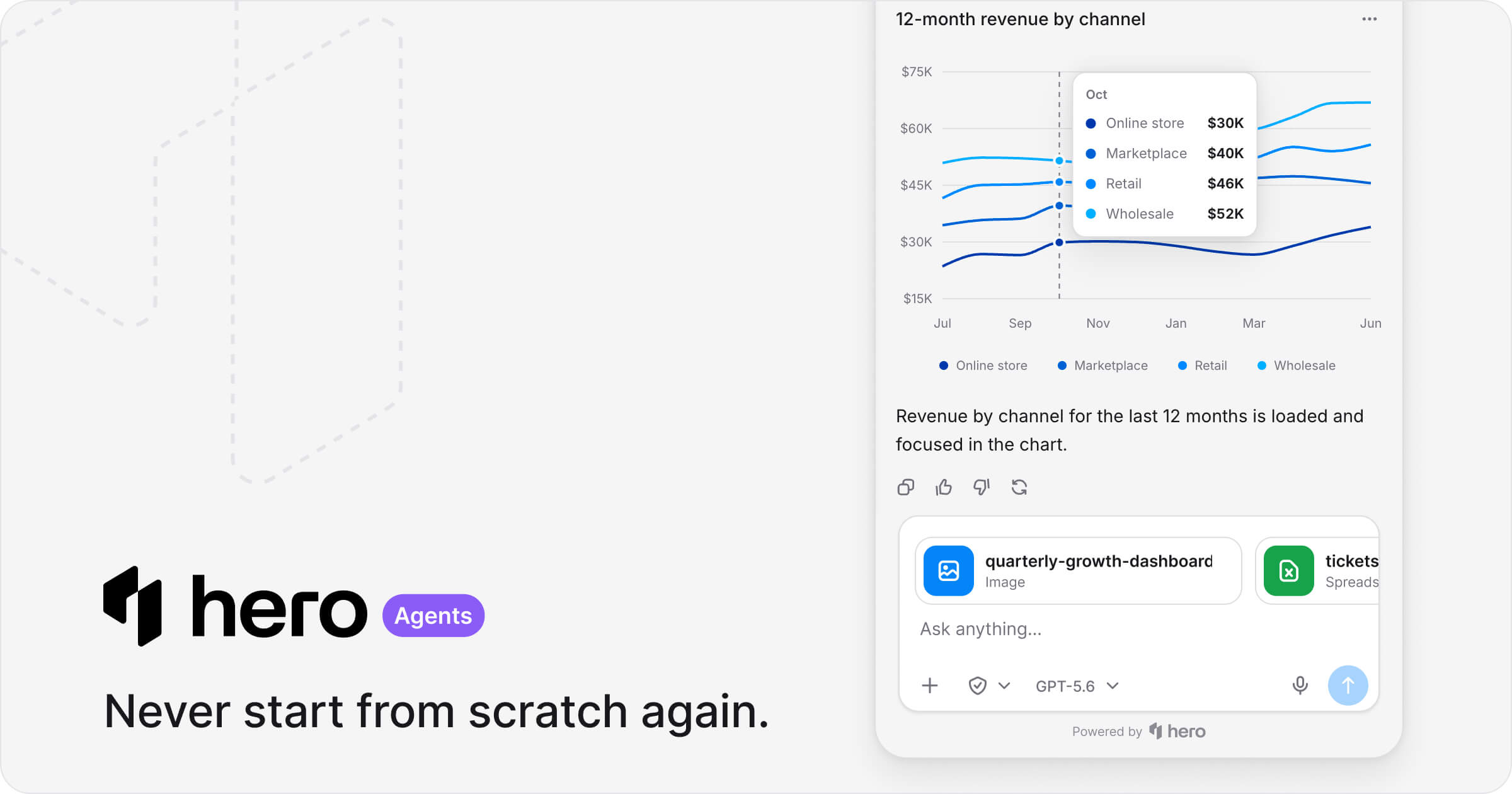
HeroUI Agents SDK
Embed a hosted generative-UI agent in your React app with @heroui/agent. Declare typed client tools that read your data — the hosted runtime plans the answer, runs calculations in a sandbox, and streams back charts, tables, and metrics.
Installation
npm install @heroui/agent@betaImport the stylesheet once:
@import "@heroui/agent/css";Usage
import {HeroUIAgent} from "@heroui/agent/next";

export function AppAgent() {
  return (
    <HeroUIAgent
      agentId={process.env.NEXT_PUBLIC_HEROUI_AGENT_ID!}
      getAuthToken={async (context) => {
        const response = await fetch("/api/heroui-agent/auth-token", {
          method: "POST",
          headers: {"Content-Type": "application/json"},
          body: JSON.stringify(context),
        });

        if (!response.ok) throw new Error("Agent authentication failed");

        return response.json();
      }}
    />
  );
}
Mint the short-lived browser credential on your server — never expose the project API key to the client:
import {createAuthToken} from "@heroui/agent/server";

export async function POST(request: Request) {
  const {anonymousId, agentId} = await request.json();

  return Response.json(
    await createAuthToken({
      apiKey: process.env.HEROUI_AGENT_API_KEY!,
      identity: {id: anonymousId, type: "anonymous"},
      agentId,
    }),
  );
}
Overview
@heroui/agent provides a unified SDK for embedding HeroUI Agents into web applications.
Entrypoints
| Entrypoint | Description | Links |
| -------------------------------------------- | -------------------------------------- | ----------------------------------------------------------------------------------------------------------------------- |
| @heroui/agent | React embed, hooks, and client tools | npm • Docs |
| @heroui/agent/next | Next.js App Router entry | Docs |
| @heroui/agent/server | Server helpers for minting auth tokens | Docs |
| @heroui/agent/css | Agent stylesheet | — |
| @heroui/agent/contracts | Shared protocol types and schemas | — |
Package Details
@heroui/agent
The core React SDK for embedding a hosted agent.
Features
- Generative UI — Charts, tables, metrics, and forms streamed from a validated component union
- Client tools — Typed browser functions that run with the signed-in user's session
- Dashboard-driven appearance — Theme, launcher, greeting, subtitle, and composer without a redeploy
- Anonymous → identified — Merge guest history when the user signs in
- Edge-safe contracts — Protocol types with no Node built-ins
Installation
npm install @heroui/agent@beta@heroui/agent/next
Next.js App Router entry that mirrors the root export.
import {HeroUIAgent} from "@heroui/agent/next";@heroui/agent/server
Server-only helpers for exchanging a project API key for a short-lived browser credential.
import {createAuthToken} from "@heroui/agent/server";Styles
@import "@heroui/agent/css";Optional Pro theme variants (brutalism, glass, mouve) ship from @heroui-pro/react:
import "@heroui/agent/css";
import "@heroui-pro/react/agent-themes/glass";
Contracts
Shared protocol version, message types, and schemas used by the SDK and hosted API.
import {HEROUI_AGENT_PROTOCOL_VERSION} from "@heroui/agent/contracts";Client Tools
Client tools let the agent call into your application — fetch data, change filters, create records:
import {HeroUIAgent, createToolHelper} from "@heroui/agent";
import {z} from "zod";

const tool = createToolHelper<{apiClient: ApiClient}>();

const tools = [
  tool({
    name: "search_users",
    description: "Search for users by name or email",
    parameters: z.object({query: z.string()}),
    execute: ({query}, context) => context.apiClient.searchUsers(query),
  }),
];

<HeroUIAgent
  agentId={process.env.NEXT_PUBLIC_HEROUI_AGENT_ID!}
  getAuthToken={getAuthToken}
  context={{apiClient}}
  tools={tools}
/>;
Only tool names, descriptions, and JSON schemas reach the hosted agent. Implementations and context never leave the browser.
Documentation
Projects and API keys are managed in the Agents dashboard.
What runs where
The HeroUI API authenticates the visitor once, verifies conversation ownership, and returns a
one-use connection ticket. The browser then keeps a resumable WebSocket directly to the
conversation's Cloudflare Durable Object. That object owns the transcript, streams from the model
provider, and starts MCP or an offline, per-call-scoped sandbox only when a tool actually needs
one. Before the composer clears, the SDK durably stores the submitted turn and attachment blobs in
an identity-and-conversation-scoped IndexedDB outbox. It removes that entry only after the Durable
Object acknowledges committed admission, and reconciles the same turnId after a reload. InstantDB
is updated asynchronously for dashboard monitoring and never sits in front of a response stream.
| In the browser | At the HeroUI edge runtime | | ------------------------------------------- | -------------------------------------------- | | Panel, theme, composer, generated UI | Conversation Durable Object and model stream | | Client tools, running as the signed-in user | Server tools, lazy MCP and offline Python | | Pre-admission IndexedDB turn outbox | SDK transcript and resumable stream storage | | A short-lived HeroUI browser credential | Hashed tickets, credit lease, Queue outbox |
Compatibility
- React 19+
- Next.js 15+ for
@heroui/agent/next - Chrome/Edge 120+, Firefox 121+, Safari 17.2+
- ESM only
This SDK speaks protocol version 6. The hosted API returns 426 Upgrade Required when a beta SDK is no longer compatible.
Support
License
MIT — see LICENSE.
Built by HeroUI