
@hunpeolabs/ai-agent-kit
v1.7.1
Published
The governed agent operating system that turns rough product ideas into approved requirements, specifications, delivery, and evidence-backed software.

Maintainers
 hunpeo97
Keywords
Readme
AI Agent Kit — From product idea to governed, traceable delivery.


Your agent can now begin before code exists, without a special prompt prefix. The Conversation Entry Gate recognizes a natural raw idea, enters Product Genesis, and resumes the durable workspace in later sessions. Product Genesis discusses and improves a rough idea, researches its practical opportunity, writes versioned business requirements and product specifications, waits for named human approval, and only then plans professional delivery. AI Agent Kit preserves why that code exists, which run produced it, what failed, what was fixed, and what evidence actually passed. It combines repository context, governed plugins, specialist workcells, security boundaries, review loops, memory, recovery, and proof in one local engineering system.
Install it once. Every supported agent starts from the same canonical .ai/
system while using only the capabilities its host really provides.
AI Agent Kit is MIT-licensed open source. Claude Code and Codex have the most complete integration today; every other adapter publishes its limitations instead of implying feature parity.
Idea → Discuss → Research → Approve → BRD + Rules → Approve → Spec + Design → Approve → Delivery → Build → Converge → OperateEvery decision should be recoverable. Every run should be traceable.
# Codex only
npx --yes @hunpeolabs/ai-agent-kit@latest bootstrap --agents codex

# Claude Code only
npx --yes @hunpeolabs/ai-agent-kit@latest bootstrap --agents claude
Bootstrap is local. It does not edit application code, commit, push, open a pull request, update a ticket, or deploy.
Develop a product from one goal
After installing this working-tree version, describe your goal to your active coding agent in ordinary language. For example:
Develop this product from my goal: [users and useful outcome]. Follow the installed product workflow, explain each step and continue approved work. Show output paths, review findings, evidence limits and the next action.
The agent performs discovery, rules/specs, design, approved coding, actual checks, independent review/fix loops and authorized release/sanity work. You can inspect or resume its recorded progress:
ai-agent-kit start "My product goal"
ai-agent-kit delivery list --format json
ai-agent-kit delivery next
ai-agent-kit delivery view
The saved view shows eight steps, their purpose, actual files, blockers, review
cycles and evidence levels. Local checks, authenticated review and operator
attestations stay distinct. The CLI needs an active coding-agent host; it does
not start a model or background worker. Publishing/deploying requires explicit
authorization. Available in v1.7.0. For a source checkout, build with npm run build and use
node bin/ai-agent-kit.mjs. Product flow guide.
Why it is different · Context model · What ships · Install · Supported agents · Documentation · npm
See it fail safely
npx --yes @hunpeolabs/ai-agent-kit@latest tracelab run --scenario production-bugTraceLab injects a realistic failure, sends the finding through the real review/fix states, and produces a local evidence timeline. Try parent drift, plugin escape, incomplete evidence, agent crash, or conflicting reviewers. The demo is deterministic and offline; it proves the control plane, not production agent quality.
Ask why a line exists:
ai-agent-kit why src/payment.ts:142The answer links recorded intent, alternatives, approval, run, review, fixes,
and evidence. Missing history stays UNKNOWN instead of becoming a confident
story.
Open the local redacted control view or export a portable run:
ai-agent-kit control view
ai-agent-kit run export --run-id <id> --output .ai-agent-kit/exports/run.aakrun
A system, not another prompt
Prompts are temporary. AI Agent Kit installs a reusable engineering harness in the repository, so planning, context selection, verification, review, memory, and safety do not depend on one long conversation.
| Without an engineering system | With AI Agent Kit | | --- | --- | | Plans disappear into chat history | Plans become scoped, reviewable artifacts before implementation starts | | “Please test this” is a reminder the model may skip | Repository-defined tests and quality gates produce explicit pass, fail, not-run, or blocked evidence | | The same context writes and approves the change | A fresh reviewer who did not own the write checks regressions, blind spots, security, and remaining risk | | Memory means saving a large transcript | Only approved, provenance-bound knowledge is retrieved; stale, revoked, sensitive, and speculative entries stay out | | Quality depends on repeatedly pasting standards | Stack-aware quality profiles, rules, skills, and hooks apply the relevant checks for the task | | Every task gets the same agent shape | Agent Department chooses solo, product, bug, or assurance workcells and keeps one write owner | | Agent configuration is trusted by default | Adapter conformance, config validation, supply-chain checks, capability gates, and evidence receipts make trust inspectable |
The kit does not replace human judgment or decide what a team should approve. It makes the workflow reproducible and the evidence reviewable.
Product Genesis: durable idea-to-product execution
Product Genesis stores current artifact heads, immutable predecessors, open decisions, evidence receipts, environment attestations, iterations, release candidates, and exact human approvals under .ai/products/<product-id>/. This lets an agent resume from evidence instead of asking the user to repeat the conversation.
Describe the idea naturally—Mình muốn làm một ứng dụng giúp các salon giảm
khách bỏ hẹn is enough. The agent runs the Conversation Entry Gate and selects
run-product-genesis; users do not need to mention v1.6 or a skill. Ambiguous
intent and multiple active products require one short confirmation.
printf '%s' 'Mình muốn làm một ứng dụng giúp salon giảm khách bỏ hẹn' | ai-agent-kit intent detect --stdin
ai-agent-kit delivery discover
ai-agent-kit delivery start --id salon-pilot --idea "Reduce salon no-shows" --profile standard
ai-agent-kit delivery resume --id salon-pilot
ai-agent-kit delivery next --id salon-pilot
ai-agent-kit delivery analyze --id salon-pilot --gate ALPHA_DECISION --write
ai-agent-kit delivery dossier-status --id salon-pilot
Discussion is limited to the three highest-impact current questions. LEAN, STANDARD, and HIGH_ASSURANCE profiles vary discovery and assurance depth without removing traceability or approval gates. Hypothesis experiments and business/trust/data decisions precede the BRD. Capacity-bounded iterations prevent stage gates from becoming document-only waterfall. GitHub issue creation remains preview-first; apply requires an exact plan approval plus a repository-trusted, one-use Ed25519 MEMBER action with product.github.write. product converge binds the approved chain to a clean full Git commit, existing code/test file hashes, and evidence receipts. Production readiness requires provider-verified CI/CD, security, accessibility, privacy/legal, deployment/operations, migration, capacity, restore/rollback, analytics, support, and environment evidence.
Keep the context focused
Rules, skills, workcells, hooks, memory, and evidence solve different problems. Keeping them separate lets the agent load what the task needs without carrying the entire engineering system in every prompt.
| Layer | What it does | Context behavior |
| --- | --- | --- |
| Skills | Reusable workflows for implementation, review, security, architecture, incidents, performance, design, SEO/GEO, and delivery | Explainable routing selects them when task evidence matches; low-confidence matches abstain |
| Workcells | Bounded specialist roles with separate assignments, tools, budgets, and one write owner | Isolates investigation, implementation, QA, assurance, and fresh review |
| Rules and quality profiles | Durable engineering standards plus language, framework, platform, and risk-specific checks | Mandatory rules stay loaded; task-specific profiles are compiled selectively |
| Hooks and action gateway | Deterministic checks for supported hosts and protected operations | Run outside model reasoning and return allow, ask, or deny receipts |
| Approved memory | Stable decisions, conventions, recurring failures, and validated patterns | Retrieval is scoped, bounded, provenance-aware, and excludes raw transcripts and unapproved candidates |
| Evidence | Decisions, runs, tests, reviews, receipts, replay, benchmarks, and release proof | Append-only canonical records stay inspectable without consuming the working context |
| Plugins | Skills, rules, profiles, hooks, commands, adapters, schemas, templates, and UI surfaces | Authority is recomputed per invocation; drifted or over-privileged plugins are denied or quarantined |
The context compiler records why every source was selected, its hash, the
repository commit, token estimate, and exclusions. Missing mandatory context
blocks implementation; missing optional indexes produce an explicit
DEGRADED state.
What ships today
| Capability | Included |
| --- | --- |
| Canonical skills | 41 skill sources, installed only where the selected adapter supports skill surfaces |
| Engineering workflows | 27 workflows for research, planning, implementation, review, incidents, architecture, delivery, policy, memory, traceability, recovery, coordination, and proof |
| Quality intelligence | 26 stack/risk profiles plus 23 durable engineering rules |
| Enforcement | 19 guards for approval, trace completeness, safe resume, plugin activation, capability, repository intelligence, memory, data, dependencies, orchestration, repository coordination, and protected actions |
| Reusable artifacts | 84 templates and schemas for business rules, behavioral specs, plans, decisions, runs, plugins, benchmarks, reviews, evidence, system design, teams, memory, product content, marketing, SEO/GEO, production release, and rehearsed demos |
| Canonical skills | 58 skill sources, including the Product Genesis orchestrator and sixteen stage skills, installed only where the selected adapter supports skill surfaces |
| Engineering workflows | 36 workflows for product discovery, experiments, requirements, iterations, production, implementation, review, incidents, architecture, policy, memory, recovery, and proof |
| Quality intelligence | 31 stack/risk/product profiles plus 29 durable engineering rules |
| Enforcement | 22 guards for product approval/evidence, trace completeness, safe resume, plugin activation, capability, repository intelligence, memory, data, dependencies, orchestration, and protected actions |
| Reusable artifacts | 113 templates and schemas for ideas, experiments, viability, trust/data, requirements, design, iterations, evidence, environments, production, support, retirement, decisions, runs, plugins, teams, memory, and release assurance |
| Agent ecosystem | 12 versioned adapters with machine-readable native, generated, bridged, advisory, preview, or unsupported capability states |
| Coordination | Four workcell modes, dependency-ready waves, leases, heartbeats, cancellation, bounded retries, recovery, and independent review |
| Verification | Behavioral evals, adapter/standards conformance, tests, Failure Lab, Agent Proof Replay, Change Passports, and fail-closed readiness |
Claude Code and Codex currently have the most complete native instruction,
skill, role, hook, and permission surfaces. GitHub Copilot has native
instructions, skills, and roles with a preview hook. The remaining adapters are
capability-limited by their hosts; run ai-agent-kit adapter matrix before
assuming feature parity.
Capability map
| Area | What AI Agent Kit provides | Honest boundary |
| --- | --- | --- |
| Context optimization | Deterministic task packs, token budgets, source reasons, exclusions, hashes, and optional indexed retrieval | Does not automatically choose the model or claim that a smaller prompt alone improves outcomes |
| Memory persistence | Proposed → approved → retrieved lifecycle with provenance, expiry, revocation, supersession, and source-commit checks | Does not retain raw sessions, secrets, personal data, or unreviewed conclusions |
| Continuous improvement | Outcome analytics, memory candidates, golden cases, routing fixtures, quality profiles, and reusable skills | Repeated wins are promoted through review; the kit does not silently learn from every session |
| Verification loops | Repository tests, explicit gates, behavioral evals, review → fix → verify cycles, replay, and evidence-backed release status | Unrun checks remain unrun; local or synthetic evidence is not production proof |
| Parallel execution | Risk-sized workcells, dependency waves, bounded concurrency, one writer, structured handoffs, and serial fallback | Native parallel execution requires verified host capabilities and a host-bound attestation |
| Security | Command policy, approval-to-diff checks, zero-trust MCP, capability tokens, adapter/config validation, SBOM, supply-chain checks, threat modeling, and security review | AI Agent Kit does not bundle AgentShield or replace independent security testing |
| Decision recovery | Append-only Decision Chronicle, supersession, intent-to-code lookup, Run Envelopes, recovery previews, and portable .aakrun bundles | Recorded provenance can explain known history; it cannot reconstruct decisions that were never captured |
| Plugin ecosystem | Keyless-by-default scaffolding, manifest validation, previewable lifecycle, per-invocation least privilege, receipts, quarantine, and a local Trust Center | No hosted marketplace is required, and publisher popularity is not treated as trust |
See the system work
For production product work, the mandatory Product Delivery Contract connects business rules, specs, design revisions, tasks, executed acceptance, release and demo claims. Reuse canonical project documents; templates are authoring aids and do not establish completion. See the kit's product rules/specs, system design, and delivery/presentation record for a concrete application and current verification limits.
Agent Department: plan, coordinate, verify, review
ai-agent-kit team demoThe offline demo runs the real planner, dependency scheduler, shared claims, approval gate, assurance rejection, fix loop, fresh independent review, and hash-chained timeline. It is explicitly marked synthetic: it proves the local control plane, not the quality or behavior of a live AI host.
The result is a standalone HTML timeline plus JSON and text evidence under
.ai-agent-kit/demo/agent-department/. For live Codex or Claude claims, create
an attestation template and verify it against the task journal:
ai-agent-kit team conformance-template --adapter codex > conformance.json
ai-agent-kit team conformance --file conformance.json
An empty template is not a pass. Live conformance requires observed spawn and result lifecycle events, host/run binding, evidence hashes, and the current journal head.
Repository Team Control Plane in v1.5.0
Task-local claims stop two assignments in one task from colliding. They cannot see another task. v1.5.0 adds a sealed repository registry in the Git common directory so linked worktrees share task, scope, lease, heartbeat, and fencing state.
ai-agent-kit team identity-verify --file identity.json --identity-key-env AAK_IDENTITY_KEY
ai-agent-kit team plan --id TASK-123 --control-plane
ai-agent-kit team registry
ai-agent-kit team workspace-plan --id TASK-123 --assignment implementation-engineer --parent-commit <full-sha>
Writers require an isolated clean worktree and exact parent snapshot. Results must carry a live monotonic fencing token. Change packages then pass structured conflict analysis, independent review, required-owner checks, and an Integration Owner decision. Child agents still cannot commit, push, merge, tag, publish, or deploy.
The default registry coordinates processes and linked worktrees sharing one Git common directory. It does not claim distributed consensus across machines. Remote execution requires an authenticated host attestation and a compatible shared backend.
See the complete loop without touching a real project:
npx --yes @hunpeolabs/ai-agent-kit@latest demoThe command creates a private, offline Agent Proof Replay with the plan, approval, policy decisions, verification, review fixes, and final readiness in one page. It includes no source, prompts, secrets, or raw logs.
What it does
AI Agent Kit gives coding agents a shared engineering system instead of a different set of instructions for every tool.
| Your agent can | How the kit helps | | --- | --- | | Understand the repository | Builds task-specific context from source, docs, ownership, architecture, CodeGraph, and CocoIndex. Missing optional indexes fall back to bounded native inspection instead of blocking work. | | Plan before changing code | Maps impact, risk, preserved behavior, tests, rollback, and exact paths, then waits for approval when the change requires it. | | Bring in the right specialists | Chooses a solo, product, bug, or assurance workcell. Shared claims and handoffs stop subagents from duplicating work or editing over one another. | | Design for real constraints | Turns latency, traffic, concurrency, reliability, security, regions, and budget into capacity math, architecture options, cost evidence, and migration triggers. | | Build against the actual stack | Selects quality profiles for the language, framework, web, mobile, desktop, API, database, infrastructure, security, testing, SEO/GEO, design, motion, and marketing work in scope. | | Review until the change is clean | Checks requirements, failure paths, security, error handling, code quality, and trade-offs. Findings return to the implementation owner for another fix and review cycle. | | Prove what happened | Produces final task reports, PR evidence, offline Agent Proof Replay, Failure Lab results, signed Change Passports, and evidence-backed readiness blockers. | | Keep humans in control | Binds tools, paths, domains, actions, policies, and approvals to the task. Commit, push, deploy, release, messaging, spending, and other protected actions stay separately authorized. |
Change-aware Architecture Pulse in v1.4.1
Architecture Pulse answers questions that tests and local review do not fully cover: what structural facts changed, which exact findings are new or fixed, which components are affected, and whether the evidence is precise enough to warn or block?
Git snapshot → Tiered dependency evidence → Stable findings → Baseline or diff → Named policy → EvidenceIt scans locally with path, resource, artifact, and deadline bounds. Findings carry stable fingerprints, witness paths, affected components, and evidence tiers. Coverage distinguishes supported source, policy exclusions, external packages, unresolved internal imports, ambiguity, and parse failure instead of compressing them into a misleading percentage.
ai-agent-kit pulse scan --format text
ai-agent-kit pulse diff --base origin/main --head working-tree --format text
ai-agent-kit pulse baseline create --config pulse.json
ai-agent-kit pulse check --config pulse.json --format text
The aggregate Pulse index is diagnostic only. Blocking requires an explicit named rule and an approved evidence tier. Count cancellation, stale baselines, tampered or expired waivers, unsupported source, incompatible semantics, and low-confidence evidence fail closed. Task reports and Change Passports accept only digest-valid, task-bound artifacts that still match the current commit and worktree state.
Architecture Pulse is a clean-room, first-party module with no Sentrux code, package, binary, service, telemetry, asset, or runtime dependency. See the workflow, configuration, trust model, and limitations.
If this workflow helps your agents do better engineering work, consider starring the repository. It helps other developers find the project.
What's included
Repository-aware workflow
- CodeGraph for structure and impact analysis.
- CocoIndex for semantic search across code and documentation.
- A bounded
DEGRADEDfallback when either index is unavailable. - Task-specific context packs with sources, selection reasons, token budgets, and deterministic hashes.
- Ready-made workflows for planning, implementation, bug fixes, reviews, incidents, architecture, security, testing, releases, and handoff.
Code quality
- Profiles for Go, Java, Python, TypeScript/JavaScript, and HTML/CSS.
- Web, mobile, desktop, infrastructure, and DevOps guidance.
- API, database, concurrency, memory, security, observability, dependency, and testing checks.
- Automatic profile selection based on the repository's language, framework, platform, and risk.
System design from real constraints
Describe the outcome in normal language—latency, traffic, concurrent users, security, reliability, regions, and budget. The agent turns it into measurable requirements, inspects the current system, calculates capacity, and recommends the smallest architecture with a clear path to the target scale.
Requirements → Capacity → Options → Cost → Risks → Recommendation- Keeps RPS, active users, open connections, and in-flight requests distinct.
- Uses percentile-based latency and explicit availability, RTO, RPO, consistency, durability, and data boundaries.
- Calculates concurrency, bandwidth, storage growth, headroom, and evidenced replica needs with a deterministic model.
- Looks up AWS, Google Cloud, or Azure catalog prices only when provider, region, and service dimensions are known; snapshots are hashed and cached, while unavailable pricing never becomes zero.
- Generates approval-bound benchmark plans, imports measured results, and keeps calculated capacity separate from unproven instance throughput.
- Produces a local architecture evidence pack with an offline visual report, traceability, tamper detection, repository-staleness checks, and diffs.
- Applies workload playbooks for APIs, realtime, streams, batch, media, search, AI/RAG, multi-tenant SaaS, and payment ledgers.
- Compares launch, target, and justified extreme-scale stages without forcing premature Kubernetes, microservices, partitioning, or multi-region writes.
- Stops at
READY_FOR_REVIEW; architecture alone is never production proof.
ai-agent-kit architecture start --goal "Design a secure API for 1M RPS" \
  --peak-rps 1000000 --latency-ms 900 --provider aws --region us-east-1
ai-agent-kit architecture status
ai-agent-kit architecture validate --file request.json
ai-agent-kit architecture model --file request.json --tested-safe-rps 500
ai-agent-kit architecture build --file design.json
ai-agent-kit architecture verify --file .ai-agent-kit/architecture/designs/ARCH-1/architecture.json
architecture start creates the normalized request and shows no more than
three architecture-changing questions plus copy-ready next commands. Use
architecture quick for the same guidance without writing a file. A pricing
snapshot can be attached to architecture model with --pricing-snapshot and
--monthly-quantity; missing pricing remains unavailable rather than zero.
Writing quality
- A
humanize-writingskill for natural voice editing across posts, blogs, emails, and personal or marketing drafts. - A mandatory
write-product-contentgate for labels, actions, forms, state messages, accessibility text, and displayed-data semantics in websites, mobile apps, desktop apps, and other product interfaces. - Context-first copy decisions tied to verified behavior, business meaning, complete UI states, accessibility, localization, and rendered evidence; the gate blocks vague, unsupported, robotic, blaming, or misleading content.
- A mandatory Apple HIG-derived Human Interface mapping for Purpose, Agency, Responsibility, Familiarity, Flexibility, Simplicity, Craft, and Delight, with target-platform fit and an explicit no-imitation boundary.
- Task-local voice mirroring, a model-language pattern dictionary, and meaning-preserving rules for facts, attribution, authorship, and privacy.
- No fabricated experiences or specificity, and no claims that a rewrite can prove human authorship or bypass AI detectors.
Website growth, end to end
The kit helps an agent understand what the website needs to say, build it well, and measure what happens next.
Context → Positioning → Page → SEO/GEO → Design & motion → Measure → Improve- Marketing context, message match, funnels, landing pages, CTAs, attribution, and safe experiments.
- A claim ledger that keeps assumptions, missing proof, and invented customer stories out of public content.
- SEO and GEO rules for metadata, canonical URLs, structured data, hreflang, crawl policy, raw HTML, and evidence-backed public claims.
- Design and animation guidance that works with the existing system and keeps accessibility, performance, reduced motion, and content intact.
- Measurement plans with clear metrics, consent, privacy, source of truth, and
an honest
NOT_MEASUREDresult when evidence is missing.
Add the complete workflow to your repository:
npx --yes @hunpeolabs/ai-agent-kit@latest bootstrapGovernance and safety

AI Agent Kit gives every coding agent the same path:
Understand → Inspect → Plan → Approve → Execute → Verify → Report
Inside Verify, the agent repeats review → fix → verify until a fresh review passes. Release actions always require separate authorization.
- Existing-system changes stop for a reviewed impact plan and explicit approval.
- Protected edits are checked against the approved paths and current diff.
- Command policy separates safe, review-required, and forbidden operations.
- Task capabilities limit tools, paths, domains, risk, expiry, and action count.
- Protected execution returns
allow,ask, ordenywith hash-linked evidence. - Zero-trust MCP checks server identity, permissions, network access, credentials, timeouts, and rate limits.
Portable across agents
- A versioned adapter SDK keeps instructions, skills, roles, hooks,
permissions, protected actions, and evidence mapped to one
.ai/source. ai-agent-kit adapter matrixshows the exact capability level and known limitations for all 12 supported agents.ai-agent-kit adapter conformance --adapter copilot --target .verifies the installed surfaces instead of assuming they work.- GitHub Copilot gets repository and path-specific instructions, custom planner/implementer/reviewer/security agents, native skill delivery, and an approval hook that keeps read-only work moving while gating mutations and protected release actions.
ai-agent-kit standards verifychecks Agent Skills bundles, explicit MCP compatibility, namespaced extensions, and the optional A2A profile.- A2A stays disabled by default. It is only relevant for explicitly approved, authenticated delegation to an independently operated remote agent.
One task. The right engineering team.
Some changes need one focused agent. Others need an investigator, an implementer, QA, security, and a reviewer who did not write the code. The kit decides after it understands the task, then assembles the smallest safe workcell.

- Feature work gets a product workcell; bugs start with investigation; risky security, data, payment, concurrency, or infrastructure changes add assurance specialists.
- A shared, versioned brief lets specialists reuse facts instead of scanning the same code again. Claims prevent duplicate work; one write owner prevents agents from editing over each other.
- Execution is capability-driven. Codex and Claude default to an unverified serial contract; host-native spawning is enabled only after a host probe declares structured results, cancellation, scope enforcement, and safe concurrency. A native dispatch must carry an external run ID or be executed by an injected bridge. Other hosts run the same assignments as serial personas, so missing subagent support never blocks useful work.
- The planner reconciles against current paths, facts, assumptions, risk, and approval immediately before dispatch. Security, migration, API, performance, concurrency, and design specialists are selected only when signals justify them.
- Review stays independent. Findings go back to the implementation owner, then downstream QA and assurance run again before a fresh review is accepted.
- Fan-out, depth, time, tokens, actions, paths, and external operations remain bounded. Subagents cannot quietly expand scope or release on their own.
- Handoffs carry evidence, structured findings, risks, tests, and open questions—not prompts, chat history, credentials, or chain-of-thought. They are treated as untrusted data and bound to file hashes. Duplicate findings are synthesized while confidence and severity disagreements stay visible.
- Every lifecycle mutation writes a content-minimized, hash-chained event. Retried result ingestion is idempotent; recovery verifies the journal, reconciles state-ahead gaps, and stops for possible orphaned writes.
ai-agent-kit team plan --id TASK-123
ai-agent-kit team start --id TASK-123 --adapter codex
ai-agent-kit team next --id TASK-123
ai-agent-kit team dispatch --id TASK-123 --assignment impact-explorer --agent explorer-1
ai-agent-kit team heartbeat --id TASK-123 --assignment impact-explorer
ai-agent-kit team ingest --id TASK-123 --assignment impact-explorer --result-file result.json
ai-agent-kit team watch --id TASK-123 --output .ai-agent-kit/proof/TASK-123
ai-agent-kit team recover --id TASK-123
ai-agent-kit team report --id TASK-123
team next exposes only the dependency-ready wave. The host-native bridge
spawns that wave, and dispatch claims each assignment before execution.
cancel releases active claims; resume retries bounded read-only work but
stops for Team Lead review when a writer may be orphaned. Write dispatch always
requires the current approval hash.
To compare coordination modes without marketing-by-anecdote, use the three-mode benchmark contract:
ai-agent-kit team benchmark-template > team-benchmark.json
ai-agent-kit team benchmark --fixture team-benchmark.json
The evaluator compares SINGLE_AGENT, UNGOVERNED_MULTI_AGENT, and
AGENT_DEPARTMENT only when task, repository commit, host, and model are held
constant with at least three equal repetitions per mode. Missing fields or
unequal samples return INSUFFICIENT_EVIDENCE; synthetic inputs never authorize
a product-performance conclusion.
The workcell, shared handoffs, conflicts, review cycles, and evidence hashes appear in Agent Proof Replay, so the final report shows both what changed and how the team reached it.
Lifecycle and evidence
- Give every completed AI change a signed Change Passport that another developer can verify without trusting the report author.
- Exercise timeouts, denied access, partial failures, cleanup, rollback, and other relevant unhappy paths through a shell-free Failure Lab manifest.
- Preview an action against the current task capability and policy without recording or executing it.
- Generate an offline Agent Proof Replay with redacted JSON, a standalone HTML report, PR summary card, trust badge, and optional OpenTelemetry-compatible trace export.
- Resolve signed organization, team, repository, and task policies into one effective contract while preserving the source and precedence of every rule.
- Measure verified outcomes, review effort, rework, rollback, cost, and action decisions locally without collecting source, prompts, secrets, or direct personal identifiers by default.
- Keep approved memory current and revocable with expiry, review dates, supersession, source-commit checks, deterministic retrieval, and a health report.
- Turn repeated verified runs into review-only skill, rule, profile, plugin, or routing proposals. Evidence never promotes policy automatically.
- Inspect installed plugin permissions, compatibility, provenance, signature, lifecycle receipts, drift, and quarantine state through the local Trust Center.
- Replay the same recorded repository task across Claude Code and Codex, then compare outcomes, trajectory, latency, cost, and action counts offline.
- Generate a concise PR evidence package with task scope, changed files, approval match, checks, receipt verification, and remaining uncertainty.
- Measure review accuracy, severity calibration, duplicates, actionable findings, accepted fixes, latency, and escaped defects without rewarding comment volume.
- Run a mandatory final implementation review before handoff. It checks requirements, security, code quality, failure paths, error handling, production readiness, and trade-offs. The agent fixes approved findings, verifies them, and reviews again until a fresh cycle passes; the report keeps every cycle, finding, fix, residual risk, and blocker.
- Read-only
status,doctor, and manageddiffcommands. - Dry-run bootstrap, update, uninstall, and tool-install planning.
- Migration-safe
update --applywith backups, rollback, and conflict evidence. - Approved memory with provenance and stale-state handling.
- Behavioral safety evaluations and an SPDX SBOM.
- Final task reports covering acceptance progress, checks, remaining work, blockers, Git state, token usage, estimated API-equivalent cost, and fail-closed readiness.
Install for the agents you use
Run one command inside your Git repository. The kit installs only the adapter files and skill surfaces needed by the agents you select.
| AI coding agent | Install command |
| --- | --- |
| OpenAI Codex | npx --yes @hunpeolabs/ai-agent-kit@latest bootstrap --agents codex |
| Claude Code | npx --yes @hunpeolabs/ai-agent-kit@latest bootstrap --agents claude |
| GitHub Copilot | npx --yes @hunpeolabs/ai-agent-kit@latest bootstrap --agents copilot |
| Cursor | npx --yes @hunpeolabs/ai-agent-kit@latest bootstrap --agents cursor |
| Windsurf / Cascade | npx --yes @hunpeolabs/ai-agent-kit@latest bootstrap --agents windsurf |
| Google Gemini CLI | npx --yes @hunpeolabs/ai-agent-kit@latest bootstrap --agents gemini |
| Amazon Q Developer | npx --yes @hunpeolabs/ai-agent-kit@latest bootstrap --agents amazonq |
| JetBrains Junie | npx --yes @hunpeolabs/ai-agent-kit@latest bootstrap --agents junie |
| Cline | npx --yes @hunpeolabs/ai-agent-kit@latest bootstrap --agents cline |
| Devin | npx --yes @hunpeolabs/ai-agent-kit@latest bootstrap --agents devin |
| Aider | npx --yes @hunpeolabs/ai-agent-kit@latest bootstrap --agents aider |
| Continue | npx --yes @hunpeolabs/ai-agent-kit@latest bootstrap --agents continue |
Use more than one agent in the same repository:
npx --yes @hunpeolabs/ai-agent-kit@latest bootstrap --agents codex,claude,cursorInstall every supported adapter only when your team needs all of them:
npx --yes @hunpeolabs/ai-agent-kit@latest bootstrap --agents allThen check the installation and see the available workflows:
npx --yes @hunpeolabs/ai-agent-kit@latest doctor
npx --yes @hunpeolabs/ai-agent-kit@latest prompts
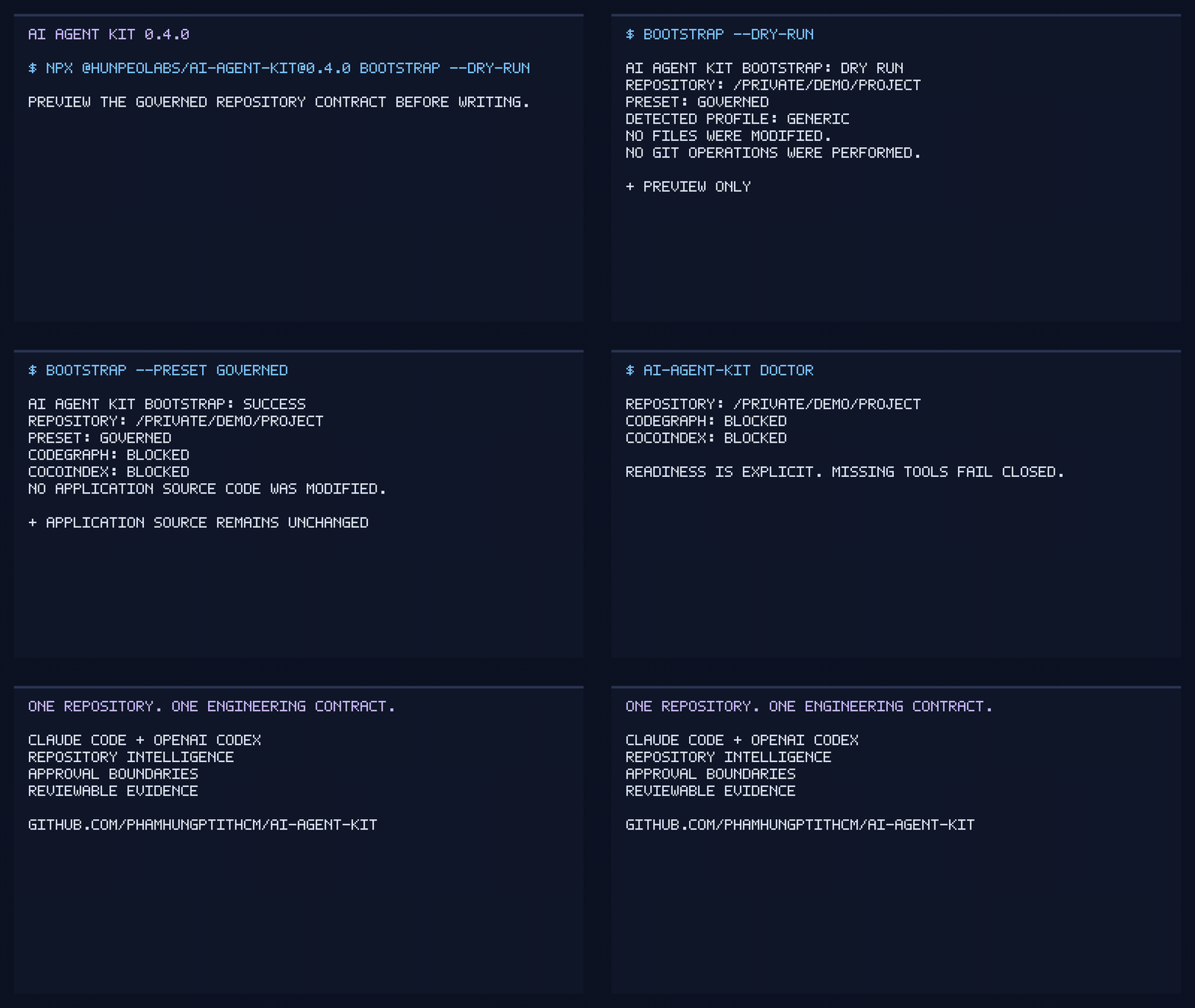
Add --dry-run to any bootstrap command if you want a preview. Bootstrap stays
local either way and never edits application code or runs Git operations.
Run the package without a command for the interactive menu:
npx --yes @hunpeolabs/ai-agent-kit@latestUse npx for a one-time import. npm install @hunpeolabs/ai-agent-kit keeps the
package in package.json and node_modules and imports the default governed
setup.
Daily use
Build a focused context pack for a task:
npx --yes @hunpeolabs/ai-agent-kit@latest context compile --id TASK-123 --budget 12000
npx --yes @hunpeolabs/ai-agent-kit@latest context inspect --id TASK-123
Review the final task report:
npx --yes @hunpeolabs/ai-agent-kit@latest runtime task report --id TASK-123 --format compactReplay an offline evaluation or generate PR evidence:
npx --yes @hunpeolabs/ai-agent-kit@latest eval replay --fixture path/to/case.json
npx --yes @hunpeolabs/ai-agent-kit@latest evidence pr-package --id TASK-123
Create a visual proof pack after the task reaches its review gate:
npx --yes @hunpeolabs/ai-agent-kit@latest proof --id TASK-123The output under .ai-agent-kit/proof/TASK-123/ contains:
index.html— offline visual replay.proof.json— deterministic redacted evidence.proof-card.md— compact GitHub PR summary.trust-badge.svg— readiness badge derived from current evidence.
Add --otlp only when an explicit observability export is approved.
Break the change safely, fix what fails, then sign the result:
npx --yes @hunpeolabs/ai-agent-kit@latest failure plan --manifest .ai/templates/failure-lab.json
npx --yes @hunpeolabs/ai-agent-kit@latest failure run --manifest .ai/templates/failure-lab.json --output .ai-agent-kit/failure-lab/TASK-123.json --apply
npx --yes @hunpeolabs/ai-agent-kit@latest passport keygen --key-id maintainer
npx --yes @hunpeolabs/ai-agent-kit@latest passport issue --id TASK-123 --key-id maintainer --private-key .ai-agent-kit/local/passport-keys/maintainer.private.pem --failure-report .ai-agent-kit/failure-lab/TASK-123.json --apply
npx --yes @hunpeolabs/ai-agent-kit@latest passport verify --file .ai-agent-kit/passport/TASK-123.json
The passport binds the READY proof, Git commit, content fingerprint, review,
evidence integrity, and Failure Lab report to a repository-trusted Ed25519
signature. A valid signature from an unknown or revoked key is
VALID_UNTRUSTED; repository drift is STALE. Neither is reported as verified.
Create and manage signed repository policy without hand-writing crypto:
npx --yes @hunpeolabs/ai-agent-kit@latest policy keygen --key-id repo-owner --layer repository
npx --yes @hunpeolabs/ai-agent-kit@latest policy init --layer repository --key-id repo-owner
npx --yes @hunpeolabs/ai-agent-kit@latest policy sign --bundle .ai/policies/repository.json --private-key .ai-agent-kit/local/policy-keys/repo-owner.private.pem --key-id repo-owner --apply
npx --yes @hunpeolabs/ai-agent-kit@latest policy verify --bundle .ai/policies/repository.json
npx --yes @hunpeolabs/ai-agent-kit@latest policy resolve
npx --yes @hunpeolabs/ai-agent-kit@latest policy diff
npx --yes @hunpeolabs/ai-agent-kit@latest policy simulate --id TASK-123 --tool deploy --domain production.example.com
Simulation is read-only. It returns allow, ask, or deny without consuming
the task action budget, writing evidence, or running the action.
Start a constraint-driven system design without preparing a long brief:
npx --yes @hunpeolabs/ai-agent-kit@latest prompt design-systemThe skill also activates automatically when a request mentions architecture, RPS, throughput, concurrent connections, latency percentiles, availability, recovery, security level, compliance, capacity, cloud choice, or cost.
Update an existing installation safely:
npx --yes @hunpeolabs/ai-agent-kit@latest update --dry-run
npx --yes @hunpeolabs/ai-agent-kit@latest update --apply
Local edits are preserved. Non-overlapping changes can merge automatically;
conflicts stay untouched and are written to .ai-agent-kit/conflicts/ for
review. Updates do not run Git commands.
Supported agents
The kit currently ships adapters for:
- Claude Code and OpenAI Codex
- GitHub Copilot
- Cursor and Windsurf/Cascade
- Gemini CLI and Amazon Q Developer
- JetBrains Junie
- Cline, Devin, Aider, and Continue
All adapters share the same .ai/ policy source, so switching tools does not
change the engineering contract. Use the agent-specific install
commands to add only the surfaces your team
needs.
See Agent Adapter Strategy for details.
Safety
- Critical operations are never autonomous.
- Protected actions return
allow,ask, ordenywith a reason. - Production, infrastructure, database, release, Git, messaging, destructive, and secret operations still require explicit human approval.
- Runtime evidence excludes prompts, responses, source content, raw command output, credentials, secrets, and chain-of-thought.
- CodeGraph and CocoIndex are optional. If either is unavailable, the kit uses
bounded native repository evidence in
DEGRADEDmode instead of blocking work or claiming full indexed coverage. - A repository report does not prove that an undeployed system is ready in its live environment.
How the kit evolved
| Version | Main additions |
| --- | --- |
| 0.1.0 | Local bootstrap, Claude and Codex setup, repository intelligence, backups, and validation. |
| 0.2.0 | Stack-aware quality profiles, SEO/GEO, design taste, animation engineering, lifecycle inspection, ownership protection, and packed smoke tests. |
| 0.3.0 | Governed runtime, approval-to-diff checks, command policy, capabilities, evidence receipts, approved memory, telemetry, evaluations, MCP trust contracts, and SBOM. |
| 0.4.x | Clearer adoption flow, optional-index DEGRADED mode, interactive activation, and governed npm install import. |
| 0.5.0 | Migration-safe updates, deterministic task context, and adapters for 12 coding agents. |
| 0.6.0 | Execution-bound action gateway, zero-trust MCP broker, token/cost usage ledger, and evidence-driven final task reports. |
| 0.6.1 | Human writing integrity, evidence-based website growth, portable skill references, and hardened resource synchronization. |
| 0.7.0 | Replayable cross-agent evals, evidence-native PR packages, regression gates, and high-signal review measurement. |
| 0.8.0 | Agent Department orchestration, shared Team Context, constraint-driven system design, signed policy overlays, local outcome analytics, memory lifecycle 2.0, Agent Proof Replay, Change Passports, Failure Lab, and Policy Playground. |
| 0.9.0 | Versioned adapter SDK, honest capability matrix, full GitHub Copilot surfaces, portable conformance, Agent Skills compatibility, MCP versioning, and optional A2A boundaries. |
| 0.9.1 | Durable Agent Department execution, approval-bound dispatch, idempotent results, recovery, hash-chained timelines, live-host conformance attestations, and evidence-gated three-mode benchmarks. |
| 1.0.0 | Explainable skill routing, SEO/GEO evidence contracts, context-bound dispatch, recoverable result ingest, unified fail-closed release proof, verified host capability gates, and package-state isolation. |
| 1.0.1 | Cleaner product positioning and a complete, current capability overview. |
| 1.1.0 | Append-only Decision Chronicle, portable Run Envelopes, safe resume and recovery, governed plugin runtime, ai-agent-kit why, .aakrun, TraceLab, and dogfooded proof. |
| 1.2.0 | Local Plugin Trust Center, privacy-safe agent observability, reproducible reliability benchmark, and evidence-backed case studies. |
| 1.3.0 | Governed shared memory for agents, subagents, worktrees, and later sessions with independent promotion, scoped retrieval receipts, and fail-closed trust boundaries. |
| 1.4.0 | Native Architecture Pulse with bounded polyglot scanning, dependency graphs, explainable structural metrics, trusted baselines, explicit regression policy, CLI workflows, and governed evidence binding. |
| 1.4.1 | Change-aware Pulse with stable finding identity, truthful coverage, tiered precision, base/head impact, governed waivers, SARIF, trends, bounded evidence packs, and a polyglot effectiveness benchmark. |
| 1.5.0 | Repository Team Control Plane with authenticated identities, cross-task claims, isolated worktrees, fencing tokens, integration packages, independent review, privacy-safe SLOs, and four-mode release benchmarks. |
| 1.6.0 | Product Genesis from a rough idea through discovery, research, human-approved BRD/spec baselines, Agile delivery planning, change control, and outcome review. |
| 1.7.0 | Evidence-bound delivery, 21 production controls, candidate-bound signed review/release and eight-step progress view. |
| 1.6.1 | Product Genesis Auto Entry with natural-language intent detection, safe workspace discovery/resume, cross-adapter entry instructions, and no required skill/version prefix. |
Documentation
- Adoption Guide
- High-Level Design
- Product Genesis: Idea to Production
- v1.7.0 Evidence-Bound Product Delivery release notes
- v1.6.1 Product Genesis Auto Entry release notes
- v1.6.0 Product Genesis release notes (draft)
- Agent Department Proof Loop
- Traceable Plugin Runtime
- Agent Reliability Benchmark
- Traceability Case Studies
- Traceable Plugin Runtime Security Review
- Skill Routing
- Additive AI Change Assurance Deep Review
- Additive AI Change Assurance Discovery Plan
- Runtime Enforcement and MCP Trust
- Governed Shared Memory v1.3.0
- v1.3.0 story and release notes
- Architecture Pulse v1.4.1
- Architecture Pulse v1.4.1 implementation plan
- v1.4.0 story and release notes
- v1.4.1 story and release notes
- Repository Team Control Plane v1.5.0 plan
- v1.5.0 story and release notes (draft)
- Code Quality Intelligence
- Security · Contributing
Development
npm ci
npm run check
npm run release:dry-run
The goal is simple: give AI agents enough context and freedom to be useful, while keeping important decisions and risky actions in human hands.
License
Production work uses revisioned contract v2 and AAK-PRODUCTION-1 checks. Progress shows document/source declarations, stack/budget/schedule constraints, missing execution evidence and limitations. Legacy local contracts cannot authorize production release.