@hurling/shared-tab-service
v0.1.0
Published
One service, every tab, zero duplication. Typed RPC and events shared across browser tabs with automatic transport selection (SharedWorker → tab-elected leader → SSR-safe stub).

Maintainers
 mrhut10
Readme
@hurling/shared-tab-service
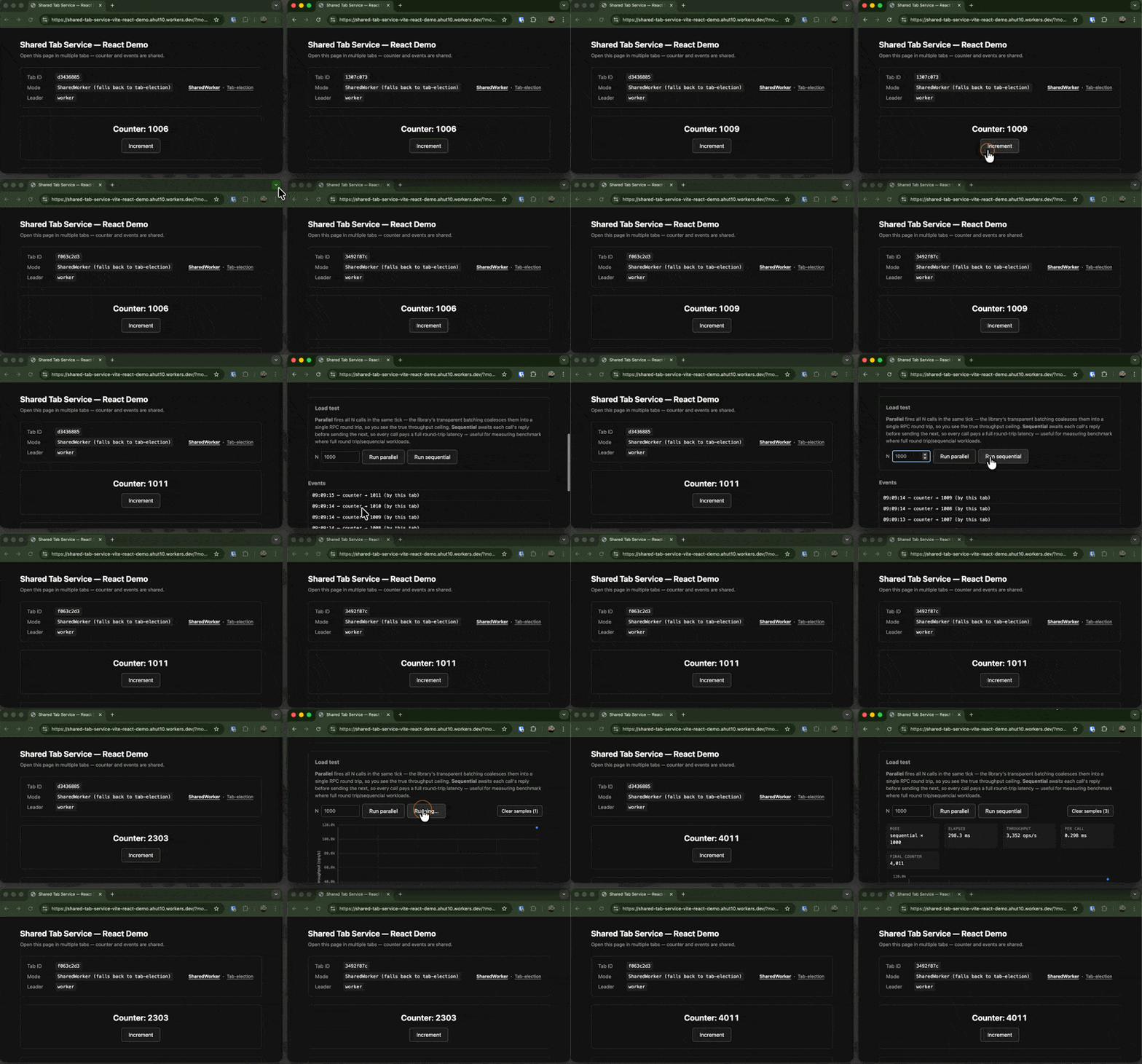
One service. Every tab. Zero duplication.
Stop opening N WebSockets, N auth sessions, and N polling loops just because your user opened N tabs. @hurling/shared-tab-service lets you define a service once and share a single live instance across every tab of your app — with fully typed RPC, typed events, and automatic transport selection under the hood.
const client = createSharedTabService({ name: 'my-app', services, workerUrl });

// Every tab calls this. Only the leader actually runs it.
const user = await client.auth.getUser();

// Every tab sees this event. Emitted once.
client.prices.on('tick', ({ symbol, price }) => update(symbol, price));
Try it live
Open either in a few tabs at once to watch them share a single service instance in real time:
- React demo (benchmark panel + throughput-over-N chart) — shared-tab-service-vite-react-demo.ahut10.workers.dev
- Minimal vanilla-TS demo — shared-tab-service-vite-demo.ahut10.workers.dev
Why you'll like it
- Typed end-to-end. Define your service, get a strongly-typed client everywhere — methods, arguments, return values, event names, event payloads. No codegen.
- Best transport, picked for you.
SharedWorkerwhen the browser supports it, a tab-elected leader overBroadcastChannelwhen it doesn't, an SSR-safe stub in Node. No branching in your app code. - Transparent batching. Calls made in the same microtask are coalesced into a single message. Events emitted during a batched call are fanned out in one broadcast. Your code never knows.
- Tiny surface area. One function to host the hub, one function to get a client, one helper to declare a service. That's the whole library.
- Credit where it's due. Leader election and cross-tab messaging build on the excellent
tab-electionlibrary. This package extends that foundation with automatic detection of what your browser supports, so work is offloaded via the most efficient mechanism available.
When to use it
- One tab should hold a shared WebSocket / EventSource / SSE connection, and every other tab reads from it.
- Your app opens an expensive IndexedDB handle or auth session that you'd like to dedupe across tabs.
- You're fanning out polling / subscriptions and don't want N tabs all hitting the server.
- Any state or side-effect you'd rather run once per browser, not once per tab.
Install
pnpm add @hurling/shared-tab-service
# or npm install / yarn add
The library is browser-first. Imports resolve safely in Node (SSR, tests) but calls will reject with a clear error unless a browser runtime is detected.
Quick start
The idiomatic setup is three small files: your services, a worker entry, and your app code.
1. Define your service
// src/services.ts
import type { Hub, SharedTabService } from '@hurling/shared-tab-service';

export interface CounterEvents {
  changed: { value: number };
}

export class CounterService implements SharedTabService<CounterEvents, 'counter'> {
  readonly namespace = 'counter' as const;
  readonly __events?: CounterEvents;
  private hub?: Hub;
  private count = 0;

  init(hub: Hub) {
    this.hub = hub;
  }

  async increment(): Promise<number> {
    this.count += 1;
    this.hub?.emit(this.namespace, 'changed', { value: this.count });
    return this.count;
  }

  async get(): Promise<number> {
    return this.count;
  }
}

export const services = {
  counter: new CounterService(),
};
The record key (counter) is authoritative — it's used as the runtime namespace and as the client property name. If the service declares a different namespace, registration throws.
2. Worker entry
// src/shared.worker.ts
import { runSharedTabHub } from '@hurling/shared-tab-service/worker';
import { services } from './services';

runSharedTabHub({
  name: 'my-app',
  services,
});
3. Client
// src/main.ts
import { createSharedTabService } from '@hurling/shared-tab-service';
import { services } from './services';

const client = createSharedTabService({
  name: 'my-app',
  services,
  workerUrl: new URL('./shared.worker.ts', import.meta.url), // Vite / webpack / Rollup all understand this
});

// Fully typed RPC
const n = await client.counter.increment();

// Typed events
client.counter.on('changed', ({ value }) => {
  console.log('counter is now', value);
});
That's it. Open multiple tabs — they share the same CounterService instance.
Transport modes
createSharedTabService picks the transport for you:
| Condition | Transport | Notes |
| ----------------------------------------------------- | ------------------------- | ----------------------------------------------------------------------------- |
| workerUrl set + browser supports SharedWorker | SharedWorker | One shared process per origin; survives tab closes until the last one goes. |
| workerUrl set + only Worker supported | dedicated Worker | Each tab gets its own worker; tab-election still elects one as authoritative. |
| workerUrl missing, or neither worker type available | in-tab (Tab-election) | One tab is elected leader; all others RPC to it via BroadcastChannel. |
| No browser runtime (Node, SSR) | stub | All RPC calls reject with a clear error; .on(...) is a no-op. |
Force or skip a mode:
createSharedTabService({
  name: 'my-app',
  services,
  workerUrl,
  useSharedWorker: false, // skip SharedWorker, fall through to the next option
  useDedicatedWorker: false, // skip dedicated Worker too, force in-tab fallback
});
Defining a service
Two styles, same result:
// Class (recommended for stateful services)
export class DbService implements SharedTabService<MyEvents, 'db'> {
  readonly namespace = 'db' as const;
  readonly __events?: MyEvents;
  async getUser(id: string) {
    /* … */
  }
}

// Sugar for plain objects (no class ceremony)
import { defineService } from '@hurling/shared-tab-service';

export const db = defineService('db', {
  async getUser(id: string) {
    /* … */
  },
});
Every service exposed to the client must live under a key in the services record:
createSharedTabService({
  services: {
    db, // from defineService
    auth: new AuthService(),
    // ...
  },
});
Events
- Emit from the hub side:
this.hub.emit(this.namespace, 'eventName', payload). - Subscribe from the client side:
client.<namespace>.on('eventName', listener)returns an unsubscribe function. - Event names and payloads are typed via the
__eventsphantom property on the service.
const off = client.counter.on('changed', ({ value }) => {
  console.log(value);
});
off(); // stop listening
Batching (default on)
Every client.X.method(...) call gets queued and flushed in a microtask as a single batched RPC. Events emitted on the hub side during a batched call are coalesced into one broadcast. This is transparent to your code — your service doesn't know or care.
Controls:
createSharedTabService({
  batch: false, // opt out — every call goes as its own message
  batch: { flushMs: 4 }, // timer-based flush instead of microtask
  batch: true, // default — microtask flush
});
runSharedTabHub takes the same option — keep them in sync.
Lazy services
If you want the worker fallback path to not load your services module in the main bundle:
const client = createSharedTabService({
  name: 'my-app',
  services: () => import('./services').then((m) => m.services),
  workerUrl,
});
When workerUrl + SharedWorker is available the main thread never imports ./services. The worker does. If the library falls back to the in-tab Hub, the loader runs to resolve services on demand.
Client API
client.<namespace>.<method>(...args): Promise<Return>
client.<namespace>.on<K>(event: K, listener: (payload) => void): () => void

client.isLeader: boolean                            // true when this tab holds the lock
client.onLeaderChange(fn: (isLeader: boolean) => void): () => void
client.close(): void
isLeader is always false in SharedWorker mode (the worker is the "leader").
How replies stay paired with callers
Every RPC carries a (spokeId, callNumber) correlation pair so concurrent
calls on the same BroadcastChannel never cross wires — see
docs/correlation-ids.md for the full
walk-through.
Caveats
- State lives in the leader's memory. When a tab-election leader closes, a new tab is elected and services are re-initialized (counters restart from 0, subscriptions re-established, etc.). If you need state to survive leader flips, persist it (IndexedDB / localStorage) and rehydrate in
init. postMessagelimits apply — arguments and return values are structured-cloned. Functions, DOM nodes, and classes-with-methods don't cross the wire.- Services are singletons per transport. There is one instance per elected leader (tab-election) or one per SharedWorker.
- Namespace keys must be unique across the
servicesrecord — they're the addressable identifier.
Examples
Runnable Vite demos live in the repo's examples/ directory — a vanilla-TS demo and a React app with a benchmark panel and throughput-over-N chart.
Both are deployed:
- React: shared-tab-service-vite-react-demo.ahut10.workers.dev
- Vanilla TS: shared-tab-service-vite-demo.ahut10.workers.dev