
@iamem/amem
v0.15.0
Published
amem — agent memory, anchored to your code. Local facts, skills and tasks for Claude Code, Cursor, Codex and any MCP client. Private to your machine.

Maintainers
 getamem
Readme
amem






amem — agent memory, anchored to your code. Facts tied to the files they describe, skills and tasks, all in one SQLite file on your machine. Works with Claude Code, Cursor, Claude Desktop, Copilot, Codex, Gemini CLI, Qwen Code, OpenCode, Windsurf, Continue, Aider and Zed, on macOS, Linux and Windows.
npx @iamem/amem setup --platform claude # or cursor, codex, copilot …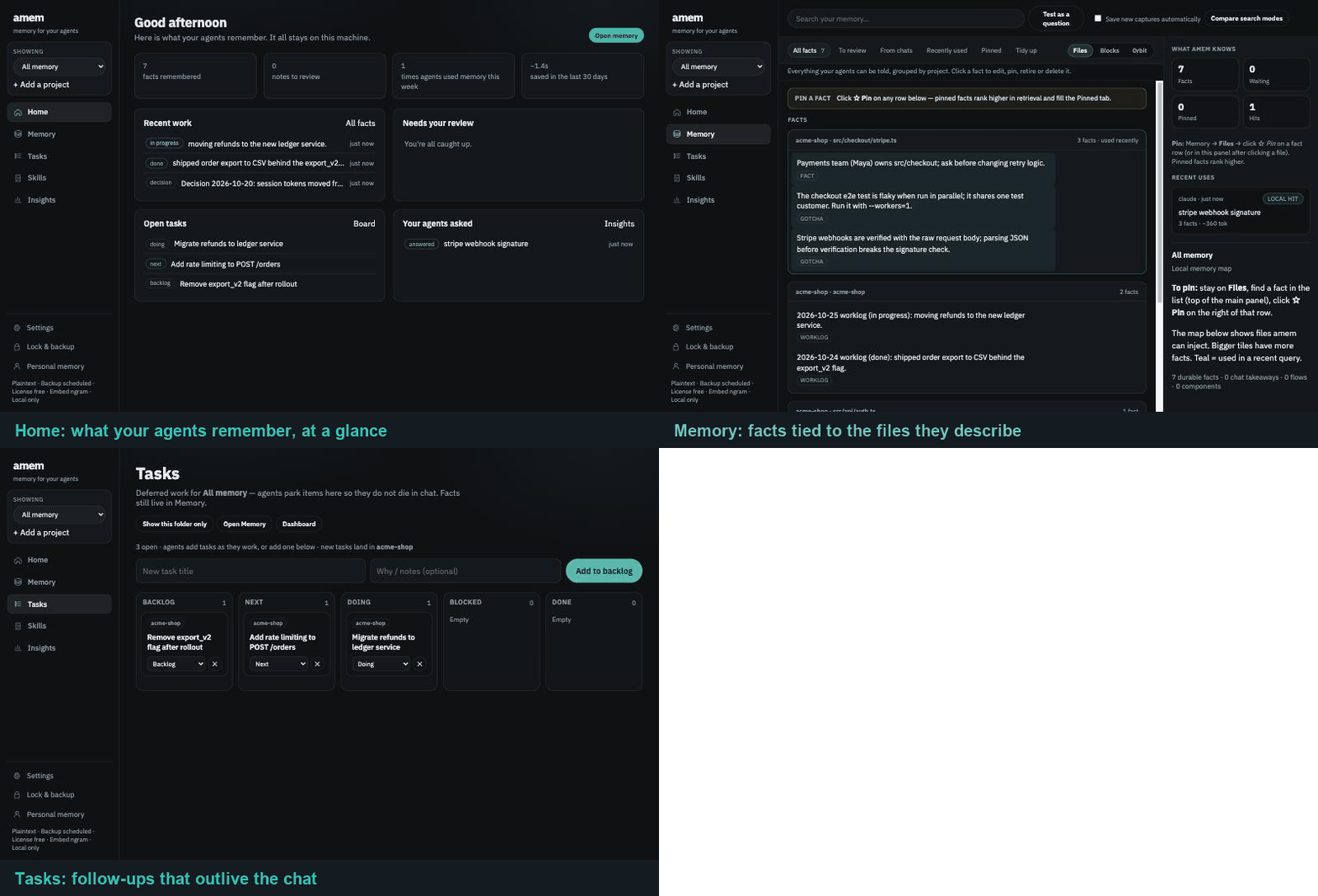
Website · Features · Why amem · How it works Coding agents forget between sessions. They re-read the same files, re-learn the same constraints and spend tokens rediscovering decisions you already made.
amem gives them a private memory that lives on your machine. The next session starts with what the last one learned.
The amem app
Prefer not to use a terminal? Download the amem app for Mac, Windows or Linux. It ships amem inside it, so you don't need Node. A two-minute guided setup finds your AI tools and projects and connects them, and the app then shows what your agents remember as it happens. It updates itself. See docs/desktop-app.md.
What you get
- Memory: short facts (constraints, gotchas, decisions, owners) tied to the files they describe. Facts are flagged stale when those files change.
- Context on autopilot: hooks hand your agent a small, ranked packet at session start and with each prompt. No pasting a project brief.
- Failure records: when an approach does not work, agents save what they tried, what happened, why, and when it is worth retrying (
amem remember --approach … --symptom …), so the next session does not walk into the same dead end. - Cited answers:
amem_evidencereturns the memories behind a question numbered [E1], [E2] with their files, dates and freshness, so an agent can say where each claim came from. - Skills: repeatable procedures (release steps, deploy order, test setup), loaded only when they apply.
- Tasks: a Backlog → Next → Doing → Done board your agents update, so follow-ups survive the chat.
- A dashboard:
amem uishows what your agents remember, what needs review and open tasks. Retire or delete a fact in one click. - Live activity: the Activity page shows every client talking to amem (Claude Code, Cursor, Codex, Claude Desktop, hooks, the CLI) as it happens: what they save, what context amem feeds back, errors, and the tokens it saved (measured where agents reported what they opened, estimate otherwise).
amem ui --panelopens it as a small side panel, always on top with the desktop shell. - Private by design: one SQLite file in
~/.amem, a localhost-only UI, optional encryption and local backups.
Works with Claude Code, Cursor, Claude Desktop, Copilot, Codex, Gemini CLI, Qwen Code, OpenCode, Windsurf, Continue, Aider, Zed and any other MCP client.
Quick start
cd ~/code/your-project
npx @iamem/amem setup --platform claude   # or: cursor, codex, copilot, windsurf … (amem platforms)
amem ui                                   # open the dashboard at http://127.0.0.1:7843
Setup installs the amem CLI, adds the hooks, registers the amem MCP server (restart your client once) and seeds the repo with build, test and CI facts from its manifests, so the first question already has an answer. From then on your agent checks memory before exploring and saves what it learns. You can also do it by hand:
amem remember "Stripe webhooks must be verified with the raw body" --kind gotcha --anchor src/webhooks/stripe.ts
amem context "stripe webhook signature"
### claim.remember_2f41c0c9e1ff
Kind: `gotcha`
Why: `keyword+12`, `fts+4.2`, `embed+5.4`, `kind:gotcha`, `fresh`
Stripe webhooks must be verified with the raw body.
Anchors: `src/webhooks/stripe.ts`Prefer a plugin? amem ships one for each major agent:
| App | Install |
| --- | --- |
| Claude Code | /plugin marketplace add sslugic/amem, then /plugin install amem@amem |
| Codex | codex plugin marketplace add sslugic/amem, then /plugins → amem |
| Gemini CLI | gemini extensions install https://github.com/sslugic/amem |
| Cursor, VS Code, LM Studio | One-click buttons on getamem.com |
| Claude Desktop | Download amem.mcpb and double-click it |
More you can do:
amem bootstrap                                   # ~350-token startup brief: global rules, project facts, active tasks, skill hints
amem search "auth flow" --types claim,task --max-tokens 200   # BM25 over facts, skills and tasks
amem remember "Staging queue paused for the incident" --ttl-days 2   # expires; kept as history
amem import .                                    # CLAUDE.md, AGENTS.md, .cursorrules, .cursor/rules/*.mdc (idempotent)
amem import notes.md --scope global              # global = shared across every project
amem export --format md --all                    # or JSON (default) for backups and round-trips
Agents get the same through MCP: amem_bootstrap at session start, amem_search, max_tokens on amem_context, and ttl_days / supersedes on amem_remember. Skills can declare triggers in their frontmatter (files: ["*.swift", "Package.swift"], keywords: [deploy, migration]), and amem surfaces a one-line hint when they match.
Any MCP client can use the same memory: amem mcp --print-config prints a ready-to-paste config. Connect amem to your AI tools has step-by-step setup for Claude Desktop, Codex, Copilot, Gemini CLI, Antigravity, Perplexity, Warp, JetBrains, LM Studio and more.
Something off? amem doctor --fix rewires the current repo's client. To remove amem, run amem uninstall to see what it added, then amem uninstall --yes. Your memory stays unless you add --purge.
How well it finds things
npm run bench loads 36 memories from a sample web shop and asks 32 questions phrased the way people ask, often without the memory's words. It also sends 8 vague prompts ("ok sounds good, go ahead") that name no topic. CI fails if these numbers drop.
| Path | Right memory first | Right memory in top 3 | Vague prompts given memory |
|---|---|---|---|
| Prompt hook (automatic) | 88% | 97% | 0% |
| amem_context (agent asks) | 81% | 94% | n/a |
The data is in bench/retrieval.json. Add your own cases and run npm run bench -- --misses to see what it gets wrong.
Architecture and token savings
One SQLite file in ~/.amem, FTS5/BM25 plus on-device embeddings, MCP over stdio or localhost HTTP, and no model calls. The technical fact sheet covers the architecture, the max_tokens and bootstrap budgets, staleness, supersession and TTL, and a cost comparison with cloud memory services and other local tools.
Privacy (non-negotiable)
- Memory never leaves your machine: no sync, no cloud embeddings, no "share with org" mode.
- The UI and HTTP MCP endpoint bind to
127.0.0.1only, and~/.amemis created with mode0700. - Credentials and tokens are blocked from being saved. Personal notes stay out of work projects unless you ask about them.
- Optional AES-256-GCM lock (
amem lock) and encrypted local backups (amem backup schedule). - The activity log behind the Activity page stores metadata only (client, action, in or out, size, time taken), never memory text, prompts or tool arguments. It keeps 30 days or 20,000 rows;
AMEM_ACTIVITY=offturns it off. - No network calls by default. If you opt in (
amem setupasks once, oramem telemetry on), amem sends an anonymous ping at install and first run, then at most one a day with the version, OS and which parts ran (MCP, hooks, UI, CLI). No memory, repos, paths or names.amem telemetry offstops it; managed (IT policy) installs never send it.
Learn more
- Full guide: setup, the day-to-day loop, what gets stored, skills, savings, other clients, every command
- Security & architecture FAQ
- IT-managed installs
- Website · Issues and ideas
License
MIT, see LICENSE.