
@iflow-mcp/n1byn1kt-apitap
v1.5.4
Published
Intercept web API traffic during browsing. Generate portable skill files so AI agents can call APIs directly instead of scraping.
Downloads
80


Readme
ApiTap



The MCP server that turns any website into an API — no docs, no SDK, no browser.
ApiTap is an MCP server that lets AI agents browse the web through APIs instead of browsers. When an agent needs data from a website, ApiTap automatically detects the site's framework (WordPress, Next.js, Shopify, etc.), discovers its internal API endpoints, and calls them directly — returning clean JSON instead of forcing the agent to render and parse HTML. For sites that need authentication, it opens a browser window for a human to log in, captures the session tokens, and hands control back to the agent. Every site visited generates a reusable "skill file" that maps the site's APIs, so the first visit is a discovery step and every subsequent visit is a direct, instant API call. It works with any MCP-compatible LLM client and reduces token costs by 20-100x compared to browser automation.
The web was built for human eyes; ApiTap makes it native to machines.
# One tool call: discover the API + replay it
apitap browse https://techcrunch.com
  ✓ Discovery: WordPress detected (medium confidence)
  ✓ Replay: GET /wp-json/wp/v2/posts → 200 (10 articles)

# Or read content directly — no browser needed
apitap read https://en.wikipedia.org/wiki/Node.js
  ✓ Wikipedia decoder: ~127 tokens (vs ~4,900 raw HTML)

# Or step by step:
apitap capture https://polymarket.com    # Watch API traffic
apitap show gamma-api.polymarket.com     # See what was captured
apitap replay gamma-api.polymarket.com get-events  # Call the API directly
No scraping. No browser. Just the API.
How It Works
- Capture — Launch a Playwright browser, visit a site, browse normally. ApiTap intercepts all network traffic via CDP.
- Filter — Scoring engine separates signal from noise. Analytics, tracking pixels, and framework internals are filtered out. Only real API endpoints survive.
- Generate — Captured endpoints are grouped by domain, URLs are parameterized (
/users/123→/users/:id), and a JSON skill file is written to~/.apitap/skills/. - Replay — Read the skill file, substitute parameters, call the API with
fetch(). Zero dependencies in the replay path.
Capture:  Browser → Playwright listener → Filter → Skill Generator → skill.json
Replay:   Agent → Replay Engine (skill.json) → fetch() → API → JSON response
Install
npm install -g @apitap/coreClaude Code — one command to wire it up:
claude mcp add -s user apitap -- apitap-mcpThat's it. 12 MCP tools, ready to go. Requires Node.js 20+.
Optional: To use
captureandbrowse(which open a real browser), also run:npx playwright install chromiumThe
read,peek, anddiscovertools work without it.
Quick Start
Capture API traffic
# Capture from a single domain (default)
apitap capture https://polymarket.com

# Capture all domains (CDN, API subdomains, etc.)
apitap capture https://polymarket.com --all-domains

# Include response previews in the skill file
apitap capture https://polymarket.com --preview

# Stop after 30 seconds
apitap capture https://polymarket.com --duration 30
ApiTap opens a browser window. Browse the site normally — click around, scroll, search. Every API call is captured. Press Ctrl+C when done.
List and explore captured APIs
# List all skill files
apitap list
  ✓ gamma-api.polymarket.com       3 endpoints   2m ago
  ✓ www.reddit.com                 2 endpoints   1h ago

# Show endpoints for a domain
apitap show gamma-api.polymarket.com
  [green] ✓ GET    /events                        object (3 fields)
  [green] ✓ GET    /teams                         array (12 fields)

# Search across all skill files
apitap search polymarket
Replay an endpoint
# Replay with captured defaults
apitap replay gamma-api.polymarket.com get-events

# Override parameters
apitap replay gamma-api.polymarket.com get-events limit=5 offset=10

# Machine-readable JSON output
apitap replay gamma-api.polymarket.com get-events --json
Text-Mode Browsing
ApiTap includes a text-mode browsing pipeline — peek and read — that lets agents consume web content without launching a browser. Seven built-in decoders extract structured content from popular sites at a fraction of the token cost:
| Site | Decoder | Typical Tokens | vs Raw HTML |
|------|---------|----------------|-------------|
| Reddit | reddit | ~627 | 93% smaller |
| YouTube | youtube | ~36 | 99% smaller |
| Wikipedia | wikipedia | ~127 | 97% smaller |
| Hacker News | hackernews | ~200 | 90% smaller |
| Grokipedia | grokipedia | ~150–5000+ | varies by article length |
| Twitter/X | twitter | ~80 | 95% smaller |
| Any other site | generic | varies | ~74% avg |
Average token savings: 74% across 83 tested domains.
# Triage first — zero-cost HEAD request
apitap peek https://reddit.com/r/programming
  ✓ accessible, recommendation: read

# Extract content — no browser needed
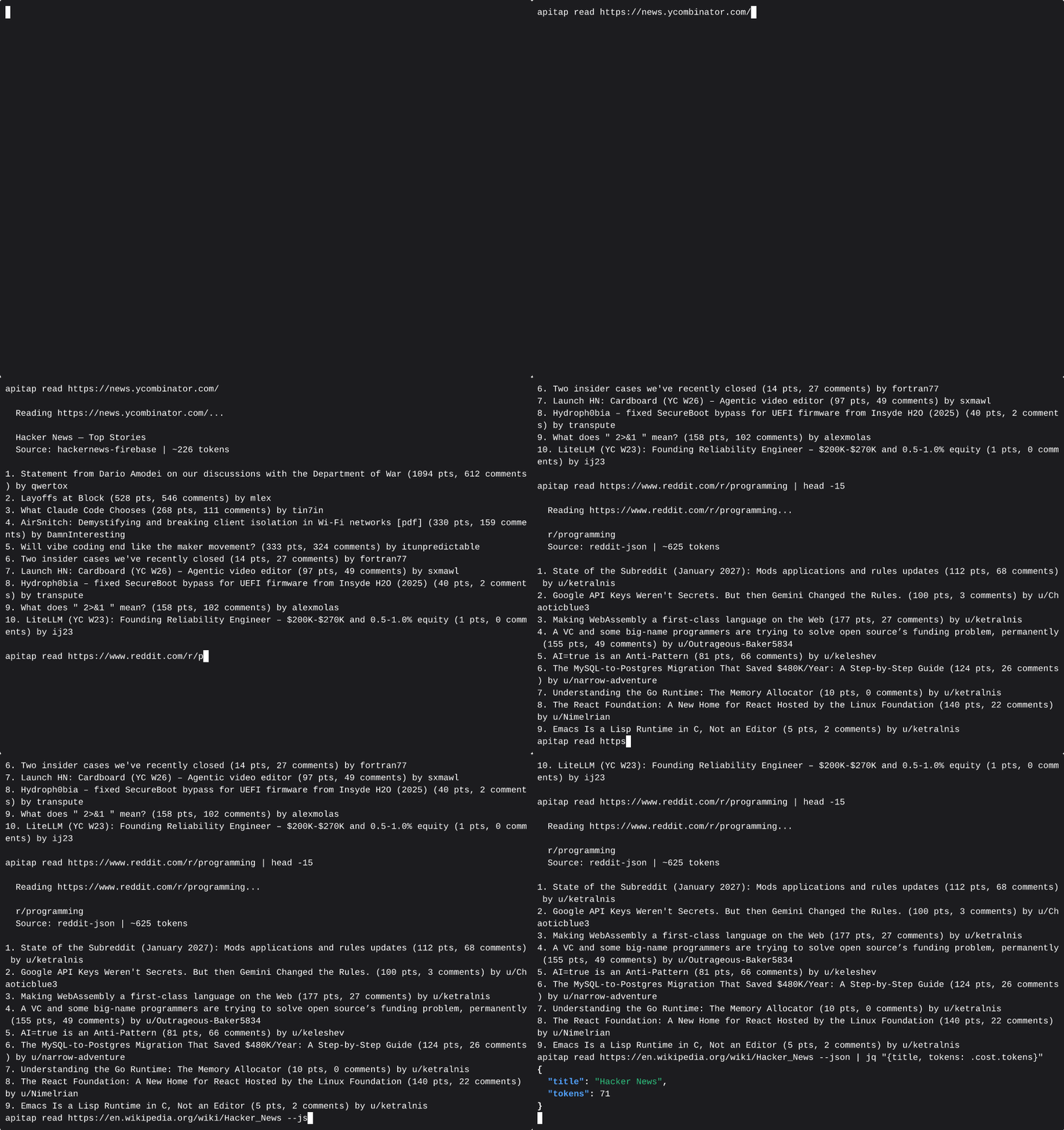
apitap read https://reddit.com/r/programming
  ✓ Reddit decoder: 12 posts, ~627 tokens

# Works for any URL — falls back to generic HTML extraction
apitap read https://example.com/blog/post
For MCP agents, apitap_peek and apitap_read are the fastest way to consume web content — use them before reaching for apitap_browse or apitap_capture.
Tested Sites
ApiTap has been tested against real-world sites:
| Site | Endpoints | Tier | Replay | |------|-----------|------|--------| | Polymarket | 3 | Green | 200 | | Reddit | 2 | Green | 200 | | Discord | 4 | Green | 200 | | GitHub | 1 | Green | 200 | | HN (Algolia) | 1 | Yellow | 200 | | dev.to | 2 | Green | 200 | | CoinGecko | 6 | Green | 200 |
78% overall replay success rate across 9 tested sites (green tier: 100%).
Why ApiTap?
Why not just use the public API? Most sites don't have one, or it's heavily rate-limited. The internal API that powers the SPA is often richer, faster, and already handles auth.
Why not just use Playwright/Puppeteer? Browser automation costs 50-200K tokens per page for an AI agent. ApiTap captures the API once, then your agent calls it directly at 1-5K tokens. No DOM, no selectors, no flaky waits.
Why not reverse-engineer the API manually? You could open DevTools and copy headers by hand. ApiTap does it in 30 seconds and gives you a portable file any agent can use.
Isn't this just a MITM proxy? No. ApiTap is read-only — it uses Chrome DevTools Protocol to observe responses. No certificate setup, no request modification, no code injection.
Replayability Tiers
Every captured endpoint is classified by replay difficulty:
| Tier | Meaning | Replay |
|------|---------|--------|
| Green | Public, permissive CORS, no signing | Works with fetch() |
| Yellow | Needs auth, no signing/anti-bot | Works with stored credentials |
| Orange | CSRF tokens, session binding | Fragile — may need browser refresh |
| Red | Request signing, anti-bot (Cloudflare) | Needs full browser |
GET endpoints are auto-verified during capture by comparing Playwright responses with raw fetch() responses.
MCP Server
ApiTap includes an MCP server with 12 tools for Claude Desktop, Cursor, Windsurf, and other MCP-compatible clients.
# Start the MCP server
apitap-mcp
Claude Code — see Install above.
Claude Desktop / Cursor / Windsurf — add to your MCP config:
{
  "mcpServers": {
    "apitap": {
      "command": "apitap-mcp"
    }
  }
}
VS Code (GitHub Copilot) — add .vscode/mcp.json:
{
  "servers": {
    "apitap": {
      "command": "apitap-mcp"
    }
  }
}
MCP Tools
| Tool | Description |
|------|-------------|
| apitap_browse | High-level "just get me the data" (discover + replay in one call) |
| apitap_peek | Zero-cost URL triage (HEAD only) |
| apitap_read | Extract content without a browser (7 decoders) |
| apitap_discover | Detect a site's APIs without launching a browser |
| apitap_search | Search available skill files |
| apitap_replay | Replay a captured API endpoint |
| apitap_replay_batch | Replay multiple endpoints in parallel across domains |
| apitap_capture | Capture API traffic via instrumented browser |
| apitap_capture_start | Start an interactive capture session |
| apitap_capture_interact | Interact with a live capture session (click, type, scroll) |
| apitap_capture_finish | Finish or abort a capture session |
| apitap_auth_request | Request human authentication for a site |
You can also serve a single skill file as a dedicated MCP server with apitap serve <domain> — each endpoint becomes its own tool.
Chrome Extension
Optional. ApiTap works fully without the extension. Install it if you want passive API discovery or want to capture from your already-logged-in browser sessions.
The extension captures API traffic directly from your browser — no Playwright, no auth dance, no browser popups. It also silently builds a map of every API you visit in the background.
Why use the extension?
- You're already logged into Spotify, Discord, Reddit — the extension captures from your live session
- No
apitap auth requestneeded — real tokens are captured automatically - Passively builds a map of every API you visit, so your agents know what's available before asking
Setup
Step 1 — Install ApiTap CLI (if you haven't already):
npm install -g @apitap/coreStep 2 — Get the extension source:
git clone https://github.com/n1byn1kt/apitap.git
cd apitap
Step 3 — Build the extension:
cd extension && npm install && npm run buildStep 4 — Load into Chrome:
- Open
chrome://extensions - Enable Developer mode (toggle, top right)
- Click Load unpacked
- Select the
extension/folder inside the cloned repo
You should see the ApiTap icon appear in your toolbar.
Step 5 — Wire up native messaging (one-time):
apitap extension install --extension-id <your-extension-id>Find your extension ID on the chrome://extensions page (shown under the extension name after loading).
Step 6 — Verify the connection:
Click the ApiTap icon in Chrome. The popup should show "CLI: Connected". If it shows disconnected, re-run Step 5 with the correct extension ID.
Passive Index (always-on)
Once installed, the extension silently observes API traffic as you browse — no infobar, no CDP, no performance impact. It builds a lightweight index of every domain's API shape: endpoints, HTTP methods, auth type, pagination patterns.
# See everything the extension has discovered
apitap index

# Filter to a specific domain
apitap index discord.com
The index lives at ~/.apitap/index.json and is automatically read by the apitap_discover MCP tool — so your agents can ask "what do you know about Discord's API?" and get a useful answer without triggering a full capture.
Agents see something like:
discord.com — 8 endpoints mapped, Bearer auth, last seen 2h ago
  GET /api/v10/channels/:id  (hits: 47, JSON, paginated)
  GET /api/v10/guilds/:id/members  (hits: 12, JSON)
  POST /api/v10/channels/:id/messages  (hits: 8, JSON)
  ...
Promoting to a Full Skill File
The index is a map — it knows what endpoints exist but not their response shapes. To get a full replayable skill file, promote a domain:
From the popup: Click the ApiTap icon → find the domain → Generate skill file
Via agent: Your agent can request a capture automatically. You'll get a notification to approve, the extension briefly attaches CDP, captures response shapes, then detaches. The full skill file saves to ~/.apitap/skills/.
Auto-learn (opt-in): In the extension popup → Settings → enable Auto-learn. The extension will automatically promote domains you visit frequently. Off by default.
Manual Capture
For one-off captures without the passive index:
- Click the ApiTap icon → Start Capture
- Browse the site — extension records API traffic
- Click Stop → skill file auto-saves to
~/.apitap/skills/
The popup shows CLI connection status and live capture stats. Auth tokens are automatically stored to ~/.apitap/auth.enc with [stored] placeholders in the exported skill files.
Note: Chrome Web Store submission coming soon. For now, load as an unpacked extension in Developer mode.
Auth Management
ApiTap automatically detects and stores auth credentials (Bearer tokens, API keys, cookies) during capture. Credentials are encrypted at rest with AES-256-GCM.
# View auth status
apitap auth api.example.com

# List all domains with stored auth
apitap auth --list

# Refresh expired tokens via browser
apitap refresh api.example.com

# Force fresh token before replay
apitap replay api.example.com get-data --fresh

# Clear stored auth
apitap auth api.example.com --clear
Skill Files
Skill files are JSON documents stored at ~/.apitap/skills/<domain>.json. They contain everything needed to replay an API — endpoints, headers, query params, request bodies, pagination patterns, and response shapes.
{
  "version": "1.1",
  "domain": "gamma-api.polymarket.com",
  "baseUrl": "https://gamma-api.polymarket.com",
  "endpoints": [
    {
      "id": "get-events",
      "method": "GET",
      "path": "/events",
      "queryParams": { "limit": { "type": "string", "example": "10" } },
      "headers": {},
      "responseShape": { "type": "object", "fields": ["id", "title", "slug"] }
    }
  ]
}
Skill files are portable and shareable. Auth credentials are stored separately in encrypted storage — never in the skill file itself.
Import / Export
# Import a skill file from someone else
apitap import ./reddit-skills.json

# Import validates: signature check → SSRF scan → confirmation
Imported files are re-signed with your local key and marked with imported provenance.
Security
ApiTap handles untrusted skill files from the internet and replays HTTP requests on your behalf. That's a high-trust position, and we treat it seriously.
Defense in Depth
- Auth encryption — AES-256-GCM with PBKDF2 key derivation, keyed to your machine
- PII scrubbing — Emails, phones, IPs, credit cards, SSNs detected and redacted during capture
- SSRF protection — Multi-layer URL validation blocks access to internal networks (see below)
- Header injection protection — Allowlist prevents skill files from injecting dangerous HTTP headers (
Host,X-Forwarded-For,Cookie,Authorization) - Redirect validation — Manual redirect handling with SSRF re-check prevents redirect-to-internal-IP attacks
- DNS rebinding prevention — Resolved IPs are pinned to prevent TOCTOU attacks where DNS returns different IPs on second lookup
- Skill signing — HMAC-SHA256 signatures detect tampering; three-state provenance tracking (self/imported/unsigned)
- No phone-home — Everything runs locally. No external services, no telemetry
- Read-only capture — Playwright intercepts responses only. No request modification or code injection
Why SSRF Protection Matters
Since skill files can come from anywhere — shared by colleagues, downloaded from GitHub, or imported from untrusted sources — a malicious skill file is the primary threat vector. Here's what ApiTap defends against:
The attack: An attacker crafts a skill file with baseUrl: "http://169.254.169.254" (the AWS/cloud metadata endpoint) or baseUrl: "http://localhost:8080" (your internal services). When you replay an endpoint, your machine makes the request, potentially leaking cloud credentials or hitting internal APIs.
The defense: ApiTap validates every URL at multiple points:
Skill file imported
  → validateUrl(): block private IPs, internal hostnames, non-HTTP schemes
  → validateSkillFileUrls(): scan baseUrl + all endpoint example URLs

Endpoint replayed
  → resolveAndValidateUrl(): DNS lookup + verify resolved IP isn't private
  → IP pinning: fetch uses resolved IP directly (prevents DNS rebinding)
  → Header filtering: strip dangerous headers from skill file
  → Redirect check: if server redirects, validate new target before following
Blocked ranges: 127.0.0.0/8, 10.0.0.0/8, 172.16.0.0/12, 192.168.0.0/16, 169.254.0.0/16 (cloud metadata), 0.0.0.0, IPv6 equivalents (::1, fe80::/10, fc00::/7, ::ffff: mapped addresses), localhost, .local, .internal, file://, javascript: schemes.
This is especially relevant now that MCP servers are being used as attack vectors in the wild — Google's Threat Intelligence Group recently documented underground toolkits built on compromised MCP servers. ApiTap is designed to be safe even when processing untrusted inputs.
CLI Reference
All commands support --json for machine-readable output.
| Command | Description |
|---------|-------------|
| apitap browse <url> | Discover + replay in one step |
| apitap peek <url> | Zero-cost URL triage (HEAD only) |
| apitap read <url> | Extract content without a browser |
| apitap discover <url> | Detect APIs without launching a browser |
| apitap capture <url> | Capture API traffic from a website |
| apitap list | List available skill files |
| apitap show <domain> | Show endpoints for a domain |
| apitap search <query> | Search skill files by domain or endpoint |
| apitap replay <domain> <id> [key=val...] | Replay an API endpoint |
| apitap import <file> | Import a skill file with safety validation |
| apitap refresh <domain> | Refresh auth tokens via browser |
| apitap auth [domain] | View or manage stored auth |
| apitap serve <domain> | Serve a skill file as an MCP server |
| apitap inspect <url> | Discover APIs without saving |
| apitap stats | Show token savings report |
| apitap audit | Audit stored skill files and credentials |
| apitap forget <domain> | Remove skill file and credentials for a domain |
| apitap --version | Print version |
Capture flags
| Flag | Description |
|------|-------------|
| --all-domains | Capture traffic from all domains (default: target domain only) |
| --preview | Include response data previews |
| --duration <sec> | Stop capture after N seconds |
| --port <port> | Connect to specific CDP port |
| --launch | Always launch a new browser |
| --attach | Only attach to existing browser |
| --no-scrub | Disable PII scrubbing |
| --no-verify | Skip auto-verification of GET endpoints |
Development
git clone https://github.com/n1byn1kt/apitap.git
cd apitap
npm install
npm test          # 1051 tests, Node built-in test runner
npm run typecheck # Type checking
npm run build     # Compile to dist/
npx tsx src/cli.ts capture <url>  # Run from source
Contact
Questions, feedback, or issues? → [email protected]
License
Business Source License 1.1 — free for all non-competing use (personal, internal, educational, research, open source). Cannot be rebranded and sold as a competing service. Converts to Apache 2.0 on February 7, 2029.