
@inferdi/inferdi
v5.0.1
Published
Zero-dependency, decorator-free, strictly typed DI container for TypeScript. Features scopes, lazy injection, lifetime guards, and explicit async teardown.

Maintainers
 maxrendel
Readme
InferDI






A zero-dependency, decorator-free, strongly typed DI container for modern TypeScript.
Table of Contents
- Getting Started
- Overview
- Core Concepts
- Advanced Usage
- Types & Reference
Why InferDI?
Legacy DI is slow, bloated with decorators, and prone to memory leaks. InferDI is built for 2026: it’s ruthlessly fast, strictly typed, and built for the modern edge.
☁️ Zero-Weight Edge Native
Just 2.1KB gzipped. Zero dependencies. The perfect fit for all serverless platforms, including Cloudflare Workers, Vercel Edge, Deno Deploy, and Supabase. While other frameworks trigger cold starts, InferDI is already running.⚡ Raw Engine Speed
Built to outperform the competition. Highly optimized for V8 and JSC inline caching. It doesn't just resolve dependencies — it executes at native engine speed.🛡️ Zero Magic. 100% Type-Safe
No@Inject(). Noreflect-metadata. The compiler strictly enforces your constructor signatures. Wrong argument order or type? It simply won't compile.🛑 Impossible Memory Leaks
Silent cross-user data leaks are a thing of the past. InferDI physically blocks you from injecting short-lived scoped resources into global singletons. Architectural flaws crash instantly in development, guaranteeing zero leaks in production.♻️ Native
usingTeardown
Full support for modern resource management. Scopes destroy instances in strict LIFO order, safely catching multiple disconnect failures in a single cleanAggregateError.🔣 String or Symbol keys
Register services under either a plain string or asymbol. UseSymbol.for('shared')for cross-module identity without imports,unique symbolconstants for type-level branding, or localSymbol()for collision-free private DI.
Performance
InferDI is built for raw engine speed. Static type checking instead of runtime reflection, no Proxy traps on resolve, and arity-unrolled constructor calls (0–7 args take a direct new Ctor(...) path) translate into measurable wins across every common DI workload.
The repository ships a comprehensive benchmark suite in benchmarks/ comparing InferDI against the five widely used TypeScript DI containers — InversifyJS v8, Awilix v13 (both PROXY and CLASSIC modes), TSyringe v4, TypeDI v0.10, and Typed Inject v5. All numbers below are operations per second on Node 22 — higher is better. Reproduce locally with cd benchmarks && pnpm install --frozen-lockfile && pnpm run bench.
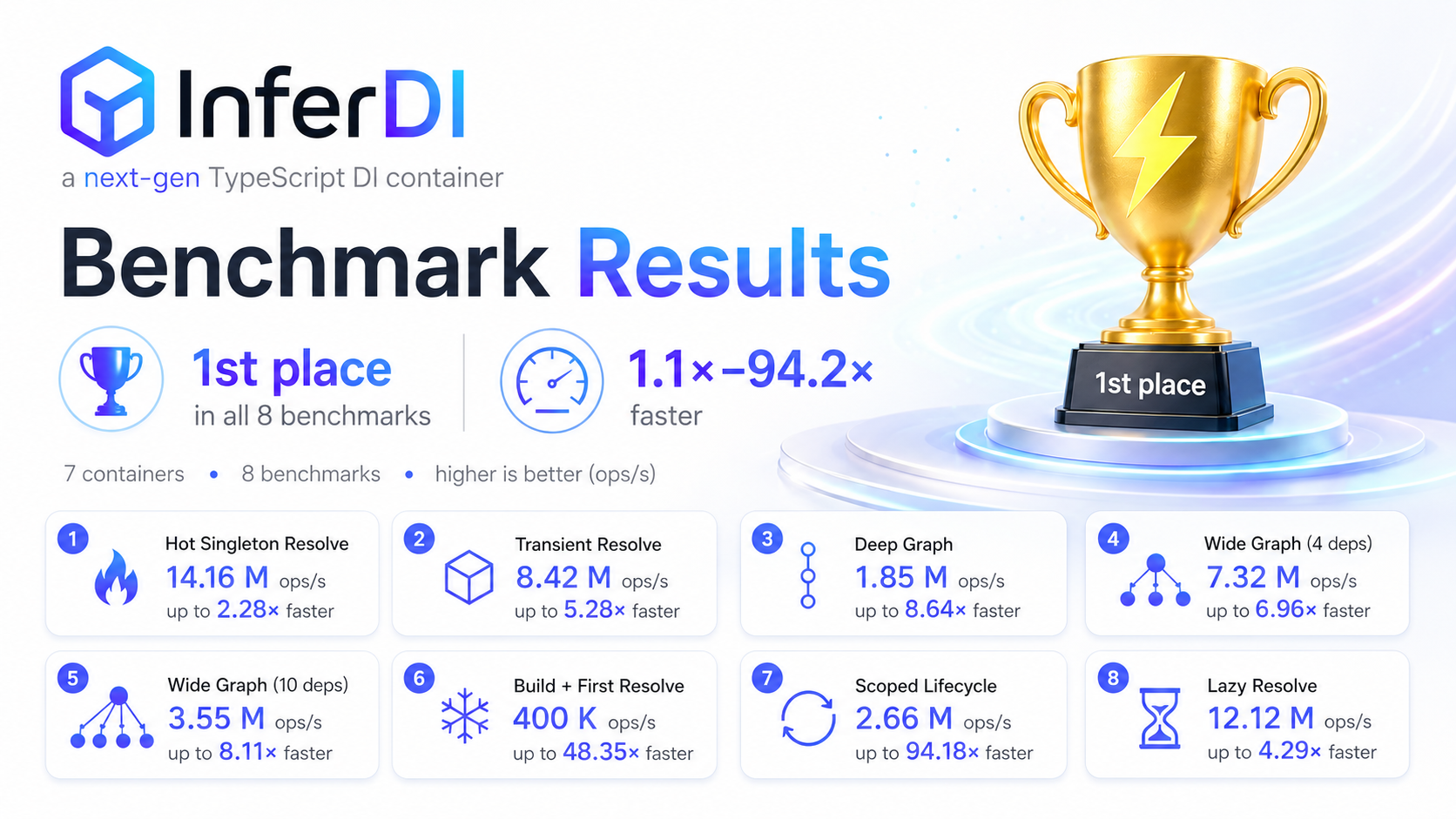
| Scenario | InferDI | Typed Inject | Awilix (PROXY) | Awilix (CLASSIC) | InversifyJS | TSyringe | TypeDI | |-------------------------------------------------------|------------|--------------|----------------|------------------|-------------|----------|--------| | 1. Hot singleton resolve (warm cache) | 14.2 M | 7.0 M | 7.2 M | 6.9 M | 6.3 M | 6.2 M | 6.4 M | | 2. Transient resolve (new instance per call) | 8.4 M | 4.3 M | 3.4 M | 2.9 M | 3.4 M | 2.4 M | 1.6 M | | 3. Deep graph (10 levels, all transient) | 1.85 M | 1.28 M | 701 k | 739 k | 750 k | 601 k | 214 k | | 4a. Wide graph (4 deps, root transient) | 7.3 M | 3.2 M | 2.2 M | 2.3 M | 2.3 M | 1.6 M | 1.1 M | | 4b. Wide graph (10 deps, root transient) | 3.5 M | 2.6 M | 1.2 M | 1.3 M | 1.6 M | 1.0 M | 437 k | | 5. Container build + first resolve | 400 k | 228 k | 10 k | 8 k | 13 k | 202 k | 272 k | | 6. Scoped lifecycle (create + resolve + cleanup) | 2.66 M | 2.39 M | 492 k | 413 k | 28 k | 1.08 M | 637 k | | 7. Lazy resolve (deferred wrapper) | 12.1 M | 7.0 M | 5.5 M | 4.7 M | 4.2 M | 4.0 M | 2.8 M |
Highlights
- ~2× faster on the hot path than every competitor. A cached singleton resolve in InferDI effectively reduces to a hot
Map.get()fast path — no Proxy, no metadata lookup, no parent-chain walk for warm services. - 30× faster than InversifyJS and 48× faster than Awilix at building a fresh container with a 30+ key graph and resolving its first service. Registration is a flat
Map.setper service — no fluent-builder chains, no AST parsing of constructor signatures, no decorator side-effects to apply. - Wide-graph leadership confirms the arity-unrolling fast path: for up to 7 dependencies V8 inlines the direct
new Ctor(...)call instead of going throughReflect.construct. Even at 10 dependencies — where InferDI falls back toReflect.construct— it stays 1.35× ahead of the next-fastest non-reflection-based competitor (Typed Inject) and up to 3.5× ahead of reflection-based containers. - Clean sweep across all eight scenarios. InferDI now leads every workload, including the previously close ones: the deep-graph 10-level chain (1.44× over Typed Inject) and the scope lifecycle (Scenario 6, 1.11× over Typed Inject) — while including a synchronous
Symbol.disposeon every iteration of the latter and beating InversifyJS by 94×. - Typed Inject is the strongest non-InferDI baseline. Its compile-time-known graph and
static inject = [...] as constdesign let it close the gap on deep graphs and scoped flows where reflection-based containers fall apart. InferDI still pulls ahead in every scenario, but the proximity is real and worth crediting. - Scenario 5 caveat: decorator-based libraries (TypeDI, TSyringe) register classes at import time via decorator side-effects, so their registration cost is paid during module evaluation — what's measured for them at "build time" is only child-context creation. InferDI still beats them while registering an entire graph from scratch in under 3 μs.
Full methodology, fairness notes, fixture sources, and per-scenario reasoning: see benchmarks/README.md.
Install
For the full multilingual guide, adapter docs, API reference, and migration notes, see inferdi.com.
InferDI is published to two registries with identical contents:
- npm as
@inferdi/inferdi— for Node, Bun, and any tooling that resolves npm. - JSR as
@inferdi/inferdi— for Deno and any runtime that prefers TypeScript sources directly.
Pick the channel that matches your runtime — the import code below stays the same.
Node.js
npm  i   @inferdi/inferdi   # npm
pnpm add @inferdi/inferdi   # pnpm
yarn add @inferdi/inferdi   # yarn
import { Container } from '@inferdi/inferdi'Bun
bun add @inferdi/inferdi          # from npm
# or
bun add jsr:@inferdi/inferdi      # from JSR (TypeScript sources)
import { Container } from '@inferdi/inferdi'Deno
deno add jsr:@inferdi/inferdiimport { Container } from '@inferdi/inferdi'Or import via the full JSR specifier without an add step:
import { Container } from 'jsr:@inferdi/inferdi'Requirements
- Node ≥ 16. On Node < 20.4
Symbol.dispose/Symbol.asyncDisposeare auto-polyfilled viaSymbol.foron import, sousing/await usinginterop is preserved. - Bun ≥ 1.0 and Deno ≥ 1.40 ship native
Symbol.dispose/Symbol.asyncDispose— the polyfill is a no-op there. - TypeScript ≥ 5.2 is recommended on the consumer side if you want to use
using/await usingsyntax. The library itself works with older TypeScript versions — only the explicit-resource-management syntax requires 5.2+.
Quick Start
Notice how you don't need any @Injectable() decorators. The dependency types are inferred directly from the strings you pass.
import { Container } from '@inferdi/inferdi'

class Logger {
  log(msg: string) { console.log(`[LOG] ${msg}`) }
}

class UserRepo {
  // Plain TypeScript class, no decorators!
  constructor(private readonly logger: Logger, private readonly dsn: string) {}

  find(id: string) {
    this.logger.log(`Finding ${id} in ${this.dsn}`)
  }
}

const container = new Container()
  .registerValue('dsn', 'postgres://localhost/app')
  .registerClass('logger', Logger, [])
  // The deps tuple is type-checked positionally against UserRepo's constructor.
  // Swapping the order to ['dsn', 'logger'] is rejected at compile time.
  .registerClass('userRepo', UserRepo, ['logger', 'dsn'])

// Type-safe resolve — TypeScript knows `userRepo` is `UserRepo`:
container.get('userRepo').find('42')
.get(key) is the only way to resolve a registration: it is fully typed (K extends keyof T), throws synchronously on a missing key, and stays out of the way at runtime — there is no Proxy overhead.
Examples
The repository includes framework and runtime examples in examples/. They are GitHub-only reference snippets: framework dependencies are not installed in this package, and examples/ is excluded from the npm tarball.
- JavaScript usage —
examples/javascript/node-esm.mjs— Node ESMimportwith// @ts-checkand JSDoc constructor types.node-commonjs.cjs— Node CommonJSrequirewith the same runtime wiring.browser-vite.js— browser-oriented ESM for Vite or another bundler.
- Shared foundation —
examples/_shared/container.ts— canonical container builder used by most server examples.testing.ts— typed test fixtures andoverride()usage.
- Backend frameworks —
examples/backend/fastify.ts— uses@inferdi/fastifyfor request scopes.hono.ts— uses@inferdi/honofor request scopes.koa.ts— uses@inferdi/koafor request scopes.express.ts— uses@inferdi/expressfor request scopes.elysia.ts— uses@inferdi/elysiafor request scopes.
- API layers —
examples/api-layers/ - Full-stack frameworks —
examples/fullstack/ - Runtimes and edge platforms —
examples/runtimes-edge/ - Frontend frameworks —
examples/frontend/ - Bots, queues, and CLI —
examples/workers-cli/
Fastify Adapter
Fastify v5 applications can use the separate @inferdi/fastify package to create and dispose one InferDI scope per request. It is published to npm and JSR with the same version as @inferdi/inferdi.
pnpm add @inferdi/inferdi @inferdi/fastify fastifyimport Fastify, { type FastifyRequest } from 'fastify'
import { inferdiFastify } from '@inferdi/fastify'
import {
buildRootContainer,
createRequestScope,
type RequestContainer,
type RootContainer,
} from './container.js'
const root = buildRootContainer()
const app = Fastify()
declare module 'fastify' {
interface FastifyInstance {
di: RootContainer
}
interface FastifyRequest {
di: RequestContainer
}
}
await app.register(inferdiFastify, {
container: root,
// Annotate hook params: `app.register` cannot infer the plugin's generics.
createScope: (root: RootContainer, request: FastifyRequest) =>
createRequestScope(root, {
requestId: request.id,
ip: request.ip,
}),
})
app.get('/users/:id', async (request) => {
const { id } = request.params as { id: string }
return request.di.get('users').profile(id)
})Set scopePerRequest: false for root-only Fastify apps. In that mode the plugin exposes only app.di / request.server.di and installs no request lifecycle hooks.
Hono Adapter
Hono applications can use the separate @inferdi/hono package to create and dispose one InferDI scope per request. It is published to npm and JSR with the same version as @inferdi/inferdi.
pnpm add @inferdi/inferdi @inferdi/hono honoimport { Hono } from 'hono'
import { inferdiHono, type InferdiHonoEnv } from '@inferdi/hono'
import { buildRootContainer } from './container.js'
const root = buildRootContainer()
type AppEnv = InferdiHonoEnv<typeof root>
const app = new Hono<AppEnv>()
app.use('*', inferdiHono({
container: root,
setupScope: (scope, c) => {
const ctx = scope.get('request')
ctx.requestId = crypto.randomUUID()
ctx.userId = c.req.header('x-user-id')
},
}))
app.get('/users/:id', async (c) => {
return c.json(await c.var.di.get('users').profile(c.req.param('id')))
})Streaming Hono routes should call skipInferdiDispose(c) and dispose the scope inside the stream lifecycle, because Hono can return the Response before the stream callback finishes.
Koa Adapter
Koa v3 applications can use the separate @inferdi/koa package to create and dispose one InferDI scope per request. It is published to npm and JSR with the same version as @inferdi/inferdi.
pnpm add @inferdi/inferdi @inferdi/koa koa
pnpm add -D @types/koa
import Koa from 'koa'
import { inferdiKoa, type InferdiScopeOf } from '@inferdi/koa'
import { buildRootContainer } from './container.js'
const root = buildRootContainer()
const app = new Koa()
declare module 'koa' {
interface DefaultState {
di: InferdiScopeOf<typeof root>
}
}
app.use(inferdiKoa({
container: root,
setupScope: (scope, ctx) => {
const request = scope.get('request')
request.requestId = crypto.randomUUID()
request.userId = ctx.get('x-user-id') || undefined
request.ip = ctx.ip
},
}))
app.use(async (ctx) => {
const id = ctx.path.split('/').pop() ?? ''
ctx.body = await ctx.state.di.get('users').profile(id)
})Koa stream bodies normally do not need manual disposal handling: the adapter waits for the underlying Node response finish or close event. Call skipInferdiDispose(ctx) only when application code intentionally keeps the scope beyond the HTTP response boundary, such as background work that disposes the scope later. The skip suppresses cleanup only for a successful response — a downstream error still disposes the scope.
Express Adapter
Express 5 applications can use the separate @inferdi/express package to create and dispose one InferDI scope per request. It is published to npm and JSR with the same version as @inferdi/inferdi.
pnpm add @inferdi/inferdi @inferdi/express express
pnpm add -D @types/express
import express from 'express'
import { inferdiExpress, type InferdiScopeOf } from '@inferdi/express'
import {
buildRootContainer,
createRequestScope,
} from './container.js'
const root = buildRootContainer()
const app = express()
declare global {
namespace Express {
interface Request {
di: InferdiScopeOf<typeof root>
}
}
}
app.use(inferdiExpress({
container: root,
createScope: (root, req) =>
createRequestScope(root, {
requestId: crypto.randomUUID(),
userId: Array.isArray(req.headers['x-user-id'])
? req.headers['x-user-id'][0]
: req.headers['x-user-id'],
ip: req.ip,
}),
}))
app.get('/users/:id', async (req, res, next) => {
try {
res.json(await req.di.get('users').profile(req.params.id))
} catch (error) {
next(error)
}
})Express stream bodies normally do not need manual disposal handling: the adapter waits for the underlying Node response finish or close event. Call skipInferdiDispose(req) only when application code intentionally keeps the scope beyond the HTTP response boundary. Unlike the other adapters, Express cannot force-dispose on a handled route error — its callback middleware never observes a downstream exception — so a skipped scope on a failed request stays application-owned; see the package README.
Elysia Adapter
Elysia applications can use the separate @inferdi/elysia package to create and dispose one InferDI scope per request. It is published to npm and JSR with the same version as @inferdi/inferdi.
pnpm add @inferdi/inferdi @inferdi/elysia elysiaimport { Elysia } from 'elysia'
import { inferdiElysia } from '@inferdi/elysia'
import {
buildRootContainer,
createRequestScope,
} from './container.js'
const root = buildRootContainer()
const app = new Elysia()
.use(inferdiElysia({
container: root,
createScope: (root, { request }) =>
createRequestScope(root, {
requestId: crypto.randomUUID(),
userId: request.headers.get('x-user-id') ?? undefined,
}),
}))
.get('/users/:id', ({ di, params }) =>
di.get('users').profile(params.id),
)Elysia streaming routes should call skipInferdiDispose(context) and dispose the scope when stream or background work ends. The adapter uses both onError and onAfterResponse so validation failures after derive do not leak request scopes.
Factories
Use registerFactory when construction is more than new Class(deps) — for example, when you need to read multiple values from the container, build a config object, or wrap a third-party connection. The factory receives the container; the type V is inferred from its return value.
import { Pool } from 'pg'

const container = new Container()
  .registerValue('config', { dsn: 'postgres://...', poolSize: 10 })
  .registerFactory('pgPool', (c) => {
    const { dsn, poolSize } = c.get('config')
    return new Pool({ connectionString: dsn, max: poolSize })
  })
  // ^ container.get('pgPool') is now typed as `Pool` automatically.
  .registerClass('userRepo', UserRepo, ['pgPool'])
Factories follow the same lifetime rules as classes — pass the kind as the third argument: registerFactory('cache', factory, 'scoped'). Inside a singleton factory the container parameter is narrowed via AllowedDeps<T, 'singleton'>, so c.get(...) will only autocomplete (and accept) singleton keys and Lazy<singleton> companions. A scoped/transient key (or Lazy<scoped> / Lazy<transient>) inside a singleton factory body is a TypeScript error, not a runtime exception.
Binding Interfaces
TypeScript interfaces do not exist at runtime, so you cannot pass them to registerClass — the key would be inferred as the concrete class, not the abstraction. To bind an interface to a concrete implementation, use registerFactory with an explicit type argument:
interface Mailer { send(msg: string): void }

class SendGridMailer implements Mailer {
  send(msg: string) { /* ... */ }
}

const container = new Container()
  // Explicitly tell InferDI this key yields a `Mailer`, not a `SendGridMailer`.
  .registerFactory<'mailer', Mailer>('mailer', () => new SendGridMailer())
Now any consumer that depends on 'mailer' sees the Mailer abstraction, and you can swap SendGridMailer for another implementation (e.g. MockMailer in tests) without touching downstream types.
Compiler-enforced Signatures
In traditional DI frameworks, injection errors — like swapping the argument order, passing the wrong type, or forgetting a dependency entirely — only surface as runtime crashes.
InferDI validates your dependency graph at compile time. Thanks to advanced TypeScript mapping (DepsOf), the array of dependency keys is strictly checked against the types and positional order of the target class's constructor arguments.
class Logger {
  log(msg: string) {}
}

class UserRepo {
  // The constructor strictly expects: (Logger, string)
  constructor(
    private readonly logger: Logger,
    private readonly dsn: string
  ) {}
}

const container = new Container()
  .registerValue('dsn', 'postgres://localhost/app')
  .registerClass('logger', Logger, [])

  // ❌ TypeScript Error: Type '"dsn"' is not assignable to type '"logger"'.
  // The compiler knows the 1st arg needs a Logger, but 'dsn' yields a string.
  .registerClass('userRepo', UserRepo, ['dsn', 'logger'])

  // ✅ Compiles perfectly.
  // If you change the UserRepo constructor later, this line will break at compile time!
  .registerClass('userRepo', UserRepo, ['logger', 'dsn'])
Fearless Refactoring: If you ever change the UserRepo constructor signature (add a parameter, remove one, or just swap their order), TypeScript will instantly highlight the error at the .registerClass() call. Your production app will never crash due to a misaligned dependency again.
Scopes & Native Teardown
Container itself implements Symbol.dispose and Symbol.asyncDispose, so it works with using / await using directly. Owned instances are torn down in reverse-creation order (LIFO).
const root = new Container()
  .registerClass('db', Db, [])                     // singleton on root
  .registerClass('reqCtx', RequestCtx, [], 'scoped')

async function handle(request: Request) {
  // The scope's owned instances (its scoped/singleton-on-scope services) are
  // auto-disposed in LIFO order when the function exits. Transient instances
  // are owned by the caller — the container neither caches nor disposes them.
  // Singletons live on `root` and stay alive until root is disposed.
  await using scope = root.createScope()

  const ctx = scope.get('reqCtx') // cached on this scope only
  // ... handle request ...
}

// At application shutdown, dispose the root explicitly:
await root[Symbol.asyncDispose]()           // or: await root.dispose()
The container probes each owned instance in order: Symbol.asyncDispose → Symbol.dispose → plain .dispose(). If multiple disposers throw, all errors are collected into a single AggregateError so one failing resource never leaves the rest unclosed.
What gets disposed by which container. Each container disposes only the instances it created.
root.dispose()does not propagate into already-created child scopes — give scopes their ownawait using(ordispose()call) to release their resources. Forgetting to dispose a scope leaks every singleton/scoped instance it created.
try {
  await root.dispose()
} catch (e) {
  // Catch multiple DB/Redis disconnect failures at once!
  if (e instanceof AggregateError) {
    console.error(e.errors)
  }
}
Async Factories
Factories can be async without any special API. The factory's Promise is cached verbatim, so every concurrent c.get(key) sees the same in-flight Promise — initialization runs exactly once even under request bursts (Edge functions, serverless cold starts). Callers await the value at the use site. On await container.dispose() the container unwraps the Promise and probes the resolved instance for the disposer protocol; rejections fold into the same AggregateError as any other teardown error. Sync using on a container that cached a Promise is a misuse — use await using / await container.dispose().
const c = new Container()
  .registerValue('dsn', 'postgres://localhost/app')
  .registerFactory('db', async (c) => {
    const pool = new Pool({ connectionString: c.get('dsn') })
    await pool.connect()
    return pool
  })

// Concurrent callers share the same in-flight Promise — no race, one connect.
const [a, b] = await Promise.all([c.get('db'), c.get('db')])

await c.dispose() // unwraps the cached Promise and closes the pool
⚠️ Cycles between async factories are not detected and produce a silent Promise deadlock. The runtime cycle detector projects the synchronous call stack only — the
resolvingset is cleared by the time anasyncfactory'sawaitcontinuation runs. If two async factories depend on each other (aawaitsc.get('b'),bawaitsc.get('a')), each one's pending Promise gets cached during the synchronous prelude, and the resumed continuations find that cached Promise on every reentry.await c.get('a')then hangs forever with no error, no rejection, no diagnostic. Fixing this in the runtime would require an async-aware cycle tracker on the resolve fast-path, which is incompatible with the 1-Map.get()hot-path contract — so the recommendation is architectural: keep one side synchronous (split the cycle, hoist the shared init), or break it with aLazy<singleton>companion if both sides are singletons. If you suspect a cycle in async code, wrap the top-levelawait c.get(...)with a watchdog timeout during development.
Strict Lifetime Guards
| Kind | Created | Cached on | Disposed by container |
| ----------- | ----------------------------------------------- | ------------------------ | --------------------- |
| singleton | once per container that owns the registration | the owner container | yes |
| scoped | once per scope | the scope | yes |
| transient | every time requested | never | no (caller owns it) |
The Lifetime Rule: A singleton cannot directly depend on a scoped or transient service. That would freeze a short-lived value inside a long-lived cache. InferDI enforces this at compile time:
new Container()
  .registerClass('requestCtx', RequestCtx, [], 'scoped')
  // ❌ TS error: '"requestCtx"' is not assignable to type 'never'.
  //    AllowedDeps<T, 'singleton'> filters scoped/transient keys out of
  //    the deps tuple visible to a singleton target.
  .registerClass('userService', UserService, ['requestCtx'], 'singleton')
Inside a singleton factory, the container parameter is structurally narrowed so only legal keys autocomplete:
new Container()
  .registerClass('requestCtx', RequestCtx, [], 'scoped')
  .registerFactory('userService', (c) => {
    // ❌ TS error: 'requestCtx' is not a key of the narrowed container.
    const ctx = c.get('requestCtx')
    return new UserService(ctx)
  }, 'singleton')
The same check fires at runtime as defense-in-depth — if you bypass the type
system with an as-cast, you still get a clear diagnostic:
Error: Singleton "userService" cannot depend on scoped "requestCtx".
Use Lazy<T> (register with a lazyKey companion) to get a fresh instance per access.
Fast Mode: new Container({ strict: false })
If you fully trust the compile-time guard and want maximum throughput on the hot path, opt out of the runtime cycle / lifetime checks:
const root = new Container({ strict: false })
  .registerClass('logger', Logger, [])
In strict: false mode get() drops the cycle bookkeeping (resolving
push/pop + Array#includes), the singleton-stack push/pop, and the
surrounding try/finally from the resolve path. Local transient resolves
collapse to a bare fn(this) call — measured ~30% faster on a flat
transient graph; cached singleton/scoped resolves are unaffected because
the cache fast-path runs upstream of any guard. The flag is inherited by
every child created via createScope().
strict: true is a floor under two independent problem classes — not
just "type-substitution defense". The compile-time guard covers a strict
subset of what the runtime guard catches:
| Problem | Compile-time | Runtime (strict: true) |
|---|---|---|
| Singleton depends on scoped/transient directly via deps or the narrowed c parameter | ✓ | ✓ |
| Singleton depends on scoped/transient via a captured outer container reference inside a factory body | ✗ | ✓ |
| Singleton ↔ Singleton cycle | ✗ | ✓ |
| Transient ↔ Transient cycle | ✗ | ✓ |
| Lifetime violation introduced via an as-cast (as never, as any, as Container<...>) | ✗ | ✓ |
| Dynamic key construction (c.get(computedKey as keyof T)) | ✗ | ✓ |
In particular, the type system cannot see cycles. A Singleton →
Singleton cycle compiles cleanly (both ends pass the AllowedDeps
filter); only strict: true reports it as Circular dependency detected:
a -> b -> a, while strict: false lets V8 recurse until
RangeError: Maximum call stack size exceeded. The same applies to
Transient ↔ Transient cycles, which AllowedDeps never filters at all.
The narrowing of c inside a factory is also per-parameter, not
per-scope. If you capture an outer container reference in the closure,
that reference still has its wider type:
const root = new Container().registerClass('req', ReqCtx, [], 'scoped')
root.registerFactory('logger', () => {
  // `root` here is the wide Container<T>, NOT the narrowed AllowedDeps view.
  // TypeScript happily compiles this:
  return new Logger(root.get('req'))   // 💀 leaks scoped into singleton
}, 'singleton')
strict: true catches this at runtime; strict: false does not.
Use strict: false only when you're certain that:
- Your graph has no cycles (including
transient ↔ transient). - Every factory reads dependencies only through its own
cparameter — no captured outer container references. - All registrations go through the fluent API without
as-casts to bypassAllowedDeps. - Any
Module<TIn, TOut>declarations honestly describe their input shape.
Recommended workflow. Develop and test in strict: true (the default).
Your runtime tests transitively prove the graph is cycle-free and that no
factory leaks short-lived state through a captured closure. Only after that
audit, switch to strict: false for production builds where the ~30%
transient-path speed-up matters.
Lazy Injection
Lazy<T> is a deferred-resolution primitive — useful when two services would otherwise have to be constructed in a precise order (or when the type system would reject a forward reference). Pass a lazyKey to the target registration and the container creates a companion Lazy<T> under that explicit key (string or symbol):
import { Container, type Lazy } from '@inferdi/inferdi'

class Clock { now() { return Date.now() } }

class Audit {
  constructor(private readonly clockLazy: Lazy<Clock>) {}
  record(event: string) { console.log(event, this.clockLazy.get().now()) }
}

const c = new Container()
  .registerClass('clock', Clock, [], 'singleton', 'clockLazy')
  // ^ registers BOTH 'clock' (singleton) AND 'clockLazy' (Lazy<Clock>).
  //   The companion key is passed explicitly — TS infers Lazy<Clock>.
  .registerClass('audit', Audit, ['clockLazy'], 'singleton')

c.get('audit').record('login')
Lazy preserves the target's lifetime; it is not a lifetime escape hatch. A singleton consumer may inject only Lazy<singleton> companions. Lazy<scoped> and Lazy<transient> are rejected by the compile-time AllowedDeps filter inside a singleton, and the strict-mode runtime guard rejects the same shape if you bypass the type system with an as-cast. For scoped or transient consumers, every Lazy<*> variant remains legal.
new Container()
  .registerClass('req', RequestContext, [], 'scoped', 'reqLazy')
  // @ts-expect-error — Lazy<scoped> is not singleton-safe in v4.
  .registerClass('app', AppService, ['reqLazy'], 'singleton')
Need a fresh per-request view of a short-lived service inside a singleton? Use AsyncLocalStorage — a DI container with captured scope cannot model "dynamic scope" on its own. The runtime diagnostic for a Lazy-companion leak still reads Singleton "X" cannot depend on transient "<lazyKey>" because the wrapper itself is transient; treat that as "this Lazy resolves a non-singleton target — not safe here".
Note on circular dependencies. True mutual recursion (A's constructor needs B, B's constructor needs A) cannot be expressed in fluent registration — both sides would forward-reference each other's keys, which the type system rejects by design. Between two singletons, you can break the cycle with
Lazy<singleton>on one side. For factory-introduced cycles the runtime detector reports them precisely; it never "breaks" cycles automatically.
Symbol Keys
Every register* method also accepts a symbol for the key. String and symbol keys mix freely in the same container — deps arrays, the lazyKey companion, factory bodies and Module<TIn, TOut> all accept both interchangeably. Using symbols unlocks three patterns that string keys cannot express:
- Collision-free private DI. A local
Symbol(desc)exists only inside the module that created it. Registering under it makes the service unreachable from outside without explicitly exporting the token. - Cross-module sharing via
Symbol.for(name). Two parts of the codebase agree on a name;Symbol.forreturns the same token everywhere, so they share identity without importing each other. - Type-level branding. A symbol token is nominally typed: two structurally identical services keyed by distinct symbols are no longer interchangeable in
DepsOf. (For maximum nominal precision, annotate asunique symbol— but ordinaryconstdeclarations are enough for runtime identity and most type checking.)
import { Container } from '@inferdi/inferdi'

const DB    = Symbol('db')
const CACHE = Symbol('cache')

const c = new Container()
  // String key for plain config, symbol keys for the privately-shared services.
  .registerValue('config', { dsn: 'postgres://localhost/app' })
  .registerClass(DB,    PgPool,    ['config'])
  .registerClass(CACHE, RedisPool, [])
  // `deps` mixes string and symbol keys in a single tuple — both are typed.
  .registerClass('repo', UserRepo, [DB, CACHE])

c.get(DB)     // typed as PgPool
c.get(CACHE)  // typed as RedisPool
c.get('repo') // typed as UserRepo
Lazy companions follow the same rule — pass any string or symbol as lazyKey to expose the Lazy<V> wrapper. The companion key kind does not have to match the primary key kind:
const DB       = Symbol('db')
const DB_LAZY  = Symbol('dbLazy')

const c = new Container()
  // Symbol primary, symbol companion.
  .registerClass(DB, PgPool, [], 'singleton', DB_LAZY)
  // String primary, string companion.
  .registerClass('clock', Clock, [], 'transient', 'clockLazy')
  // String primary, symbol companion (or vice versa) — also accepted.
  .registerClass('cache', RedisPool, [], 'singleton', Symbol('cacheLazy'))

c.get(DB_LAZY).get()      // typed as Lazy<PgPool>
c.get('clockLazy').get()  // typed as Lazy<Clock>
⚡ Performance tip — symbol keys on the hottest paths. The internal registry is a
Mapkeyed by your raw keys. Symbols compare by identity (a pointer check), while string keys go through hashing and, on a hash collision, character comparison. In almost every app the difference is unmeasurable — reach for symbols here only when a profiler points at a tight resolve loop, and benchmark the swap before relying on it.
Modularity with .use()
For large applications, split your container setup into chunks via .use(). The idiomatic shape is an inline lambda — TypeScript infers the lambda's container type from the call site, so c.registerXyz(...) typechecks against the full accumulated key set without you re-listing prior keys. Inside the lambda you can also read previously registered values to make dynamic registration decisions:
import { Container } from '@inferdi/inferdi'

const appContainer = new Container()
  .registerValue('config', { env: 'production' as 'production' | 'test' })
  .use((c) => c.registerClass('db', Database, []))
  .use((c) => {
    const { env } = c.get('config')
    return env === 'test'
      ? c.registerClass('mailer', MockMailer, [])
      : c.registerClass('mailer', RealMailer, [])
  })
For named, fixed-shape module builders (e.g., test fixtures that always start from a specific base), use the exported Module<TIn, TOut> type — TIn must match the container's T exactly at the .use() call site. Because v3 carries lifetime kind alongside each entry, wrap flat { key: ServiceType } shapes in SpecMap<...> (defaults every entry to singleton) or write Spec<V, 'scoped' | 'transient'> for mixed-kind modules:
import { Container, type Module, type Spec, type SpecMap } from '@inferdi/inferdi'

// Always invoked on a container whose T is exactly { config: { env: string } } (singleton).
const fixtureMailer: Module<SpecMap<{ config: { env: string } }>, SpecMap<{ mailer: Mailer }>> = (c) => {
  const { env } = c.get('config')
  return env === 'test'
    ? c.registerClass('mailer', MockMailer, [])
    : c.registerClass('mailer', RealMailer, [])
}

// Mixed-kind: TIn requires a scoped `req` and a singleton `cfg`.
type ReqHandlerIn = SpecMap<{ cfg: Config }> & { req: Spec<ReqCtx, 'scoped'> }
const reqHandler: Module<ReqHandlerIn, SpecMap<{ handler: Handler }>> = (c) =>
  c.registerClass('handler', Handler, ['cfg', 'req'])

const fixture = new Container()
  .registerValue('config', { env: 'test' })
  .use(fixtureMailer)
Why no portable generic modules? A function like
<T>(c: Container<T>) => c.registerClass('db', ...)cannot type-check inside the body —keyof Tcollapses tostringfrom theDependenciesMapupper bound andExclude<'db', string>becomesnever, blocking the call. This is the cost of the compile-time uniqueness guarantee on registration. Use inline lambdas for one-shot grouping; useModule<TIn, TOut>when input shape is known.
Querying with .has()
.has(key) is a type-guard predicate: it returns true if key is registered on this container or any ancestor scope, and narrows the key to keyof T inside the truthy branch. The walk-up matches .get() exactly, but .has() is a pure observer — it never resolves the value and never throws. On a disposed container, .has() returns false for every key (the container's regs map is cleared by dispose(), so this is the literal truth).
declare const c: Container<{ logger: Spec<Logger> }>

if (c.has('logger')) {
  c.get('logger').log('ok')   // narrowed to Logger inside the branch
}

c.has('missing')   // false — does not throw
For statically known keys, you don't need .has() — TypeScript already rejects unknown keys at compile time, so .get() is the direct path. Reach for .has() when the key is genuinely dynamic (e.g., constructed from runtime input) and you need a safe probe.
Test Overrides
In tests you almost always need to swap a real dependency for a mock. The Exclude<K, keyof T> guard on every register* method intentionally prevents re-registering a key in production — but in tests it gets in the way. Use .override(key, value):
import { Container } from '@inferdi/inferdi'

function buildAppContainer() {
  return new Container()
    .registerClass('logger', ConsoleLogger, [])
    .registerClass('db', PgDb, [])
    .registerClass('userRepo', UserRepo, ['logger', 'db'])
}

// Test setup
const c = buildAppContainer()
  .override('logger', new MockLogger())   // ✅ TS verifies MockLogger is assignable to ConsoleLogger
  .override('db', mockDb)                 // same
// .override('missing', x)                ❌ TS error — key not registered
// .override('logger', 42)                ❌ TS error — number is not assignable to ConsoleLogger

c.get('userRepo').save(/* ... */)         // uses the mocks
Strict guarantees:
- 🛡️ Type-safe.
valuemust satisfy the originally registered type (T[K]). Mocks have to structurally implement the production interface — noas anyescape hatch. - ⛔ Fail-fast on late overrides.
.override()throws if the key has already been resolved on this container. A late override would leave existing consumers holding the original reference while new resolves see the mock — a split dependency graph. Always override before the first.get(). - 💥 Disposed-container guard. Throws on a disposed container.
- 🧹 Externally owned. Like
registerValue, the override value is not added to the container's disposal queue. The test suite owns the mock's lifetime. - 🔒 Scope-local.
.override()mutates only the container it was called on.root.createScope().override('db', mock)leavesrootuntouched and is invisible to sibling scopes; a parent-level override propagates via the standard parent walk-up.
⚠️ Production code should not call
.override(). It exists for tests and hot-reload-style fixtures. Use.use()for conditional registration in production builders.
Typing a Built Container — Container.Resolve<C>
Once you build your container fluently, the resulting type captures every registered key. You usually want to factor this into a builder function and reuse the inferred map elsewhere (DTOs, factories, tests). Use Container.Resolve<typeof builder> to extract it:
import { Container } from '@inferdi/inferdi'

function buildContainer(config: AppConfig) {
  return new Container()
    .registerValue('config', config)
    .registerClass('logger', Logger, [])
    .registerClass('db', Db, ['config'])
    .registerClass('userRepo', UserRepo, ['logger', 'db'])
}

// Extract the full DI map type from the builder's return:
type AppContainer = ReturnType<typeof buildContainer>
type AppDeps      = Container.Resolve<AppContainer>
//   ^? { config: AppConfig; logger: Logger; db: Db; userRepo: UserRepo }

// Now you can type code that consumes the container without re-listing keys:
function buildHandler(c: AppContainer) {
  return async (req: Request) => c.get('userRepo').find(req.userId)
}
This pattern keeps registration (the builder) and consumption (handlers, tests) in separate places without duplicating type information.
Provider Maps — Container.Providers<C>
For tests that build a mock fixture as a record of zero-arg factories, Container.Providers<C> flattens the built container into { [K in keyof T]: () => T[K] }. The compiler then enforces that every registered key is covered with a thunk returning the right shape — extraneous keys and missing keys are both surfaced as type errors.
import { Container } from '@inferdi/inferdi'

function buildContainer() {
  return new Container()
    .registerClass('logger', Logger, [])
    .registerClass('clock', Clock, [], 'transient', 'clockLazy')
}

const mocks: Container.Providers<ReturnType<typeof buildContainer>> = {
  logger:    () => mockLogger,
  clock:     () => mockClock,
  clockLazy: () => ({ get: () => mockClock }),   // Lazy<Clock> shape
}
The lazy companion's entry returns the Lazy<V> wrapper ({ get: () => V }), not the unwrapped value — this matches the container's actual registration shape.
Errors
The container throws structured errors with actionable messages — surface these in your test assertions so registration mistakes show up early:
| Trigger | Message |
|---|---|
| .get(k) on unregistered key | Key "k" not found |
| Singleton depends on scoped/transient | Singleton "x" cannot depend on scoped "y". Use Lazy<T> ... |
| Resolution loop (synchronous) | Circular dependency detected: a -> b -> a. Consider breaking the cycle with Lazy<T> ... |
| Resolution loop (between async factories) | Not detected. Produces a silent Promise deadlock — see the warning under Async Factories. |
| Use of disposed container | Container is disposed (key: "k") |
| Resolving across a disposed ancestor | Ancestor container is disposed (key: "k") |
| createScope() after dispose | Cannot create scope from a disposed container |
| Sync [Symbol.dispose] over an async resource | Sync [Symbol.dispose] called on a resource whose .dispose() returned a Promise. Use \await using` / container.dispose() for async teardown.|
|.override()after first resolve |Cannot override "k" because it has already been resolved. Overrides must be applied before any .get() calls...|
|.override()on a disposed container |Cannot override on a disposed container (key: "k")` |
Migration
Upgrading from a previous major version? See MIGRATION.md for the full per-version checklist (breaking changes, one-line rewrites, and what's new).
API Summary
import {
  Container,
  type Lazy,
  type LazySpec,
  type Module,
  type DependenciesMap,
  type RegistrationKind,
  type Spec,
  type SpecMap,
  type ContainerOptions,
} from '@inferdi/inferdi'

class Container<T extends DependenciesMap = Record<never, never>> {
  // Public — use this to construct a root container.
  constructor(options?: ContainerOptions)
  // Internal overload used by createScope() to wire the parent chain.
  constructor(parent: Container<T>)

  // Registration — each call returns a Container widened by Record<K, Spec<V, Kind>>.
  // The `deps` tuple and the factory `c` are narrowed via `AllowedDeps<T, Kind>`:
  // for a singleton target, only singleton entries and `LazySpec<*, 'singleton'>`
  // companions are visible.
  registerClass<
    K extends string | symbol,
    V,
    A extends readonly unknown[],
    Kind extends RegistrationKind = 'singleton',
    LK extends string | symbol = never,
  >(
    key: Exclude<K, keyof T>,
    Ctor: new (...args: A) => V,
    deps: DepsOf<AllowedDeps<T, Kind>, A>,
    kind?: Kind,                                     // default: 'singleton'
    lazyKey?: Exclude<LK, keyof T | K>,              // optional companion key for `Lazy<V>`
  ): Container<
       T
       & Record<K, Spec<V, Kind>>
       & ([LK] extends [never] ? {} : Record<LK, LazySpec<V, Kind>>)
     >

  registerFactory<
    K extends string | symbol,
    V,
    Kind extends RegistrationKind = 'singleton',
  >(
    key: Exclude<K, keyof T>,
    factory: (c: Container<AllowedDeps<T, Kind>>) => V,
    kind?: Kind,                                     // default: 'singleton'
  ): Container<T & Record<K, Spec<V, Kind>>>

  registerValue<K extends string | symbol, V>(
    key: Exclude<K, keyof T>,
    value: V,
  ): Container<T & Record<K, Spec<V, 'singleton'>>>

  // Test-only: replace an existing registration with a static value.
  // Walks the parent chain to read the original kind and preserves it locally,
  // so `root.createScope().override('db', mock)` keeps the scoped semantics.
  // Throws if the container is disposed, the key was already resolved, or
  // the key is not registered anywhere in the chain.
  override<K extends keyof T>(key: K, value: T[K]['type']): this

  use<R extends DependenciesMap>(fn: Module<T, R>): Container<T & R>

  // Scopes & resolution
  createScope(): Container<T>
  get<K extends keyof T>(key: K): T[K]['type']
  // Type-guard: narrows the key to keyof T inside the truthy branch.
  // Returns false on a disposed container (regs is empty).
  has<K extends string | symbol>(key: K): key is K & keyof T

  // Lifecycle
  get disposed(): boolean
  dispose(): Promise<void>
  [Symbol.dispose](): void
  [Symbol.asyncDispose](): Promise<void>
}

namespace Container {
  // Extract the registered map from a built container as a **flat**
  // `{ key: ServiceType }` view — the Spec wrapper is unwrapped, so consumers
  // see the same shape they always did pre-v3.
  type Resolve<C> = C extends Container<infer U>
    ? { [K in keyof U]: U[K]['type'] }
    : never

  // Same as Resolve, but unwraps Lazy<T> entries to T — useful for typing mocks.
  type ResolveUnwrapped<C> = {
    [K in keyof Resolve<C>]: Resolve<C>[K] extends Lazy<infer V> ? V : Resolve<C>[K]
  }

  // Look up a single key's unwrapped service type.
  // For a Lazy<T>-registered key returns T (no wrapper); useful when overriding
  // a Lazy<T> companion in tests:
  //   const mock: Container.UnwrappedValue<typeof c, 'clockLazy'> = { now: () => 0 }
  //   c.override('clockLazy', { get: () => mock })
  type UnwrappedValue<C, K extends keyof Resolve<C>> = ResolveUnwrapped<C>[K]

  // Flatten a built container into a record of zero-arg provider thunks,
  // one per registered key. Lazy<V> companion entries keep the wrapper shape.
  // Useful for typing mock-factory fixtures in tests.
  type Providers<C> = C extends Container<infer U>
    ? { [K in keyof U]: () => U[K]['type'] }
    : never
}

// Public types
type Lazy<T> = { readonly get: () => T }
type RegistrationKind = 'singleton' | 'transient' | 'scoped'

// Construction options.
interface ContainerOptions {
  // Toggle runtime cycle / lifetime guard inside get(). Default true.
  // Inherited by child scopes spawned via createScope().
  readonly strict?: boolean
}

// Single registry entry — service type V plus its lifetime kind. `interface`
// (not type alias) so TS caches instantiations across long fluent chains.
interface Spec<V, K extends RegistrationKind = 'singleton'> {
  readonly type: V
  readonly kind: K
}

// Brand a flat `{ key: ServiceType }` map as a SpecMap (defaults to singleton).
type SpecMap<M, K extends RegistrationKind = 'singleton'> =
  { [P in keyof M]: Spec<M[P], K> }

type DependenciesMap = Record<string | symbol, Spec<unknown, RegistrationKind>>

type Module<TIn extends DependenciesMap, TOut extends DependenciesMap> =
  (c: Container<TIn>) => Container<TIn & TOut>
Repository Structure
This repository is a pnpm monorepo. The published packages:
| Package | JSR | npm | Description |
| --- | --- | --- | --- |
| @inferdi/inferdi | JSR | npm | Core DI container — zero-dependency, decorator-free, strongly typed |
| @inferdi/fastify | JSR | npm | Fastify v5 request-scope adapter |
| @inferdi/hono | JSR | npm | Hono request-scope middleware |
| @inferdi/koa | JSR | npm | Koa v3 request-scope middleware |
| @inferdi/express | JSR | npm | Express 5 request-scope middleware |
| @inferdi/elysia | JSR | npm | Elysia request-scope plugin |
Repository-only workspaces (not published):
benchmarks/— private, self-contained comparative benchmarks against InversifyJS, Awilix, TSyringe, TypeDI, and Typed Inject. Isolated workspace with its own lockfile.examples/— GitHub-only reference snippets for framework and runtime integrations.
License
MIT — see LICENSE.