
@inso_web/els-next
v0.5.2
Published
Next.js helpers for @inso_web/els-client — logging in API routes (Pages + App Router), middleware.ts and edge runtime support. A drop-in replacement for console.log in Next.js apps.

Maintainers
 insoweb
Readme
@inso_web/els-next




Next.js helpers for the Inso Error Logs Service (ELS) — a managed SaaS for centralised event logging (debug → fatal) with AI-assisted error triage. Works in API Routes (App + Pages Router), middleware.ts, edge runtime, server actions, and the client bundle.
Table of contents
- What you get
- Install
- Quick Start
- When to use what
- Core concepts
- Configuration
- Migration
- Versioning
- Quick reference
- Why ELS
- API
- FAQ
- Other ELS SDKs
- Pricing
- License
What you get
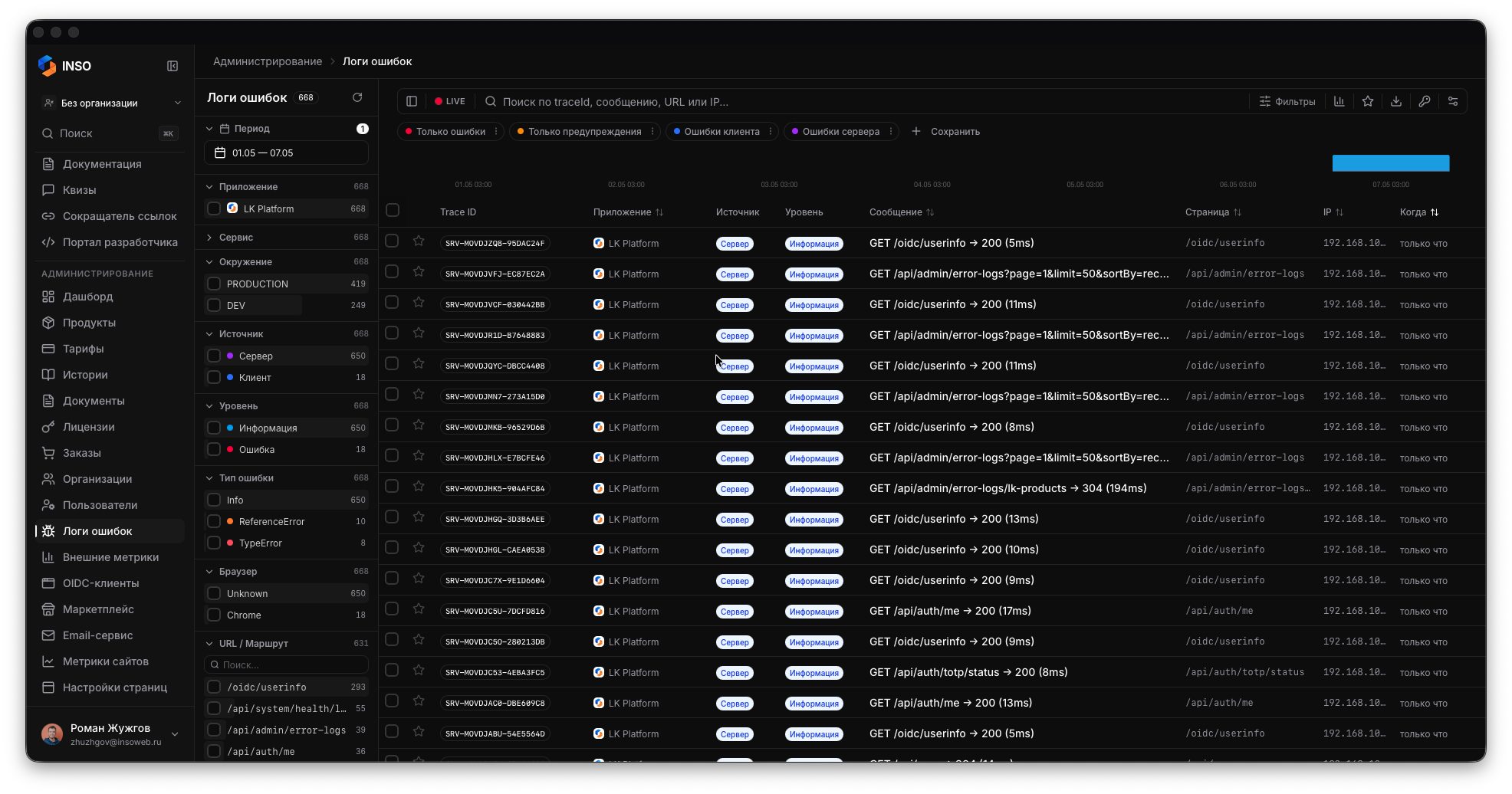
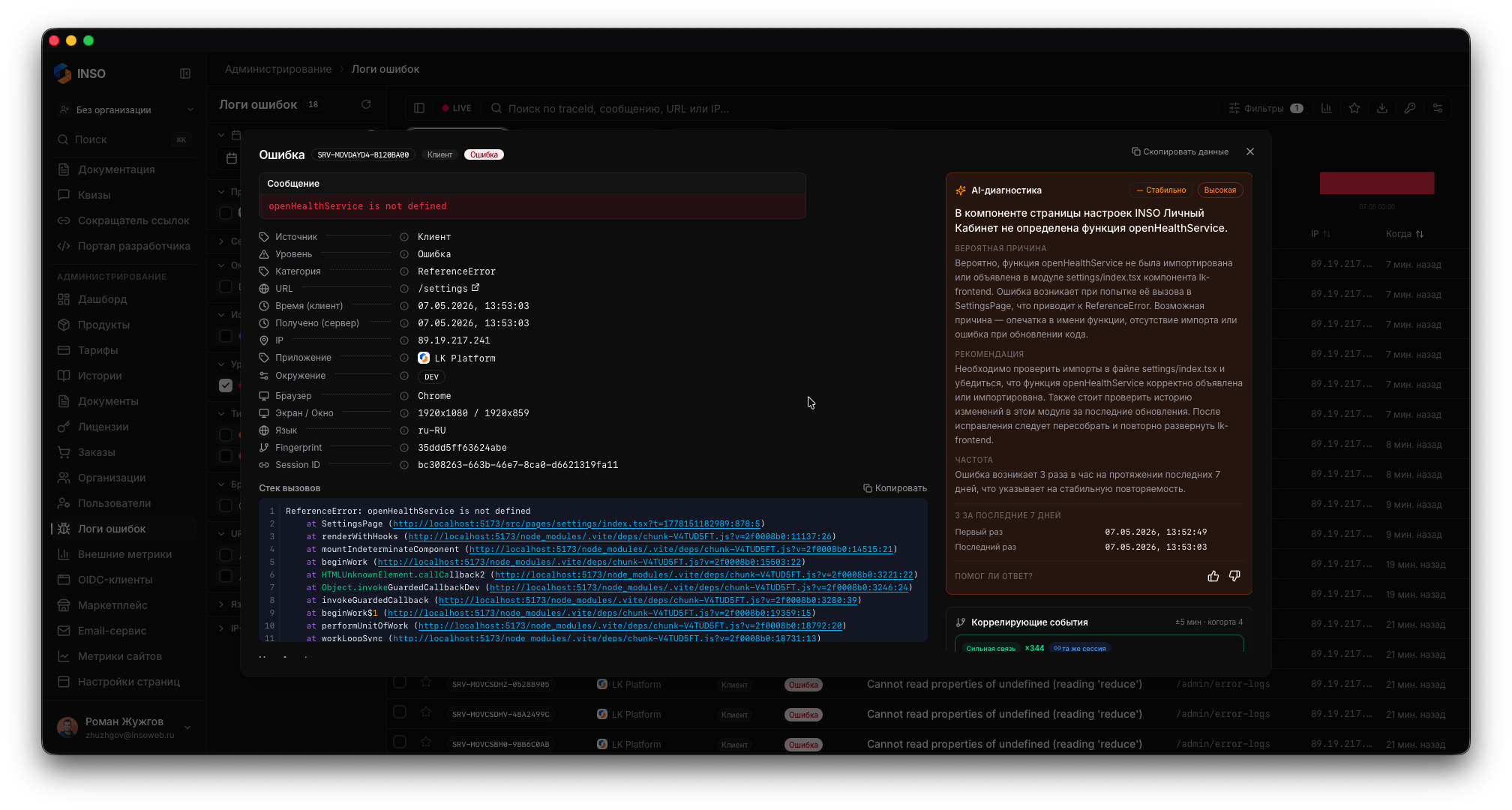
ELS ships with a built-in admin dashboard. Every event captured by this SDK — server (API routes, middleware, RSC) and client — lands there with full-text search, faceted filtering, AI-assisted diagnosis, and version-aware regression detection.
| | |
|---|---|
|  |
| 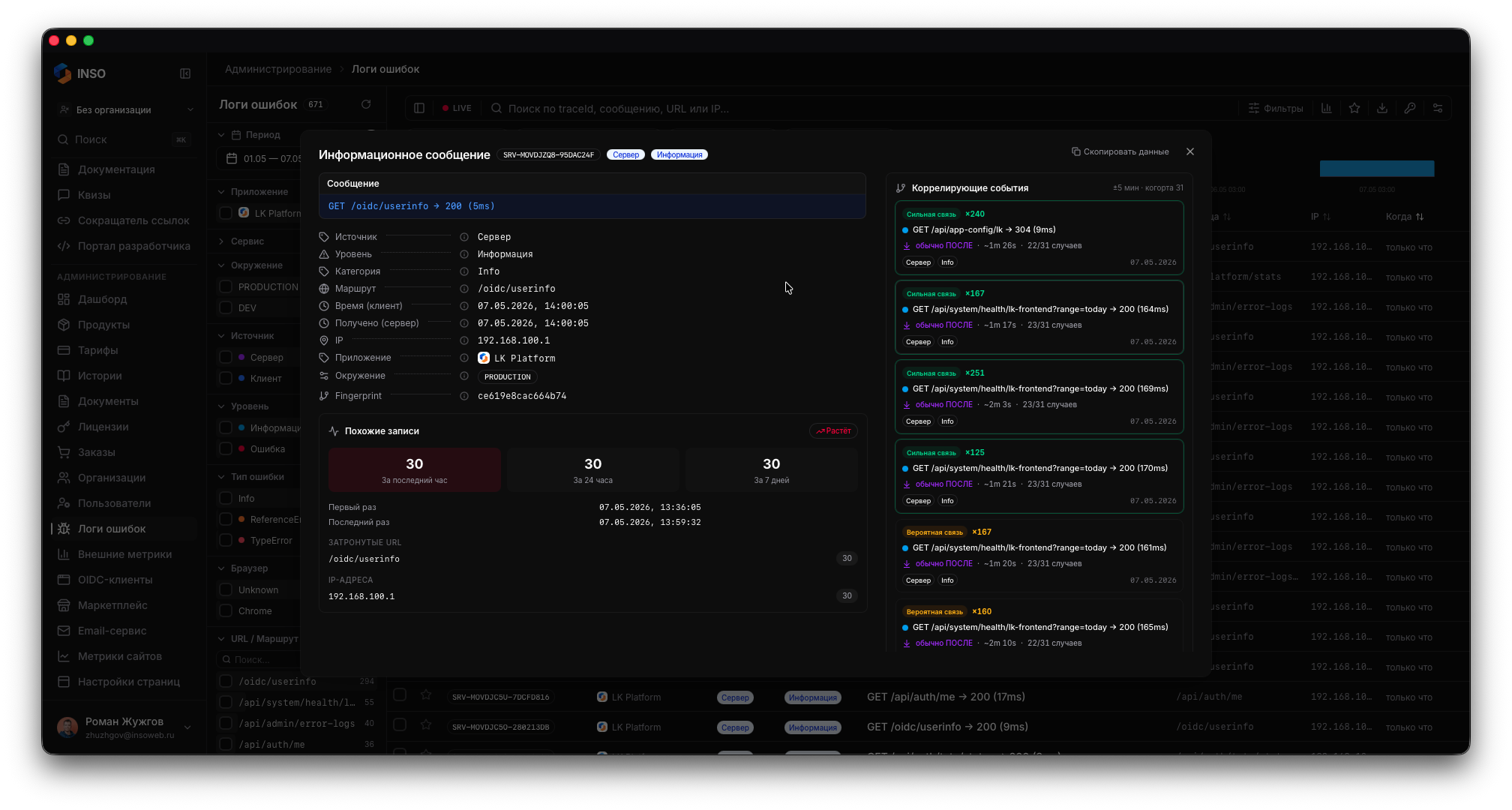 |
| Virtual table with facet sidebar (app, env, version, source, level, browser, IP, category). Live mode auto-refreshes every 5s. | Full event metadata: timestamps, geo, env, app version, fingerprint, session, repetition cards, in-session correlation. |
|
|
| Virtual table with facet sidebar (app, env, version, source, level, browser, IP, category). Live mode auto-refreshes every 5s. | Full event metadata: timestamps, geo, env, app version, fingerprint, session, repetition cards, in-session correlation. |
|  |
| 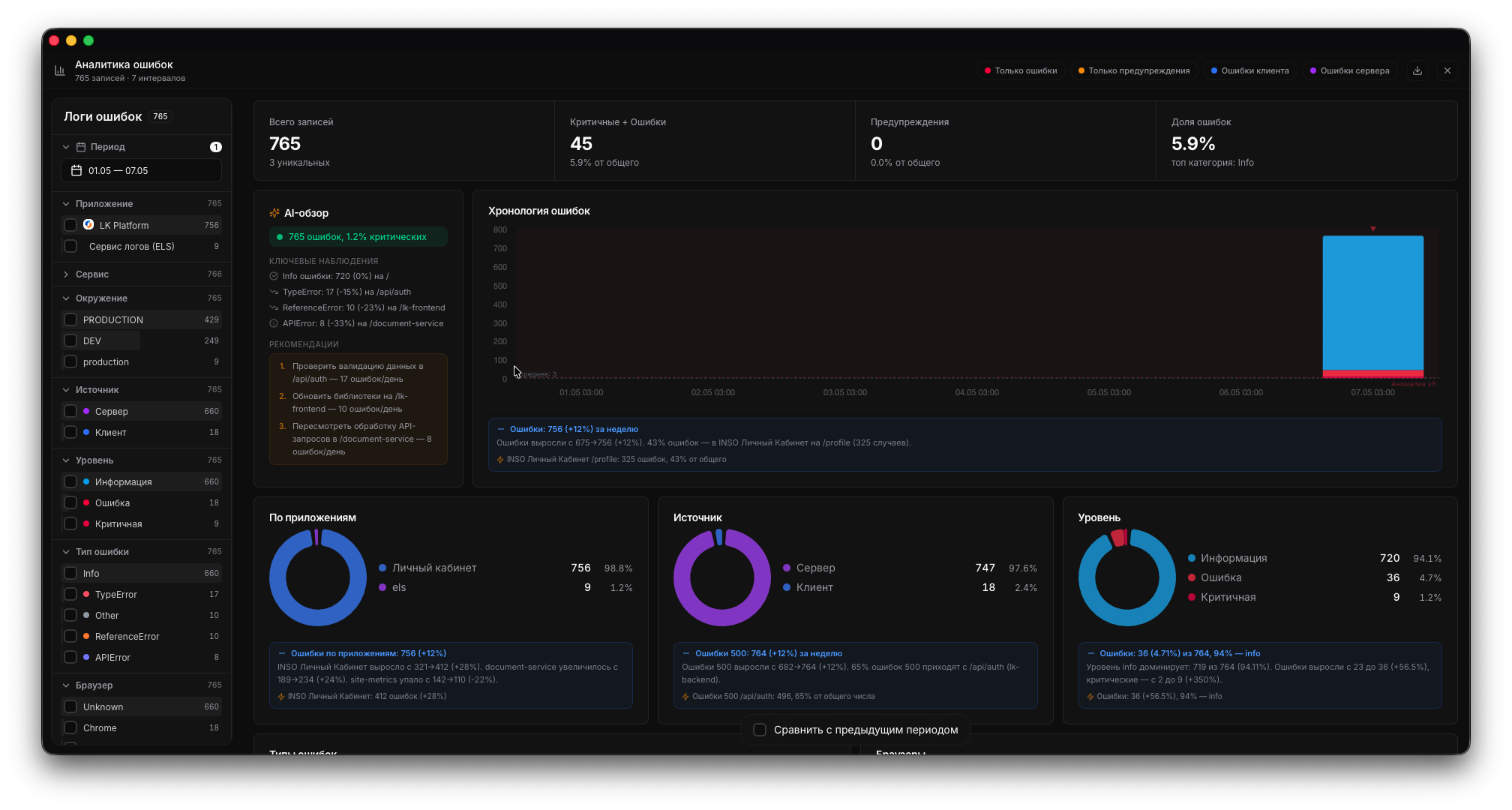 |
| Parsed stack trace + AI-assisted diagnosis: what broke, where, how to fix. | Timeline, donuts, top URLs/IPs, hourly heatmap, version-regression widget. |
|
| Parsed stack trace + AI-assisted diagnosis: what broke, where, how to fix. | Timeline, donuts, top URLs/IPs, hourly heatmap, version-regression widget. |
Install
npm install @inso_web/els-client @inso_web/els-next@inso_web/els-client is a peer dependency.
Requirements: Next.js 13+ (App Router) or Next.js 12+ (Pages Router), Node.js 18+.
Quick Start
0. Create the logger
lib/logger.ts — one module to import from everywhere:
import { createELSLogger } from '@inso_web/els-next';

export const log = createELSLogger({
  apiKey: process.env.NEXT_PUBLIC_ELS_API_KEY ?? '',
  appSlug: 'my-nextjs-app',
  serviceName: 'web',
  deploymentEnv: process.env.NODE_ENV === 'production' ? 'PRODUCTION' : 'DEV',
  appVersion: process.env.NEXT_PUBLIC_BUILD_VERSION,
  minLevel: 'info',
});
Don't have an API key yet? Sign up at lk.insoweb.ru — takes under a minute.
1. App Router (recommended)
app/api/users/[id]/route.ts:
import { log } from '@/lib/logger';

export async function GET(_req: Request, { params }: { params: { id: string } }) {
  log.info({ userId: params.id }, 'Fetching user');
  try {
    const user = await db.user.findUnique({ where: { id: params.id } });
    return Response.json(user);
  } catch (err) {
    log.error(err as Error, 'User fetch failed');
    return new Response('Internal error', { status: 500 });
  }
}
Global error boundary — app/global-error.tsx:
'use client';
import { useEffect } from 'react';
import { log } from '@/lib/logger';

export default function GlobalError({ error, reset }: { error: Error; reset: () => void }) {
  useEffect(() => { log.error(error, 'global-error boundary'); }, [error]);
  return (
    <html><body>
      <p>Something went wrong</p>
      <button onClick={() => reset()}>Try again</button>
    </body></html>
  );
}
2. Pages Router
pages/api/users/[id].ts:
import type { NextApiRequest, NextApiResponse } from 'next';
import { log } from '@/lib/logger';

export default async function handler(req: NextApiRequest, res: NextApiResponse) {
  try {
    const user = await db.user.findUnique({ where: { id: String(req.query.id) } });
    res.json(user);
  } catch (err) {
    log.error(err as Error, 'User fetch failed');
    res.status(500).end('Internal error');
  }
}
Custom error page — pages/_error.tsx:
import { log } from '@/lib/logger';

function ErrorPage({ statusCode, err }: { statusCode: number; err?: Error }) {
  if (err) log.error(err, `_error ${statusCode}`);
  return <p>Status: {statusCode}</p>;
}
ErrorPage.getInitialProps = ({ res, err }: any) => ({
  statusCode: res?.statusCode ?? err?.statusCode ?? 404,
  err,
});
export default ErrorPage;
3. Client components
'use client';
import { log } from '@/lib/logger';

export function CheckoutButton() {
  const onClick = async () => {
    try {
      await fetch('/api/checkout', { method: 'POST' });
    } catch (err) {
      log.error(err as Error, 'Checkout failed');
    }
  };
  return <button onClick={onClick}>Pay</button>;
}
Global browser handlers — drop into app/layout.tsx or a small ErrorReporter component:
'use client';
import { useEffect } from 'react';
import { log } from '@/lib/logger';

export function ErrorReporter() {
  useEffect(() => {
    const onError = (e: ErrorEvent) => log.error(e.error ?? e.message);
    const onReject = (e: PromiseRejectionEvent) => log.error(e.reason);
    window.addEventListener('error', onError);
    window.addEventListener('unhandledrejection', onReject);
    return () => {
      window.removeEventListener('error', onError);
      window.removeEventListener('unhandledrejection', onReject);
    };
  }, []);
  return null;
}
4. Edge runtime
// middleware.ts
import { NextResponse, type NextRequest } from 'next/server';
import { log } from '@/lib/logger';

export const config = { matcher: '/api/:path*' };

export function middleware(req: NextRequest) {
  log.info({ url: req.nextUrl.pathname }, 'Edge request');
  return NextResponse.next();
}
The logger uses only the global fetch — fully edge-compatible.
When to use what
| Scenario | Use |
|---|---|
| API route in App Router | import { log } + log.info(...), log.error(...) |
| Server Component fetch failure | log.error(err, 'rsc-fetch') in try/catch |
| Client component handler | 'use client' + same log |
| Middleware / edge | Same log — only fetch is used |
| Global render-crash | app/global-error.tsx boundary (App Router) |
| Pages Router 4xx/5xx | pages/_error.tsx |
There is one logger surface across runtimes. Bundle splitter decides server vs client automatically — you don't.
Core concepts
One logger, two runtimes
createELSLogger(...) is safe to import from both server and client code. On the server it ships directly. In the browser it ships via fetch too — your apiKey is still an ELS scoped key (write-only for one app), so it's fine to expose in the bundle just like Sentry's public DSN.
Fire-and-forget
log.error(...) never throws and never blocks. Transport errors land in console.error (visible in server logs / browser devtools).
Bindings & child loggers
const reqLog = log.child({ requestId: crypto.randomUUID(), userId: '42' });
reqLog.info('processing checkout');
Use bindings to carry per-request context through async boundaries.
Configuration
ELSConfig matches the base client — see @inso_web/els-client. The most relevant fields:
| Option | Description |
|---|---|
| apiKey | API key (required) |
| appSlug | App slug (required) |
| serviceName | Module / service name |
| deploymentEnv | DEV / STAGING / PRODUCTION |
| appVersion | Version string (any format, ≤128 chars) |
| minLevel | Minimum level to send |
Migration
From console.log + global error boundary
Before — server (Pages Router):
// pages/api/users/[id].ts
export default function handler(req, res) {
  try {
    // ...
  } catch (err) {
    console.error('user fetch failed', err);
    res.status(500).end();
  }
}
Before — client:
'use client';
useEffect(() => {
  const onError = (e: ErrorEvent) => console.error('window.error', e.error);
  window.addEventListener('error', onError);
  return () => window.removeEventListener('error', onError);
}, []);
After — single logger across both:
// lib/logger.ts
import { createELSLogger } from '@inso_web/els-next';
export const log = createELSLogger({ apiKey, appSlug: 'my-app' });
// pages/api/users/[id].ts
import { log } from '@/lib/logger';
export default function handler(req, res) {
try { /* ... */ }
catch (err) {
log.error(err as Error, 'user fetch failed');
res.status(500).end();
}
}'use client';
import { log } from '@/lib/logger';
useEffect(() => {
const onError = (e: ErrorEvent) => log.error(e.error ?? e.message);
window.addEventListener('error', onError);
return () => window.removeEventListener('error', onError);
}, []);| console method | ELS method | Notes |
|---|---|---|
| console.log / info | log.info | |
| console.warn | log.warn | |
| console.error | log.error | First arg can be Error or string |
Gotchas:
console.*keeps writing to stdout / devtools. Leave it for local dev; ELS only carries remote-worthy events.- Variadic
printf-style formatting is not supported — pass structured fields instead.
From @sentry/nextjs
Before:
// sentry.server.config.ts
import * as Sentry from '@sentry/nextjs';
Sentry.init({
  dsn: process.env.SENTRY_DSN,
  environment: process.env.NODE_ENV,
  release: process.env.NEXT_PUBLIC_BUILD_VERSION,
});

// sentry.client.config.ts
import * as Sentry from '@sentry/nextjs';
Sentry.init({
  dsn: process.env.NEXT_PUBLIC_SENTRY_DSN,
  environment: process.env.NODE_ENV,
});

// api/users/[id]/route.ts
export async function GET() {
  try { /* ... */ }
  catch (err) {
    Sentry.captureException(err);
    return new Response('500', { status: 500 });
  }
}
After:
// lib/logger.ts — single config for client + server
import { createELSLogger } from '@inso_web/els-next';
export const log = createELSLogger({
  apiKey: process.env.NEXT_PUBLIC_ELS_API_KEY!,
  appSlug: 'my-app',
  deploymentEnv: process.env.NODE_ENV === 'production' ? 'PRODUCTION' : 'DEV',
  appVersion: process.env.NEXT_PUBLIC_BUILD_VERSION,
});

// api/users/[id]/route.ts
import { log } from '@/lib/logger';
export async function GET() {
  try { /* ... */ }
  catch (err) {
    log.error(err as Error, 'user fetch failed');
    return new Response('500', { status: 500 });
  }
}
| Sentry concept | ELS equivalent | Notes |
|---|---|---|
| sentry.{server,client,edge}.config.ts | One lib/logger.ts | No runtime-specific configs |
| dsn | apiKey + appSlug | Three explicit fields |
| captureException(err) | log.error(err) | |
| captureMessage(msg, level) | log.<level>(msg) | |
| release | appVersion | Same field, any string ≤128 chars |
| environment | deploymentEnv | Fixed enum |
| Source maps upload | Not provided | Pair with another tool if critical |
| withSentryConfig(...) wrapper | Not needed | No build-time wrapper |
Gotchas:
- Sentry's Next plugin instruments build artefacts (sourcemap upload, tunnel route). ELS does neither — drop
withSentryConfigand removesentry-cli. - For App Router's automatic error boundaries Sentry registers an integration; ELS uses the standard
app/global-error.tsxpattern (shown above). - Tracing / performance is out of scope — keep Sentry Performance alongside if you depend on it.
Versioning
Next.js inlines NEXT_PUBLIC_* variables at build time. Pass through Dockerfile:
ARG NEXT_PUBLIC_BUILD_VERSION=dev
ENV NEXT_PUBLIC_BUILD_VERSION=$NEXT_PUBLIC_BUILD_VERSION
RUN npm run build
# .gitlab-ci.yml
- export BUILD_VERSION=$(date -u +%Y%m%d%H%M%S)
- docker build --build-arg NEXT_PUBLIC_BUILD_VERSION="$BUILD_VERSION" ...createELSLogger({ ..., appVersion: process.env.NEXT_PUBLIC_BUILD_VERSION });ELS accepts any string ≤128 chars: semver, CalVer, date-compact, git SHA, opaque. The server auto-detects the format and sorts timelines.
Quick reference
| Need | Use |
|---|---|
| API route logging | import { log } + log.info(...) |
| Server Component error | log.error(err) inside try/catch |
| Client error reporter | useEffect with window.error handler |
| Edge middleware | Same log (only fetch used) |
| Global render-crash | app/global-error.tsx |
| Pages-Router 4xx/5xx | pages/_error.tsx |
| Hide key from client bundle | Use server-only env vars + an internal /api/log proxy |
| Suppress noisy levels | minLevel: 'warn' |
Why ELS
ELS for Node.js is a focused logging SaaS, not a full observability suite. It optimises for capture speed, AI-driven triage, and a low integration cost.
- Lower weight. No transitive deps, no build-time plugins.
- Zero external API calls. Only
POST /errors[/batch]andGET /health. - AI-assisted diagnosis on every stack trace.
- 5-minute integration. One
lib/logger.tscovers server, client, and edge. - Predictable price. Tariffs live in the dashboard.
Detailed comparison
| Category | ELS | Sentry | Datadog / New Relic | Grafana Loki | LogRocket / Logtail / BetterStack | |---|---|---|---|---|---| | Hosting model | Managed SaaS | SaaS or self-hosted | SaaS only | Self-hosted / Grafana Cloud | SaaS | | SDK runtime deps | Zero | Medium (sub-SDKs, integrations) | Heavy (agent + tracing) | Promtail / agent | Medium | | Typical integration time | ~5 min | 10–20 min | 30–60 min | Hours to days | 10–20 min | | AI-assisted triage | Built-in | Paid add-on | Paid add-on | None | None | | Error grouping / fingerprint | Yes | Yes | Yes | Manual via LogQL | Partial | | Source-map upload | No | Yes | Yes | n/a | Partial | | Session replay (frontend) | No | Paid | Paid | n/a | Yes (core) | | Distributed tracing / APM | No | Partial | Yes (core) | Yes with Tempo | No | | Infrastructure metrics | No | No | Yes (core) | Yes with Mimir | No | | Free tier log retention | 24 hours | 30 days (limited volume) | Trial only | Self-cost | 3–30 days | | Russian-language support / docs | Native | Community | Limited | Community | None |
When ELS is the wrong choice
- You need a single vendor for APM + logs + metrics under one bill — go Datadog or New Relic.
- Your frontend bug triage relies on DOM session replay — go LogRocket or Sentry Replay.
- You ship a public mobile app and need crash symbolication + ANR detection — Firebase Crashlytics or Sentry Mobile.
For everything else — backend errors, frontend JS errors, request logs, structured app events with version-aware analytics — ELS is built to be the cheapest path to a working dashboard.
→ Sign up at lk.insoweb.ru to grab an API key.
API
function createELSLogger(config: ELSConfig): Logger;ELSConfig matches the base client — see @inso_web/els-client. Logger methods: fatal / error / warn / info / debug / trace / child / flush.
FAQ
Is the API key safe in the client bundle? Yes. ELS keys are scoped — a write key for your app cannot read events. The same model Sentry uses for public DSNs. If you still want to hide it, run an internal /api/log proxy and only log from API routes.
What if the API key is empty? The SDK does not throw — it returns a no-op logger. Useful for preview deployments without keys yet.
Does it work in edge runtimes? Yes. The transport is plain fetch — no Node APIs.
Does withSentryConfig need replacement? No build-time wrapper is needed. Just import and use.
Other ELS SDKs
Same wire format, same dashboard — pick by stack.
Node.js family
@inso_web/els-client— base TS / Node / browser client@inso_web/els-express— Express middleware@inso_web/els-next— Next.js helpers (this repo)@inso_web/els-nest— NestJS module@inso_web/els-react— React Provider, hooks, ErrorBoundary@inso_web/els-vue— Vue 3 plugin
Other stacks
Inso.Els— .NET (Core + ASP.NET Core + ILogger)io.github.official-inso:els-core— Java + Spring Boot starter + SLF4Jgithub.com/official-inso/els-go— Go
Pricing
Free tier — 24-hour log retention. See lk.insoweb.ru for the full tariff matrix.
License
MIT © INSOWEB