
@inso_web/els-react
v0.5.2
Published
React bindings for the Error Logs Service (ELS): Provider, hooks, ErrorBoundary and a HOC for automatic component error reporting.

Maintainers
 insoweb
Readme
@inso_web/els-react




React bindings for the Inso Error Logs Service (ELS) — a managed SaaS for centralised event logging (debug → fatal) with AI-assisted error triage. Ships <ELSProvider> for DI, useELS() hook, a ready-made <ELSErrorBoundary> that auto-reports render-phase errors, and a useGlobalErrorHandlers() hook for window listeners. React 17+.
Table of contents
- What you get
- Install
- Quick Start
- When to use what
- Core concepts
- Configuration
- Migration
- Versioning
- Quick reference
- Why ELS
- API
- FAQ
- Other ELS SDKs
- Pricing
- License
What you get
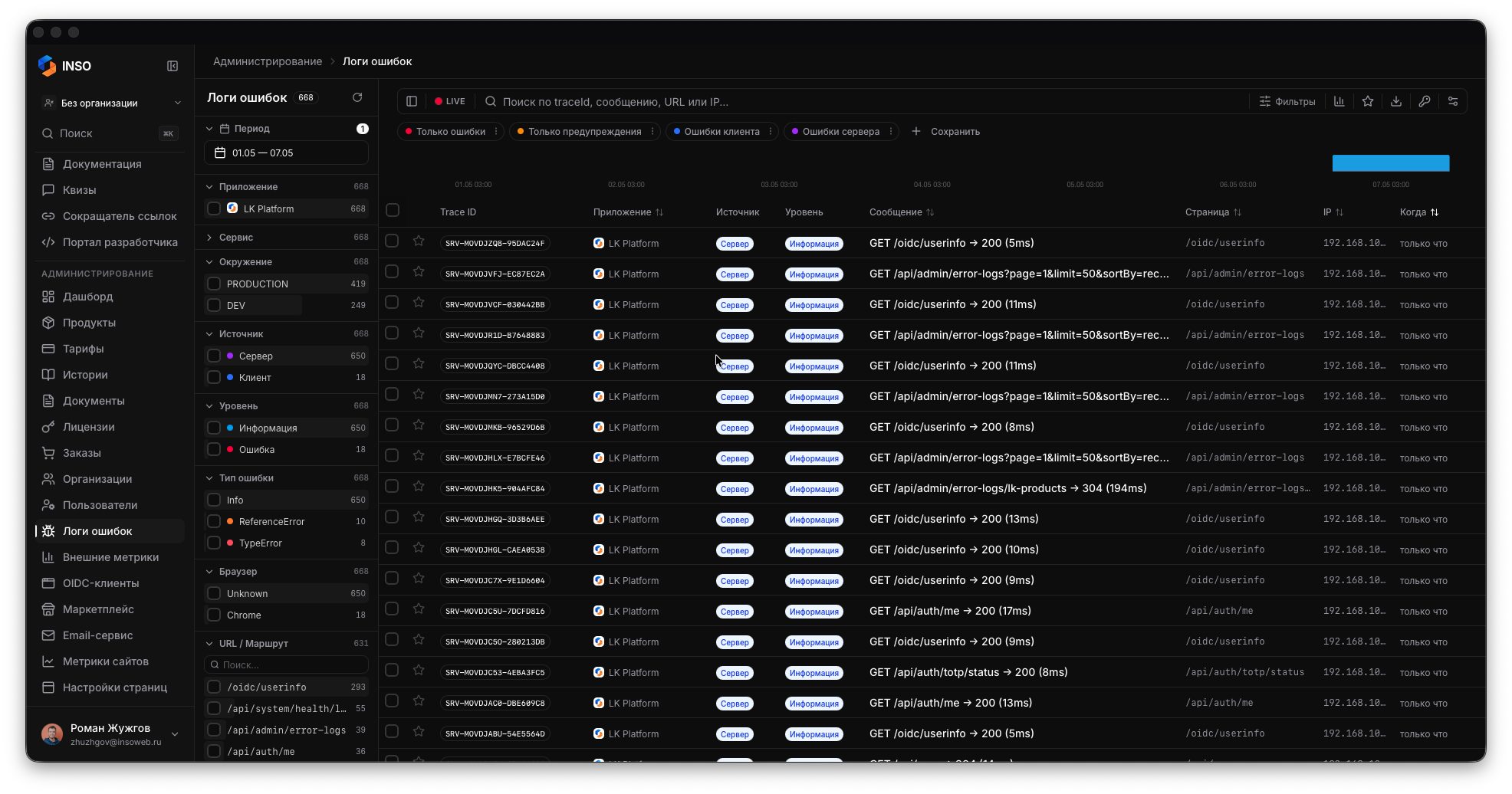
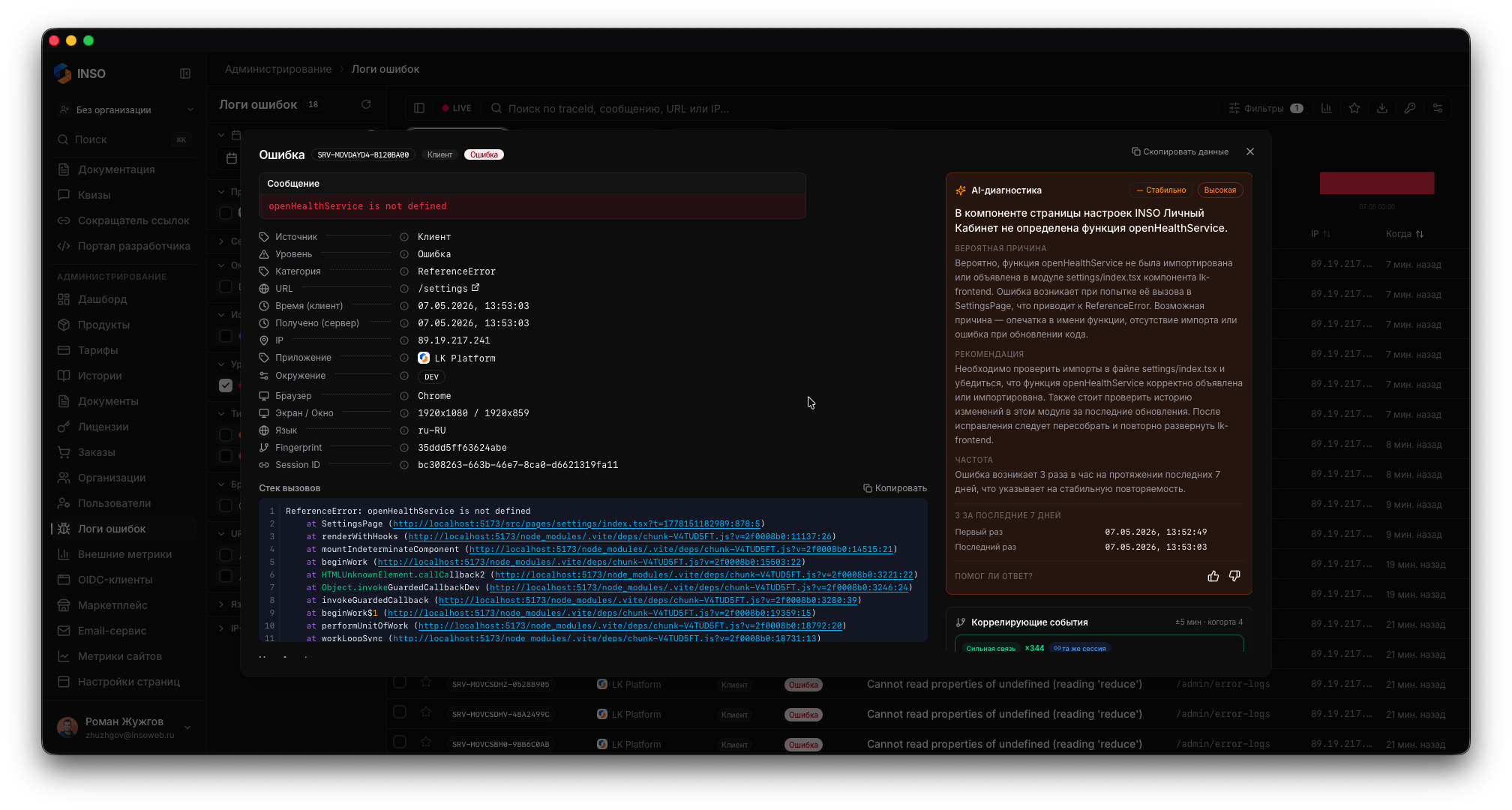
ELS ships with a built-in admin dashboard. Every event captured by this SDK lands there with full-text search, faceted filtering, AI-assisted diagnosis, and version-aware regression detection. React render-phase errors carry componentStack alongside the regular stack trace.
| | |
|---|---|
|  |
| 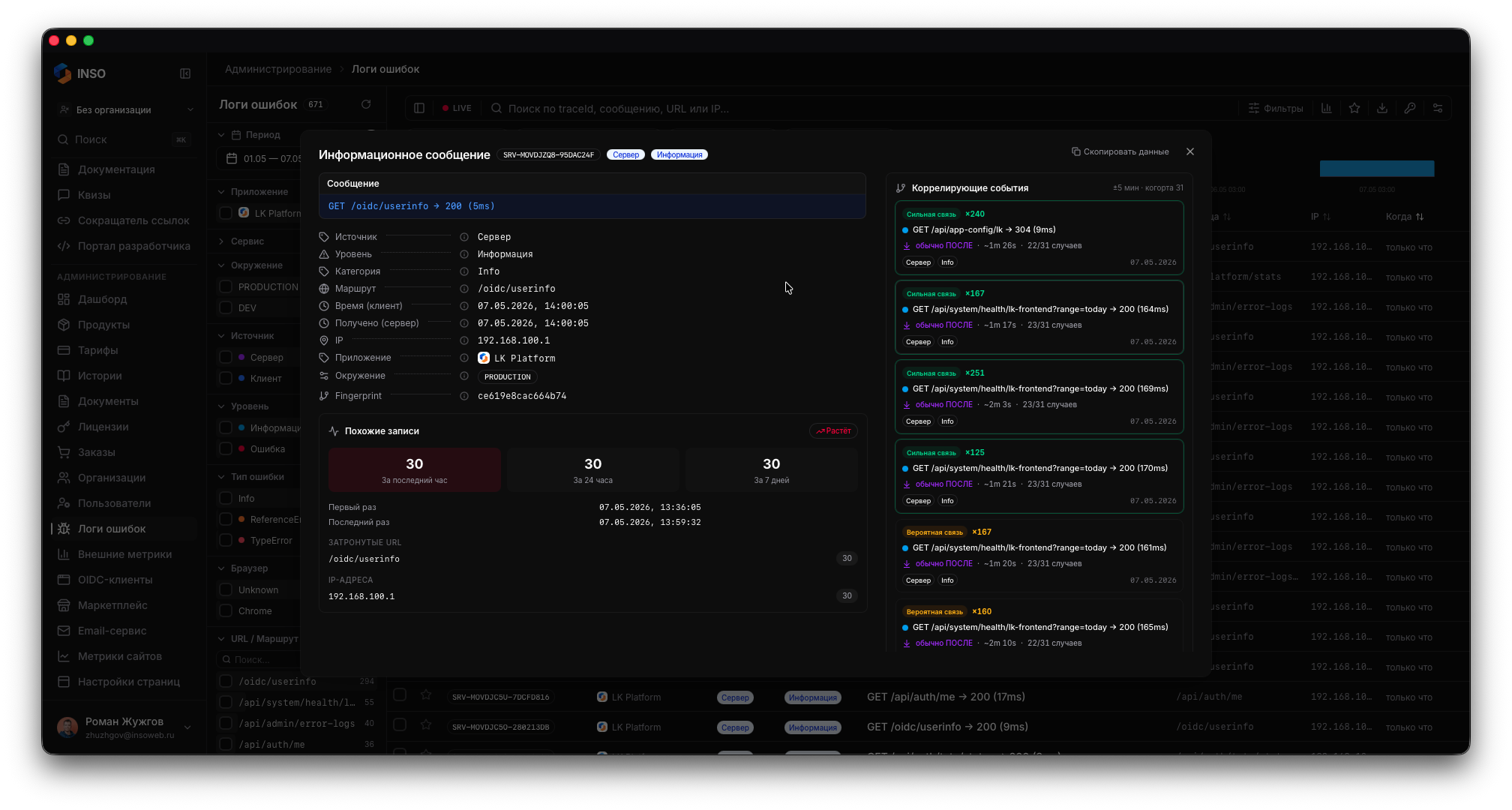 |
| Virtual table with facet sidebar (app, env, version, source, level, browser, IP, category). Live mode auto-refreshes every 5s. | Full event metadata: timestamps, geo, env, app version, fingerprint, session, repetition cards, in-session correlation. |
|
|
| Virtual table with facet sidebar (app, env, version, source, level, browser, IP, category). Live mode auto-refreshes every 5s. | Full event metadata: timestamps, geo, env, app version, fingerprint, session, repetition cards, in-session correlation. |
|  |
| 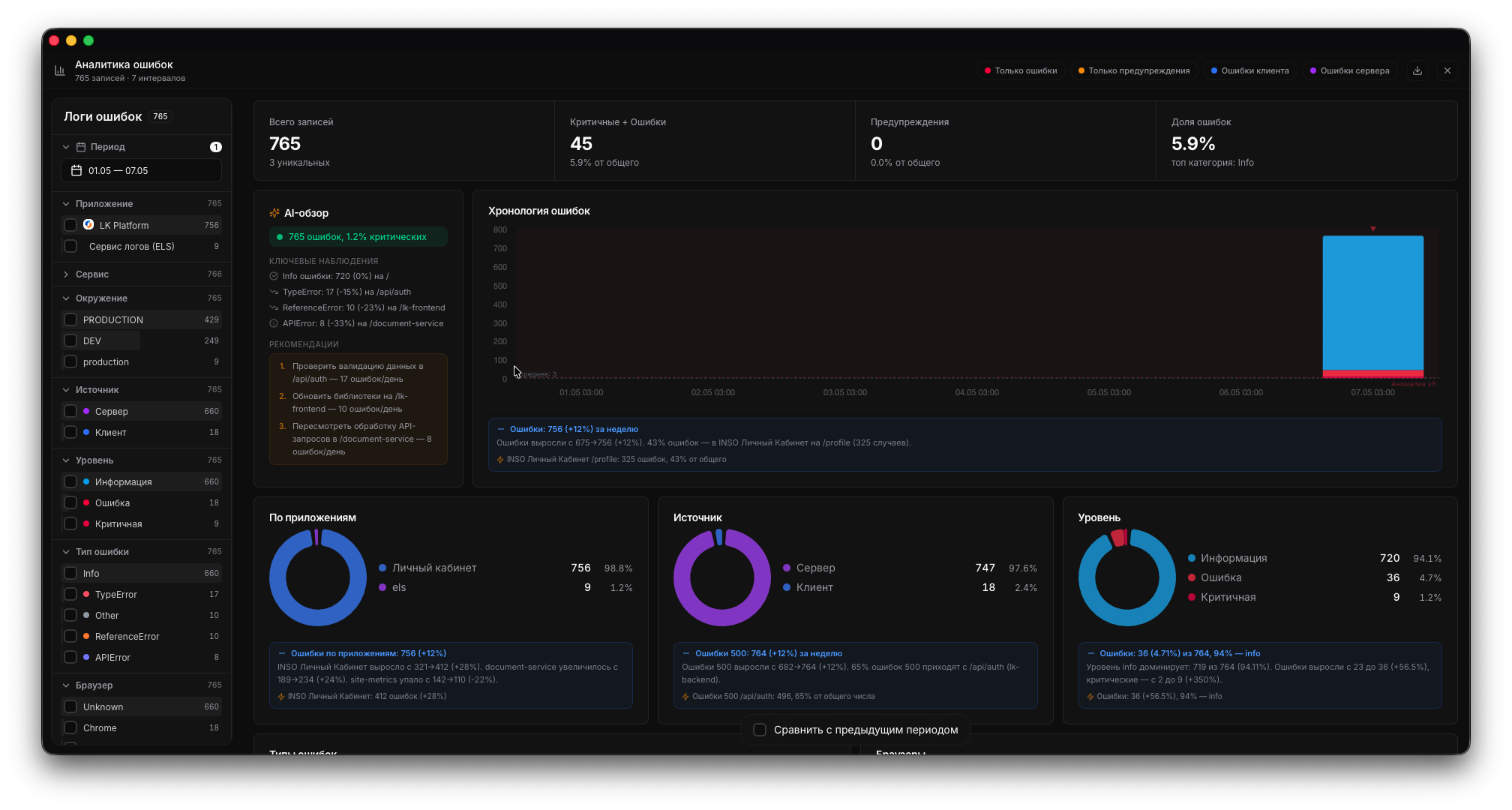 |
| Parsed stack trace + AI-assisted diagnosis: what broke, where, how to fix. | Timeline, donuts, top URLs/IPs, hourly heatmap, version-regression widget. |
|
| Parsed stack trace + AI-assisted diagnosis: what broke, where, how to fix. | Timeline, donuts, top URLs/IPs, hourly heatmap, version-regression widget. |
Install
npm install @inso_web/els-client @inso_web/els-reactRequirements: React 17+, Node.js 18+ at build time. Works with Vite, CRA, Webpack, Parcel.
Quick Start
1. Wrap your app in <ELSProvider>
main.tsx (Vite) or index.tsx (CRA):
import { ELSClient } from '@inso_web/els-client';
import { ELSProvider } from '@inso_web/els-react';
import { App } from './App';

const client = new ELSClient({
  apiKey: import.meta.env.VITE_ELS_API_KEY,
  appSlug: 'my-react-app',
  serviceName: 'web',
  deploymentEnv: import.meta.env.PROD ? 'PRODUCTION' : 'DEV',
  appVersion: import.meta.env.VITE_BUILD_VERSION,
  minLevel: 'info',
});

ReactDOM.createRoot(document.getElementById('root')!).render(
  <ELSProvider client={client}>
    <App />
  </ELSProvider>,
);
Don't have an API key yet? Sign up at lk.insoweb.ru — takes under a minute.
2. Log via useELS()
import { useELS } from '@inso_web/els-react';

export function CheckoutButton() {
  const log = useELS();
  const onClick = async () => {
    log.info('Checkout started');
    try {
      await fetch('/api/checkout', { method: 'POST' });
    } catch (err) {
      log.error(err as Error, 'Checkout failed');
    }
  };
  return <button onClick={onClick}>Pay</button>;
}
3. Wrap the root in <ELSErrorBoundary>
import { ELSErrorBoundary } from '@inso_web/els-react';

<ELSErrorBoundary fallback={<div>Something went wrong</div>}>
  <App />
</ELSErrorBoundary>
Render-phase errors are captured automatically with stack trace + componentStack.
4. Global handlers (optional)
import { useGlobalErrorHandlers } from '@inso_web/els-react';

export function ErrorReporter() {
  useGlobalErrorHandlers(); // window.error + unhandledrejection
  return null;
}
Mount <ErrorReporter /> once inside the provider.
When to use what
| Scenario | Use |
|---|---|
| Catch render-phase errors | Wrap a subtree in <ELSErrorBoundary> |
| Handle async errors in event handlers | useELS() + try/catch |
| Background window.error / unhandledrejection | Mount <ErrorReporter /> with useGlobalErrorHandlers() |
| Multiple sub-apps with different configs | Multiple <ELSProvider> instances (innermost wins) |
| Outside React (utility module) | Import the ELSClient directly |
| SSR (Next.js) | Use @inso_web/els-next instead |
Core concepts
<ELSErrorBoundary>
A regular React error boundary that calls client.error(err, ..., { meta: { componentStack } }) in componentDidCatch. Render-phase exceptions are captured; event-handler errors are not (React itself doesn't surface them to boundaries — wrap with try/catch).
useELS()
Returns the same Logger interface as the base client: info, warn, error, debug, trace, fatal, child, flush. The reference is stable across renders.
Bindings & child loggers
const log = useELS();
const userLog = log.child({ userId: 42, role: 'admin' });
userLog.info('viewed profile');
child is cheap — create one per user, per workflow, per route as needed.
Configuration
ELSConfig matches the base client — see @inso_web/els-client. Key fields:
| Option | Description |
|---|---|
| apiKey | API key (required) |
| appSlug | App slug (required) |
| serviceName | Service / module name |
| deploymentEnv | DEV / STAGING / PRODUCTION |
| appVersion | Version (≤128 chars) |
| minLevel | Minimum level to send |
Migration
From @sentry/react
Before:
import * as Sentry from '@sentry/react';

Sentry.init({
  dsn: 'https://[email protected]/1',
  environment: process.env.NODE_ENV,
  release: import.meta.env.VITE_BUILD_VERSION,
});

const SentryRoute = Sentry.withSentryReactRouterV6Routing(Route);

ReactDOM.createRoot(document.getElementById('root')!).render(
  <Sentry.ErrorBoundary fallback={<p>Crashed</p>}>
    <App />
  </Sentry.ErrorBoundary>,
);

function MyButton() {
  return (
    <button onClick={() => {
      Sentry.captureMessage('clicked');
      doStuff().catch(Sentry.captureException);
    }}>Click</button>
  );
}
After:
import { ELSClient } from '@inso_web/els-client';
import { ELSProvider, ELSErrorBoundary, useELS } from '@inso_web/els-react';

const client = new ELSClient({
  apiKey: import.meta.env.VITE_ELS_API_KEY,
  appSlug: 'my-react-app',
  deploymentEnv: import.meta.env.PROD ? 'PRODUCTION' : 'DEV',
  appVersion: import.meta.env.VITE_BUILD_VERSION,
});

ReactDOM.createRoot(document.getElementById('root')!).render(
  <ELSProvider client={client}>
    <ELSErrorBoundary fallback={<p>Crashed</p>}>
      <App />
    </ELSErrorBoundary>
  </ELSProvider>,
);

function MyButton() {
  const log = useELS();
  return (
    <button onClick={() => {
      log.info('clicked');
      doStuff().catch((err) => log.error(err, 'click failed'));
    }}>Click</button>
  );
}
| Sentry | ELS | Notes |
|---|---|---|
| Sentry.init({ dsn }) | new ELSClient({ apiKey, appSlug }) | Three explicit fields |
| <Sentry.ErrorBoundary> | <ELSErrorBoundary> | Same role, same API |
| Sentry.captureException(err) | log.error(err) | Via useELS() |
| Sentry.captureMessage(msg, level) | log.<level>(msg) | |
| Sentry.setUser({ id }) | log.child({ user: { id } }) | Or via loggerDefaults |
| release | appVersion | Any string ≤128 chars |
| environment | deploymentEnv | Fixed enum |
| Sentry.withSentryReactRouterV6Routing | Not provided | Routing telemetry stays in Sentry if needed |
| Source maps upload | Not provided | Pair with another tool if critical |
| Session replay | Not provided | LogRocket / Sentry Replay if needed |
Gotchas:
- React event-handler errors are not caught by error boundaries — wrap async logic in
try/catchand calllog.error(...)explicitly. - Sentry's
breadcrumbshave no direct equivalent — uselog.child({ ... })to carry context.
From LogRocket React SDK
Before:
import LogRocket from 'logrocket';
import setupLogRocketReact from 'logrocket-react';

LogRocket.init('app/123');
setupLogRocketReact(LogRocket);

LogRocket.identify('user-42', { email: '[email protected]' });
LogRocket.captureException(new Error('boom'));
After:
import { ELSClient } from '@inso_web/els-client';
import { ELSProvider, ELSErrorBoundary, useELS } from '@inso_web/els-react';

const client = new ELSClient({
  apiKey: import.meta.env.VITE_ELS_API_KEY,
  appSlug: 'my-react-app',
});

// usage
const log = useELS();
log.child({ user: { id: 'user-42', email: '[email protected]' } }).info('identified');
log.error(new Error('boom'));
| LogRocket | ELS | Notes |
|---|---|---|
| LogRocket.init('app/123') | new ELSClient({ apiKey, appSlug }) | Three explicit fields |
| LogRocket.identify(id, meta) | log.child({ user: { id, ...meta } }) | Bindings travel with the logger |
| LogRocket.captureException(err) | log.error(err) | |
| LogRocket.log/info/warn/error | log.<level>(...) | |
| Session replay | Not provided | Stay on LogRocket if replay is critical |
| Network request capture | Not provided | Log explicit log.info({ url, status }) instead |
| Redux integration | Not provided | Call log.info(action.type, ...) in middleware |
Gotchas:
- LogRocket records full DOM sessions; ELS only stores discrete events. If session replay is the reason you chose LogRocket, keep it.
- LogRocket's request/response interception is opaque — replicate with explicit log calls in your fetch wrapper.
Versioning
Pass via build-time env. For Vite — VITE_BUILD_VERSION (Vite inlines at npm run build):
ARG VITE_BUILD_VERSION=dev
ENV VITE_BUILD_VERSION=$VITE_BUILD_VERSION
RUN npm run build
# .gitlab-ci.yml
- export BUILD_VERSION=$(date -u +%Y%m%d%H%M%S)
- docker build --build-arg VITE_BUILD_VERSION="$BUILD_VERSION" ...new ELSClient({ ..., appVersion: import.meta.env.VITE_BUILD_VERSION });ELS accepts any format ≤128 chars: semver, CalVer, date-compact, git SHA, opaque. The server auto-detects the format and sorts timelines.
Quick reference
| Need | Use |
|---|---|
| Logger in components | const log = useELS() |
| Catch render crashes | <ELSErrorBoundary> |
| Catch event-handler errors | try/catch + log.error(err) |
| Global browser errors | Mount <ErrorReporter /> with useGlobalErrorHandlers() |
| Identify user | log.child({ user: { id, email } }) |
| Per-route context | log.child({ route }) in a layout component |
| Suppress noisy levels | minLevel: 'warn' |
Why ELS
ELS for Node.js is a focused logging SaaS, not a full observability suite. It optimises for capture speed, AI-driven triage, and a low integration cost.
- Lower weight. ~3 KB gzip in the browser, no transitive deps.
- Zero external API calls. Only
POST /errors[/batch]andGET /health. - AI-assisted diagnosis on every stack trace —
componentStackincluded for React render errors. - 5-minute integration. Provider + boundary + hook, done.
- Predictable price. Tariffs in the dashboard.
Detailed comparison
| Category | ELS | Sentry | Datadog / New Relic | Grafana Loki | LogRocket / Logtail / BetterStack | |---|---|---|---|---|---| | Hosting model | Managed SaaS | SaaS or self-hosted | SaaS only | Self-hosted / Grafana Cloud | SaaS | | SDK runtime deps | Zero | Medium (sub-SDKs, integrations) | Heavy (agent + tracing) | Promtail / agent | Medium | | Typical integration time | ~5 min | 10–20 min | 30–60 min | Hours to days | 10–20 min | | AI-assisted triage | Built-in | Paid add-on | Paid add-on | None | None | | Error grouping / fingerprint | Yes | Yes | Yes | Manual via LogQL | Partial | | Source-map upload | No | Yes | Yes | n/a | Partial | | Session replay (frontend) | No | Paid | Paid | n/a | Yes (core) | | Distributed tracing / APM | No | Partial | Yes (core) | Yes with Tempo | No | | Infrastructure metrics | No | No | Yes (core) | Yes with Mimir | No | | Free tier log retention | 24 hours | 30 days (limited volume) | Trial only | Self-cost | 3–30 days | | Russian-language support / docs | Native | Community | Limited | Community | None |
When ELS is the wrong choice
- You need a single vendor for APM + logs + metrics under one bill — go Datadog or New Relic.
- Your frontend bug triage relies on DOM session replay — go LogRocket or Sentry Replay.
- You ship a public mobile app and need crash symbolication + ANR detection — Firebase Crashlytics or Sentry Mobile.
For everything else — backend errors, frontend JS errors, request logs, structured app events with version-aware analytics — ELS is built to be the cheapest path to a working dashboard.
→ Sign up at lk.insoweb.ru to grab an API key.
API
const ELSProvider: React.FC<{ client: ELSClient; children: ReactNode }>;

function useELS(): Logger;

class ELSErrorBoundary extends React.Component<{
  fallback?: ReactNode | ((error: Error) => ReactNode);
  onError?: (error: Error, info: ErrorInfo) => void;
  children: ReactNode;
}>;

function useGlobalErrorHandlers(opts?: { errors?: boolean; rejections?: boolean }): void;
Full ELSConfig reference — see @inso_web/els-client.
FAQ
React 18 / 19? Yes. Supported on React 17+.
Is the API key safe in the client bundle? Yes. ELS keys are scoped — a write key cannot read events. Same model as Sentry public DSN. If you still want to hide it, run an internal /api/log proxy.
What if apiKey is empty? new ELSClient({ ..., apiKey: '' }) throws. Guard in the entry file:
const client = apiKey
  ? new ELSClient({ ..., apiKey })
  : ({ info: () => {}, warn: () => {}, error: () => {}, /* ... */ } as any);
Or use @inso_web/els-next which has the silent-no-op guard built-in.
SSR with Next.js? Use @inso_web/els-next — single config for server + client + edge.
Other ELS SDKs
Same wire format, same dashboard — pick by stack.
Node.js family
@inso_web/els-client— base TS / Node / browser client@inso_web/els-express— Express middleware@inso_web/els-next— Next.js helpers (App + Pages router)@inso_web/els-nest— NestJS module@inso_web/els-react— React Provider, hooks, ErrorBoundary (this repo)@inso_web/els-vue— Vue 3 plugin
Other stacks
Inso.Els— .NET (Core + ASP.NET Core + ILogger)io.github.official-inso:els-core— Java + Spring Boot starter + SLF4Jgithub.com/official-inso/els-go— Go
Pricing
Free tier — 24-hour log retention. See lk.insoweb.ru for the full tariff matrix.
License
MIT © INSOWEB