
@justethales/casp
v0.16.0
Published
Your agent says the phase shipped; git says it didn't. CASP validates a project's recorded state against git and blocks the push on drift. Deterministic, local-only, zero telemetry. Works with Claude Code, Cursor, Aider.

Maintainers
 justethales
Keywords
Readme
CASP — the Coding-Agent State Protocol
Your agent says the phase shipped. Git says it didn't.
CASP is a CLI that reads what your project claims about itself — current phase, next task, last commit, migrations applied — and checks every claim against what git actually contains. When they disagree, it exits non-zero and your push is blocked, so a state file that lies never reaches your remote.
On top of that gate sits the half most people miss: you stop hand-writing session prompts. Queue the work once, and
casp nexthands your agent the next slice — in an order the validator has proven is executable.No LLM. No network. No account. The model holds the context; CASP proves the state is true — against git.




npm i -g @justethales/casp        # or: npx @justethales/casp <command>
casp init            # scaffold the casp/ layer in any repo
casp status          # one-screen "where am I"
casp check # validate the state against git — exits 1 on driftCoding-Agent · State · Protocol. Works with Claude Code, Cursor, Aider, Continue, or any agent that can run a CLI. Node ≥ 20. No account, no telemetry, nothing leaves your machine.
What it does, in six screens
Every image below is real casp output, byte for byte, captured on 0.14.1 against a
demo cockpit whose queue and history are genuinely chained — not a mockup, not an
AI-generated terminal, and not a screenshot anyone touched up. Reproduce them yourself with
docs/img/capture-readme-shots.sh
— it refuses to run unless your installed casp matches the release it documents, so these
screenshots cannot quietly fall behind the binary. Screen 6 arrived with 0.15.0 and is a
text capture rather than a PNG — pasted verbatim from a real run, not yet part of that
script's set.
1 · A push that lies gets blocked
Your state file says phase 14 is next. Git says phase 14 shipped last week. casp check
compares the two and exits 1, so the push stops here — instead of at a code review
where someone eventually notices the work was done twice.

Every finding carries a stable rule code and a one-line → fix hint, so an agent can
resolve it without re-reading docs. Install it once as a pre-push hook — casp install-hook
— and the gate stops depending on anyone remembering to run it.
2 · You stop hand-writing session prompts
This is the half that changes a working week. You write the plan once: each slice
becomes a file in your repo whose frontmatter declares what it comes after, and
state.json.next_prompt points at the head of the line.
casp new prompt --slug phase-16-team-permissions   # scaffold the next slice
casp next                                          # hand the head of the queue over
From then on a session opens with one command, and your agent gets a fully-formed prompt nobody composed that morning:
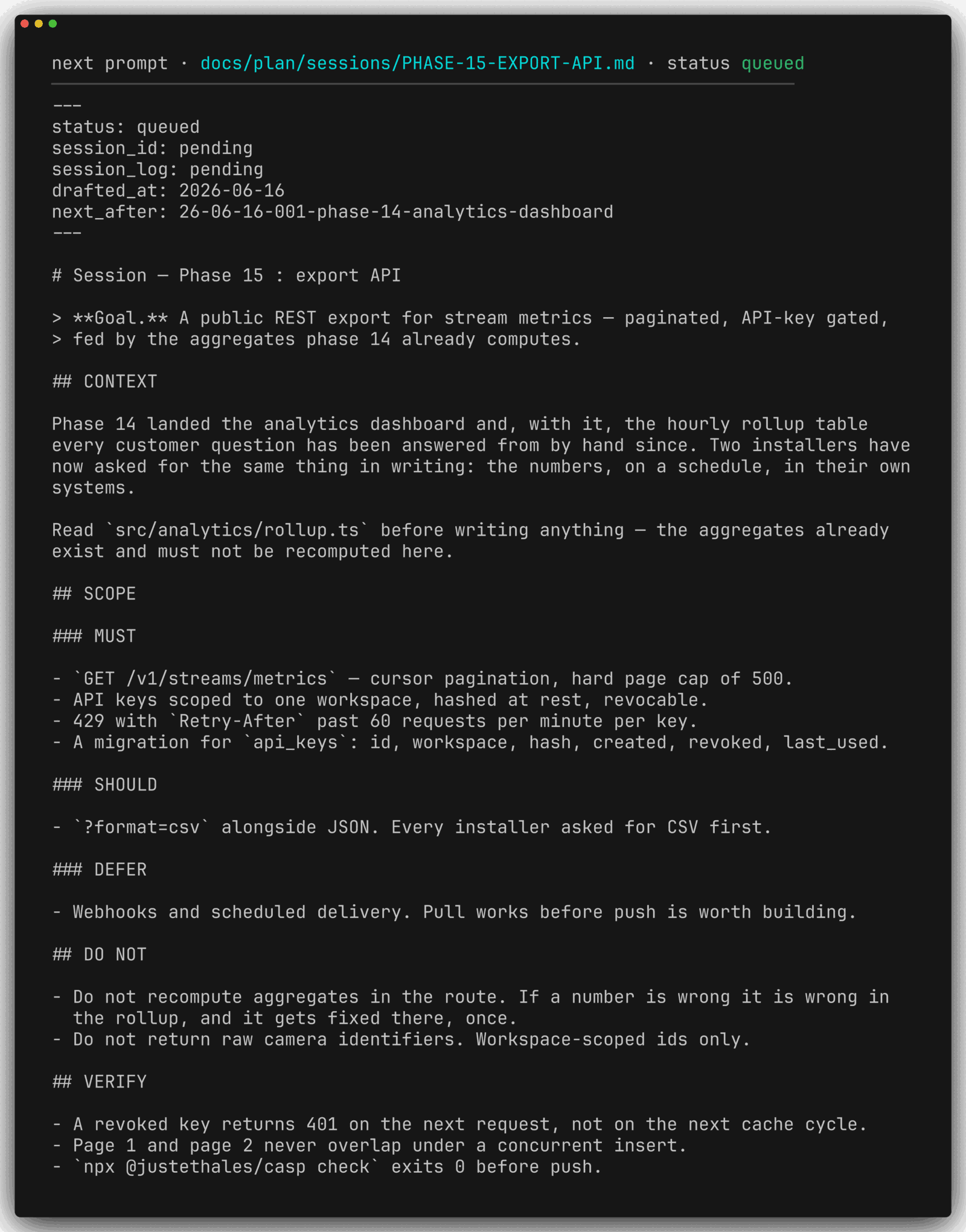
The refusal is what earns the trust. Anything can print a file. casp next reads the
recorded state before it prints anything, and hands over nothing when the head of the
queue is a slice that already shipped:

That is the specific afternoon this tool gives back: an agent starting confidently on last week's work, because a file told it to.
The plan lives in the repo — reviewable in a PR, diffable, and readable by whatever model you use next month.
Scope, stated honestly.
casp nextprints. It never executes — your agent does that. CASP is what makes the handoff worth trusting, not an orchestrator. It proves the plan is executable; it never decides what the plan should be.
3 · The plan is checked as a plan, not just as a list
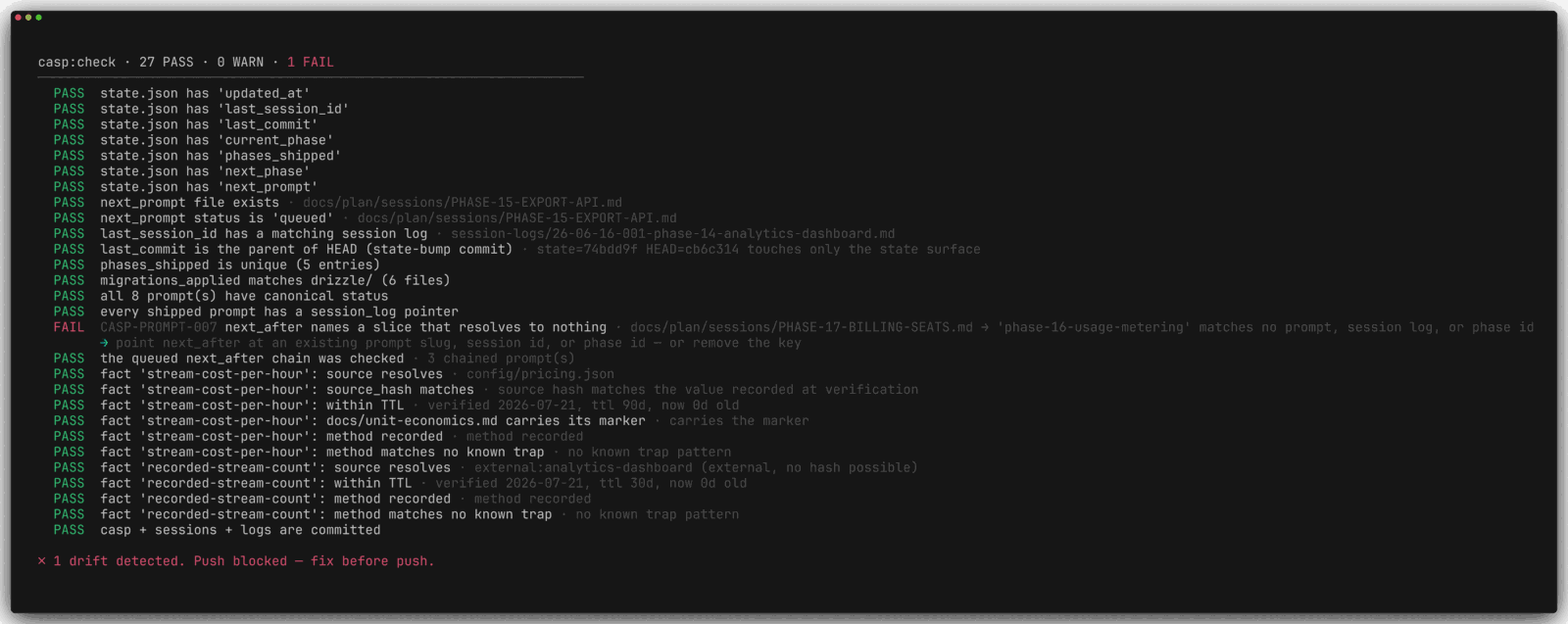
A queue is only as good as its order. CASP resolves the whole chain and refuses a plan that cannot be executed as written — a slice declaring a predecessor that exists nowhere, or a cycle no linear order can satisfy.
| Rule | What it refuses to let past |
|---|---|
| CASP-PROMPT-001 | next_prompt points at a file that doesn't exist |
| CASP-PROMPT-003 | next_prompt is a slice that already shipped — the re-do-last-week's-work bug |
| CASP-PROMPT-005 | A shipped prompt with no session log to show for it |
| CASP-PROMPT-007 | A next_after naming a slice that exists nowhere in the repo |
| CASP-PROMPT-008 | A cycle — A after B, B after A — that no linear execution can satisfy |
| CASP-PROMPT-009 | Two queued prompts claiming the same predecessor, so the order has two answers (warn) |
| CASP-PROMPT-010 | A queued prompt no chain reaches, which will simply never run (warn) |
| CASP-SESSION-003 | A phase on the shipped scoreboard that no session log declares |
The severity split is deliberate: a dangling reference and a cycle are claims that cannot be true, so they block the push. A fork or a parked prompt is ambiguous rather than false — a deliberate parking lot is a legitimate way to work, and reddening it would punish a real workflow.
Opt-in, derived from your files, nothing to configure. The canonical template ships
next_after as a placeholder, so a repo that never fills one in gets no finding at all —
not even a PASS. The first real declaration switches the category on. Once the chain is
coherent, casp status --json hands your agent the whole resolved order, head first.
4 · Where the project stands, in one screen
Come back after a week, or open the fifth project of the morning. One command replaces
reading git log and guessing.
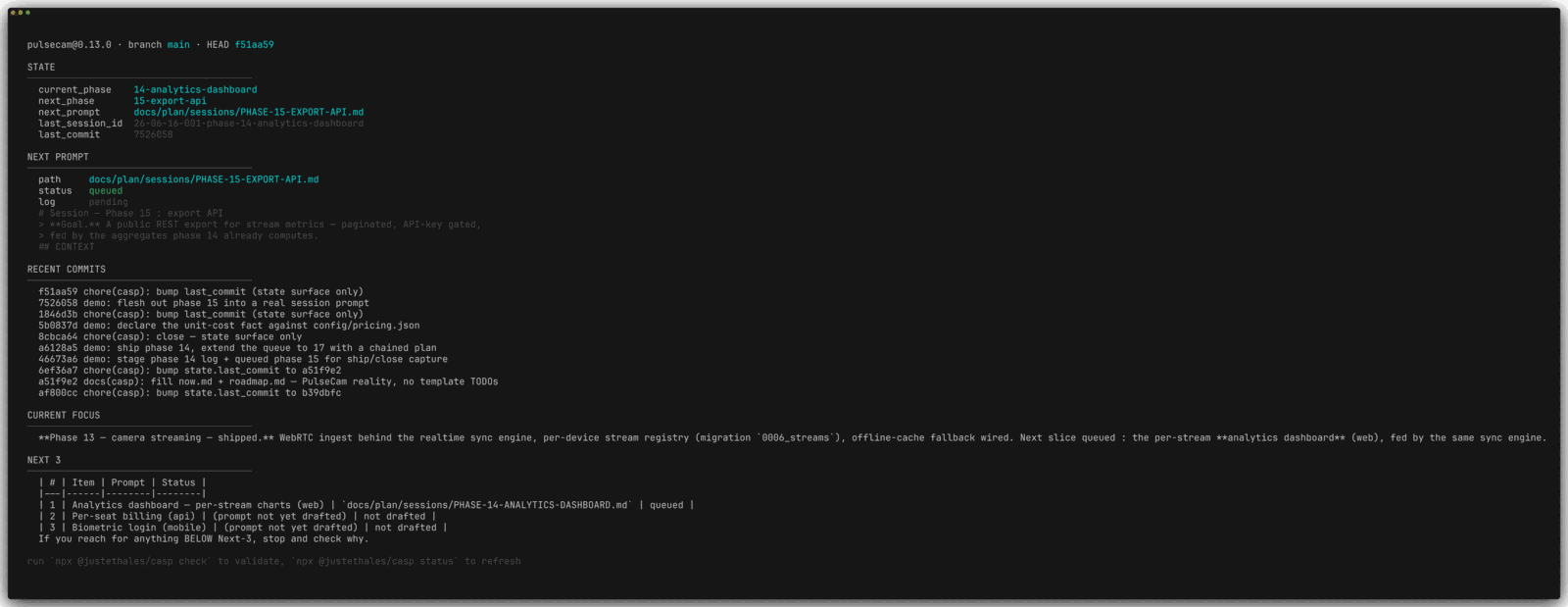
Phase, what's next, what already shipped, the recent commits. --json hands the same
thing to an agent instead of a human, and casp check --all rolls up every cockpit under
a root — one report for a whole fleet of repos.
A real product isn't one feature; it's dozens of phases across API, web and mobile, shipped
over weeks by rotating sessions and agents. casp/roadmap.md keeps the scoreboard in the
repo, so nobody maintains it in a second place:
roadmap.md — phase scoreboard            13 shipped ▰▰▰▰▱▱ 22 total

  10  api     Realtime sync engine        shipped
  11  mobile  Push notifications          shipped
  12  mobile  Offline-first cache         shipped
  13  web     Team permissions            shipped
  14  web     Analytics dashboard ◂ NEXT  active
  15  api     Per-seat billing            queued
  16  mobile  Biometric login             queued
One ordered thread across forty phases, web and mobile — and any agent that opens the repo knows which one is next, without being told and without re-shipping a shipped one.
5 · A number that stopped being true
Everything above validates what your project claims about itself. The facts layer covers
the claims in the documents around it — a unit cost derived from a config file, a figure
in a runbook, a percentage in a pricing note. None of those is state drift, so casp check
was always right to stay green on them, and always blind to them.
Declare the source once in casp/facts.json. When the source changes underneath the value,
the claim goes stale — mechanically, by comparing a hash, with no model reading your
prose. Here a provider migration rewrote the pricing config, and the unit cost derived from
it stopped being verified while the fact beside it stayed fresh:
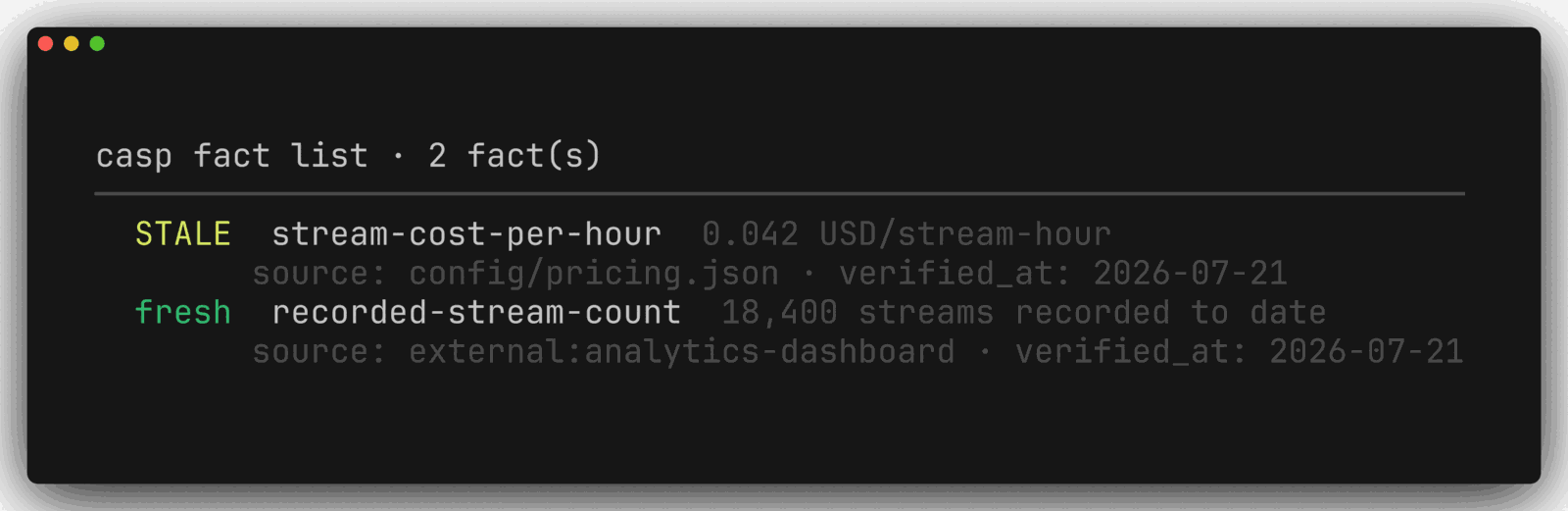
casp fact stale prints that as a work list; casp check turns it into a CASP-FACT-002
FAIL that blocks the push, same as any other drift.
Three comparisons, zero LLM: has the source changed since verification (a hash), has the
verification aged past its declared shelf life (a TTL), was a reproduction method ever
recorded (a presence test). A static registry also flags known false-measurement patterns —
n_live_tup read as an exact count, EXPLAIN without ANALYZE — because an estimate that
reads like a measurement is how a number gets believed for a month.
It proves freshness, never truth. An unchanged source and an unexpired shelf life can both be right about freshness and wrong about the world, if the original verification was itself mistaken. What you get is that a claim nobody has re-checked stops being able to pass silently.
Opt-in like the chain rules: a cockpit with no casp/facts.json sees no CASP-FACT-*
finding at all.
6 · Two sessions, one repo, no collision
Everything above is the durable record: state.json syncs at session boundaries and git
is the witness. Between those boundaries there is a second problem, and it only appears once
you run more than one agent at a time. Session B has no way to know session A is halfway
through src/billing/. The usual answers are to coordinate by hand, or to pipe every session
into one shared stream — which puts every message in N contexts and invalidates N prompt
caches to tell N-1 sessions something they did not need.
casp live shares the state instead of the stream. A session declares what it holds:
casp live claim src/billing --label billing-train --ttl 120Wire casp live hook as a PreToolUse hook (casp live install prints the block) and the
claim stops being a note in a doc. A foreign session's Edit on that path is refused before
it happens, with the owner named:
casp live: "src/billing/rates.ts" is claimed by billing-train (a3f9c1d2) until
2026-08-16T06:59:56.531Z. Work elsewhere, message that session, or have the human
release the claim (casp live release src/billing --session a3f9c1d2).
That message goes to stderr, which the harness hands back to the model — so the blocked session is told who to talk to, not merely that it failed. Meanwhile the human — the one reader for whom reading is free — gets the whole picture in one terminal, and no agent context pays for it:
$ casp live claims
src/billing  billing-train (a3f9c1d2)  until 2026-08-16T06:59:56.531Z
app/mobile  mobile-train (7c21ba55)  until 2026-08-16T06:59:56.710Z

$ casp live tail
04:59:56  billing-train  claim   src/billing
04:59:56  mobile-train   claim   app/mobile
04:59:56  a3f9c1d2  edit    Edit   src/billing/invoice.ts
04:59:57  7c21ba55  edit    Write  app/mobile/screens/Cart.tsx
04:59:57  7c21ba55  denied  Edit   src/billing/rates.ts  held by a3f9c1d2
casp live watch is the same view that keeps printing as lines land.
Two properties do the load-bearing work.
It fails open, absolutely. A tool built to coordinate work must never be able to forbid it.
An expired claim, a claim whose process is gone, an unparseable timestamp, a corrupt claims
file, malformed hook input, an unknown event, any internal error — every one of them means
no coordination, never no editing. The only non-zero exit in the whole verb is a live
foreign claim on the exact path. And because the guard runs inside the session that would be
blocked, the off ramp lives outside it: CASP_LIVE=0, casp live off, or casp live off
--global for the whole machine.
It never touches the gate. casp/live/ writes its own .gitignore on first touch, so
runtime churn never reaches git status and therefore never reaches casp check. Live does
not gate a push and check does not read live — they are two records with one wall between
them. No LLM, no network, no telemetry; polling a local file is the entire "real-time"
machinery.
state.jsonis the durable register;casp liveis the in-flight one. Both are records. Neither schedules, assigns, or runs anything —casp live claimstates what a session holds and the guard refuses a write against it. What runs the sessions is still you.
Single-session projects can ignore this entirely: with no claims declared, nothing changes.
Quickstart
npm i -g @justethales/casp
cd my-project
casp init                 # scaffold the layer
casp status               # where am I right now
casp check                # prove the state is true (exits 1 on drift)
casp init creates:
casp/
├── state.json          # machine-readable session state (the validator reads this)
├── now.md              # current focus (human-readable, one paragraph)
├── roadmap.md          # Next-3 to ship + phase scoreboard
├── README.md           # the protocol, in your repo
└── templates/
    ├── session-prompt.md
    ├── session-log.md
    └── audit-brief.md
Edit casp/now.md, casp/roadmap.md and casp/state.json to describe your project, draft
your first session prompt with casp new prompt --slug phase-1-first-slice, and run
casp check before every push. That is the whole loop.
When a newer CASP ships a better scaffold, run casp upgrade (--dry-run first if you want
to see the plan). It refreshes casp/README.md and casp/templates/** only, and stamps
state.casp_version; now.md, roadmap.md and every existing state.json value are left
byte-identical. casp doctor tells you when the cockpit is behind.
Why this exists
You come back to a project after a week — or you juggle five at once. The agent reads a state file that no longer matches reality, confidently starts work that already shipped, and you burn an afternoon undoing it.
Boards, cards and spreadsheets don't save you: reconstructing context is manual, and the agent can't read any of it. The state needs to be machine-readable, git-native — and provably true.
// casp/state.json  ● DRIFTED
{
  "phase":       "13 — camera streaming",
  "next_prompt": "phases/14-camera.md",   // already shipped in v13.4
  "last_commit": "a1f3c9",                // not in git history
  "migrations":  ["0001"…"0007"]          // git stops at 0006
}
The wedge: everyone stores context, CASP validates it. The adjacent space — Mem0,
Letta, Zep, the git-native "memory" projects — all store what happened. Almost none
verify that the stored state still matches git reality. That verification is
casp check, and it is a hard pass/fail gate rather than a similarity score.
| | CASP | Memory layers · Mem0 / Letta / git-native "soul" | |---|---|---| | What it holds | Project execution state | User facts & preferences | | Core operation | Validates against git | Stores & recalls | | On conflict | Deterministic check vs ground-truth | Fuzzy similarity guess | | When it runs | Synchronous gate — blocks the push | Async / eventual recall | | Leaves your machine | Never · zero telemetry | Varies / cloud |
Beside your existing stack
CASP replaces nothing in your workflow. It fills a gap the rest of the stack leaves open — the validated present tense of a project, in a form your agent can read and act on.
| Layer | Tool | What it holds | The gap | |---|---|---|---| | Intent | Jira · Linear | What you plan to do | Drifts from reality, lives in the cloud, your agent can't reliably read it. | | Validated present | CASP | Where the project stands now — and the exact next move, proven against git | (the layer this table exists to name) | | History & verification | git · PR · CI | What changed · is it reviewed · does it build | A perfect record of the past — silent about what comes next. |
Git, PRs and CI don't know what ships next. CASP does.
Three files. One thread.
No database. No service. No vector store. Three plain files an agent can read on the first
line of any session, scaffolded by casp init into casp/:
| File | Role | What it holds |
|---|---|---|
| state.json | source of truth | Machine-readable, per project: current phase, next phase, the exact next-prompt to execute, phases shipped, migrations applied, last commit, last session id. |
| now.md | for humans | The one-screen "where am I right now." Open it, get the thread back in five seconds — no archaeology. |
| roadmap.md | what ships next | The Next-3 to ship plus a phase scoreboard. The agent always knows the order of work. |
Templates are gates, not guidance. Canonical session-prompt, session-log and
audit-brief templates mean every session — human or agent — produces the same-shaped
artifacts. Structure is enforced, not suggested. Draft them with casp new prompt|log —
don't copy-paste a prior one.
The command deck
The five that are the protocol
Learn these and you are done. Everything after them is convenience.
| What you type | What it does for you |
|---|---|
| casp init | Adds a casp/ folder to your repo. That folder is the thread your agent picks up at the start of every session. Nothing to configure, nothing to sign up for. |
| casp status | "Where am I?" in one screen — current phase, what's next, what already shipped, the last 10 commits. Type this after a week away instead of reading git log and guessing. |
| casp check | The gate. Proves the state file still matches git, and exits 1 when it doesn't. Run it before every push — or install it as a hook and stop having to remember. |
| casp next | Prints the exact prompt for the next session, straight from the state file. Hand it to your agent: no deciding what to work on, no hunting for where you stopped. It refuses to print while the state is drifted, so a bad session never starts. |
| casp new | Creates the next session prompt or session log from the canonical template, so every session — yours or an agent's — comes out the same shape instead of whatever the model felt like writing. |
The full reference
The rest is tooling built on top of those five — reach for it when you need it. Every name is trivially typed: one syllable, no homographs, the same in English, French or Spanish.
| Command | What it does |
|---|---|
| casp init | Scaffold the continuity layer (casp/) into any repo. Idempotent — re-running never overwrites existing files. |
| casp upgrade | Refresh an existing cockpit's scaffolds (casp/README.md, casp/templates/**) to the installed CLI and stamp its casp_version. Never writes now.md or roadmap.md, and never templates over state.json — the only state write is the additive version stamp; every other value stays byte-identical. casp/README.md is a scaffold and is replaced (the output line says so) — keep local notes in now.md. Never deletes, never writes through a symlink, idempotent, never gates. --dry-run prints the plan and writes nothing. The non-destructive counterpart to init --force, which overwrites everything. |
| casp status | One-screen snapshot: phase, next, what's shipped, last 10 commits. --plain strips ANSI. |
| casp check | The drift validator. Validates state.json against the filesystem and git. Exits 1 on drift. --quiet only prints on FAIL (CI-friendly); --no-git skips git-dependent checks; --json emits a machine-readable report with a stable schema (docs/check-json.md) — same checks, same exit code; --all [root] validates every cockpit under a root in one report. |
| casp next | Print the next session's prompt straight from state.next_prompt — pipe-friendly, exits non-zero when there's no actionable prompt. Gates on drift: runs the validator first and refuses to print on a drifted state (--no-check to start anyway, --no-git to skip git checks). The start boundary, symmetric with install-hook's push boundary. |
| casp ship <slug> | Mark a phase shipped: flip its prompt to status: shipped, wire the session_log pointer, move the slug from phases_queued to phases_shipped. Pure state mutation — never touches git. |
| casp close | Bump last_commit / last_session_id from HEAD and the newest session log (confirm or override), then run check. Never commits — the operator owns the commit. |
| casp new prompt --slug X | Generate a gated session-prompt from the canonical template into docs/plan/sessions/ (or your configured sessions_dir). |
| casp new log --slug X | Open a session-log in the shape every session shares, into session-logs/ (or your configured logs_dir). |
| casp install-hook | Write .git/hooks/pre-push so casp check --quiet runs on every push — the gate stops depending on discipline. Refuses to clobber a foreign hook (--force to override); --remove uninstalls a hook CASP wrote. Explicit opt-in — casp init never installs it, and it never touches core.hooksPath. |
| casp verify <commit> | Run the validator against a historical commit in a throwaway worktree — proves whether that commit's recorded state was in sync. Exits with that verdict; never mutates the worktree, index or history. |
| casp state diff [A] [B] | Field-level diff of casp/state.json between two commits (default HEAD~1 → HEAD), with element-level deltas for array fields. --json for data. |
| casp audit status / bump | The deep-audit watermark: separates the cheap per-merge gate (check, every session) from the expensive batch pass (adversarial sub-agent audit + full e2e + security review, on demand). status shows the unaudited range last_deep_audit..HEAD (--json for data); bump [<sha>] records HEAD as deep-audited. A production-cutover gate, never a merge gate — check doesn't block on it. Driven by the /audit-batch skill. |
| casp live claim / release / claims / controller / watch / tail / hook / install / off / on | Coordination between parallel sessions on one machine — the in-flight record beside the durable one. claim holds a repo-relative path prefix for a session with a TTL and a holder-liveness probe (overlap with a foreign claim is refused in both directions; segment-boundary prefixes, no globs). hook is one command wired for every harness event: as PreToolUse it refuses a file-writing tool call on a path a living foreign session holds (the only non-zero exit in the verb), otherwise it journals. controller declares the one session allowed to write shared state — the cockpit, session logs, root instruction files, lockfiles — and is dormant unless a fleet is demonstrably flying, so a solo session is never blocked from its own casp/state.json. watch / tail are the human's view of casp/live/journal.jsonl. Fails open by contract and stands down entirely on CASP_LIVE=0 or casp live off [--global]. casp/live/ is machine-local runtime state, self-gitignored — casp check never reads it and it never gates a push. It guards path writes, not the side effects of shared state: a git commit without a pathspec publishes the whole index, an install regenerates a shared lockfile — in-lane actions with out-of-lane effects that no claim sees (threat model). |
| casp fact list / check / stale / verify <id> | The facts layer (opt-in via casp/facts.json — see docs/rules.md): claims verified once, kept fresh by comparing a source hash and a TTL, never by a model judging prose. list/check/stale are read-only; verify <id> replays the fact's declared method, shows the before/after, and asks for confirmation (--yes to skip it) before writing. The one deliberate code-execution surface in the binary — everything else only reads, and no gating path can reach it. |
| casp rules | List the verification rules check enforces — the stable CASP-<AREA>-<NNN> codes that appear on every finding. --json for data. |
| casp explain <CODE> | Print one rule's full definition: what it verifies, the evidence it inspects, and how to remediate. Accepts a code (CASP-GIT-001) or an internal finding id. |
| casp doctor | Read-only environment diagnostic for onboarding: Node, git, casp/state.json, the cockpit's CASP version, the resolved sessions/logs dirs, the pre-push hook and core.hooksPath. PASS/WARN/FAIL per line (--json for data). Never gates — always exits 0; it maps what to fix, check is the gate. |
| casp version | Print the version (same as -V). --json emits { name, version, node, schema_version } — the machine handoff, where schema_version is the check --json report schema. |
| casp help [command] | The top-level overview, or one command's focused help (usage, every flag, real examples). casp <command> --help is equivalent. casp help exits 0 — the most natural thing a user types is first-class. |
In your editor
CASP ships Claude Code slash-commands so the state lives where you already work. Drop them in once:
cp -r node_modules/@justethales/casp/skills/casp ~/.claude/skills/
cp -r node_modules/@justethales/casp/skills/next ~/.claude/skills/
cp -r node_modules/@justethales/casp/skills/fleet ~/.claude/skills/
| Command | What it does |
|---|---|
| /casp | Read-only status — the agent reads the current thread before it writes a single line. |
| /next | Auto-start the next session straight from state.next_prompt. No copy-paste, no guessing. |
| /fleet | Coordinate several parallel agent sessions on one repository — one writer, N adversarial readers. Distributed by casp, not part of CASP (see below). |
Works with Claude Code · Cursor · Aider · Continue — anything that reads files. The CLI is the contract; the slash-commands are an optional convenience.
fleet is distributed by casp — it is not part of CASP
The package ships a fleet skill because parallel agent sessions are where state drift
hurts most. The boundary is strict, and each claim is testable:
fleetlaunches sessions, therefore it orchestrates — therefore it is never a CASP feature. CASP validates recorded state against git; it does not launch, schedule, or assign anything.- No
casp checkrule readsfleetor anything it produces, and nothing in it gates a push. - Its model default is empty. The reasoning ships — a controller and its workers do not need to run at the same tier — but a model name never does: naming one would contradict a model-agnostic tool and date the file at the next release.
The skill's default shape is one writer plus N adversarial read-only reviewers, because the measured value of a fleet is contradiction, not speed — and no speed gain is claimed.
For engineering orgs
One agent doing the wrong thing costs an afternoon. A hundred agents doing it across a hundred repos costs a quarter. CASP is the deterministic guardrail you drop into the automation loop — the same shape in every project.
- A required CI status check.
casp checksits in the same slot as lint and tests. A state that lies can't merge — drift is blocked at the org level, not left to anyone's discipline. - A guardrail for agent fleets. Autonomous agents multiply mistakes. CASP hands every one of them the same validated thread to read and the same hard gate before it pushes. Automation without the duplicate-work tax.
- An audit trail, for free. Every state transition is a git commit. A complete, diffable, revertable record of how each project moved —
git logis your compliance trail. - Passes infosec by design. Local-only, zero telemetry, no cloud, no account. Nothing to vet, nothing to exfiltrate. The security review is one line: it never leaves the machine.
# .github/workflows/ci.yml
jobs:
  state-check:
    runs-on: ubuntu-latest
    steps:
      - uses: actions/checkout@v4
        with: { fetch-depth: 0 }   # casp checks against full git history
      - run: npx @justethales/casp check        # ✗ fails the build the moment state drifts
One protocol, every repo. The same validated shape, org-wide.
The contract
A protocol earns adoption by being predictable. These don't bend.
- Validate state, not intent. CASP checks what your repo is, never what you meant to do. Facts against git, every time.
- Templates are gates. Canonical artifacts are enforced, not suggested. Every session comes out the same shape.
checkbefore every push. The validator is not optional. A lying state never reaches your remote.- Nothing leaves your machine. Deterministic, git-native, local-only. Zero telemetry. No cloud, no account, no bill.
What the validator catches
Every finding carries a stable rule code (CASP-<AREA>-<NNN>) and a one-line → fix
hint, so the agent can resolve without re-reading docs — or run casp explain <CODE> for
the full definition. Among others:
CASP-PROMPT-001/003—next_promptpoints at a missing file, or one alreadystatus: shipped. (The exact bug CASP was built to catch.)CASP-GIT-001—last_commitnot ingit log, or inconsistent with HEAD.CASP-SESSION-001—last_session_iddoes not map to a session-log file.CASP-SESSION-003— aphases_shipped[]entry no session log declares. (Opt-in by declaration; pre-adoption history stays exempt.)CASP-FACT-002— a declared fact'ssource_hashno longer matches its source. (Opt-in viacasp/facts.json: proves a claim's source changed since it was verified — never that the claim itself is true.)CASP-STATE-003—phases_shipped[]has duplicates.CASP-MIGRATION-002—migrations_applied[]does not match the migrations directory.CASP-PROMPT-005— a session prompt isstatus: shippedbut itssession_logis missing.CASP-WORKTREE-001— uncommitted changes incasp/, the sessions dir, or the logs dir.CASP-IO-001— a file the gate had to read could not be opened (mode000, a directory squatting a*.mdpath, a symlink cycle). (A gate that crashes is not a verdict: the run completes,--jsonstill parses, and the finding names the path and the reason.)
See the full catalogue with casp rules or in docs/rules.md.
A claim the validator cannot verify — a missing backing directory for claimed migrations,
shipped phases, or a session id — is a FAIL, never a silent green.
The exit-code contract — clean → exit 0, drift → exit 1 — is covered by npm test, so the
CI gate stays real.
What CASP proves — and what it doesn't. A clean casp check proves the recorded
execution state is consistent with git evidence. It deliberately says nothing about
whether your code is correct, deployed, or bug-free — that's tests, review and CI. The
precise scope is in docs/what-casp-proves.md;
the security posture (repository content is untrusted input, git is invoked without a shell
for any interpolated value) is in docs/threat-model.md.
Layout is yours. Prompts default to docs/plan/sessions and logs to session-logs, but
a project that already has its own structure sets "sessions_dir" and/or "logs_dir" in
state.json — both optional — and the whole protocol (check, new, ship, close)
validates against that real layout instead of forcing CASP's. CASP fits your repo; you don't
refactor for CASP.
Need the report as data instead of text? casp check --json emits the same findings as
structured PASS/WARN/FAIL with a stable, documented schema — for CI annotations, webhooks,
and roll-ups. See docs/check-json.md.
What this is NOT
- Not a task tracker. Use Linear, Jira, GitHub Issues. CASP is about which session ships next, not which issues are open.
- Not an AI memory / RAG layer. It validates project state against git; it doesn't store user facts or do similarity recall.
- Not an orchestrator.
casp nextprints a prompt; it never runs a session.casp liverecords which session holds which path and refuses a write against it; it does not launch, schedule, sequence or assign anything. That is a deliberate design limit, not a missing feature. - Not a CI tool. It runs locally. You can wire
casp checkinto CI as a pre-push gate, but it doesn't replace your test runner. - Not opinionated about your code. Rust, Python, TypeScript, Go — CASP cares about session state, not your stack.
- Not a replacement for
CLAUDE.md. That's your project's constitution (rules, conventions). CASP is the operating state on top of it.
Roadmap
- 0.4 —
casp ship+casp close(the close loop, automated), optional migrations (non-code projects carry no migration noise), andcasp check --allfor fleets. Shipped. - 0.5 — Configurable paths (
sessions_dir/logs_dirstate keys) so a project validates against its real layout instead of adopting CASP's. Shipped. - 0.6 — Both session boundaries become gates, plus inspection.
casp install-hookwritescasp check --quietinto your pre-push hook (the push boundary);casp nextrefuses to start a session on a drifted state (the start boundary);casp status --jsongives the structured session handoff;casp verify <commit>+casp state diffmake "git log is your compliance trail" inspectable. Shipped. - 0.7 — First-class
casp help(exit 0) with a focused per-command block for every verb. Shipped. - 0.8 — Stable rule codes (
CASP-<AREA>-<NNN>) on every finding, withcasp rules/casp explain <CODE>; published JSON Schemas forstate.jsonand thecheck --jsonreport; an injection-safe git path for untrusted state values; and precise "what CASP proves / does not prove" + threat-model docs. Shipped. - 0.9 — DX + machine-handoff:
casp doctor(a read-only environment diagnostic that never gates),casp version --json, and additiveexpected/actualfields oncheck --jsonfindings. Shipped. - 0.10 —
casp audit status/casp audit bump: the deep-audit watermark that separates the cheap per-merge gate from the expensive batch pass. A production-cutover gate, never a merge gate. Shipped. - 0.11 —
CASP-SESSION-003: everyphases_shipped[]entry must be declared by a session log. The mapping is declared, never inferred from filenames; adoption is derived from the data, so a repo with pre-CASP history is never retroactively reddened. Shipped. - 0.12 —
casp upgrade: refresh an existing cockpit's scaffolds to a newer CASP without touching a byte of its data. The protocol's own continuity across releases. Shipped. - 0.13 —
CASP-PROMPT-007…010: prompt-chain integrity — anext_after-declared queue is checked as an ordered, executable plan.casp status --jsongains the resolvedqueue. Shipped. - 0.14 — The facts layer:
casp/facts.json(opt-in) declares claims verified once and kept fresh by comparing a source hash and a TTL, never by a model reading prose — plus a static trap registry for known false-measurement patterns, and compare-and-swap on everystate.jsonwrite so two agents racing the same cockpit get an honest refusal instead of a silent clobber. Shipped. - 0.15 —
casp live: the in-flight record beside the durable one. Advisory path claims with a TTL and a holder-liveness probe, an append-only journal fed by harness lifecycle hooks, aPreToolUseguard that refuses a write onto a living foreign claim, andcasp live watchfor the human. Fail-open by contract, self-gitignored, and walled off from the gate —checknever reads it. Shipped. - Demand-gated — native binaries, a narrow
casp rollback(state mutation only, never code), a CI status-check installer, a generic webhook notifier (user-owned outbound, off by default).
Cut from earlier drafts, deliberately: casp lint (an LLM verb inside the CASP binary —
even advisory — would undercut the deterministic claim; prose-vs-reality checking belongs in
your agent, which can read casp/ today for free).
Vote on the roadmap with GitHub issues / reactions.
FAQ
Does this require Claude Code? No. The CLI works standalone with any agent that runs shell commands. The /casp and /next slash-commands are an optional bundle for Claude Code users.
Is CASP an AI memory product? No — that's the wedge. Memory tools (Mem0, Letta, Zep) store and recall. CASP validates project execution state against git and blocks the push on drift. Different artifact, different operation.
So the queue is just a TODO list? A TODO list can't refuse. The queue is validated against git and the files on disk: a head that doesn't exist, one that already shipped, or a chain that can't be executed in any order fails the gate and blocks the push.
Does it work for Cursor, Aider, Continue? Yes. The CLI is just a CLI; any agent that runs shell commands and reads files can use it.
What about Python, Rust, Go projects? The CLI is Node-only (TypeScript via tsx). Use it via npx without committing Node as a project dependency. A binary distribution is on the roadmap.
Is any data sent anywhere? No. Zero network calls. Zero telemetry. CASP reads your filesystem and your git. Nothing leaves your machine.
Why "CASP"? Coding-Agent State Protocol — the name says exactly what the artifact is. An earlier name for this tool collided with a well-known Red Hat project of the same name; CASP relaunches it as a protocol, the way MCP did for model context.
Where do I report bugs or request features? github.com/ThalesGnimavo/casp/issues
License
MIT. Use it, fork it, ship it.
Built by Juste A. Gnimavo — Chief AI-Augmented Architect and solo founder of ZeroSuite, running seven production products with Claude as the only engineer, from Abidjan, Côte d'Ivoire. CASP is the layer that keeps months of AI-driven sessions from collapsing into drift. The partnership behind it is documented in the open at thalesandhisaictoclaude.com.
If CASP saves you 30 minutes a week, that's enough payback. If you want to say thanks: star the GitHub repo, or say hi on X.
CASP — the Coding-Agent State Protocol. The model holds the context; CASP proves the state is true — against git.