
@kieransimkin/dance-rudiments
v0.2.0
Published
C++/WASM rhythmic motion for DanceFlow, with TypeScript bindings. Music: https://kieransimkin.co.uk/my-songs/
Downloads
796


Readme
DanceRudiments
By Kieran Simkin — My Songs · Part of the DanceFlow motion workflow.
Visualizer · Language bindings · C++ · Python · C# / .NET · TypeScript / JavaScript
▶ Try the pattern visualizer
Download the self-contained visualizer — HTML
Save the file and open it in a browser. No install, server, CDN, soundfont or separate WASM file is required. The complete 1,731-movement catalogue includes a shared-tempo beat player: 305 scores, including all 68 dance-music studies, the full four-bar Amen break, four-to-the-floor, garage, drill, grime, jungle, house, techno, Groove MIDI excerpts and the earlier event/sticking studies.
Choose a beat, press Play, and change BPM to retime the sound and animations
together. Compare any movements, or use Only matching movements and
Use this movement’s beat. Local .mid import and MIDI export are included.
Sound is synthesised from note events, not the original Amen recording.
The downloadable file is the checked-in snapshot; the Pattern visualizer workflow also rebuilds a fresh version from every pushed native catalogue. Beat player, rebuilding, release downloads and optional live hosting.
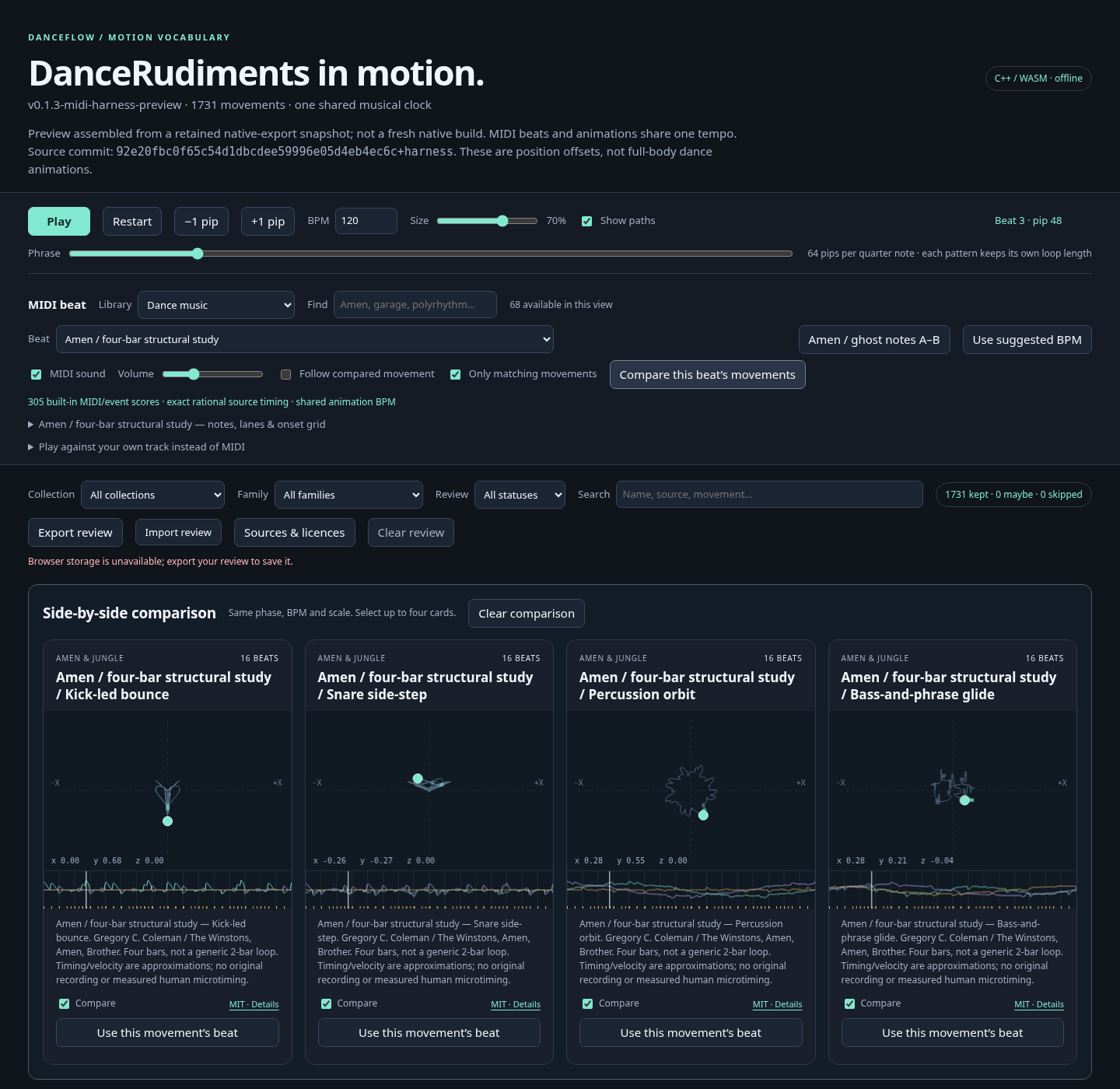
Captured from the running C++/WebAssembly visualizer at beat 2.75. Audio was not started during this screenshot.
DanceRudiments is a C++17 library of deterministic rhythmic position functions. One integer pip is 1/64 of a beat. Built-in and custom patterns each keep their own loop period. Every sampler wraps positive or negative input into its own loop before sampling.
Outputs are dimensionless offsets, normally in [-1, 1]. The caller chooses pixels, CSS units, metres, or another scale. There is deliberately no time interpolation in the public API: renderers advance with integer pips and get one exact sample per pip.
Default collections
The default catalogue contains 1,731 movements: 15 original routines, 28 Initial 01,
24 Expansion 02, 256 Motion Atlas, 320 Continuum, 144 Club Rhythms 05 movements, and 944 Dancefloor 06 additions.
Use the ordinary sample(name, pip_count) API without loading a separate pack.
Club Rhythms 05 interprets 36 beat patterns, including the four-bar Amen, four-to-the-floor, UK garage, drill, grime, jungle, house and techno, using four different movement mappings. Its offline demo includes a synthesised drum player, exact onset grid, and C++/WASM movement animations.
python -m pip install .
python tools/build_club_demo.py --output dist/club-demo.html
See the default library guide for all collections. Release demos enumerate the actual tagged native catalogue and also render the focused Club Rhythms page. No original recordings are bundled.
Dancefloor 06
The default catalogue now contains 1,731 movements, including 944 new Dancefloor 06 entries. All 68 beat studies have sixteen movement interpretations. The previous Club 05 scores and their original 144 movements remain unchanged. Research, rhythm-specific notes, and exact timing semantics are in the Dancefloor guide and complete mapping catalogue.
python tools/build_dancefloor_collection.py --check
python tools/build_default_catalogue.py --check
The release workflow builds the complete native catalogue demo plus an offline, audio-enabled 68-rhythm / 16-mapping comparison page. All live motion comes from C++/WASM.
Curve and event authoring
The optional Python authoring tools compile LFOs, segmented curves, sampled
waveforms, seeded repeating randomness and rational-beat event/gesture scores into
JSON packs or C++17 headers. All movement playback remains C++, including
Python and TypeScript/WASM consumers. The original fifteen motion tables are
preserved; additional custom packs use independent PatternLibrary objects
rather than global overrides.
python tools/compile_patterns.py compile examples/patterns/starter.json --json generated/starter.json --cpp generated/starter.hppThe compiler runs from a checkout without third-party Python dependencies or a native build. See the authoring and native API guide for curve formats, event anchoring, loop validation, generated functions, Python playback, WASM loading, provenance and testing. These are original infrastructure examples, not imported third-party preset banks.
DanceFlow ecosystem
DanceRudiments is the reusable motion-vocabulary layer in Kieran Simkin's DanceFlow BPM and motion-response ecosystem:
- StemLab is the music-understanding layer. It analyses audio to produce BPM, beat, structure, stem, lyric, harmony, and related timing evidence.
- DanceRudiments turns integer musical positions at 64 pips per beat into deterministic 1D, 2D, or 3D position offsets.
- DanceMoves is the WordPress EPK motion runtime. It schedules and applies BPM-, cue-, and lyric-timed effects on public pages.
The three components can also be used independently. They exchange explicit timing and analysis data rather than depending directly on one another. DanceRudiments' 64-pips-per-beat sampling convention is intentionally higher resolution and is not the same unit as DanceMoves' 16-ticks-per-beat runtime clock.
Which package should I use?
| You are building | Install or download | What you get |
| --- | --- | --- |
| C# / .NET application | dotnet add package DanceRudiments from NuGet.org after its first release | Managed .NET 8+ wrapper and x64/ARM64 native assets for Windows, Linux and macOS |
| Python application | pip install dancerudiments from PyPI | Native Python extension and the catalogue/sample API |
| TypeScript or JavaScript application | npm install @kieransimkin/dance-rudiments from npm | TypeScript declarations, JavaScript wrapper, and WebAssembly module |
| C++ application using a listed release platform | Download the matching DanceRudiments-cpp-<version>-<platform>-static.zip from GitHub Releases | Headers, static library, CMake package files, licence, platform manifest, and instructions |
| C++ application using another toolchain or architecture | Build from source or use conan create with conanfile.py | A library compiled for your own settings |
GitHub automatically adds “Source code” ZIP and tar.gz links to every release; those are repository snapshots, not precompiled packages. Python wheels belong on PyPI, the C# package on NuGet.org (mirrored to GitHub Packages), and the TypeScript/WASM package on npm, while GitHub release attachments include C++ archives and the separately generated HTML demos, screenshots and checksums.
Included rudiments
The general motions are bounce, sway, circle, figure_eight, step_touch, box_step, helix, and clay_background.
The first drum-derived set is single_stroke_roll, multiple_bounce_roll, double_stroke_roll, single_paradiddle, flam, drag, and five_stroke_roll. The first six mirror the fundamentals in Vic Firth's Tier One learning sequence and collectively cover the roll, diddle, flam, and drag families in the Percussive Arts Society's 40 International Drum Rudiments. A right-hand stroke moves right, a left-hand stroke moves left, and both rise slightly. Every stroke is a raised-cosine (sin²) gesture: zero displacement at the start, smooth attack, a rounded peak, and smooth decay back to zero before the next motion. Accents use greater amplitude rather than an instantaneous position jump.
Source references: Percussive Arts Society International Drum Rudiments and Vic Firth 40 Essential Rudiments, accessed 28 September 2026.
clay_background preserves the translation waypoints from the Clay/Stars ks-particle-dance background treatment as a normalized 256-pip lookup table. The source effect's opacity, rotation, and scale are not position offsets, so they are intentionally excluded.
Language bindings
All four language interfaces sample the same C++ runtime. Choose the interface, not
another movement implementation. The examples below are checked into
examples/bindings/ so they can be built and tested.
| Interface | Catalogue | Sample | Loop-length field | Custom-library lifetime |
| --- | --- | --- | --- | --- |
| C++17 | dancerudiments::catalogue() | dancerudiments::sample(name, pip) | period_pips | Owned by its C++ object; normal RAII |
| Python | d.catalogue() | d.sample(name, pip) | info["period_pips"] | Owned by the Python object wrapping C++ |
| C# / .NET | Rudiments.Catalogue | Rudiments.Sample(name, pip) | info.PeriodPips | using / Dispose() for custom banks |
| TypeScript / JavaScript | catalogue (an array, not a function) | sample(name, pip) after bindNative() | info.periodPips | Call the custom bank's dispose() |
One beat is 64 pips. Supply a signed 32-bit integer, not milliseconds or a
floating-point beat number. Every sampler wraps negative as well as positive
positions into its own loop. Offsets are {x, y, z}, dimensionless and bounded to
[-1, 1]; choose the pixel/metre scale in your application. There is no automatic
interpolation, BPM detection or audio playback inside a binding.
For an absolute playback time, use
floor((playback_seconds - beat_zero_seconds) * BPM / 60 * 64).
Use floor, not integer truncation, for negative positions. Do not add a rounded
pip increment on every frame: that accumulates drift. For a tempo map, integrate
the elapsed beats; do not multiply the entire song time by the latest tempo.
For long-running playback, wrap at the selected movement's period before passing
an integer that could overflow the API. Different movements have different periods.
Checkout versus published version: these examples describe the current repository.
pip install/npm installretrieve the latest published package, which may predate this catalogue. Inspectcatalogue()/cataloguerather than assuming a fixed count. Build the checkout when trying unreleased patterns such as the expanded Amen interpretations.
C++ binding
Requirements: CMake 3.20+ and a C++17 compiler. Python is not needed to build or play the committed movement tables. Build and install the core from the repository root; choose a prefix writable by your user:
cmake -S . -B build -DCMAKE_BUILD_TYPE=Release -DCMAKE_INSTALL_PREFIX="$PWD/install"
cmake --build build --config Release
ctest --test-dir build -C Release --output-on-failure
cmake --install build --config Release
In PowerShell, use an absolute prefix such as
-DCMAKE_INSTALL_PREFIX="${PWD}/install". Multi-configuration generators put
executables under Release/; the --config Release arguments handle that.
In your application's CMakeLists.txt, create the executable before linking it:
cmake_minimum_required(VERSION 3.20)
project(MyAnimation LANGUAGES CXX)
find_package(DanceRudiments CONFIG REQUIRED)
add_executable(my_animation main.cpp)
target_link_libraries(my_animation PRIVATE DanceRudiments::DanceRudiments)
#include <dancerudiments/dance_rudiments.hpp>
#include <dancerudiments/sampled_pattern.hpp>
#include <iostream>
int main() {
const auto& items = dancerudiments::catalogue();
std::cout << items.size() << " movements\n";
const auto position = dancerudiments::sample("beat_amen_four_bar_bounce", 48);
std::cout << position.x << ", " << position.y << ", " << position.z << '\n';
// Negative pips wrap; the original named C++ functions are also retained.
const auto previous = dancerudiments::sample("circle", -1);
const auto direct = dancerudiments::circle(-1);
return previous.x == direct.x ? 0 : 1;
}Configure the consumer with -DCMAKE_PREFIX_PATH=/absolute/path/to/install.
Alternatively, point that prefix at an extracted, compatible native release
archive. A static archive is specific to its OS, architecture, compiler and
runtime-library settings; use a source build or the Conan recipe for another
combination. The exported target handles the Windows DanceRudimentsCore.lib
filename, so do not hard-code an archive name.
Run the complete installed-package example (it also checks custom-table ownership):
cmake -S examples/bindings/cpp -B build-example -DCMAKE_PREFIX_PATH="$PWD/install"
cmake --build build-example --config Release
ctest --test-dir build-example -C Release --output-on-failure
Custom data: SampledPattern copies and validates an std::vector<Offset3>;
PatternLibrary owns its custom patterns and also exposes all defaults. Construct
it once, not on every frame. catalogue() metadata contains string_views, so a
custom library must outlive those views. Unknown names and invalid custom tables
raise C++ exceptions. See the complete
C++ source and
authoring guide.
Python binding
Install a released package, or build the checkout to use unreleased additions:
python -m pip install --upgrade dancerudiments
# Alternative, from this checkout (requires a C++17 compiler):
python -m pip install .
A matching prebuilt wheel does not require a local C++ compiler. A source build
does; pip's isolated build installs the declared scikit-build-core/pybind11 build
dependencies. Use the same Python interpreter for -m pip and your application.
The package metadata supports Python 3.9+; release wheel availability is narrower
than every possible Python/OS/CPU combination.
import dancerudiments as d

items = d.catalogue()
info = next(p for p in items if p["name"] == "beat_amen_four_bar_bounce")
print(len(items), "movements")
print(info["period_pips"] / d.PIPS_PER_BEAT, "beats per loop")

position = d.sample(info["name"], 48)
print(position.x, position.y, position.z)
print(position.as_tuple())

# Original named functions are also exposed. Generated names use sample().
assert d.circle(-1).as_tuple() == d.sample("circle", -1).as_tuple()
Offset3 exposes read-only x, y, z and as_tuple(); it is not a dictionary
or NumPy array. catalogue() returns dictionaries with name, description,
period_pips and integer dimensions. Sample values come from C++, not a Python
reimplementation. Native invalid-argument errors are exposed as ValueError;
use integers and catch errors for untrusted names or data.
Run the complete example, including validated time-to-pip conversion:
python examples/bindings/python/quickstart.py
# Export the complete loop as pip/beat/XYZ rows:
python examples/bindings/python/sample_motion.py --name beat_amen_four_bar_bounce --csv amen.csv
Author and load a private pattern: compilation is a Python build-time step;
.to_native() transfers the result to a C++ bank for runtime playback.
python tools/compile_patterns.py compile examples/bindings/pulse.score.json --json generated/tutorial.json --cpp generated/tutorial.hpp
python examples/bindings/python/quickstart.py --pack generated/tutorial.json
from dancerudiments_authoring import load_pack
compiled = load_pack("generated/tutorial.json")
library = compiled.to_native()
print(library.sample("tutorial_pulse", 0).as_tuple())
print(library.sample("circle", -1).as_tuple()) # Defaults remain available.The generated C++ header can instead be included by a native application.
Existing collections are already defaults: loading initial_pack() or
dancefloor_pack() is for inspection/subsetting, not a prerequisite for ordinary
sampling. An exact default reload is idempotent; changing a default under the
same name is rejected. Give an edited movement a new identifier.
C# / .NET binding
The DanceRudiments NuGet package wraps the original C++ library through a versioned, exception-safe C ABI. It targets .NET 8+ desktop/server applications; CI tests .NET 8 and .NET 10. Native Windows, Linux and macOS libraries are included for x64 and ARM64, with automatic NuGet/.NET runtime selection. This does not claim support for .NET Framework, Unity, mobile or browser-WASM hosts.
After the first release containing this binding has been published:
dotnet add package DanceRudimentsusing DanceRudiments;
Console.WriteLine(Rudiments.NativeVersion);
var amen = Rudiments.Catalogue.Single(p => p.Name == "beat_amen_four_bar_bounce");
int pip = Rudiments.PipAtTime(1.25, bpm: 140, periodPips: amen.PeriodPips);
Offset3 position = Rudiments.Sample(amen.Name, pip);
Console.WriteLine($"{position.X}, {position.Y}, {position.Z}");
// Full-loop export: one interop call; every sample is still calculated in C++.
Offset3[] loop = Rudiments.SampleMany(amen.Name, 0, amen.PeriodPips);Offset3 has read-only double-precision X, Y, Z fields. Negative pips wrap
normally. SampleInto fills an existing span; batches handle int32-boundary
crossings safely. PatternLibrary.Load / FromJson read the same compiled JSON
packs as the other bindings; a custom bank owns copies of its tables and should
be enclosed in using. SafeHandle protects native lifetime, including concurrent
sampling. No movements are reimplemented in C# and there is no Python dependency
at playback time.
For a checkout build, enable -DDANCERUDIMENTS_BUILD_C_ABI=ON in CMake, then build
bindings/csharp/DanceRudiments/DanceRudiments.csproj with dotnet. The
runnable C# example and
complete C# guide cover native loading, custom packs, supported
platform baselines, source development and one-time registry configuration.
The NuGet README is included in the output package
along with your usage guide, screenshots and
Kieran Simkin — My Songs.
.github/workflows/csharp.yml builds/tests all six native targets, creates one
complete nupkg, and tests installing it on each target. A published GitHub release
then uploads to NuGet.org and GitHub Packages, plus release attachments.
Ordinary pushes and pull requests only build/test and retain CI artifacts.
NuGet.org requires a configured trusted publisher and NUGET_USER; see
release setup. Until publication, use the
checkout or the csharp-nuget CI artifact; merging this code alone does not publish.
TypeScript/WASM binding
The npm package contains a typed ES-module wrapper and a separate Emscripten
factory and .wasm binary. JavaScript uses the same API; omit the TypeScript
import type statements. Initialise the factory once before sampling:
npm install @kieransimkin/dance-rudimentsimport { bindNative, catalogue, sample } from "@kieransimkin/dance-rudiments";
import type { RudimentName } from "@kieransimkin/dance-rudiments";
import createDanceRudiments from "@kieransimkin/dance-rudiments/wasm";
const native = await createDanceRudiments();
bindNative(native);
const name: RudimentName = "beat_amen_four_bar_bounce";
const info = catalogue.find(item => item.name === name);
if (!info) throw new Error("This release does not contain the requested movement");
console.log(catalogue.length, info.periodPips / 64);
console.log(sample(name, 48)); // { x, y, z }, sampled in C++/WASMThe currently untyped factory subpath has a small local declaration in
examples/bindings/typescript/wasm.d.ts.
Include that file in a strict TypeScript project; it derives the module type from
bindNative rather than inventing another motion API. The wrapper itself already
ships its declarations.
Node.js: use ESM (.mjs or "type": "module") and a current supported Node
version. With the package installed, run
node examples/bindings/javascript/node.mjs. The factory loads its adjacent
WASM binary. The source-build route below avoids relying on an older published
package.
Browser: serve the loader and its binary over HTTP(S). Keep them adjacent or
supply locateFile: (file, prefix) => ... to the factory when your bundler moves
assets. The server must return the WASM bytes rather than an HTML fallback page;
application/wasm is the appropriate MIME type. Bare package imports require a
bundler or import map. The checked-in browser example supplies a map for a local
source build, starts paused, and preserves beat position when BPM changes.
To build from source, activate an Emscripten SDK environment first, then run from the repository root:
npm ci
npm run build:harness
emcmake cmake -S . -B build-wasm -DCMAKE_BUILD_TYPE=Release -DDANCERUDIMENTS_BUILD_WASM=ON -DDANCERUDIMENTS_BUILD_TESTS=OFF
cmake --build build-wasm --config Release
node examples/bindings/javascript/node.mjs ./dist/typescript/index.js ./build-wasm/dancerudiments.js
npx tsc -p examples/bindings/typescript/tsconfig.json
python -m http.server 4173
Open http://localhost:4173/examples/bindings/typescript/. This small consumer is
not self-contained; the main visualizer linked at the top of the README is.
The visualizer's compact snapshot-WASM interface is not an Embind module and must
not be passed to bindNative(). No JavaScript fallback computes movement here.
Custom compiled packs and cleanup: fetch or import the JSON, then explicitly release its native memory when finished:
import { createPatternLibrary } from "@kieransimkin/dance-rudiments";

const response = await fetch("/generated/tutorial.json");
if (!response.ok) throw new Error(`Pack request failed: ${response.status}`);
const bank = createPatternLibrary(await response.json());
try {
    console.log(bank.sample("tutorial_pulse", -1));
    console.log(bank.catalogue());
} finally {
    bank.dispose();
}
Create the bank after binding the native module. A disposed bank must not be
sampled. dispose() is idempotent; the wrapper releases its temporary native
objects automatically. The global default catalogue does not need disposal.
Keep a library alive for the lifetime of an animation rather than constructing it
inside requestAnimationFrame.
Limits, attribution and troubleshooting
A private pack accepts at most 1,024 patterns and 1,048,576 total samples; a single pattern is 1–65,535 pips long. These custom-pack validation limits are separate from the larger built-in catalogue. Imported content retains its original licences and notices: copying generated tables does not remove attribution.
The author/project link is Kieran Simkin — My Songs.
It is retained in package metadata, the packaged READMEs, AUTHORS.md, CMake and
Conan descriptions, and the C++ release's PACKAGE-INFO.txt. Original upstream
licences are not modified to insert project branding.
Binding examples and screenshot notes · Complete authoring format · Historical build troubleshooting.
Harness
Use the self-contained HTML link at the top. No server is required for that page. Its 305 beat/event scores include the complete four-bar Amen study; all 1,731 movements remain available. Choose a score, press Play, set BPM, and optionally restrict the catalogue to matching movements. The transport coordinates synthesized MIDI notes and integer-pip C++/WASM motion.
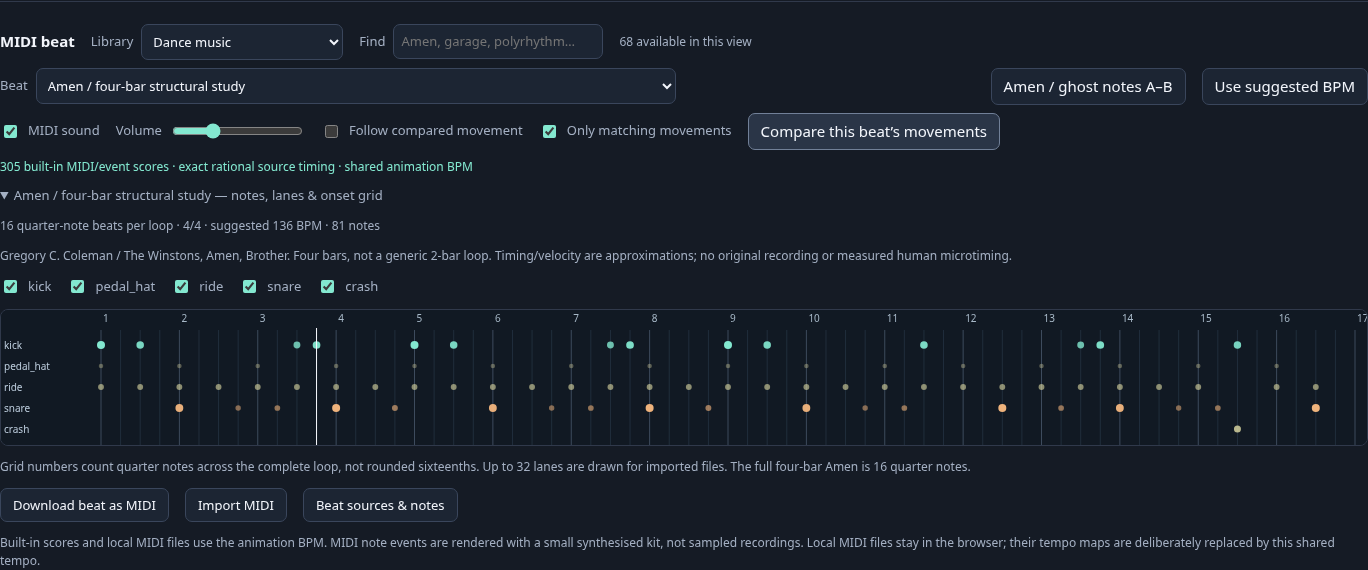
The score view includes ghost-note strengths, fractional event positions, lane mutes, MIDI import and export. It is a timing aid, not a General MIDI soundfont emulator or the original Amen recording. View the mobile screenshot or the full harness guide.
For rebuilding rather than simply viewing, use python tools/build_harness.py
after installing this checkout's native extension. The builder also needs
clang++ and wasm-ld; screenshot automation needs Playwright/Chromium. Those
are build-time requirements, not dependencies of the downloaded HTML.
Continuous integration and releases
The additional .github/workflows/csharp.yml builds the shared C ABI and C# wrapper, tests actual installed NuGet packages, and publishes .NET packages only for release tags. Its NuGet.org setup is documented in the C# guide.
.github/workflows/ci.yml builds and tests the C++ core on Linux, Windows, and macOS; builds and imports the Python package; compiles/tests the TypeScript and browser runtime; and creates a Conan package on every push to main and every pull request.
A pushed vMAJOR.MINOR.PATCH tag is the CD trigger. Use the release helper so all five version locations stay in sync:
python tools/release_version.py prepare 0.2.0
git diff
git add CMakeLists.txt pyproject.toml package.json package-lock.json bindings/csharp/DanceRudiments/DanceRudiments.csproj
git commit -m "Prepare v0.2.0 release"
git push
# Wait for the normal main-branch CI to pass, then:
python tools/release_version.py tag 0.2.0 --push
prepare updates CMake, Python/PyPI, npm + its lockfile and C#/NuGet together. tag refuses a dirty worktree, a non-main branch, mismatched manifests or an existing tag. The pushed tag runs .github/workflows/release-tag.yml, which revalidates the exact tagged checkout and creates the GitHub Release. The package and demo workflows are also tag-triggered; they do not depend on a GitHub Release event generated by another workflow.
.github/workflows/release.yml rejects mismatches before it publishes anything, then:
- builds platform Python wheels and a source distribution and publishes them to PyPI using OIDC Trusted Publishing;
- builds the TypeScript wrapper and C++ WebAssembly module and publishes
@kieransimkin/dance-rudimentsto npm using the configured publishing credentials and provenance; - builds installable C++ archives for Linux, Windows, and macOS and attaches them to the GitHub release; and
- builds a Conan package and uploads it only when a separate Conan remote has been configured. ConanCenter packages are submitted through
conan-center-index; they are not directly uploaded by this repository.
One-time registry configuration is required before the first release:
- On PyPI, create a pending Trusted Publisher for owner
kieransimkin, repositoryDanceRudiments, workflowrelease.yml, environmentpypi, and project namedancerudiments. - On npm, configure the package's GitHub Actions Trusted Publisher for
kieransimkin/DanceRudiments, workflowrelease.yml, environmentnpm, with direct publishing allowed. Because npm Trusted Publishers are configured from an existing package's settings, the first scoped-package registration may require a granularNPM_TOKENsecret in thenpmenvironment. Remove that bootstrap token after Trusted Publishing is configured. - Create GitHub environments named
pypi,npm, andconan; add required reviewers if desired. - For an optional private or organisational Conan repository, set environment variable
CONAN_REMOTE_URLand secretsCONAN_LOGIN_USERNAMEandCONAN_PASSWORDin theconanenvironment. If they are absent, the recipe is built and verified but not uploaded. - For C#, configure the
nugetenvironment and NuGet.org Trusted Publisher as described in the C# guide.
The PyPI publishing job requests short-lived OIDC identity. npm can use Trusted Publishing when configured; the workflow retains NPM_TOKEN as a bootstrap/fallback credential. See the official PyPI Trusted Publisher and npm Trusted Publishing documentation.
Motion safety
Apply an output to a bounded subject. DanceRudiments changes position only; it must not be used to add a repetitive full-frame tint, brightness, flash, or colour-grade effect. Under prefers-reduced-motion, do not autoplay the harness or production motion.
Troubleshooting history
See build and release troubleshooting for prior failures, causes and fixes.