
@lenard9191/pi-project-profile
v1.3.0
Published
Pi (π) coding-agent extension: project-aware system prompt for any repo (stack, commands, conventions, AGENTS.md/CLAUDE.md rules) plus a gate that runs the project's own typecheck/lint/tests after every agent turn, with self-repair and diff review.

Maintainers
 lenard9191
Keywords
Readme
pi-project-profile
Project-aware π (pi) coding agent, with a verification gate. A π extension that detects any repository's stack, commands, conventions and instruction files (AGENTS.md, CLAUDE.md, .cursorrules, …), injects them as a stable <project_profile> system-prompt section, and then runs the project's own typecheck, lint, tests and build after every agent turn — with a bounded self-repair loop and a review of the agent's diff.




pi install npm:@lenard9191/pi-project-profile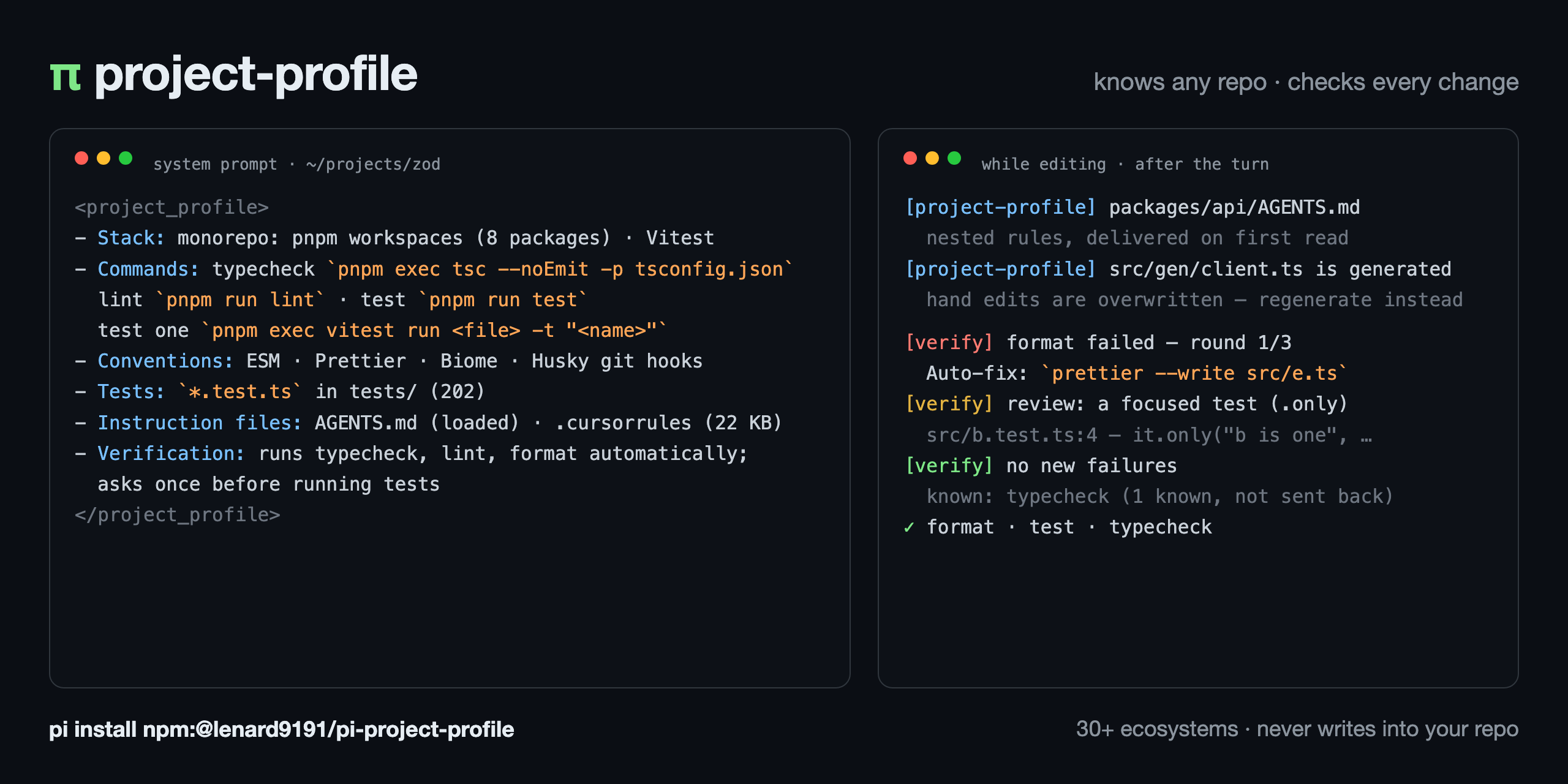
- Profile: detects the stack, commands (including how to run one test), conventions, CI checks, test layout, generated code and instruction files (
AGENTS.md,CLAUDE.md,.cursorrules, Copilot, Windsurf, Cline, Gemini, Codex, …), and injects them as a stable<project_profile>system-prompt section. - Verify: after every turn that changed files, runs the project's own checks and sends new failures back to the agent for a bounded number of repair rounds.
- Review: flags what a reviewer would want to know about the agent's diff: added suppressions, skipped or focused tests, stubs, loosened configs, deleted tests, secrets, unignored
.envfiles, stale lockfiles. - Rules on demand: delivers nested
AGENTS.mdfiles and glob-scoped rules (Cursor, Copilot, Windsurf) when the agent first touches a file they apply to, and warns before hand-editing generated files.
It never writes into the repository. Cache and settings live under ~/.pi/agent/project-profile/.
Why
A coding agent dropped into an unfamiliar repository guesses: which package manager, which test runner, whether tsc or biome is the source of truth, where tests live, which files are generated. Then it reports "done" without having run anything, or runs the wrong thing. pi-project-profile answers those questions once per repository, keeps the answer stable so prompt caching works, and turns "done" into "the project's own checks pass" — without ever running installs, migrations or deploys on its own.
How it works
- Session start — the repository is scanned (manifests, lockfiles, CI files, Makefiles, instruction files; nothing is executed), cached under
~/.pi/agent/project-profile/, and rendered as<project_profile>in the system prompt. Re-detection happens automatically when a manifest changes. - Each turn — files the agent touches are tracked; nested
AGENTS.md/CLAUDE.mdand glob-scoped rules that apply to them are delivered with the first matching tool result; generated files get a warning. The agent's first read in a project directory starts that project's typecheck and lint once, in the background, on the untouched tree: whatever already fails there is the baseline, so it is never blamed on the agent (a run that finishes after the agent's first write is discarded). - Before the turn settles — if files changed, the syntax, typecheck and lint tiers run (tests and builds once you have allowed them for the repo). New failures go back to the agent as a
[verification]message for at most three repair rounds; pre-existing failures are reported to you once and never blamed on the agent. The diff review runs alongside.
Install
pi install npm:@lenard9191/pi-project-profileRequires π ≥ 0.87 and Node ≥ 22.18. No runtime dependencies. Update with pi update npm:@lenard9191/pi-project-profile. Try it once without installing: pi -e npm:@lenard9191/pi-project-profile.
The package ships one extension and one Agent Skill (skills/project-profile): an operating and troubleshooting guide the model loads on demand when a verification message needs interpreting or you ask how to configure the extension. /skill:project-profile loads it explicitly.
What the agent sees
<project_profile>
- Project: zod — ~/projects/zod · remote github.com/colinhacks/zod · ~741 tracked files
- Stack: monorepo: pnpm workspaces (8 packages) · pnpm · Vite · Vitest
- Commands: install `pnpm install` · typecheck `pnpm exec tsc --noEmit -p tsconfig.json` · lint `pnpm run lint` · test `pnpm run test` · test one `pnpm exec vitest run <file> -t "<name>"`
- Conventions: ESM · Prettier · Biome · Husky git hooks · License: MIT
- Tests: `*.test.ts` in tests/ (202)
- Instruction files: AGENTS.md (loaded) · .cursorrules (22 KB — read it when relevant)
- Verification: after each turn that changed files, the harness runs `pnpm exec tsc --noEmit -p tsconfig.json`, `pnpm run lint:check` automatically; asks once before running tests
</project_profile>
The section is identical for every turn of a session, so prompt caching keeps working.
Verification
| Tier | Examples | Policy |
|---|---|---|
| syntax | node --check, python -c ast.parse, ruby -c, bash -n, JSON parse | automatic, changed files only |
| fast | tsc --noEmit, cargo check, go build/go vet, mypy/pyright, mix compile, dart analyze | automatic |
| lint | eslint, biome, prettier --check, ruff, cargo fmt --check/clippy, gofmt, rubocop, swiftlint | automatic |
| test | npm test, cargo test, pytest, go test, rspec, mix test, phpunit, swift test, ./gradlew test | confirmed once per repo |
| build | pnpm build, ./gradlew compile*, swift build, zig build, cmake --build | confirmed once per repo |
Installs, migrations, deploys and anything network-bound are never run.
- Only new failures cost repair rounds. Diagnostics recorded before the agent's first write (a repo that was already red) are pre-existing: not sent back to the agent, noted once for you, and they don't block the tests. The baseline comes from a background run of the project-wide typecheck and lint, started by the agent's first read in each project directory (at most four per session; workspace-wide scripts such as
turbo run lintare not started this way). - Narrowed runs. Tests run as
vitest related,jest --findRelatedTests,go test ./<pkg>/...,cargo test -p <package>orpytest <changed test files>when that is safe;cargo checkdrops--all-targetswhen no test/bench/example code changed. Monorepo packages are checked in their own directory with their own scripts, and a workspace-wide root run replaces the per-package duplicates. - Fast. Read-only checks in a tier run in parallel; tests and builds run one at a time.
- Actionable failures. Diagnostic lines first (~40 lines, full log path), plus the exact auto-fix command for format/lint failures (
prettier --write <files>,ruff check --fix <files>, …). - Bounded. At most
maxRepairRounds(3); stops early when a round changes nothing or repeats the same failure, then asks the agent for a summary. Environment failures (missing tool, deps not installed, timeout, database down) go to you and disable that check for the session.
Review of the agent's changes
Compared with the content before the agent's first write (or git HEAD; files that were already dirty are never blamed on the agent):
@ts-ignore,eslint-disable,# type: ignore,# noqa,#[allow],//nolint,@Suppress, … added- tests skipped (
.skip,xit,@pytest.mark.skip,t.Skip,#[ignore]) or focused (.only), test files deleted, test cases removed - stubs left in (
raise NotImplementedError,todo!(),throw new Error("not implemented")) - checks loosened in config (
"strict": false, ESLint rules"off",continue-on-error: true,|| truein scripts) - secrets (AWS, GitHub, OpenAI/Anthropic, Slack, Stripe, Google, npm, Hugging Face keys, private keys; values are never repeated),
.envfiles that are not gitignored - dependency changes without a lockfile update (
pnpm install,uv lock,go mod tidy, …)
Secrets, stale lockfiles and .only get one follow-up turn; weakening added while checks were failing gets one follow-up turn; everything else is shown to you.
Commands and tool
| | |
|---|---|
| /profile | show the profile, checks, availability and cache path |
| /profile doctor | required vs installed runtimes, tool and dependency availability, fix commands (never run) |
| /profile refresh | re-detect (also automatic when a manifest changes) |
| /profile set <key> <cmd> | override typecheck, lint, test, build, … (- disables) |
| /profile note <text> | persist a per-repo note for the agent (/profile notes lists them, /profile notes clear drops them) |
| /profile tests allow\|deny\|ask | test-tier permission (same for build) |
| /profile verify on\|off | per-repo switch for the gate |
| /profile forget | drop cache and user data for this repo |
| /verify [fast\|lint\|test\|build\|all] [file…] | run checks now, showing every failure (/verify cancel aborts) |
| run_checks | the same, as a tool the model can call mid-task; at an umbrella directory without a manifest it runs the single nested project, or names the nested projects when there are several |
Configuration
~/.pi/agent/project-profile/config.json — create it with /profile config. Main keys:
{
  "verify": { "enabled": true, "maxRepairRounds": 3, "runTests": "ask", "runBuild": "ask", "guard": true, "perTurn": false, "concurrency": 0 },
  "profile": { "inject": true, "scopedInstructions": true, "maxInstructionFileChars": 3000 }
}
verify.perTurn also runs the syntax + fast tiers after every turn that changed files and adds a short informational note when red (no repair loop: multi-file edits are legitimately red half-way). PI_PROJECT_PROFILE_DEBUG=1 writes a JSONL trace to $TMPDIR/pi-project-profile/.
Design rules
- Nothing is hardcoded per project; every capability degrades detected → generic → no-op, never to a wrong action.
- Only read-only checks run unprompted. The gate runs only in projects π reports as trusted.
- Tools are bound late (
node_modules/.bin,uv run/poetry run/.venv), so the profile stays valid before and after installs. - Repository instructions are framed as repository content, inlined only when small, and skipped when they read like a bot directive.
Coverage
Node/TypeScript (npm, pnpm, yarn, bun; workspaces, Turborepo, Nx), Deno, Rust, Go, Python (uv, poetry, pdm, pipenv, hatch), Ruby, JVM (Gradle, Maven, Kotlin, Android), .NET, Swift, PHP, Elixir, Dart/Flutter, C/C++ (CMake, Meson), Zig, Haskell, Scala, OCaml, Gleam, Erlang, Terraform, shell, Lua, Perl, plus Makefile/justfile/Taskfile targets, Bazel, CI (GitHub Actions, GitLab, CircleCI, Azure, Travis, Jenkins, Buildkite, Bitbucket), docker-compose services and umbrella repos. Tested on macOS, Linux and Windows.
Instruction files: AGENTS.md, AGENTS.override.md, CLAUDE.md (root and nested), .cursorrules, .cursor/rules/*.mdc, .github/copilot-instructions.md, .github/instructions/*.instructions.md, .windsurfrules, .windsurf/rules, .clinerules, .roo/rules, .agents/rules, GEMINI.md, CONVENTIONS.md, .junie/guidelines.md, .codex/instructions.md, codex.md, .continuerules, .aider.conf.yml.
FAQ
Does it work with Claude Code, Cursor, Codex or GitHub Copilot?
It is an extension for the π coding agent only. It does read the instruction files those tools use (CLAUDE.md, .cursorrules, .cursor/rules, copilot-instructions.md, .github/instructions, Windsurf and Cline rules, GEMINI.md, codex.md), so a repository already set up for them is understood by π with no extra configuration.
Does it change anything in my repository?
No. Detection is read-only, the cache and per-repo settings live under ~/.pi/agent/project-profile/, logs under $TMPDIR/pi-project-profile/. The automatic checks are the project's own read-only commands; auto-fix commands are suggested, never run.
Will it run my tests or builds automatically?
Only after you allow it once per repository (/profile tests allow, or answer the prompt the first time). Typecheck and lint run automatically because they are read-only. Installs, migrations, deploys and anything that needs the network are never run.
What happens when a check fails?
The failing diagnostics (pruned to ~40 lines, with the full log path and an auto-fix hint) go back to the agent, which must fix the cause — not disable the check — and end its turn; the checks re-run. After three rounds, or when a round changes nothing or repeats the same failure, the loop stops and the agent summarizes what is still failing instead of claiming success.
My repo was already failing before the agent touched it. Will the agent try to fix that?
No. The project-wide typecheck and lint run once in the background when the agent starts reading, before it writes; what fails then is pre-existing: hidden from the agent, reported to you once ("already fails on the untouched tree"), and it doesn't block the test tier. /verify still shows everything.
Does it break prompt caching?
No. The <project_profile> section contains no timestamps, branch names or iteration-order-dependent content, so it is byte-identical for every turn of a session.
The detected command is wrong. How do I fix it?
/profile set test "pnpm vitest run" overrides one key for this repository (/profile set lint - disables one); /profile doctor explains missing tools; /profile refresh re-detects. Persist guidance for the agent with /profile note "…". For a wrong detection worth reporting, include the output of node scripts/scan.ts <repo> --checks in the issue.
How is this different from an LSP or linter extension?
An LSP-based extension gives the model diagnostics as it edits. pi-project-profile runs the project's own commands — the ones CI runs — as a gate after the turn, with a repair loop, a pre-existing-failure baseline and a diff review; it also supplies the profile in the first place. The two are complementary.
Does it work in headless or scripted π runs?
Yes: verify.headless (default true) runs the gate in print/JSON/RPC modes too, and test/build tiers that would need a confirmation are skipped instead of blocking.
Links
- npm: https://www.npmjs.com/package/@lenard9191/pi-project-profile
- π package catalog: https://pi.dev/packages/@lenard9191/pi-project-profile
- Site: https://jlrrequina.github.io/pi-project-profile/ ·
llms.txtfor language models - Changelog · Security policy · Contributing · Constraints for changes
Development
npm install
npm run check                       # tsc
npm test                            # node --test
node scripts/scan.ts <dir> --checks # print the profile + checks for any directory
CI runs the tests on Linux, macOS and Windows (Node 22.18, 24, 26), smoke-tests the packed tarball, and runs detection weekly on ~20 real repositories (npm run corpus). Releases are published from GitHub Actions with npm provenance and a signed build attestation. See AGENTS.md for the constraints every change must keep and CONTRIBUTING.md for releasing. MIT © John Lenard Requina