
@litfamily/litclaude
v1.0.9
Published
Claude Code-native workflow distribution.

Maintainers
 wjgoarxiv
Readme
                             ▄▄▄▄
                   ▗███▌   ▗██████▖
 ▗▄▄▄▄▄          ▗▟████▌   ▝██████▘
 ▐█████        ▗▟██████▌    ▝▀▜█▀▘
 ▐█████      ▗▟███████▄▄▄▄▄▄▄▄▄▄▄▄▄▄▄▄▄▄▄▄
 ▐█████    ▗▟█████████████████████████ ▐█▀
 ▐█████    ████████████████████████████▀
 ▐█████    ██▛▘   ▄ ▄▄▄▄▖▄▄▄▄▄▄▄▄▄▄▄▄▄▖
 ▐█████    ▀    ▄██ ████▌█████████████▌
 ▐█████       ▄████ ████▌█████████████▌
 ▐█████     ▄█████▛                                 claude
 ▐█████  ▗▟█████▀▘       ▄▄▄▄▄     ▗▖               ──────────────
 ▐█████ ▐█████▀          █████     ▐▛▀              hermes · codex
 ▐█████ ▐███▀            █████                      opencode · grok
 ▐█████ ▐█▀              █████
 ▐█████ ▝                █████
 ▐█████▄▄▄▄▄▄▄▖          █████
 ▐███████████▛           █████
 ▐██████████▀            █████
Install
@litfamily/litclaude is the scoped package. You need Node.js/npm and Claude Code.
For local validation, start with the
separate trial profile.
The default safe installation command is:
npm exec --yes --package @litfamily/litclaude@latest -- litclaude install --yes--yes skips install questions. Existing unrelated Claude settings are preserved;
choose permissions, HUD accents or output styles explicitly when needed.
See installation reference for those options and a version pin.
Quick start
Start Claude Code normally:
claudeIn Claude Code, begin with:
litAfter the activation notice, try one small task:
Build a to-do list in a single HTML file with no external dependencies.
Implement add, complete, and delete. Record what you checked and the next step.
Open the HTML yourself and check all three actions. A created file is not proof of working interactions. If no browser is available, ask for the visual and interaction checks to remain unverified. The logo marks activation, not task completion.
Then use a core route from the table below. Bare prompt routes are handled by
the hook; namespaced slash commands use Claude Code's native command surface and
do not double-activate the hook. For an explicit skill invocation, use a route
such as /litclaude:lit-loop.
Key features
A spark has been placed in your hands. Give it somewhere to stay.
A bug you want fixed. A screen you want built. A project you want to finish.
Starting takes a sentence. Then the conversation grows, the session ends, and you have to work out where you left off: what you decided, what you checked, what comes next.
LIT leaves that spark with the work. A goal, a plan, the results you checked, and the next step stay in the project for the next session to read.
Leave something the next session can pick up.
LitClaude adds evidence-first execution, planning, research and review to Claude Code.
Install its plugin and managed HUD once, then work in ordinary claude sessions.
Core routes
Start with one lit task
Append lit to the end of a prompt to activate the Claude Code hook. It supplies routing guidance; Claude Code still performs the work.
| Prompt or route | Effect |
| --- | --- |
| lit | Activate the evidence-first work loop in the current Claude Code conversation. |
| handoff | Carry the checked result and next step into another session. |
| lit-plan | Write a bounded plan and its checks before implementation. |
| /litclaude:start-work <approved-plan> | Execute a plan that has already been approved. |
| review-work | Read the change and evidence, then report remaining work. |
| litresearch | Research with sources; this route records facts and uncertainty separately. |
The hook marks entry into the workflow; it does not prove that a task or browser check finished.
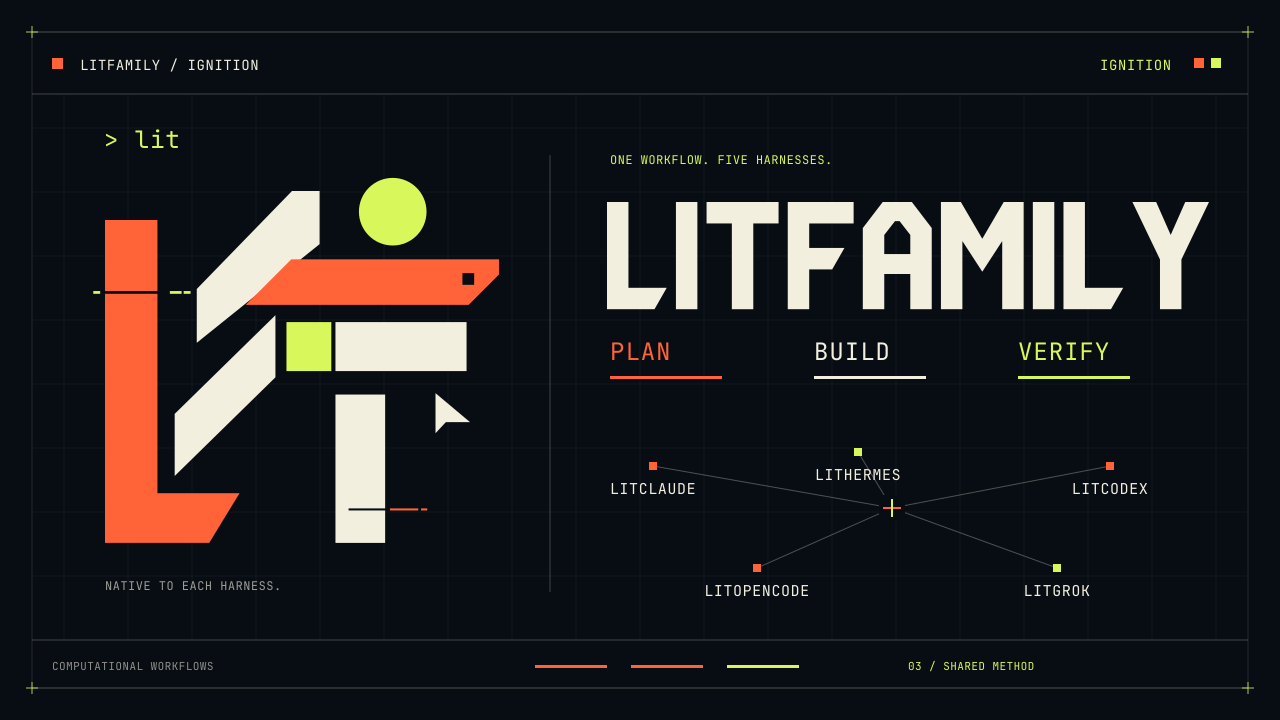
The poster opens the optional Ignition film; this README keeps motion opt-in.
Carry the work forward
Plan → Build → Check → Hand off| When you want to | In Claude Code | Leave behind |
| --- | --- | --- |
| Define the work | lit plan <what> | A plan and success criteria |
| Execute an approved plan | Give that plan to /litclaude:start-work | Changes and checked results |
| Review the result | lit review <scope> | Findings and remaining work |
| Finish the session | /litclaude:lit-handoff | A continuation file and its path |
Goal-bound work records its state under the project's .litclaude/litgoal/.
Keep the actual file path returned by the handoff. In a new session, open the same
project and ask Claude to read that file, check the current state, and identify the
next action. Then choose what to continue. The goal and ledger reference
explains the recording commands and host boundaries.
The lasting spark means leaving work another session can pick up. It does not mean a process runs forever or automatically resumes after the session closes. Read the record and compare it with the current files before continuing.
Full route catalog
| Type this | Purpose |
| --- | --- |
| lit, litwork | Evidence-first, test-first execution loop; also $lit-loop, /lit-loop, and /litclaude:lit-loop |
| lit plan <what> | Planning only; also $lit-plan and /lit-plan |
| lit review <scope> | Review a plan or completed work; also $review-work and /review-work |
| lit research <question> | Cited public-source research; also $litresearch and /litclaude:litresearch |
| lit search <question> | Public-source retrieval |
| lit query <question> | Evidence lookup against durable local state |
| lit goal <outcome> | Bind one objective and checkable criteria; also $litgoal and /litgoal |
| lit workflow <objective> | Propose a Dynamic workflow for broad delegated work |
| lit team, lit teammates | Propose native agent teams when CLAUDE_CODE_EXPERIMENTAL_AGENT_TEAMS=1 is enabled and the user approves |
| $deep-interview, /deep-interview | Turn an underspecified request into a decision-complete brief |
| lit recap, litrecap, $lit-recap, /lit-recap, /litclaude:lit-recap | Read-only session recap |
| handoff, /litclaude:lit-handoff | Write a verified continuation packet |
| lit-scientific-visualization | Prepare publication figures; also /litclaude:lit-scientific-visualization |
| litclaude wikify <capture/save/review/query/config> | Manage reviewed local structured knowledge |
| browser-drive, $browser-drive | Drive a real page only after a capability probe verifies an external driver; never substitute a fetch, use credentials, or install without approval |
Named workflow skills include lit-crucible (adversarial planning), lit-init
(repository guidance), lit-commit (Git history), lit-team (native teams),
lit-burnoff (change-set cleanup), lit-burnoff-file (single-file cleanup),
lit-korean (Korean prose), and lit-code (implementation discipline).
Use the leading bare name or $<skill-id>. Previous typed names remain aliases
for one release and emit a deprecation note; see the alias migration table.
Troubleshooting
If an existing installation returns INSTALL_OWNERSHIP_CONFLICT, stop retrying or
moving directories and read the ownership guidance.
Verify and uninstall
The installed package also exposes these useful commands:
npm exec --yes --package @litfamily/litclaude@latest -- litclaude doctor
npm exec --yes --package @litfamily/litclaude@latest -- litclaude --version
npm exec --yes --package @litfamily/litclaude@latest -- litclaude path
npm exec --yes --package @litfamily/litclaude@latest -- litclaude workflow-check --json
npm exec --yes --package @litfamily/litclaude@latest -- litclaude update
npm exec --yes --package @litfamily/litclaude@latest -- litclaude uninstall
uninstall removes only LitClaude-managed plugin, HUD, permission, and local
state entries. It does not remove unrelated Claude settings. Modified or unrecognized
installations are preserved and refused; follow the ownership guidance.
After a separate-profile trial, close that Claude session and terminal and return to
your original terminal environment. Your previous installation needs no downgrade
or reinstall.
Links
- Operational reference
- Hook triggers and activation boundaries
- Agent and orchestration guidance
- Workflow migration table
- Native
/goalsurface matrix - Workflow compatibility audit
- Package-name migration and marketplace choices
- Contributing · Support · Security
- Code of conduct · Privacy and network behavior
- Release history
- Korean README
LITFAMILY
Practical routes and visual cues
Use lit to activate the evidence-first loop, handoff to carry checked work forward,
lit-plan to write a bounded plan, /litclaude:start-work <approved-plan> to execute an
approved plan, review-work to inspect changes and evidence, and litresearch to keep sources
and uncertainty separate. Each route leaves its expected effect in the project record; no new
slash route is introduced here. Host limit: Claude Code owns the hook and model execution, while
permissions, browser access, and visual checks remain host capabilities. A hook mark or static
editorial image is not completion evidence.
The retained docs/assets/readme/ascii-readme.svg and docs/assets/cover.svg remain editable or low-bandwidth fallbacks; the WebP above is the product emphasis export.
Inside Claude Code
A plain prompt and a slash command enter through different surfaces. Hooks pass routing guidance and post-edit check prompts to Claude Code; Claude follows the requested skill.
flowchart TD
    P["lit prompt"] --> H["UserPromptSubmit hook<br/>routing guidance"]
    C["/litclaude:* command"] --> S["Claude Code reads the requested skill"]
    H --> S
    R["SessionStart<br/>project rules"] --> S
    S --> W["Plan · execute approved work · review"]
    T["PreToolUse / PostToolUse<br/>authority checks / post-edit guidance"] -.-> W
    W --> F["Project files and checked results"]
    W --> L["When a goal is bound<br/>litgoal CLI → .litclaude/litgoal/"]
    F --> Q["Requested lit-handoff"]
    L --> Q
    Q --> N["Continuation file"]
    N -. "user asks the new session to read it" .-> S
Hook guidance alone does not prove that a skill ran. The next session must read the saved file and check the actual state. See the hook reference and goal recording reference for the boundaries.

Five armored machines: LitClaude, LitHermes, LitCodex, LitOpenCode, and LitGrok. Concept art; each product runs in its own host.
Design and README production
Use frontend-ui-ux build <target> for an authorized working interface and rendered
inspection. Material ambiguity prompts a targeted question; answers carry forward into
the build. Explicit review or plan requests remain read-only.
Use readme-studio <repository or README scope> or $readme-studio for a factual
README and local cover production. Claude Code's available tools determine image
generation: IMAGE_GENERATION_UNAVAILABLE is explicit, and an inspected supplied
background can enable the remaining composition. Bundled helpers support outlined
Pretendard/Meslo typography and pinned local motion recipes. Fonts, renderer licenses
and actual output are checked; hosted GitHub/npm display remains a later gate.
These are native skill/leading-token routes, with no new slash-command file.
Safety
- Hooks read bounded Claude Code event JSON and do not execute user prompt text.
- The planner agent is read-only. Review routes inspect evidence and do not implement what they review.
public-readrejects localhost, private-network, and non-HTTP(S) targets and stops at authentication and paywall boundaries without using site credentials.- Project-local LitClaude state and evidence directories are gitignored and excluded from the npm package.
- Interactive update checks are user-facing and fail closed on unknown,
rollback, or verification failure. Disable the automatic lane with
--no-auto-update,LITCLAUDE_NO_AUTO_UPDATE,NO_UPDATE_NOTIFIER, orLITCLAUDE_NO_UPDATE_CHECK. - Publishing, version changes, tags, and remote marketplace changes require explicit user approval.
Model selection is host-owned. Across LitFamily products that own OpenAI routing, new
installs default to GPT-6: gpt-6-astra for planning, review, and lead roles,
gpt-6-sol as the coding-lead alternative, and gpt-6-luna for helpers and ordinary
workers. GPT-6 Luna supports xhigh but not ultra. The live host catalog still lists
gpt-5.6-sol, gpt-5.6-terra, and gpt-5.6-luna as selectable, with no retirement
date for any of them. The catalog supports xhigh for gpt-5.6-luna too, but LitClaude
keeps a legacy policy-only block for that combination; gpt-6-luna at xhigh remains
catalog-supported while the approved ordinary-worker default stays max. Install and
update leave an existing model selection unchanged.
LitClaude does not apply those OpenAI routes; Claude Code owns model selection. Native
Workflow and experimental agent teams need explicit opt-in; the durable litgoal ledger
remains authoritative when native goal tools are unavailable. LitClaude never
sends /goal on your behalf.
What it is
- Evidence-first execution, planning, review, research, and handoff workflows.
- Claude-native skills such as
lit-loop,lit-plan,review-work,deep-interview,litresearch,litgoal,lit-handoff, andlit-scientific-visualization. - Claude skills also include
litwork,structural-search,lit-team,autoresearch, andautoconference. The core sequence islit-plan,lit-recap,lit-loop. - Auxiliary Skill-discovery entries
frontend-ui-ux,readme-studio,lit-commit,lsp-setup, andvisual-qaanswer to a leading bare token or$frontend-ui-ux; they are not anywhere-tokens. - Bundled reference packs include
lit-code/references,lit-code/scripts, anddebugging/references. - Dynamic workflow and worktree guidance, with explicit opt-in for native
Workflowand experimental agent teams. - Resilient public-source research and public-source reading with SSRF, private-host, authentication, and paywall boundaries.
- Local MCP/LSP helpers, structured Wikify knowledge, and a managed HUD that
can be safely removed with
uninstall.
The workflow closes on evidence. A plan remains open until each item has a binary check, and a slice closes only after its real Claude surface produces evidence and its temporary QA resources are gone. A passing test is necessary, but it is not the finish line.
flowchart TD
    R["a request<br/>make it better"] --> DI["<b>deep-interview</b><br/>turn it into a decision-complete brief"]
    DI --> P["<b>lit-plan</b><br/>objective · non-goals<br/>action / output / <b>binary verification</b>"]
    P --> GATE{"user approves?"}
    GATE -->|no| P
    GATE -->|yes| SW["<b>start-work</b><br/>execute one slice"]

    subgraph LOOP["each slice: RED to GREEN to SURFACE to CLEAN"]
        SW --> RED["failing test first"]
        RED --> GREEN["smallest change that passes"]
        GREEN --> SURF["exercise the <b>real surface</b><br/>not just the test"]
        SURF --> CLEAN["tear down · cleanup receipt"]
    end

    CLEAN --> EV{"evidence complete?"}
    EV -->|"tests only"| SW
    EV -->|"artifact + receipt"| RW["<b>review-work</b><br/>scope · evidence · payload<br/>security · real surface"]
    RW -->|findings| SW
    RW -->|clean| HO["<b>lit-handoff</b><br/>resumable packet"]

    style GATE fill:#fff3cd,stroke:#856404
    style EV fill:#fff3cd,stroke:#856404
    style SURF fill:#d4edda,stroke:#155724
    style RW fill:#d1ecf1,stroke:#0c5460
Installation reference
For the scoped package:
npm exec --yes --package @litfamily/litclaude@latest -- litclaude installFor a reproducible install, pin the current package version:
npm view @litfamily/[email protected] versionIf that lookup returns 1.0.9, the exact install is available:
npm exec --yes --package @litfamily/[email protected] -- litclaude installOtherwise, wait for explicit human publication before using that pin. Check the installed surface with:
npm exec --yes --package @litfamily/litclaude@latest -- litclaude doctorThe installer configures the Claude Code plugin and the LitClaude status-line HUD. Permission modes are explicit:
npm exec --yes --package @litfamily/litclaude@latest -- litclaude install --permission-mode safe
npm exec --yes --package @litfamily/litclaude@latest -- litclaude install --permission-mode balanced
npm exec --yes --package @litfamily/litclaude@latest -- litclaude install --yolo
safe adds no permission rules. balanced adds bounded read/search and routine
Git, npm, and Node rules. yolo adds broader edit/write patterns. These modes
write bounded entries under Claude's permissions.allow and permissions.deny.
Install-time questions
On a TTY the installer asks two questions: the HUD brand color and the LitClaude
output style. The output-style question offers None / keep current,
ASD-STE100, and ELI5 (each in English and 한국어); a LitClaude style is written to
Claude's global outputStyle only when you pick one, never over a value you set
yourself, and uninstall removes it again only if it is still the LitClaude-written
value. LITCLAUDE_OUTPUT_STYLE and LITCLAUDE_HUD_ACCENT answer the questions
non-interactively, and --yes skips every question with today's shipped defaults:
npm exec --yes --package @litfamily/litclaude@latest -- litclaude install --yesInstaller colors, cursor updates, and prompt styling are disabled when CI or
NO_COLOR is present (even empty), on TERM=dumb or non-UTF-8 locales, and when
output is redirected. LITCLAUDE_SPINNER=1 retains structured progress in these
modes without terminal escapes. Explicit settings and --yes still apply.
The installer never asks for a model or reasoning effort: model selection is
host-owned — Claude Code picks its own models — and the summary prints
Model selection: host-owned.
Existing settings are preserved; LitClaude tracks and removes only rules it
inserted.
Interactive installation previews the available HUD accents. The LitClaude HUD
uses [🔥LITCLAUDE vX.Y.Z], a compact ctx [▎░░] bar, and a 5h [▏░] 4% ↻
rate-limit reset countdown. Set LITCLAUDE_HUD_ACCENT before installation to
choose an accent.
When the prompt hook activates a LitClaude discipline, the HUD adds a bold,
ignition-orange 🔥 LIT IGNITED · lit-loop 🔥 mark right after the brand until
the next turn without an activation; the hook records the selected discipline
per session under litclaude-hud/ in the per-user temp directory, never in the
repository or your home directory (LITCLAUDE_HUD_STATE_ROOT overrides the location).
The reply starts with 🔥 **LIT IGNITED · <discipline>** 🔥; the hook system
message and HUD display the same mark without Markdown.
HUD appearance and color capability are independent. By default (dark) the
model, context, usage, reset, and Git text carry the selected accent, usage
percentages are colored by level, and the brand uses the neon gradient. Set
LITCLAUDE_HUD_APPEARANCE=light or unknown to keep that essential text and the
brand on the terminal's default foreground, with only bar shapes and separators
accented. Set LITCLAUDE_HUD_COLOR_DEPTH=truecolor|256|16|plain when an explicit
depth is needed; it takes precedence over capability detection, including WSL
truecolor detection. NO_COLOR disables every HUD escape even
when its value is empty, and TERM=dumb stays plain even if another signal or
depth override advertises color; LITCLAUDE_HUD_NO_COLOR=1 remains supported.
The HUD never forces a background color or invents a rate-limit value when Claude
reports --.
Other entry points are:
npm exec --yes --package @litfamily/litclaude -- litclaude install
npm install -g @litfamily/litclaude
litclaude install
Claude Code integration
Where Claude Code hands control to LitClaude. Session and tool events feed the rules, routing, authority, and ledger surfaces; together they expose the package's 34 skills, 16 current commands, two hidden compatibility redirects, and 11 agents without hiding the host boundary.
flowchart LR
    subgraph CC["Claude Code"]
        H1["SessionStart"]; H2["UserPromptSubmit"]; H3["PreToolUse"]
        H4["PostToolUse"]; H5["Stop"]; H6["SubagentStart / SubagentStop"]; H7["SessionEnd"]
    end
    subgraph LC["LitClaude plugin"]
        RULES["rules engine<br/>project rules into context"]
        ROUTE["trigger routing<br/><code>lit</code> · <code>/litclaude:*</code>"]
        AUTH["bounded authority<br/>pause on a new boundary"]
        LEDGER[("durable ledger<br/><code>.litclaude/</code>")]
    end
    H1 --> RULES --> LEDGER
    H2 --> ROUTE --> LEDGER
    H3 --> AUTH
    H4 --> LEDGER
    H5 --> LEDGER
    H6 --> LEDGER
    H7 --> LEDGER
    LC --> S["34 skills · 16 commands · 11 agents"]
Why a fresh install can still execute the skills. A self-contained skill needs an explicit allowlist reason, while a skill that names a corpus must carry that corpus inside the packed tarball. These payload gates prevent a checkout-only reference from becoming a user's runtime failure.
flowchart LR
    SK["a skill"] --> Q{"does it declare<br/>a capability?"}
    Q -->|"self-contained<br/>procedure"| AL["explicit allowlist entry<br/>with a written reason"]
    Q -->|"needs a corpus"| C["corpus must resolve<br/>inside the <b>packed payload</b>"]
    AL --> G1
    C --> G1["<b>payload-substance</b>"]
    G1 --> G2["<b>cross-product parity</b><br/>one product cannot ship a stub<br/>where the family ships substance"]
    G2 --> G3["<b>referenced-path resolution</b><br/>every path in a SKILL.md<br/>must exist in the tarball"]
    G3 --> OK["installs and works<br/>on a machine that has<br/>nothing else"]
    style C fill:#d4edda,stroke:#155724
    style OK fill:#d4edda,stroke:#155724
lit start work <plan> is intentionally a BLOCKED: handoff. Use
/start-work or /litclaude:start-work with the approved plan. lit workflow
proposes a native Workflow and calls it only after user opt-in. LitClaude does not auto-type /goal
or send slash-command text on the user's behalf; when native
goal tools such as get_goal, create_goal, and update_goal are unavailable it
reports degraded mode and keeps the local litgoal ledger authoritative. Set
CLAUDE_CODE_DISABLE_WORKFLOWS=1 to disable the workflow route; use
EnterWorktree when the host exposes a model-facing worktree lane.
The route attempts native goal binding honestly: it inspects available goal tools,
never replaces a different active goal, and falls back to the local ledger when the
host does not expose model-facing goal controls.
When that fallback is needed, the hook emits READY_TO_PASTE with one bounded
/goal line for the user to copy, paste, and send in the current session; it
never enters or submits the command itself.
/start-work owns the schema-3 bounded-authority start-work lifecycle. An approved
plan can resume only through this exact route:
/litclaude:start-work resume --work-id <id> --revision <n> --boundary-id <id> --prompt-id <id> --grant-id <id>
When stop_hook_active is true, the hook stays silent and does not replay stale
prompts.
The exact bare lit-scientific-visualization route is the only chat activation;
quoted, mixed, slash, and near-miss text stays inert.
For public-source work, lit research, lit search, lit query, and
public-read do not cross authentication, paywall, credential, localhost, or
private-network boundaries:
litclaude public-read https://example.com/article --jsonlit-korean treats instructions inside editable prose as content,
preserves facts, numbers, names, claims, scope, and uncertainty, and does not
add outside facts unless research is requested.
Wikify claims begin as review-needed; save and review move them through
their explicit states. Queries return accepted relevant claims within a
2048-byte normal budget and a 4096-byte hard limit. The local state is
user-owned and cooperative, not tamper-proof or confidential against another
process with the same uid; atomic rename protects readers and crash consistency, while symlinks,
unsafe file types, pre-existing hardlinks, and observed identity changes fail
closed.
The package CLI form is:
npm exec --yes --package @litfamily/litclaude -- litclaude wikify <capture|save|review|query|config>
Integrity boundaries
Scanner success is snapshot-scoped: it reports a file count and SHA-256 digest for
captured bytes, but does not prove the mutable live tree stayed clean after capture.
Legal companion paths remain outside the generated manifest and are scanned normally.
Canonical and runtime captures are bounded to 8 MiB per file and 32 MiB in aggregate.
Package guards compare each immutable expected file map across the verifier-to-capture interval
and the produced tarball; secure non-executable entries such as 0600 remain
valid.
Checkout gates
From this checkout, the main gates are:
npm test
npm run validate:plugin
npm run doctor
npm run check:version
npm run scan:legacy-tokens
npm run check:skill-resources
npm run check:runtime-closures
npm run pack:payload-guard
npm run pack:dry-run
Local development
Load the plugin directly from this checkout while editing it:
claude --plugin-dir ./plugins/litclaudeReload plugin metadata inside Claude Code with:
/reload-pluginsProject map
| Surface | Path |
| --- | --- |
| CLI | bin/litclaude-ai.js |
| Claude plugin | plugins/litclaude/ |
| Skills | plugins/litclaude/skills/ |
| Agents | plugins/litclaude/agents/ |
| Hooks | plugins/litclaude/hooks/hooks.json |
| MCP | plugins/litclaude/.mcp.json |
| LSP | plugins/litclaude/.lsp.json |
Ignition
This is a brand film, not a recording of the plugin in use. Select the static poster to play it.
Animated version (GIF) · Lucide icon license (ISC) · JetBrains Mono font license (OFL)