
@metaharness/autogenous
v0.1.0
Published
Autogenous radio-moe policy-evolution adapter for @metaharness/flywheel: bounded independence weights, frozen safety gates and governed promotion.

Maintainers
 ruvnet
Readme
@metaharness/autogenous

A MetaHarness flywheel adapter for ruvnet/autogenous. It evolves the governed radio-moe mesh policy under Autogenous' own rules.
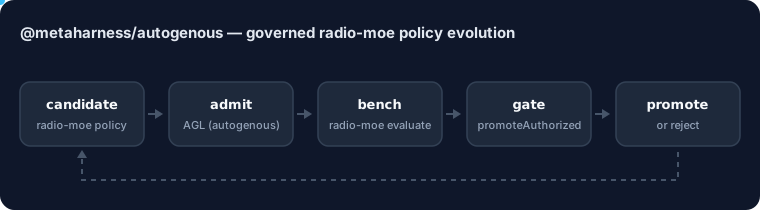
It calls the real Autogenous packages instead of copying them (ADR-323):
| From | Used for |
| --- | --- |
| autogenous (AGL, Rust compiled to WebAssembly) | Every candidate is admitted as an AGL routing_budget mutation before it can be promoted. A candidate the benchmark reports as irreversible has no rollback target and is refused. Pass your real Autogenous genome as makeAutogenousEvaluator(bench, { admission: { parent } }) so AGL also checks authority against its ceiling. The default parent is an adapter-local placeholder. |
| radio-moe | CEILINGS, DEFAULT_INDEPENDENCE_WEIGHTS, PROMOTION_MARGIN, and the promoteAuthorized predicate Better ∧ Safe ∧ Authorized ∧ Reversible. |
Install
npm install @metaharness/autogenous @metaharness/flywheel radio-moeFrozen versus evolvable
Evolvable: sameProvider, sameArch, sameSize, sourceJaccard and quorumThreshold. Each is clamped to radio-moe's constitutional CEILINGS.
Frozen:
sameAccuracyBand, until it has a dedicated benchmark. A policy that tries to change it is refused by AGL withinvariant_regressed.- Source and fusion algorithms.
- Signature, replay and sequence checks.
- Fail-closed behavior.
- Hard gates and promotion authority.
Quickstart
This example scores radio-moe's documented reference champion against the shipped defaults. The fitness comes from radio-moe's own deterministic evaluate().
import { evaluateMeshParams } from 'radio-moe';
import {
  autogenousPromotionRule,
  genomeToPolicy,
  makeAutogenousEvaluator,
  referenceChampionGenome,
  rootGenome,
} from '@metaharness/autogenous';

// The benchmark seam: radio-moe's fitness, plus your measured quality and authority.
const evaluate = makeAutogenousEvaluator(async (genome) => ({
  ...evaluateMeshParams(genome),
  correlatedGainVsBest: 0.25,
  independentGainVsBest: 1 / 3,
  authorized: true,
  reversible: true,
}));

const suite = { id: 'radio-moe-frozen-bench', items: [] };
const baseline = await evaluate(genomeToPolicy(rootGenome()), suite);
const candidate = await evaluate(genomeToPolicy(referenceChampionGenome()), suite);

console.log(baseline.separation, '->', candidate.separation);   // 0.6875 -> 1.25
console.log(candidate.aglAdmission);                             // { admissible: true }
console.log(autogenousPromotionRule({ baseline, candidate }));   // { promote: true, reasons: [] }

const unfrozen = await evaluate(
  { ...genomeToPolicy(referenceChampionGenome()), sameAccuracyBand: '0.5' },
  suite,
);
console.log(autogenousPromotionRule({ baseline, candidate: unfrozen }).reasons);
// [ 'not_authorized', 'agl_admission_refused:invariant_regressed',
//   'policy_surface_violation', 'safety_regressed' ]
To evolve the policy, pass the same evaluator to runFlywheelGenerations from @metaharness/flywheel. Use mutationTargets: [...AUTOGENOUS_MUTATION_TARGETS], proposer: makeAutogenousProposer() and promotionRule: autogenousPromotionRule.
The adapter has no authority to apply a champion, and it ignores any promote boolean supplied by a caller. AGL admission can only withdraw authorization, never grant it.
License
MIT. Homepage: ruv.io.