
@mithril-inspector/vite
v0.3.2
Published
Zero-config Vite plugin for Mithril Inspector — combines the transform, runtime, overlay and server packages.

Maintainers
 erikvullings
Readme
@mithril-inspector/vite
The Vite integration for Mithril Inspector. It only
integrates the bundler-neutral layers — the shared transform
(@mithril-inspector/transform), the runtime (@mithril-inspector/runtime), the
overlay (@mithril-inspector/overlay) and the open-in-editor server
(@mithril-inspector/server) — and adds no transform or editor logic of its own.
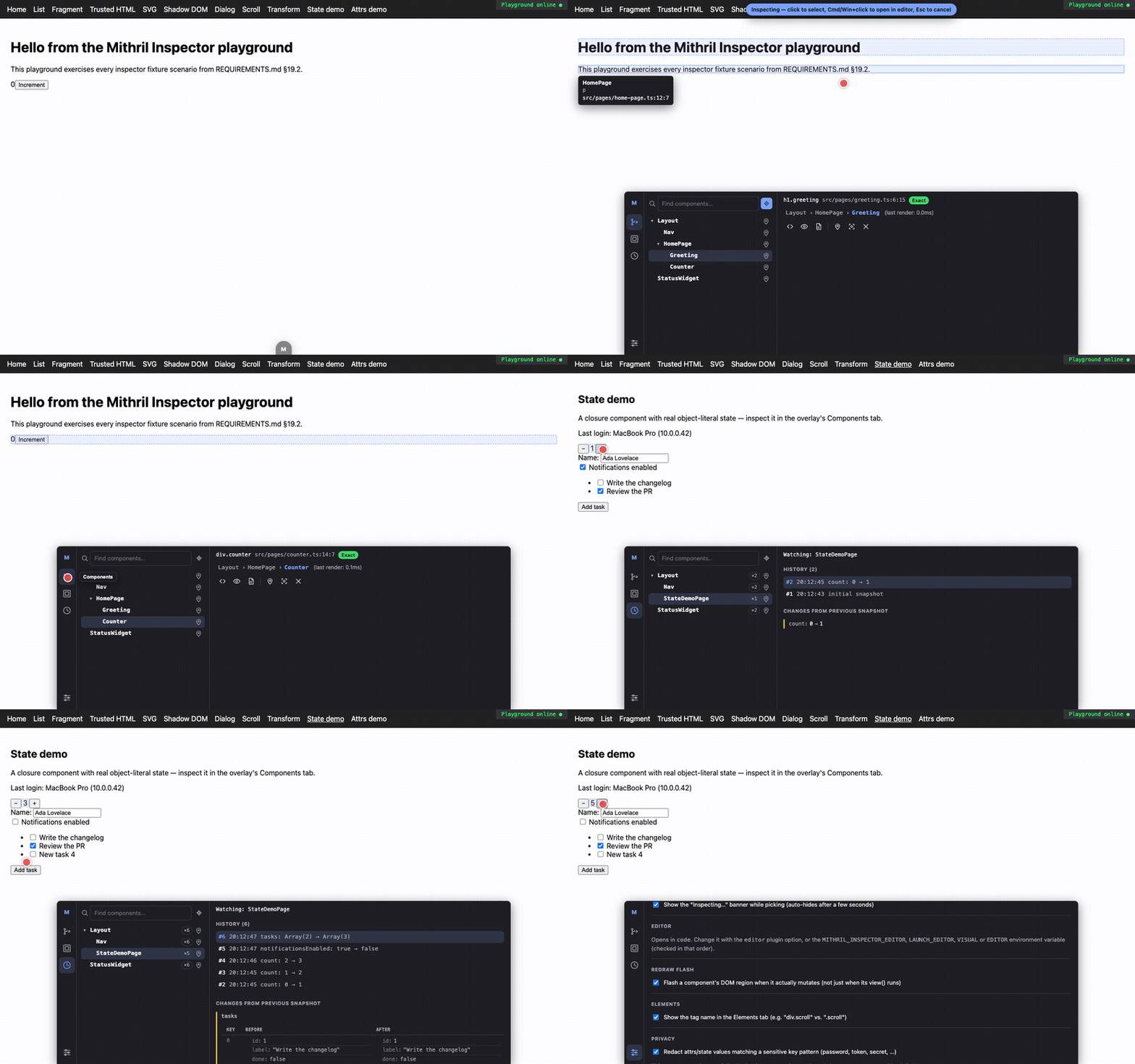
Zero-config usage
// vite.config.ts
import { defineConfig } from "vite"
import { mithrilInspector } from "@mithril-inspector/vite"

export default defineConfig({
  plugins: [mithrilInspector()],
})
No application-code changes are required: no wrapping components, no replacing
the m import, no m.mount/m.route edits, and no entry-file edits — the
overlay bootstrap is injected into the page HTML.
mithrilInspector(options?) returns a two-plugin array.
Development-only
enabled defaults to process.env.NODE_ENV !== "production". Both plugins also
carry an apply gate that disables them during vite build unless
includeInProduction is set, so production bundles contain no runtime
registration, overlay or editor endpoint — verified by a real vite build test.
Options
mithrilInspector({
  enabled,            // master switch (default: dev only)
  includeInProduction,// keep it in production builds (default false)
  include, exclude,   // FilterPattern for which modules to instrument
  root, projectRoots, // editor-endpoint roots
  editor,             // "code" | "cursor" | … | { command, args } (default "code" with no env var set)
  pathMappings,       // remote-path rewrites
  mode,               // "source" | "components" | "full" (default "full")
  ui:            { enabled, defaultOpen, theme, zIndex },
  picker:        { enabled, toggleShortcut, holdShortcut, openOnClick, continuous },
  componentTree: { enabled, captureAttrs, captureState },
  elementsPane:  { showTagName }, // Elements tab hyperscript labels (default true: "div.scroll" vs. ".scroll")
  source:        { elements, components, attributes, textExpressions, exposeDomAttributes },
  mithrilImports, hyperscriptIdentifiers, // Mithril import/alias detection
  debug,              // gate the diagnostics endpoint and runtime log-once
  redact,             // attrs/state redaction policy
})
componentTree is passed straight through to the overlay's Components tab:
enabled (default true) gates the full component tree UI
itself. captureAttrs/captureState gate the attrs/state preview panels
specifically; both default to true once mode resolves to "full"
(and to false otherwise) — "full" mode itself is defined as including
attrs/state, so the zero-config default (mode: "full") already shows them
without opting into two more flags. Set either explicitly (e.g. captureState:
false) to keep "full" mode's other diagnostics while still suppressing
one of the preview panels, or set mode: "source" for the lighter
zero-tracking experience.
The resolved editor command (whichever of editor / MITHRIL_INSPECTOR_EDITOR /
LAUNCH_EDITOR / VISUAL / EDITOR / the "code" default actually won) is
shown read-only in the overlay's Settings tab, alongside the same override
instructions — the browser never chooses what the open-in-editor endpoint
launches, so there is no control to change it there.
Set editor explicitly rather than relying on that fallback chain: an
ambient $EDITOR/$VISUAL in the shell that started your dev server (many
shell profiles export EDITOR=vi or similar) silently wins over the "code"
default, with no error — the endpoint still reports success, since the
process did start. A terminal editor (vi, vim, nvim, emacs, nano)
can never work here regardless of how it's selected: spawnEditorProcess
always launches detached with no terminal attached, so it starts and exits
without ever visibly opening. The Settings tab flags this inline when the
resolved command is one of these.
Virtual modules
Two virtual modules are served with \0-prefixed resolved ids:
virtual:mithril-inspector/runtime— re-exports the transform-facing helpers (registerModule/source/component) and installs a runtime configured withmode/debug/exposeDomAttributes/redacton the global hook before any instrumented module registers. The transform points its injected import at this specifier.virtual:mithril-inspector/overlay— imports the runtime module, then mounts the shadow-root overlay once the DOM is ready. Injected viatransformIndexHtml.
Plugin order
The instrumenting plugin is mithril-inspector:pre with enforce: "pre", so
it sees the original TypeScript/JSX before Vite's esbuild TS/JSX transform
lowers it. JSX is handled at the AST level, so no separate post-transform
plugin is needed; the plugin only splits along concerns:
mithril-inspector:pre(enforce: "pre") —resolveId/load(virtual modules),transform(instrument, preserve source maps, skipnode_modules/self/generated), andhandleHotUpdate(invalidate, ADR-106).mithril-inspector:serve—transformIndexHtml(overlay bootstrap) andconfigureServer(open-in-editor middleware, plus a diagnostics endpoint indebugmode).
HMR (ADR-106)
On a hot update of an instrumented file, handleHotUpdate sends a
mithril-inspector:invalidate message with the file's stable module id. The
runtime bootstrap invalidates that module's stale source table; the re-executed
module's own registerModule restores a fresh one. Selection survival is
computed lazily in the overlay, so no selection state crosses the HMR boundary.
Privacy
Component attrs/state are never sent to the dev server; the editor endpoint
receives only { file, line, column }. Default redaction key patterns (password,
token, cookie, …) are wired into the runtime bootstrap config.
Optional DOM metadata
source.exposeDomAttributes: true adds a compact data-mi="m:<hash>:s2"
attribute to element vnodes (no absolute paths). Off by default.