
@multisystemsuite/create-mf-app
v1.0.21
Published
Production-ready TypeScript CLI to scaffold enterprise microfrontend apps with React, Vite and Module Federation.
Downloads
81

Maintainers
Readme
create-mf-app
@multisystemsuite/create-mf-app — TypeScript CLI that scaffolds production-grade enterprise microfrontend platforms using React 17, 18, or 19 (default 19), Vite 7, Module Federation, React Router, Material UI, Docker, and npm workspaces.
Includes 10+ architect-level pillars — security, observability, scalability, failure recovery, folder structure, CI/CD, accessibility, DX, and a capstone architect guide with audit scripts for every pillar.
Inspired by Module Federation — optimized for React microfrontends, Vite, runtime federation, SaaS dashboards, and internal developer platforms.
Table of contents
- Install & run the CLI
- What it generates
- Quick start
- How to use the generated project
- CLI reference (create-mf-app)
- Ports per app module (by level)
- Custom child & shared app names
- Enterprise platform flags
- Enterprise architect pillars
- Generated monorepo structure
- Infrastructure & deployment (parent workspaces)
- MF Platform CLI (inside generated projects)
- Using corelib (shared library)
- Enterprise design system & theming
- Module Federation
- Performance & federation architecture
- SDK packages
- Task runner & build cache
- Plugins & devtools
- Runtime configuration
- Template marketplace
- CI/CD & governance
- Code quality
- Root workspace scripts
- Docker & deployment
- Documentation in generated projects
- Node version
- Troubleshooting
- Develop & publish this package
Install & run the CLI
You do not need to clone this repo to use the tool. Install and run via npx (recommended):
npx @multisystemsuite/create-mf-app@latest my-platform --type=parent --children=billing,orders --shared=corelib --template=tsx --react=19Ports & remote URLs come from .env — after scaffold, each app’s dev/preview port and Module Federation remoteEntry URL are read from the workspace root .env (Vite loads env from the monorepo root for every app under apps/). Change values there instead of editing per-app vite.config files:
# my-platform/.env (generated)
VITE_MAIN_PORT=3000
VITE_MAIN_REMOTE_ENTRY=http://localhost:3000/assets/remoteEntry.js
VITE_BILLING_PORT=3001
VITE_BILLING_REMOTE_ENTRY=http://localhost:3001/assets/remoteEntry.js
VITE_ORDERS_PORT=3002
VITE_ORDERS_REMOTE_ENTRY=http://localhost:3002/assets/remoteEntry.js
VITE_CORELIB_PORT=3003
VITE_CORELIB_REMOTE_ENTRY=http://localhost:3003/assets/remoteEntry.js- Port keys:
VITE_<APP>_PORT(app name uppercased; hyphens → underscores) - Remote URL keys:
VITE_<APP>_REMOTE_ENTRY - Unique ports: each app must use a different port — scaffold assigns
3000,3001,3002, … automatically;add-childpicks the next free port (or use--port=if unused) add-childrejects--portif that port is already assigned in.envset-portupdates ports for existing apps and syncs.env— see Ports per app module (by level)
Or use the short binary name (same package):
npx create-mf-app my-platform --type=parent --children=billing,orders --shared=corelibContributors: npx installs the published npm package. To test unreleased generator changes from this repo, build and run locally — see Develop & publish this package.
npm run build
node dist/index.js my-platform --control-plane -y
node dist/index.js my-platform --type=parent --children=admin,billing --shared=corelib -y
node dist/index.js add-child analytics --cwd=./my-platform --port=4205 -y
Global install (optional):
npm install -g @multisystemsuite/create-mf-app
create-mf-app my-platform --type=parent --children=billing,orders --shared=corelib
Interactive mode (no project name — prompts for all options, including React version 17 / 18 / 19):
npx create-mf-appHelp:
npx create-mf-app --helpAfter scaffolding, always:
cd <project-name>
npm install
Then use the scripts in How to use the generated project.
What it generates
Single app (--type=child)
- React + Vite + Module Federation remote
- React 17, 18, or 19 —
--react=17|18|19or interactive prompt (default: 19) - TypeScript (
.tsx) or JavaScript (.jsx) - Optional Docker
- Standalone dev on
--port(default3001)
Parent monorepo (--type=parent)
apps/main— host shell (router, sidebar, navbar, command palette)apps/<child>— federated remotes (names you pass in--children)apps/corelib(or custom--sharedname) — shared federated library (design system, RBAC, UI)packages/*— shared npm workspace librariestools/mf-cli— MF platform CLI (mf generate,mf graph,mf affected, …)task-runner/— parallel builds + hash cache (.mf/cache)plugins/— React, Vite, Federation, MUI, Auth, Charts, Workflow, Monitoringdevtools/— federation inspector, profiler, theme inspectorruntime-config/— tenant configs, remote manifests, pillar configs (scaling, resilience, structure, observability, architect roadmap)templates/— LIMS, ERP, HMS, SaaS enterprise blueprintsai/— AI-ready prompt engine + semantic search hooksgovernance/— import boundaries, CODEOWNERS, dependency rules- Enterprise pillar docs + audits — security, DX, observability, a11y, CI/CD, scalability, failure recovery, folder structure, architect capstone
- CI/CD — GitHub Actions, GitLab CI, Helm chart
- Root scripts for dev, watch, preview, release, affected builds, per-child dev shortcuts
Quick start
Single remote app
npx create-mf-app inventory --template=tsx --port=3001 --type=child
cd inventory
npm install
npm run dev
React 18 monorepo (non-default version)
npx create-mf-app my-platform \
  --type=parent \
  --children=billing,orders \
  --shared=corelib \
  --template=tsx \
  --react=18 \
  -y

cd my-platform
npm install
npm run local
Open http://localhost:3001
Parent monorepo (full platform)
npx create-mf-app my-platform \
  --type=parent \
  --children=billing,orders,analytics,warehouse \
  --shared=corelib \
  --template=tsx

cd my-platform
npm install
npm run local
Open http://localhost:3000 (host). Child remotes load on routes like /billing, /orders, etc.
Full enterprise platform (all optional modules)
npx create-mf-app my-platform \
  --type=parent \
  --children=billing,orders,analytics,warehouse \
  --shared=corelib \
  --template=tsx \
  --auth \
  --charts \
  --storybook \
  --monitoring \
  --table \
  --form-engine \
  --i18n \
  --testing \
  --pwa \
  --plugin-system
How to use the generated project
First-time setup
cd my-platform
npm install          # hoisted workspaces — required for federation shared deps
npm run local        # build all apps → watch → preview all ports → live-reload
| Command | When to use |
|---------|-------------|
| npm run local | Default daily dev — all apps (main + every child + shared lib) |
| npm run local:fast | Smart build (skip unchanged) + watch + preview — faster iteration |
| npm run dev | Print env + run each app's Vite dev server (no federation build watch) |
| npm run dev:fast | Dev build once, then preview + live-reload |
| npm run dev:safe | Production build, then preview only |
Work on one module only (faster)
The generator creates one npm script per child name from --children. Each script starts only the apps that module needs:
| You run | Apps started | Typical URL |
|---------|--------------|-------------|
| npm run billing | main + corelib + billing | http://localhost:3000/billing |
| npm run orders | main + corelib + orders | http://localhost:3000/orders |
| npm run analytics | main + corelib + analytics | http://localhost:3000/analytics |
| npm run corelib | main + corelib | http://localhost:3000 |
Example: only billing team local dev:
npm run billing
# edit apps/billing/src/...
# host reloads billing remote from localhost:3001
Scripts are generated dynamically from your --children list — if you scaffold with --children=invoicing,shipping, you get npm run invoicing and npm run shipping automatically.
Port assignment
Ports are assigned sequentially from 3000:
| App order | Example names | Port |
|-----------|---------------|------|
| 1st | main (always host) | 3000 |
| 2nd | first child | 3001 |
| 3rd | second child | 3002 |
| … | … | … |
| last | shared lib (corelib) | highest port |
Check your generated root README.md or .env for the exact map.
Build for environments
npm run build:local      # localdev mode — used by npm run local
npm run build:dev        # dev
npm run build:staging    # staging (+ cleanup first)
npm run build:uat        # uat
npm run build            # production (alias: build:production)
Release version
npm run release          # patch bump + build
npm run release:minor
npm run release:major
Typical developer workflow
- Scaffold with
npx create-mf-app … npm installat monorepo rootnpm run localornpm run <your-module>for focused work- Edit
apps/<module>/src/— routes, pages, services - Use
corelibfor shared UI, theme, RBAC (see below) npm run type-check/npm run lintbefore commitnpm run build:productionbefore deploynpm run federation:verifyto check remoteEntry URLs
Add a new remote after scaffold
Recommended — use create-mf-app add-child (fully wires federation, host routes, mf.json, env ports, and npm scripts):
npx create-mf-app add-child analytics --cwd=./my-platform --port=4205 -yFrom the CLI repo during development:
node dist/index.js add-child analytics --cwd=./mf-structure-test --port=4205 -yThis scaffolds apps/analytics/, updates the host router (/analytics/*), corelib registries, remote-manifest.json, root package.json scripts (npm run analytics), and .env port entries — the same wiring as children created at initial scaffold time.
Alternative — MF CLI inside the monorepo (minimal scaffold; manual federation wiring may still be needed):
npm run mf -- generate app inventoryOr copy an existing child app folder and update mf.json, federation.config.ts, host routes, and root package.json scripts manually.
CLI reference (create-mf-app)
Create a new project
npx create-mf-app <project-name> [options]| Option | Description |
|--------|-------------|
| --port=3001 | Dev/preview port (single app / child mode only) |
| --template=tsx\|jsx | TypeScript or JavaScript |
| --typescript | Alias for --template=tsx |
| --javascript | Alias for --template=jsx |
| --type=parent\|child | Monorepo or single app (default: child) |
| --children=billing,orders | Child remote app folder names (parent mode, required) |
| --shared=corelib | Shared federated lib folder name (default: sharedlib) |
| --docker=true\|false | Generate Dockerfiles (default: true) |
| --federation=true\|false | Module Federation (default: true) |
| --react=17\|18\|19 | React major version (default: 19) |
| --control-plane | Workflow Designer & Monitoring preset (6 apps + corelib, control-plane API, mf-* packages) |
| --federation-os | Full Enterprise Federation OS preset (10 apps + corelib, runtime, observability stack) |
| --lite | Faster install — skip ESLint/Vitest/Husky stack and optional SDK packages |
| -y, --yes | Non-interactive (use defaults where applicable) |
| -h, --help | Show help |
Faster install (--lite):
npx create-mf-app my-platform --type=parent --children=billing,orders --shared=corelib --lite -ySkips ESLint, Prettier, Stylelint, Vitest, Husky, commitlint, and optional SDK packages (api-client, sdk-core, websocket-sdk). Federation, apps, corelib, and query-client are still included — typical install drops from ~850 to ~400 packages.
React version (--react or interactive prompt):
Choose the React major version at scaffold time. The generator pins matching react, react-dom, @types/react, react-router-dom, and Module Federation shared singleton versions across host, remotes, and workspace packages.
| Version | react / react-dom | react-router-dom | Federation host version |
|---------|----------------------|--------------------|---------------------------|
| 19 (default) | ^19.0.0 | ^7.0.0 | 19.0.0 |
| 18 | ^18.3.1 | ^6.28.0 | 18.3.1 |
| 17 | ^17.0.2 | ^6.28.0 | 17.0.2 |
CLI:
npx create-mf-app my-platform --type=parent --children=billing,orders --shared=corelib --react=18 -y
npx create-mf-app legacy-app --type=child --port=3001 --react=17 -y
Interactive (run without a project name — step 8 asks for React version):
npx create-mf-appPer-app dev/preview ports are read from .env keys such as VITE_BILLING_PORT, VITE_ORDERS_PORT (see Module Federation).
Other ways to speed up install:
- Exclude the project folder from Windows Defender real-time scan
- Second
npm installis much faster (npm cache) - Use
HUSKY=0 npm installto skip git hooks on any scaffold - Fewer
--children= fewer apps = less to resolve
Add a child to an existing parent workspace
npx create-mf-app add-child <child-name> --cwd=./my-platform [options]| Option | Description |
|--------|-------------|
| --cwd=./my-platform | Parent monorepo root (must contain mf.json; default: current directory) |
| --port=4205 | Dev/preview port for the new remote (default: next free port after existing apps) |
| -y, --yes | Non-interactive |
| -h, --help | Show add-child help |
Example:
npx create-mf-app add-child analytics --cwd=./my-platform --port=4205 -y
cd my-platform
npm run analytics
What gets updated:
apps/<child-name>/— full enterprise child remote scaffoldmf.json— project registry + federation remotesapps/main— host routes, federation config, remote type declarationsapps/corelib— permission/module/feature registries, sidebar menuruntime-config/remote-manifest.json— remote entry map- Root
package.json—npm run <child>, watch/preview/build scripts .env/ env variants — port and remoteEntry URLsdocker-compose.ymlandinfrastructure/— when present in the workspace
Rules (add-child):
- Workspace must be an existing parent monorepo with
mf.json - Child name: letters, numbers, dashes only (
^[a-z0-9-]+$) - Do not use
mainor the shared lib name (e.g.corelib) - Child must not already exist under
apps/
Update app ports (sync .env)
Change dev/preview ports for any workspace app; root .env and env variants are rewritten with matching VITE_<APP>_PORT and VITE_<APP>_REMOTE_ENTRY URLs.
npx create-mf-app set-port <app-name> --port=3005 --cwd=./my-platform
npx create-mf-app set-port --ports=billing:3101,orders:3102,corelib:3103 --cwd=./my-platform
npx create-mf-app set-port --list --cwd=./my-platform
| Option | Description |
|--------|-------------|
| --cwd=./my-platform | Parent monorepo root (must contain mf.json) |
| --port=3005 | New port (single app: set-port billing --port=3005) |
| --ports=billing:3101,orders:3102 | Batch update (comma-separated app:port) |
| --list | Print current port map from .env |
| -y, --yes | Non-interactive |
| -h, --help | Show set-port help |
Also updated when present: per-app apps/<app>/.env, docker-compose.yml, infrastructure/, federation DEFAULT_PORTS fallbacks, host DEV_REMOTE_PORTS.
Each app must keep a unique port. Restart npm run local after changes.
See Ports per app module (by level) for where each port is read and what set-port rewrites.
Parent mode rules:
mainis always created as the host — never pass it in--childrenor--shared--childrenis required in parent mode (comma- or space-separated)- If
--sharedis omitted, generator usessharedlib - Child names become
apps/<name>/folders andnpm run <name>scripts
Interactive flow (run without project name):
- Project name
- Application type (parent / child)
- Parent only: Workflow Designer & Monitoring (
--control-plane)? - Parent only (if not control-plane): Full Enterprise Federation OS (
--federation-os)? - Child applications — checkbox pick or auto-filled when a preset is selected
- Shared applications — comma-separated or auto-filled when a preset is selected
- Template (tsx / jsx)
- React version (17 / 18 / 19 — default: 19)
- Port (child mode; presets assign ports from 3000 sequentially)
- Module Federation on/off
- Docker on/off
Preset behavior: choosing --control-plane or --federation-os skips manual child/shared selection and applies the fixed app list documented below.
Ports per app module (by level)
Each app module under apps/<name>/ (main, billing, corelib, …) has its own dev/preview port. The source of truth is the workspace root .env. Vite and Module Federation read from there at runtime (Vite loads env from the monorepo root for every app).
CLI commands (assign or change ports)
| Command | When | Port behavior |
|---------|------|----------------|
| create-mf-app (parent) | New workspace | main → 3000, children → 3001, 3002, …, shared lib → next |
| add-child | New remote in existing repo | Next free port (or --port= if unused) |
| set-port | Change existing app port(s) | Updates .env + related files (see below) |
| set-port --list | Inspect current map | Reads all VITE_<APP>_PORT from root .env |
npx create-mf-app set-port --list --cwd=./my-platform
npx create-mf-app set-port billing --port=3101 --cwd=./my-platform -y
npx create-mf-app set-port --ports=main:3010,billing:3101,corelib:3012 --cwd=./my-platform -y
Level 1 — Workspace root (source of truth)
| File | Keys per app module |
|------|---------------------|
| .env | VITE_<APP>_PORT, VITE_<APP>_REMOTE_ENTRY |
| .env.dev, .env.staging, .env.uat, .env.prod | Same keys (mode-specific copies) |
| docker-compose.yml | ports: mapping + VITE_PORT per service |
| infrastructure/ | nginx upstreams, routing manifests, compose snippets |
Example for billing and corelib:
VITE_BILLING_PORT=3001
VITE_BILLING_REMOTE_ENTRY=http://localhost:3001/assets/remoteEntry.js
VITE_CORELIB_PORT=3003
VITE_CORELIB_REMOTE_ENTRY=http://localhost:3003/assets/remoteEntry.js
Env key rule: <APP> = folder name uppercased (billing → BILLING, admin-app → ADMIN_APP).
Level 2 — Each app module (apps/<name>/)
| File | How port is used |
|------|------------------|
| vite.config.ts / vite.config.js | Reads VITE_<APP>_PORT from root .env → server.port / preview.port |
| apps/<name>/.env | Optional per-app copy; set-port updates if present |
| src/module-federation/federation.config.ts | DEFAULT_PORTS — fallback when env key is missing |
| Dockerfile | Default port in healthcheck |
No need to hand-edit vite.config after a port change — update root .env (or use set-port) and restart that app.
Level 3 — Shared package (packages/shared-config/)
| File | Role |
|------|------|
| src/federationRemotes.js | remotePortFromEnv() → VITE_<APP>_PORT; remoteEntryFromEnv() → VITE_<APP>_REMOTE_ENTRY |
All federation configs import this helper — runtime always prefers root .env over baked-in defaults.
Level 4 — Host module (apps/main/)
| File | Role |
|------|------|
| src/module-federation/bootstrapRemotes.ts | DEV_REMOTE_PORTS — dev-only localhost URLs per remote |
| runtime-config/remote-manifest.json | Route paths; host resolves ports via DEV_REMOTE_PORTS in dev |
Module → port map (typical parent scaffold)
| App module (apps/) | Env port key | Env remote URL key | Default scaffold |
|----------------------|--------------|--------------------|------------------|
| main | VITE_MAIN_PORT | VITE_MAIN_REMOTE_ENTRY | 3000 |
| <child> e.g. billing | VITE_BILLING_PORT | VITE_BILLING_REMOTE_ENTRY | 3001, 3002, … |
| <shared> e.g. corelib | VITE_CORELIB_PORT | VITE_CORELIB_REMOTE_ENTRY | last in sequence |
What set-port rewrites vs runtime-only
| Location | Updated by set-port? | Notes |
|----------|------------------------|-------|
| Root .env + env variants | Yes | Primary source of truth |
| apps/<app>/.env | Yes (if file exists) | |
| docker-compose.yml | Yes (if exists) | |
| infrastructure/ | Yes (if exists) | |
| federation.config DEFAULT_PORTS | Yes | Fallback values only |
| bootstrapRemotes.ts DEV_REMOTE_PORTS | Yes (enterprise host) | |
| vite.config.ts | No (reads .env at runtime) | Restart dev server |
| federationRemotes.js | No (reads .env at runtime) | Restart dev server |
After any port change:
cd my-platform
npm run local    # or restart individual: npm run billing
Rules: each module must have a unique port; remote URL port must match VITE_<APP>_PORT (http://localhost:<port>/assets/remoteEntry.js).
Custom child & shared app names
Folder names are entirely user-defined via CLI flags:
npx create-mf-app acme-platform \
  --type=parent \
  --children=invoicing,shipping,reports \
  --shared=corelib \
  --template=tsx
Creates:
apps/main/
apps/invoicing/      → npm run invoicing
apps/shipping/       → npm run shipping
apps/reports/        → npm run reports
apps/corelib/
Host routes (auto-wired): /invoicing/*, /shipping/*, /reports/*
Rules for names:
- Letters, numbers, dashes only (
^[a-z0-9-]+$) - Lowercase recommended (billing, not Billing)
- Do not use
main— reserved for host
Enterprise platform flags
Optional modules for parent monorepos (core modules are always included):
| Flag | Generated module |
|------|------------------|
| --auth | OAuth/OIDC foundation in apps/corelib/src/auth/ + packages/auth-sdk |
| --charts | Chart widgets in apps/corelib/src/charts/ |
| --storybook | .storybook/ + component stories |
| --monitoring | Logger, telemetry, Sentry, audit in apps/corelib/src/monitoring/ |
| --table | Advanced AppDataGrid (on by default for parent workspaces) |
| --form-engine | Schema-driven forms in apps/corelib/src/form-engine/ |
| --i18n | Lazy locales + RTL in apps/corelib/src/i18n/ |
| --testing | Vitest workspace + Playwright + Cypress configs |
| --pwa | PWA manifest placeholder |
| --plugin-system | Runtime plugin registry in apps/corelib/src/plugins/ |
| --federation-os | Full Enterprise Federation OS — see below |
| --control-plane | Workflow Designer & Monitoring Platform — see below |
Workflow Designer & Monitoring (--control-plane)
Focused enterprise control plane matching the Micro Frontend Workflow Designer spec:
npx @multisystemsuite/create-mf-app my-control-plane --control-plane -y| Layer | Generated |
|-------|-----------|
| 6 apps + corelib | shell (main), admin, analytics, auth, workflow-monitor-app, federation-registry-app, corelib |
| 5 packages | @scope/shared-ui, mf-monitor, mf-workflow, mf-devtools, mf-registry |
| Services | services/control-plane-api (Express + Socket.IO + MongoDB) |
| UI | React Flow designer, real-time monitor, registry, deployments, analytics, environments |
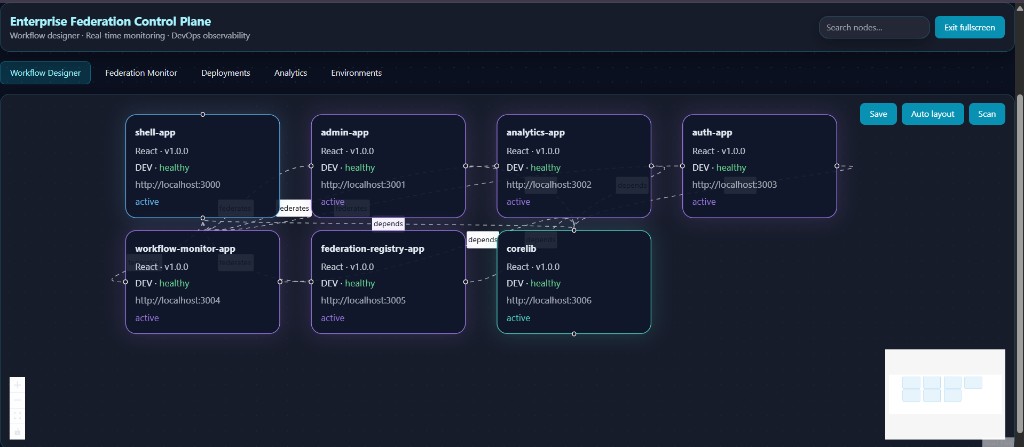
Workflow Designer tab at http://localhost:3004 (or via shell at /workflow-monitor-app) — federation topology with live node health, auto-layout, and save/scan controls.
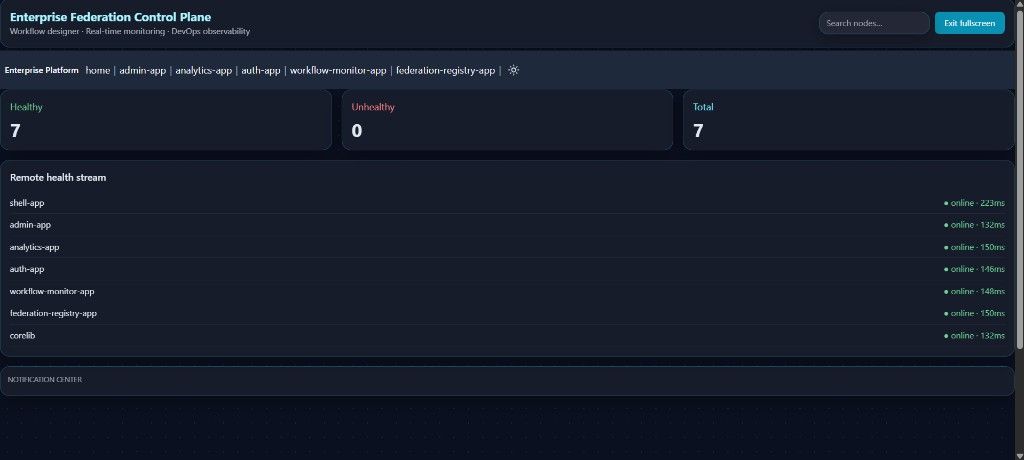
Federation Monitor tab — healthy/unhealthy summary cards and real-time remote health stream (Socket.IO from control-plane API on :4000).
npm run control-plane
npm run mss-mf -- generate workflow
npm run mss-mf -- generate monitor
npm run mss-mf -- scan federation
npm run mss-mf -- add remote analytics-app
npm run mss-mf -- generate env prod
Default ports (--control-plane):
| App | Port |
|-----|------|
| main (shell) | 3000 |
| admin-app | 3001 |
| analytics-app | 3002 |
| auth-app | 3003 |
| workflow-monitor-app | 3004 |
| federation-registry-app | 3005 |
| corelib | 3006 |
| Control-plane API | 4000 |
Enterprise Federation OS (--federation-os)
One flag scaffolds the complete control plane platform:
npx @multisystemsuite/create-mf-app my-federation-platform --federation-os -y| Layer | Generated |
|-------|-----------|
| 10 applications | Shell (main), admin, analytics, auth, workflow-designer, federation-monitor, federation-registry, federation-runtime, federation-governance, deployment-control-plane + corelib |
| 10 packages | @scope/mf-runtime, mf-monitor, mf-workflow, mf-registry, mf-devtools, mf-observability, mf-security, mf-governance, mf-ai-assistant, shared-ui |
| Services | services/control-plane-api — Express + Socket.IO + REST (registry, monitor, workflow, deployments, governance, AI) |
| Runtime | runtime/ — dynamic remote loading + auto-discovery |
| Monitoring | Prometheus + Grafana + OpenTelemetry configs |
| Infrastructure | docker-compose.federation-os.yml, Kubernetes manifests, CI pipeline |
| Architecture protection | .mss-protected.json + mss-mf protect / delete guards |
Federation OS CLI:
npm run control-plane              # API on :4000
npm run federation-os:infra        # MongoDB, Redis, Postgres, Prometheus, Grafana
npm run mss-mf -- federation scan  # Auto-discover federation configs
npm run mss-mf -- federation validate
npm run mss-mf -- runtime start
npm run mss-mf -- deploy prod
Default ports (--federation-os):
| App | Port |
|-----|------|
| main (shell) | 3000 |
| admin-app | 3001 |
| analytics-app | 3002 |
| auth-app | 3003 |
| workflow-designer-app | 3004 |
| federation-monitor-app | 3005 |
| federation-registry-app | 3006 |
| federation-runtime-app | 3007 |
| federation-governance-app | 3008 |
| deployment-control-plane-app | 3009 |
| corelib | 3010 |
| Control-plane API | 4000 |
See generated docs/FEDERATION_OS.md for full architecture.
Always included for federated parent workspaces (no flag needed):
| Module | Location |
|--------|----------|
| Design tokens | apps/corelib/src/tokens/ |
| Layouts | apps/corelib/src/layouts/ (Dashboard, Auth, Settings, Split, Fullscreen, Error) |
| RBAC | apps/corelib/src/permissions/ |
| Federation registry | apps/corelib/src/federation/ |
| Command palette | apps/corelib/src/command-palette/ (Ctrl+K) |
| Production hardening | apps/corelib/src/production/ (CSP, env validation, diagnostics) |
| React architecture | apps/corelib/src/architecture/ + docs/REACT_ARCHITECTURE.md |
| Security hardening | apps/corelib/src/security/ + docs/FRONTEND_SECURITY.md |
| Observability | apps/corelib/src/monitoring/, observability/ + docs/OBSERVABILITY.md |
| Accessibility | apps/corelib/src/accessibility/ + docs/ACCESSIBILITY.md |
| Release engineering | apps/corelib/src/release/ + docs/CICD_RELEASE_ENGINEERING.md |
| Scalability | apps/corelib/src/scalability/ + docs/ENTERPRISE_SCALABILITY.md |
| Failure recovery | apps/corelib/src/resilience/ + docs/FAILURE_RECOVERY.md |
| Folder structure | apps/corelib/src/structure/ + docs/ENTERPRISE_FOLDER_STRUCTURE.md |
| Architect capstone | apps/corelib/src/architect/ + docs/ARCHITECT_LEVEL_GUIDE.md |
| MF Platform CLI | tools/mf-cli/ |
| Project graph | tools/project-graph/ |
| Task runner + cache | task-runner/ + .mf/cache |
| Smart build | smart-build.js — dependency-order parallel builds |
| Developer experience | docs/DEVELOPER_EXPERIENCE.md, turbo.json, root tsconfig.json refs |
Enterprise architect pillars
Every federated parent workspace ships a full architect-level toolkit — docs, audit scripts, corelib modules, and runtime configs. Run the capstone audit first, then drill into individual pillars.
Capstone — start here
npm run architect-level:audit| Artifact | Purpose |
|----------|---------|
| docs/ARCHITECT_LEVEL_GUIDE.md | Synthesizes all pillars — act as Senior Frontend Architect, Performance Engineer, Platform Engineer, Enterprise UI Architect, Microfrontend Specialist, DevOps-aware Frontend Engineer |
| runtime-config/architect-roadmap.json | Phased roadmap: Foundation → Hardening → Scale → Platform → Optimize |
| apps/corelib/src/architect/ | Capstone checklist + domain definitions |
All enterprise pillar audits
| Pillar | Audit command | Documentation |
|--------|---------------|---------------|
| Architect capstone | npm run architect-level:audit | docs/ARCHITECT_LEVEL_GUIDE.md |
| Folder structure | npm run folder-structure:audit | docs/ENTERPRISE_FOLDER_STRUCTURE.md |
| React architecture | npm run react:architecture-audit | docs/REACT_ARCHITECTURE.md |
| Security hardening | npm run security:hardening-audit | docs/FRONTEND_SECURITY.md |
| Developer experience | npm run dx:audit | docs/DEVELOPER_EXPERIENCE.md |
| Observability | npm run observability:audit | docs/OBSERVABILITY.md |
| Accessibility (WCAG) | npm run a11y:audit | docs/ACCESSIBILITY.md |
| CI/CD + release | npm run cicd:audit | docs/CICD_RELEASE_ENGINEERING.md |
| Scalability | npm run scalability:audit | docs/ENTERPRISE_SCALABILITY.md |
| Failure recovery | npm run failure-recovery:audit | docs/FAILURE_RECOVERY.md |
| Platform health | npm run mf:doctor | docs/ENTERPRISE_ARCHITECTURE.md |
| Federation contracts | npm run federation:verify | apps/corelib/src/federation/ |
npm run mf:doctor prints reminders for every pillar audit after scaffold.
Pillar summaries
1. Security hardening
XSS prevention, CSP, secure token handling, refresh strategy (--auth), cookie flags, dependency audit, supply chain, federation remote trust, runtime script injection prevention.
- Corelib:
src/security/frontendSecurityAudit.ts,src/federation/remoteTrust.ts,src/auth/refreshTokenStrategy.ts - Config: hardened CSP in
src/production/csp.ts - Scripts:
npm run security:hardening-audit,npm run security:audit
2. Developer experience (DX)
Smart parallel builds, incremental cache, live reload (SSE), affected detection, project graph.
- Root:
smart-build.js(topo-sort + parallel waves),live-reload.js(port 35729),turbo.json - Scripts:
npm run local:fast,node smart-build.js localdev --skip-unchanged,npm run dx:audit - CLI:
mf cache invalidate,mf affected build
3. Observability (--monitoring for full stack)
Telemetry, distributed tracing, session replay, error tracking, user journey, performance budgets, RUM, OpenTelemetry.
- Corelib:
src/monitoring/*(frontendTelemetry, distributedTracing, sessionReplay, errorTracking, userJourney, performanceBudgets, rum, opentelemetry) - Config:
runtime-config/observability.config.json - Bootstrap:
bootstrapObservability()viawarmupCorelibShell()when--monitoring - Scripts:
npm run observability:audit
4. Accessibility (WCAG)
Focus management, live announcer, contrast checks, skip links, landmarks, eslint-plugin-jsx-a11y.
- Corelib:
src/accessibility/focusManagement.ts,liveAnnouncer.ts,contrastCheck.ts - Host: skip link,
#main-content,LiveAnnouncerRegion,:focus-visibleCSS - Scripts:
npm run a11y:audit
5. CI/CD + release engineering
Parallel CI builds, incremental deploy, federation rollout order, canary, rollback, feature-flag rollouts.
- Workflows:
mf-platform-ci.yml,mf-affected-deploy.yml,mf-canary-deploy.yml,mf-rollback.yml - Corelib:
src/release/(deploy strategy, federation rollout, rollback) - Scripts:
npm run cicd:audit,npm run release:plan,node scripts/release-deploy.js plan
6. Enterprise scalability
100k+ users, multi-tenant, CDN edge, runtime remote discovery, asset distribution, federation scaling, independent deployments.
- Corelib:
src/scalability/(multiTenant, cdnEdge, remoteDiscovery, assetDistribution, federationScaling) - Config:
runtime-config/scaling.config.json - Scripts:
npm run scalability:audit,npm run mf:graph
7. Production failure recovery
Remote fallbacks, offline strategy, retry, circuit breakers, graceful degradation, runtime remote failure handling.
- Corelib:
src/resilience/(circuitBreaker, retryPolicy, offlineStrategy, remoteFailureHandler, gracefulDegradation) - UI:
FederationFallback+RemoteRouteBoundary(emitsmf:remote-failureevents) - Config:
runtime-config/resilience.config.json - Federation expose:
corelib/resilience—loadRemoteWithResilience(),installRemoteFailureListener() - Scripts:
npm run failure-recovery:audit
8. Enterprise folder structure
Domain-driven frontend, feature modules, shared packages, federation boundaries, dependency isolation, plugin architecture.
- Corelib:
src/structure/(domainMap, boundaryRules, featureModules, dependencyIsolation, pluginArchitecture) - Config:
runtime-config/structure.config.json— bounded context → remote map - Governance:
governance/module-boundaries.json,mf.jsontags - Scripts:
npm run folder-structure:audit
9. React architecture
State colocation, context splitting, server vs client state, feature-based layout, atomic design, smart/dumb components, Suspense/error boundaries, concurrent rendering.
- Corelib:
src/architecture/reactArchitectureAudit.ts - Scripts:
npm run react:architecture-audit
10. Architect-level guide (capstone)
Enterprise-grade architecture, production optimization, scalability, security, maintainability, developer productivity, deployment strategy, observability strategy, future scalability roadmap.
- Roles: Senior Frontend Architect, Performance Engineer, Platform Engineer, Enterprise UI Architect, Microfrontend Specialist, DevOps-aware Frontend Engineer
- Roadmap:
runtime-config/architect-roadmap.json— 5 phases with milestones - Scripts:
npm run architect-level:audit
Runtime configs (generated)
runtime-config/
├── remote-manifest.json      # Remote entry URLs + versions
├── tenant-config.js          # Multi-tenant SaaS
├── observability.config.json # Telemetry, RUM, OTel settings
├── scaling.config.json       # 100k+ user targets, CDN, federation scaling
├── resilience.config.json    # Retry, circuit breaker, offline policy
├── structure.config.json     # Domain → remote bounded context map
├── architect-roadmap.json    # Foundation → Optimize phase tracker
├── deployment.config.json    # Rollout strategy (release engineering)
└── feature-flags.js          # Runtime feature toggles
Pre-production checklist
npm run architect-level:audit    # capstone — verifies all pillar docs/scripts
npm run mf:doctor                # workspace health + pillar reminders
npm run federation:verify        # remoteEntry health
npm run folder-structure:audit   # DDD layout + import boundaries
npm run security:hardening-audit # CSP, remote trust, auth
npm run failure-recovery:audit   # circuit breakers + fallbacks
npm run cicd:audit               # CI/CD + canary + rollback workflows
npm run build                    # production build all apps
Generated monorepo structure
my-platform/
├── infrastructure/                  # Auto-generated nginx, apache, docker, k8s, ssl
│   ├── nginx/nginx.conf
│   ├── apache/httpd.conf
│   ├── compose/docker-compose.yml
│   ├── kubernetes/ingress.yaml
│   └── scripts/generate-routing.js
├── mf.json                          # Workspace project registry, tags, and federation config
├── apps/
│   ├── main/                        # Host shell (port 3000)
│   ├── billing/                     # Child remote (your --children names)
│   ├── orders/
│   └── corelib/                     # Shared federated library (--shared name)
├── packages/
│   ├── shared-ui/
│   ├── shared-auth/
│   ├── shared-utils/
│   ├── shared-config/
│   ├── shared-hooks/
│   ├── shared-services/
│   ├── shared-security/
│   ├── sdk-core/
│   ├── api-client/
│   ├── query-client/
│   ├── websocket-sdk/
│   └── auth-sdk/                    # with --auth
├── tools/
│   ├── mf-cli/                      # mf CLI (generate, graph, affected, …)
│   └── project-graph/
├── task-runner/
├── plugins/
├── devtools/
├── runtime-config/
│   ├── remote-manifest.json
│   ├── observability.config.json
│   ├── scaling.config.json
│   ├── resilience.config.json
│   ├── structure.config.json
│   └── architect-roadmap.json
├── templates/
├── ai/
├── governance/
├── k8s/helm/mf-platform/
├── docs/
│   ├── ENTERPRISE_ARCHITECTURE.md
│   ├── ARCHITECT_LEVEL_GUIDE.md       # capstone architect guide
│   ├── ENTERPRISE_FOLDER_STRUCTURE.md
│   ├── REACT_ARCHITECTURE.md
│   ├── FRONTEND_SECURITY.md
│   ├── DEVELOPER_EXPERIENCE.md
│   ├── OBSERVABILITY.md
│   ├── ACCESSIBILITY.md
│   ├── CICD_RELEASE_ENGINEERING.md
│   ├── ENTERPRISE_SCALABILITY.md
│   ├── FAILURE_RECOVERY.md
│   └── PLATFORM_ARCHITECTURE.md
├── scripts/
│   ├── architect-level-audit.js
│   ├── folder-structure-audit.js
│   ├── react-architecture-audit.js
│   ├── security-hardening-audit.js
│   ├── dx-audit.js
│   ├── observability-audit.js
│   ├── a11y-audit.js
│   ├── cicd-audit.js
│   ├── scalability-audit.js
│   ├── failure-recovery-audit.js
│   └── release-deploy.js
├── .github/workflows/
│   ├── mf-platform-ci.yml
│   ├── mf-affected-deploy.yml
│   ├── mf-canary-deploy.yml
│   └── mf-rollback.yml
├── docker-compose.yml
├── .env, .env.dev, .env.staging, .env.uat, .env.prod
├── live-reload.js
├── smart-build.js
└── package.json                     # npm run local, npm run billing, …
Infrastructure & deployment (parent workspaces)
Every parent + federation workspace auto-generates infrastructure/ with:
| Path | Contents |
|------|----------|
| infrastructure/nginx/ | nginx.conf, federation routing, upstreams, WebSocket, per-env server blocks |
| infrastructure/apache/ | httpd.conf, federation vhosts, WebSocket proxy |
| infrastructure/docker/ | Gateway Dockerfile + per-app production Dockerfiles |
| infrastructure/compose/ | docker-compose.yml + DEV/QA/UAT/PROD overlays |
| infrastructure/kubernetes/ | deployment.yaml, ingress.yaml, services, HPA |
| infrastructure/ssl/ | Self-signed + Certbot scripts, env cert folders |
| infrastructure/scripts/ | Auto-routing, remote detection, deploy scripts |
Deployment modes:
# Container — nginx gateway + all MFE containers
npm run infra:gateway
npm run infra:deploy:dev
npm run infra:deploy:qa
npm run infra:deploy:uat
npm run infra:deploy:prod

# Normal server — Vite apps + bare-metal nginx upstreams
npm run dev
npm run infra:health
# use infrastructure/nginx/conf.d/upstreams-bare.conf

# Auto-detect remotes → routing manifest
npm run infra:detect
npm run infra:routing
Features: federation-aware reverse proxy, dynamic remote routing (/remotes/<name>/), SSL-ready configs, load balancing, health checks, WebSocket for control plane, runtime env injection per environment.
MF Platform CLI (inside generated projects)
After scaffolding, use the mf CLI inside your monorepo:
npm run mf -- <command>
# or
node tools/mf-cli/bin/mf.js <command>
Generators
| Command | Description |
|---------|-------------|
| mf generate app <name> | New MFE remote (create-app, create-mfe) |
| mf generate lib <name> | Shared library package (create-lib) |
| mf generate plugin <name> | Platform plugin (create-plugin) |
| mf generate page <name> [app] | Route page (create-page) |
| mf generate layout <name> | Layout component (create-layout) |
| mf generate feature <name> | Feature module (create-feature) |
| mf generate component <name> | UI component in shared-ui |
| mf generate dashboard <name> | Dashboard module (create-dashboard) |
| mf generate workflow <name> | Workflow module (create-workflow) |
| mf generate api-sdk <name> | API SDK package (create-api-sdk) |
| mf generate table <name> | AppTable scaffold (create-table) |
| mf generate form <name> | Form engine scaffold (create-form) |
| mf generate auth <name> | Auth provider scaffold (create-auth) |
| mf generate theme <name> | Theme preset (create-theme) |
Orchestration
| Command | Description |
|---------|-------------|
| mf graph | Export dependency graph to tools/project-graph/graph-ui/graph.json |
| mf graph --federation | Federation-only graph |
| mf affected build | Git-aware incremental build |
| mf affected test | Run tests only on affected projects |
| mf affected lint | Lint only affected projects |
| mf affected <target> --base=main | Custom git base branch |
| mf run <project> [target] | Run target on one project |
| mf build | Build all projects (parallel) |
| mf test | Test all projects |
| mf lint | Lint all projects |
| mf serve | Delegates to npm run local |
| mf release [patch\|minor\|major] | Release workflow |
Federation & health
| Command | Description |
|---------|-------------|
| mf federation doctor | Check host/remotes/shared lib wiring |
| mf federation graph | Export federation dependency graph |
| mf federation sync | Sync remote manifests from mf.json |
| mf doctor | Workspace health (circular deps, boundaries, mf.json, architecture protection, pillar audit reminders) |
| npm run federation:verify | HEAD-check remoteEntry URLs (MF_REMOTES env) |
Architecture protection (mss-mf)
Enterprise parent workspaces include .mss-protected.json — a guardrail config that prevents accidental deletion or modification of federation OS core infrastructure.
| Tier | Examples | CLI behavior |
|------|----------|--------------|
| Hard protected | runtime/, tools/mf-cli/, governance/, federation packages | Cannot delete |
| Soft protected | apps/main, apps/corelib, plugins/ | Requires --force |
| Non-critical apps | Child remotes under apps/* | Requires --force |
| Command | Description |
|---------|-------------|
| mss-mf delete <path> | Delete path (blocked if protected) |
| mss-mf delete runtime | ❌ Cannot delete protected folder: runtime |
| mss-mf delete apps/billing --force | Remove non-critical child remote |
| mss-mf protect validate | Workspace structure + staged-change validation |
| mss-mf protect snapshot | Capture recovery snapshot in .mss/snapshots/ |
| mss-mf protect recover | Restore missing paths from latest snapshot |
| mss-mf protect list | List hard/soft protected paths and readonly packages |
| mss-mf protect status | Quick integrity summary |
Git hooks (when .mss-protected.json exists):
- pre-commit — blocks staged deletion/modification of protected paths
- pre-push — structure validation + dependency integrity
Emergency architect override: MSS_PROTECT_OVERRIDE=1 mss-mf delete <path> --architect-override
npm script shortcuts (generated)
"mf": "node tools/mf-cli/bin/mf.js",
"mf:graph": "node tools/mf-cli/bin/mf.js graph",
"mf:affected": "node tools/mf-cli/bin/mf.js affected build",
"mf:doctor": "node tools/mf-cli/bin/mf.js doctor",
"mf:federation": "node tools/mf-cli/bin/mf.js federation doctor",
"mss-mf": "node tools/mf-cli/bin/mf.js",
"mf:protect": "node tools/mf-cli/bin/mf.js protect validate",
"mf:protect:snapshot": "node tools/mf-cli/bin/mf.js protect snapshot",
"mf:protect:recover": "node tools/mf-cli/bin/mf.js protect recover"
Using corelib (shared library)
corelib (or your --shared name) is a Module Federation remote that exposes shared UI, config, and RBAC. Child remotes and the host import it at runtime.
Host (apps/main) — single HostShell expose
The host uses a CSS-only boot shell (~137 KB gzip) and loads the MUI/RBAC shell from corelib in one federation request via corelib/HostShell:
const HostShell = React.lazy(() => import("corelib/HostShell"));

export default function App() {
  return (
    <React.Suspense fallback={<ShellSkeleton />}>
      <HostShell navLinks={<HostNavLinks />} onItemPrefetch={prefetchRemotePath}>
        <AppRouter />
      </HostShell>
    </React.Suspense>
  );
}
main.tsx bootstraps runtime remotes (manifest prefetch) before render:
await bootstrapRuntimeRemotes();
warmupCorelibShell();
Child remote — RemoteAppShell (skips duplicate providers)
When embedded in the host, RoleProvider is not mounted twice. Standalone dev still wraps with RoleProvider:
import RemoteAppShell from "corelib/RemoteAppShell";

export default function App() {
  return (
    <RemoteAppShell>
      <AppRouter />
    </RemoteAppShell>
  );
}
Available federation exports (corelib)
| Export | Purpose |
|--------|---------|
| ./App | Standalone corelib demo app |
| ./HostShell | Host shell bundle — AppConfig, RoleProvider, Navbar, Sidebar, CommandPalette |
| ./RemoteAppShell | Embedded remote wrapper — skips RoleProvider when host is active |
| ./AppConfigProvider | Theme + MUI provider + CSS variables |
| ./useAppConfig | Combined hook (backward compatible) |
| ./AppNavbar, ./AppSidebar, ./ThemeToggle | Shell UI (also inside HostShell) |
| ./EnterpriseSidebarNav | Role-filtered sidebar menu + route prefetch hook |
| ./RouteGuard, ./RoleProvider, ./usePermission | RBAC |
| ./CommandPalette | Ctrl+K palette (returns null when closed) |
| ./DashboardLayout | Dashboard shell layout |
| ./PermissionProvider, ./FederationFallback | Permissions + error UI |
| ./resilience | Circuit breakers, retry, offline, loadRemoteWithResilience(), installRemoteFailureListener() |
| ./ProfilerGate | Dev-only React Profiler wrapper |
| ./designTokens | Token registry |
TypeScript — add declarations in host/child
Generated projects include src/types/federation-remotes.d.ts for remote module names. After adding new exposes, extend that file:
declare module "corelib/MyNewComponent" {
  const Component: React.ComponentType;
  export default Component;
}
Enterprise design system & theming
apps/corelib/src/
├── tokens/                 # colors, spacing, typography, shadows, …
├── config/
│   ├── AppConfigProvider.tsx
│   ├── themeGenerator.ts   # MUI theme from tokens
│   ├── resolveTheme.ts     # contrast-safe shell colors
│   ├── colorUtils.ts       # WCAG contrast helpers
│   └── defaultConfig.ts    # enterprise-light / enterprise-dark presets
├── layouts/
├── permissions/
├── shared-ui/
└── …
Runtime theme in your components
Split config hooks reduce re-renders (prefer these over the combined hook in hot paths):
import {
  useAppConfigPick,
  useAppConfigActions,
  useAppTheme,
  useAppConfig, // backward compatible
} from "corelib/useAppConfig";

function MyWidget() {
  const { tenantId } = useAppConfigPick("tenantId");
  const { toggleColorMode } = useAppConfigActions();
  const { palette } = useAppTheme();
  return (
    <div style={{ color: palette.textPrimary, background: palette.surface }}>
      Tenant: {tenantId}
    </div>
  );
}
Config architecture: AppConfigProvider uses three contexts — State (config object), Actions (stable mutations), Theme (resolved palette). Sidebar/nav components use CSS variables (--ds-*) where possible.
Features:
- Enterprise-light / enterprise-dark presets + Azure, Atlassian, Linear-dark, etc.
- Light/dark toggle with full palette sync (background + text together)
- Contrast-safe navbar/sidebar text (no dark-on-dark)
- CSS variables (
--ds-*) applied todocument.documentElement - Responsive collapsible sidebar (flex layout, no overlap)
- MUI component overrides from design tokens
Clear cached theme (after upgrades or bad colors):
localStorage.removeItem('mf-enterprise-config')Then hard-refresh the browser.
Module Federation
Architecture (tiered host / shared / remotes)
┌──────────────────────────────────────────────────────────────┐
│  apps/main (host) :3000  — CSS shell ~137 KB gzip             │
│  ├── eager shared: react, react-dom only                      │
│  ├── lazy shared: react-router-dom, @tanstack/react-query     │
│  ├── corelib/HostShell (single federation expose)             │
│  └── feature remotes on /admin-app/*, /analytics-app/*, …     │
└──────────────────────────────────────────────────────────────┘
         │
         ▼
┌──────────────────┐     ┌─────────────────────────────────────┐
│  apps/corelib    │     │  apps/<child> (feature remotes)      │
│  MUI, RBAC, DS   │◀────│  RemoteAppShell when embedded        │
│  :3006           │     │  standard / control-plane share tiers│
└──────────────────┘     └─────────────────────────────────────┘
Shared policy lives in packages/shared-config/src/federationShared.ts:
| Tier | Packages | Host | corelib / remotes |
|------|----------|------|-------------------|
| 0 | react, react-dom | eager singleton | singleton |
| 1 | react-router-dom, @tanstack/react-query | lazy shared | shared |
| 2 | MUI, Emotion | not on host | corelib + remotes |
| 3 | zustand, @xyflow/react, … | per-app only | control-plane remotes |
Production: strictVersion: true is enabled automatically for prod, staging, and uat builds (or set VITE_MF_STRICT_SHARED=1).
Ports & remote URLs: Vite server.port / preview.port and federation remotes resolve from root .env via packages/shared-config/src/federationRemotes.ts — VITE_<APP>_PORT and VITE_<APP>_REMOTE_ENTRY. See Ports per app module (by level) for the full level-by-level map and set-port usage. Local default:
http://localhost:<port>/assets/remoteEntry.jsAfter changing federation config:
npm run build:local    # rebuild ALL apps
npm run local          # restart
Use hoisted install (generated .npmrc: install-strategy=hoisted).
Performance & federation architecture
Enterprise parent workspaces (and the reference my-platform/ in this repo) include the optimizations below. Generated scaffolds follow the same patterns via apps/vite.config.base.ts, federationShared.ts, and corelib shell modules.
Bundle size & Vite
| Feature | Location | Purpose |
|---------|----------|---------|
| Shared Vite base | apps/vite.config.base.ts | mfSafeManualChunks, resolve.dedupe, gzip/brotli in prod |
| Host thin shell | apps/main | No MUI/Emotion on host boot path |
| Lazy DataGrid | corelib/AppDataGrid | @mui/x-data-grid dynamic import |
| Route prefetch | main/src/routes/remoteLoaders.ts | Hover/focus prefetch before navigation |
| RemoteSkeleton | main/src/components/RemoteSkeleton.tsx | Non-blocking loading UI |
Run bundle analysis:
npm run analyze:bundle
# or per app: cd apps/main && npm run analyze
Runtime remote loading
| Feature | Location | Purpose |
|---------|----------|---------|
| Runtime manifest | runtime-config/remote-manifest.json | CDN/prod remote entry map |
| Bootstrap | main/src/module-federation/bootstrapRemotes.ts | Fetch manifest, preconnect, prefetch remoteEntry |
| Dev manifest server | apps/main/vite.config.ts | Serves /runtime-config/* in local dev |
| Idle warm-up | warmupCorelibShell() in main.tsx | Idle-import corelib/HostShell |
| Error boundaries | main/src/components/RemoteRouteBoundary.tsx | Per-remote fallback + retry |
| nginx caching | infrastructure/nginx/conf.d/federation.conf | Short cache on remoteEntry, manifest at /runtime-config/ |
Env override for manifest URL:
VITE_REMOTE_MANIFEST_URL=/runtime-config/remote-manifest.jsonRe-render performance (corelib)
- Split contexts:
useAppConfigState,useAppConfigActions,useAppTheme,useAppConfigPick - Memo shell:
EnterpriseSidebarNav,AppTable,AppDataGrid, host nav links - Command palette: no render when closed
- Control plane dashboard: tab-isolated data (health WebSocket only in Monitor tab)
- Dev profiling:
ProfilerGatewraps host navbar, sidebar, and router regions
Host / remote communication
| Channel | Mechanism |
|---------|-----------|
| Navigation | Host owns BrowserRouter; remotes use nested <Routes> |
| Server state | Singleton @my-platform/query-client at host |
| Theme / RBAC | corelib contexts via HostShell (single provider tree) |
| Cross-MFE events | Extend with event bus / shared query keys as needed |
Reference platform
The my-platform/ directory in this repository is a fully wired reference implementation with all of the above. See my-platform/README.md for app ports, scripts, and platform-specific notes.
SDK packages
| Package | Purpose |
|---------|---------|
| @<project>/sdk-core | Trace IDs, error normalization |
| @<project>/api-client | Axios wrapper, interceptors, API versioning |
| @<project>/auth-sdk | Token refresh helpers (--auth) |
| @<project>/query-client | Query key utilities |
| @<project>/websocket-sdk | Reconnecting WebSocket |
Import from workspace packages in apps via file:../../packages/<name> dependencies.
Task runner & build cache
task-runner/
├── orchestrator.js      # Parallel execution, dependency-aware runs
├── cache-engine.js      # Hash-based local cache
├── executors/           # build, test, lint
└── pipelines/ # default: build → test → lint- Cache directory:
.mf/cache/(gitignored) - Cache key: hash of project + target + inputs
- CI: cache
.mf/cachein pipeline for faster rebuilds
Plugins & devtools
Plugins (plugins/*-plugin/): register generators, executors, hooks (preBuild, postBuild, appCreated).
Devtools (devtools/):
- Federation inspector — inspect loaded remotes in browser
- Performance profiler — Web Vitals + route transition timing
- MFE debugger —
window.__MF_DEBUG__remote load tracing - Theme inspector — CSS variable viewer
- Dependency viewer — CLI dependency tree
Runtime configuration
runtime-config/
├── remote-manifest.json      # Remote entry URLs + versions (host bootstrap)
├── tenant-config.js          # Multi-tenant SaaS configs
├── observability.config.json # Telemetry, RUM, OTel settings
├── scaling.config.json       # Scalability targets, CDN, multi-tenant
├── resilience.config.json    # Retry, circuit breaker, offline policy
├── structure.config.json     # Domain → remote bounded context map
├── architect-roadmap.json    # Foundation → Optimize phase tracker
├── deployment.config.json    # Rollout strategy (release engineering)
├── manifest-loader.js        # CDN remote manifest fetch
├── feature-flags.js          # Runtime feature toggles
└── branding.js               # Dynamic logo/colors injection
The host loads remote-manifest.json at startup (bootstrapRuntimeRemotes) to preconnect and prefetch remoteEntry.js files. In production, nginx serves /runtime-config/ with short cache headers (max-age=30, stale-while-revalidate).
Per-remote env overrides (build time):
VITE_CORELIB_REMOTE_ENTRY=http://localhost:3006/assets/remoteEntry.js
VITE_ADMIN_APP_REMOTE_ENTRY=http://localhost:3001/assets/remoteEntry.js
# … see packages/shared-config/src/federationRemotes.ts
Template marketplace
Enterprise blueprints in templates/:
| Template | Domain |
|----------|--------|
| lims-template | Laboratory Information Management |
| hms-template | Healthcare Management |
| erp-template | Enterprise Resource Planning |
| analytics-template | Analytics dashboards |
| admin-template | Admin portal |
| saas-template | Multi-tenant SaaS |
| workflow-template | Workflow automation |
CI/CD & governance
GitHub Actions:
.github/workflows/mf-platform-ci.yml— doctor, affected lint/test/build, security audit, pillar audits.github/workflows/mf-affected-deploy.yml— affected deploy on main.github/workflows/mf-canary-deploy.yml— canary promotion with health checks.github/workflows/mf-rollback.yml— federation rollback workflow
Also generated:
.gitlab-ci.ymlk8s/helm/mf-platform/— Helm chart for host + remotesgovernance/module-boundaries.json— import boundary rulesgovernance/CODEOWNERS— team ownershipgovernance/dependency-rules.json— license governance
Deploy strategy:
mf affected buildon merge- Upload
apps/*/distto CDN - Host loads remote manifests at runtime
- Helm/Kubernetes for containerized host + ingress
Code quality
Generated parent workspaces include:
| Script | Purpose |
|--------|---------|
| npm run lint / lint:fix | ESLint across apps + packages |
| npm run format / format:check | Prettier |
| npm run stylelint | CSS / SCSS |
| npm run type-check | TypeScript every workspace app |
| npm run test / test:watch / test:ci | Vitest + coverage |
| npm run cleanup | lint:fix → imports → type-check |
| npm run analyze:bundle | Rollup visualizer per app |
| npm run security:audit | npm audit |
| npm run security:hardening-audit | Frontend security pillar audit |
| npm run architect-level:audit | Capstone — verifies all enterprise pillar docs/scripts |
| npm run folder-structure:audit | DDD layout, federation boundaries, dependency isolation |
| npm run react:architecture-audit | React architecture pillars |
| npm run dx:audit | Developer experience maturity |
| npm run observability:audit | Telemetry, RUM, tracing, error tracking |
| npm run a11y:audit | WCAG accessibility checklist |
| npm run cicd:audit | CI/CD + release engineering |
| npm run scalability:audit | 100k+ users, CDN, multi-tenant |
| npm run failure-recovery:audit | Circuit breakers, retry, fallbacks |
| npm run production:hygiene | Fail on console/debugger in sources |
Husky: lint-staged + type-check + tests on pre-commit; lint + tests on pre-push. Commitlint for Conventional Commits.
Root workspace scripts
Full platform
| Script | Purpose |
|--------|---------|
| local | Main dev command — build:local + watch + preview + live-reload (all apps) |
| local:fast | Smart build (skip unchanged) + watch + preview + live-reload |
| build:local | node smart-build.js localdev — parallel dependency-order build |
| dev | print-env + parallel Vite dev servers |
| dev:watch | Same as local |
| dev:fast | dev build once + preview + live-reload |
| dev:safe | production build + preview only |
| build | Production build (runs cleanup first) |
| build:local | localdev mode build for all apps |
| build:dev / build:staging / build:uat | Environment-specific builds |
| watch:<app> | Vite watch for one app |
| preview:<app> | Vite preview for one app |
| release / release:minor / release:major | Version bump + build |
| federation:verify | Remote entry health check |
| architect-level:audit | Capstone enterprise platform audit |
| folder-structure:audit | Domain-driven folder structure audit |
| react:architecture-audit | React architecture audit |
| security:hardening-audit | Frontend security hardening audit |
| dx:audit | Developer experience audit |
| observability:audit | Observability stack audit |
| a11y:audit | Accessibility (WCAG) audit |
| cicd:audit | CI/CD + release engineering audit |
| scalability:audit | Enterprise scalability audit |
| failure-recovery:audit | Production failure recovery audit |
| release:plan | Deployment rollout plan |
| mf, mf:graph, mf:affected, mf:doctor, mss-mf, mf:protect | Platform CLI + architecture protection |
| infra:gateway, infra:deploy:{dev,qa,uat,prod}, infra:detect, infra:routing, infra:health | Auto-generated reverse proxy + deployment (parent workspaces) |
| control-plane, federation-os:infra | Control-plane API + Federation OS observability stack |
Per-module dev (dynamic — one script per --children name)
| Script | Apps included |
|--------|----------------|
| npm run billing | main + corelib + billing |
| npm run orders | main + corelib + orders |
| npm run <child> | main + corelib + <child> |
| npm run corelib | main + corelib |
Supporting scripts (auto-generated):
build:local:<child>-only— build subset for that scenariowatch:local:<child>-only— watch subsetwatch:local:<app>/preview:local:<app>— per-app watch/preview in localdev mode
Docker & deployment
- Dockerfile per app (Node 22 Alpine, healthcheck)
- docker-compose.yml — all apps on mapped ports
.npmrc—install-strategy=hoistedfor federation shared deps
Per-app environment:
VITE_PORT=3001
VITE_APP_NAME=billing
VITE_REMOTE_ENTRY=http://localhost:3001/assets/remoteEntry.js
Root .env lists all app ports and remote URLs (.env.dev, .env.staging, .env.uat, .env.prod variants).
docker compose up --buildFor container-to-container federation, replace localhost remote URLs with Docker service hostnames.
Documentation in generated projects
| File | Contents |
|------|----------|
| README.md | Ports, quick start, Docker, quality scripts |
| docs/ARCHITECT_LEVEL_GUIDE.md | Capstone — all architect roles, 9 deliverables, master audit suite, roadmap |
| docs/ENTERPRISE_ARCHITECTURE.md | Design system, RBAC, federation, SDK, deployment, all pillar links |
| docs/ENTERPRISE_FOLDER_STRUCTURE.md | DDD, feature modules, packages, federation boundaries, plugins |
| docs/REACT_ARCHITECTURE.md | State, context, Suspense, error boundaries, feature layout |
| docs/FRONTEND_SECURITY.md | XSS, CSP, remote trust, auth, supply chain |
| docs/DEVELOPER_EXPERIENCE.md | Smart build, live reload, affected builds, caching |
| docs/OBSERVABILITY.md | Telemetry, tracing, RUM, session replay, OTel |
| docs/ACCESSIBILITY.md | WCAG, keyboard, ARIA, focus management |
| docs/CICD_RELEASE_ENGINEERING.md | Parallel CI, canary, rollback, federation rollout |
| docs/ENTERPRISE_SCALABILITY.md | Multi-tenant, CDN, remote discovery, 100k+ users |
| docs/FAILURE_RECOVERY.md | Circuit breakers, retry, offline, graceful degradation |
| docs/RUNTIME_PERFORMANCE.md | Runtime profiler (--monitoring) |
| docs/PLATFORM_ARCHITECTURE.md | MF CLI, graph, cache, plugins, CI/CD |
| docs/ARCHITECTURE_PROTECTION.md | Protected structure, .mss-protected.json |
| docs/CONTROL_PLANE.md | Workflow designer, monitor, registry (with --control-plane) |
| docs/FEDERATION_OS.md | Full Federation OS architecture (with --federation-os) |
| mf.json | Project registry, tags, federation config |
| templates/README.md | Template marketplace usage |
| ai/README.md | AI layer integration guide |
Node version
Generated projects use Vite 7. Requires:
>=20.19.0or>=22.12.0(recommended: Node 22)
Node 18 will fail on Vite 7 commands.
Troubleshooting
| Issue | Fix |
|-------|-----|
| Duplicate port(s) in … .env | Give each app a unique VITE_<APP>_PORT; remote URLs must match (http://localhost:<port>/assets/remoteEntry.js) |
| Port N is already assigned (add-child) | Pick another port with --port= or let CLI auto-assign the next free port |
| `"local" cannot be used as a