
@muthuishere/vsync
v0.9.0
Published
Encrypted secret-sync CLI for small teams. AES-256-GCM vault on any S3-compatible bucket + OS keychain key + one-passphrase .share onboarding + fanout to GitHub Actions, GCP Secret Manager, AWS Secrets Manager, Azure Key Vault, HashiCorp Vault KV v2 + app
Maintainers
Readme
vsync
One encrypted vault for your environment secrets, shared across your team, mirrored to GitHub / GCP / AWS / Azure / HashiCorp Vault, audited every time someone touches it.
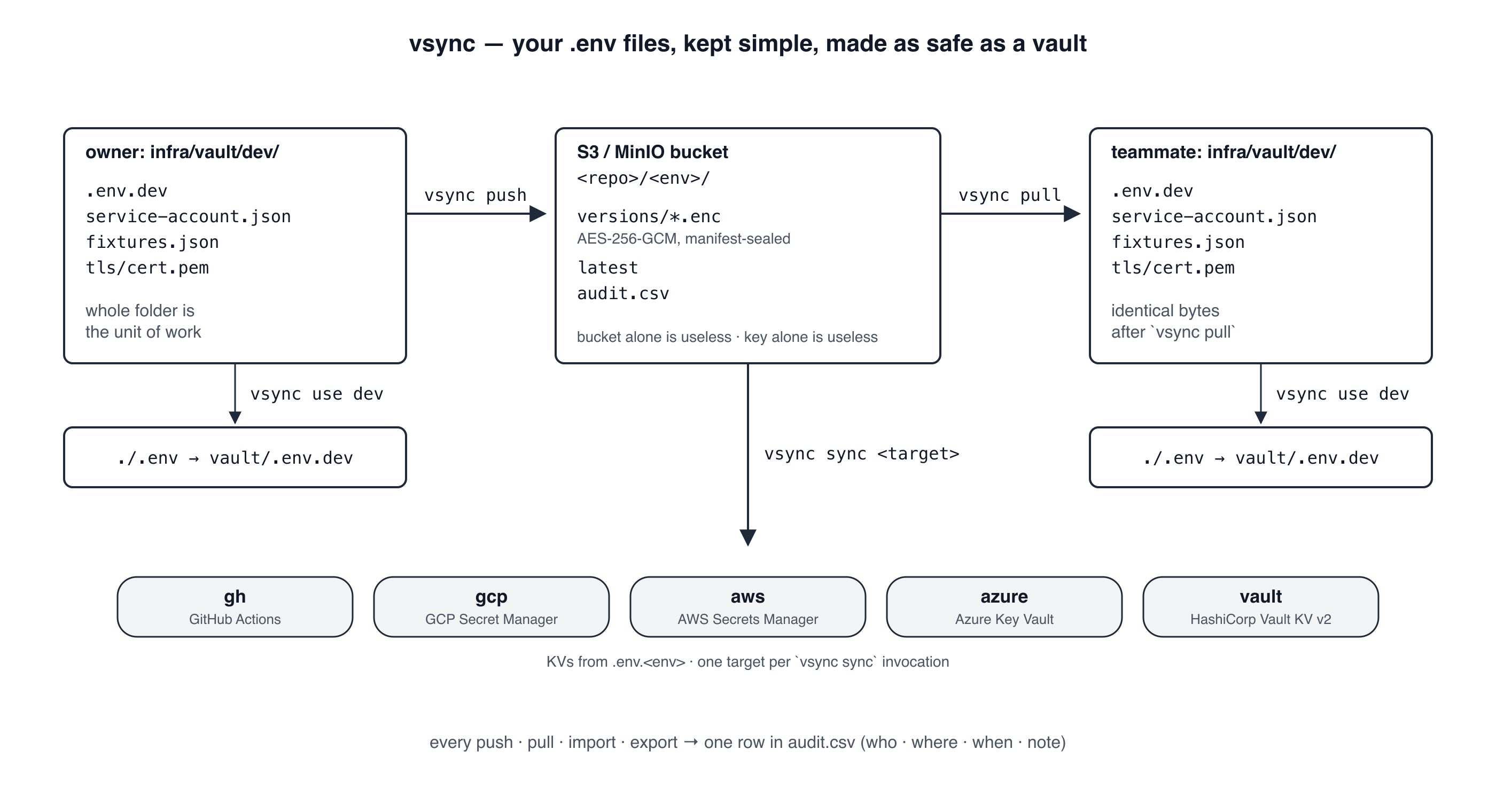
A .env file is the friendliest thing in your repo: one line per secret, edited by hand, loaded by every framework. It's also the worst thing in your repo — passed around on Slack, copy-pasted into the wrong window, never the same on any two laptops, never encrypted, never versioned, never auditable. The moment one teammate's secrets drift from another's, you stop trusting .env and start emailing JSON files.
vsync keeps the .env you already write, and turns it into a real vault:
- One folder per environment. Anything secret —
.env.dev,gcp-sa.json, TLS certs, regression fixtures, signing keys — lives underinfra/vault/<env>/. No naming convention to learn; whatever is in there gets sealed. - Encrypted bucket as the canonical store.
vsync push <env>zips the folder, seals it with AES-256-GCM + manifest-anti-rollback, uploads to any S3-compatible bucket: AWS S3, Hetzner Object Storage, self-hosted MinIO, Cloudflare R2, Backblaze B2. The bucket holds the only blessed copy. - One-passphrase onboarding. New teammate runs
vsync import dev <file>.share, types the passphrase you sent on a separate channel, runsvsync pull dev. Done. No shell-rc edits, no env-var blobs, no key sharing in Slack DMs. - Fanout to where prod actually runs.
vsync sync dev <target>pushes the same.env.<env>keys to GitHub Actions secrets, GCP Secret Manager, AWS Secrets Manager, Azure Key Vault, or HashiCorp Vault KV v2. One edit in the vault; every place that needs the secret stays in step. - Append-only audit log. Every push/pull/import/export records
who, where, when, version, free-form noteto a CSV on the bucket.vsync audit devprints it. CI passes--note="run #1234"and it shows up. - Per-machine key in the OS keychain.
Bun.secrets— macOS Keychain, Linux libsecret, Windows Credential Manager. The S3 bucket alone is useless; the key alone is useless. Both halves required to decrypt.
bun install -g @muthuishere/vsync # or: npm install -g @muthuishere/vsync
vsync --helpOne global install, then vsync is on PATH. No shell-rc edits, no giant base64 blob in ~/.zshrc. (Allergic to global installs? bunx @muthuishere/vsync <subcommand> works too — same code path, slower invocation.)
What lives in the vault
Whatever your app needs at runtime that you'd otherwise scatter across Slack DMs, a password manager, or ~/Downloads/:
infra/vault/
dev/
.env.dev # KV secrets — vsync sync ships these to gh/gcp/aws/azure/vault
gcp-sa.json # JSON service account key
regression-fixture.json # test data that mirrors prod shape
tls/cert.pem
tls/key.pem
production/
.env.production
gcp-sa.jsonvsync doesn't care what's in there — it zips and seals the whole folder. The .env.<env> file is special only in that vsync sync reads it for KV fanout to GitHub / GCP / AWS / Azure / Vault. Everything else (JSON keys, certs, regression fixtures, anything binary) just rides along in the encrypted bundle and lands back on every teammate's disk after pull.
So regression tests, scripts, or any tool that needs real-shape inputs read directly from infra/vault/<env>/whatever.json — no separate test-data dance.
For monorepos, override per-(repo, env): vsync init dev --vault-folder=apps/foo/infra/vault/dev. The path is stored in the per-repo config and carried in the .share file so teammates inherit it automatically.
Switching environments — vsync use
So apps don't need to know vault paths, vsync use <env> creates a symlink that points the conventional .env location at the vault's env file:
vsync use dev # ./.env → infra/vault/dev/.env.dev
vsync use production # repoint to infra/vault/production/.env.production
vsync use # print current targetAny framework reading .env (Vite, Next.js, Bun, dotenv, every Python lib) just works — no path argument, no custom loader. Switch environments with one command; restart your dev server and you're running against the new env.
Pick a different link name or location with --link=<path> — useful when you already have a .env, want the conventional .env.<env> name, or work in a monorepo:
vsync use dev --link=.env.dev # ./.env.dev → infra/vault/dev/.env.dev
vsync use prod --link=apps/web/.env # apps/web/.env → … (monorepo)Safety: if the link path already exists as a regular file, vsync refuses to touch it — no --force, by design. Move or delete it first (mv .env .env.local.bak) and re-run. An existing symlink at that path is replaced silently (symlinks are cheap to recreate). vsync also warns if the link's basename isn't covered by .gitignore.
Platform support: POSIX symlinks on macOS / Linux / WSL out of the box. On Windows it uses the same call with type: "file" — requires Developer Mode (Settings → Privacy & security → For developers) or an elevated terminal. vsync prints actionable guidance if the privilege is missing.
Mental model
Every (repo, env) is held by two persistent halves. Both required to push or pull; either one alone is useless.
┌──────────────────────────────────────────────────────────────────┐
│ Disk (chmod 0600) │
│ ~/.config/vsync/<repo>/env_<env> self-contained config │
│ ├── s3.{endpoint, region, bucket, …} where to find bytes │
│ ├── encryption.salt PBKDF2 input │
│ ├── files.vaultFolder optional override │
│ └── sync.{gh, gcp, aws, azure, vault} set by `vsync sync` │
└──────────────────────────────────────────────────────────────────┘
┌──────────────────────────────────────────────────────────────────┐
│ OS keychain (Bun.secrets) │
│ service: tools.vsync │
│ account: <repo>/<env> │
│ value: <base64 32-byte AES-256 key> │
└──────────────────────────────────────────────────────────────────┘The disk file gets you bucket access — no decrypt. The keychain key gets you decrypt — no bucket location. Stealing one is a non-event; you need both to read a single secret. Offboarding cuts the bucket side (the cloud provider's IAM), then vsync init mints a fresh key for the team that stays.
A .share file bundles both halves under one passphrase. Sent on a different channel than the passphrase itself, it's the smallest possible onboarding step.
Install
bun install -g @muthuishere/vsync # or: npm install -g @muthuishere/vsync
vsync --helpRequires Bun ≥ 1.2.21 on PATH (for Bun.secrets) — the shebang is #!/usr/bin/env bun, so bun must be installed even if you used npm install -g for the package itself. Most users have Bun anyway; if not, see bun.sh.
Don't want to install? bunx @muthuishere/vsync <subcommand> runs the same code from npm cache each time — fine for trying it out, slower for daily use.
For local development of vsync itself:
git clone [email protected]:muthuishere/vsync.git
cd vsync
bun install
bun testQuickstart — owner (first time on a project)
# 1. Generate the per-(repo, env) key + config. First-ever invocation prompts
# for S3 creds; subsequent inits pre-fill from ~/.config/vsync/defaults.
vsync init dev
# 2. Put your secrets under infra/vault/dev/ and push.
echo "DATABASE_URL=postgres://..." > infra/vault/dev/.env.dev
vsync push dev
# 3. Hand the team a share file + passphrase (different channels).
vsync export devFor an onboarding cheat sheet to drop into your repo (so teammates and AI agents know vsync exists), run vsync docs > infra/AGENTS.md. Plain stdout — pipe it wherever you want.
Quickstart — teammate (joining the project)
cd <cloned-repo>
# 1. Import the share file your teammate sent (carries S3 creds + key).
# No prior `init` required on this machine.
vsync import dev ./myapp-dev.share
# Passphrase: <paste>
# 2. Pull the encrypted bundle.
vsync pull devAfter step 2, infra/vault/dev/ is populated and the encryption key is in your keychain.
Daily flow
# I edited infra/vault/dev/.env.dev locally:
vsync push dev
# Get the latest from S3:
vsync pull dev
# See what versions exist on S3:
vsync versions dev
# Push secrets out — one target per invocation:
vsync sync dev gh # GitHub Actions repo secrets
vsync sync dev gcp # GCP Secret Manager
vsync sync dev aws # AWS Secrets Manager
vsync sync dev azure # Azure Key Vault
vsync sync dev vault # HashiCorp Vault KV v2One target per vsync sync invocation — if you need more than one, run more than one command. pull makes a local backup at ~/.config/vsync/backups/<env>-<ts>.zip.enc before overwriting (two-deep rolling buffer). See "Recovering a local backup" below if you ever need one.
Subcommand reference
All commands accept --repo=<name> (override auto-detected repo name) and --interactive (force prompts even when every flag is provided). Auto-detected repo precedence: $SECRETS_SYNC_REPO → package.json::name (scope-stripped) → git toplevel basename → cwd basename.
Every command works fully via flags or fully via prompts.
| Cmd | Purpose |
|---|---|
| init <env> | Generate AES key (→ keychain), write self-contained per-repo config, create the resolved vault folder, relocate an existing root .env.<env> if found (with a prompt). First-ever run on a machine also writes ~/.config/vsync/defaults from the supplied values; subsequent runs pre-fill from defaults. Flags: --bucket --endpoint --region --access-key --secret-key --use-ssl --vault-folder=<path> --migrate-from=<path> --no-migrate --audit=on\|off. |
| export <env> | Write a passphrase-encrypted .share file containing the full per-repo config + key. Flags: --out=<path> (default ./<repo>-<env>.share), --passphrase=<p> (default: auto-generated readable passphrase), --no-audit, --note=<text>, --meta key=value (repeatable). |
| import <env> <file> | Decrypt a .share file with its passphrase; write the per-repo config + save key to keychain. Idempotent — re-importing overwrites. Flags: --passphrase=<p>, --file=<path> (alt to positional), --no-audit, --note=<text>, --meta key=value (repeatable). |
| use <env> | Symlink the chosen path → <vaultFolder>/.env.<env> so plain dotenv.config() works without a path arg. Default link path is ./.env; override with --link=<path> (e.g. --link=.env.dev or --link=apps/web/.env). vsync use with no env prints the current target. Refuses to touch an existing regular file at the link path — no --force, by design. Replaces an existing symlink silently. Warns if the link's basename isn't .gitignored. POSIX symlinks everywhere; Windows requires Developer Mode or an elevated terminal. |
| push <env> | Zip the resolved vault folder → manifest-seal → AES-256-GCM encrypt → upload to s3://<bucket>/<repo>/<env>/versions/<ts>.enc, then update s3://<bucket>/<repo>/<env>/latest. Flags: --no-audit, --note=<text>, --meta key=value (repeatable). |
| pull <env> | Read latest pointer → download version → verify embedded manifest timestamp matches pointer (anti-rollback) → decrypt → unzip into the resolved vault folder. Auto-backs up existing contents first. Flags: --no-audit, --note=<text>, --meta key=value (repeatable). |
| versions <env> | List s3://<bucket>/<repo>/<env>/versions/. One line per version with size + age, * latest marker on the active one. Read-only; no decrypt. |
| sync <env> <gh\|gcp\|aws\|azure\|vault> | Read <vaultFolder>/.env.<env> → push each KV to the named target. One target per invocation — if you need more than one, run more than one command. gh / gcp / aws / azure run in a 6-worker pool (10-min timeout); vault writes the whole map in a single atomic vault kv put (KV v2 is path-atomic). First run for a given target prompts for routing config and saves it; subsequent runs zero-prompt. Parser has no defaults — pass --inline-file-suffix=<suf> and --exclude-property=<key> (both repeatable) to control file inlining and excluded keys; see "Typical vsync sync invocation" below. Flags: --inline-file-suffix=<suf>, --exclude-property=<key>, --gh-repo=<owner/name>, --gcp-project=<id>, --aws-region=<region>, --aws-secret-prefix=<prefix>, --azure-vault=<vault-name>, --vault-addr=<url>, --vault-mount=<mount>, --vault-path=<path>. |
| audit <env> | Print the S3-side audit log: who/where/when of every pull/push/import/export. Flags: --limit=N, --all, --csv. |
| docs | Print a short onboarding reference (commands, vault layout, backup recovery procedure) to stdout. Pipe wherever you want — e.g. vsync docs > infra/AGENTS.md. |
sync env-file parsing
As of v0.7 the parser has zero implicit policy — no hardcoded suffixes, no hardcoded exclude list, no defaults applied by the CLI. Every rule is named at the call site.
File references — opt in with --inline-file-suffix=<suf> (repeatable). Any key in .env.<env> whose name ends in a configured suffix is read from disk; vsync pushes the file's contents under the key with the suffix stripped. Pass --inline-file-suffix=_PATH --inline-file-suffix=_FILE for the v0.6 shape:
SSH_PRIVATE_KEY_PATH=keys/dev_ssh→ pushes<vault>/keys/dev_sshasSSH_PRIVATE_KEY.GCP_SA_KEY_FILE=keys/sa.json→ pushes<vault>/keys/sa.jsonasGCP_SA_KEY.
Relative paths anchor to VAULT_ROOT (the directory of the env file being parsed). Placeholders ${VAULT_ROOT}, ${HOME}, and leading ~/ are expanded in every value. Any missing or unreadable referenced file aborts the whole sync before any push (all-or-none).
Excluded keys — opt in with --exclude-property=<key> (repeatable). Any key in this list is dropped from the run and never pushed. Typical candidates are tokens that exist locally for gh / gcloud to use directly:
GITHUB_TOKENGOOGLE_APPLICATION_CREDENTIALS
If you pass no --exclude-property flag at all, nothing is skipped — every KV gets pushed. Same for --inline-file-suffix: with no flag, no file inlining happens.
Every vsync sync run prints the active parser policy header before the first push, so you can see exactly which rules were in effect. Full convention in docs/guide/sync.md and design context in docs/specs/v0.7-explicit-sync-parser.md.
Typical vsync sync invocation
The parser has no defaults. Pass the rules you want, every time. The shape that matches v0.6 behavior is:
vsync sync dev gh \
--inline-file-suffix=_PATH \
--inline-file-suffix=_FILE \
--exclude-property=GITHUB_TOKEN \
--exclude-property=GOOGLE_APPLICATION_CREDENTIALSDrop this into your Taskfile / Makefile / CI so the call site shows the whole policy at a glance.
Migrating from v0.6? Bare vsync sync dev gh no longer skips GITHUB_TOKEN / GOOGLE_APPLICATION_CREDENTIALS and no longer inlines *_PATH / *_FILE. Append the four flags above to every invocation to preserve the old behavior. The in-env routing keys GITHUB_REPO / GCP_PROJECT_ID are also no longer recognized — move them into config via --gh-repo / --gcp-project (persisted) and delete the lines from .env.<env>. See docs/specs/v0.7-explicit-sync-parser.md §5 for full migration steps.
Audit log
Every pull, push, import, and export appends a row to s3://<bucket>/<repo>/<env>/audit.csv so the team can see who did what, from where, and when. Columns:
ts, action, version_ts, hostname, local_ip, os_user, git_email, vsync_version, bun_version, meta
On by default. Skip a single invocation with --no-audit. Disable per (repo, env) with vsync init <env> --audit=off (or pick "off" at the first-time prompt).
Tag any row with free-form context via --note=<text> (sugar for --meta note=<text>) or --meta key=value (repeatable). The matching env vars VSYNC_AUDIT_NOTE and VSYNC_AUDIT_META (a JSON object) merge in for CI ergonomics. Example one-liner:
VSYNC_AUDIT_META='{"run_id":"7891234","commit":"abc123"}' \
vsync pull production --note="prod deploy" --meta ticket=BUG-42View the log with vsync audit <env> (--limit=N, --all, --csv).
Two honesty bullets:
- This is a transparency aid, not tamper-proof. Anyone with bucket write can rewrite the CSV; vsync just makes honest activity legible.
- The log does not let you reclaim already-pulled secrets. Once a teammate has pulled, they hold a local copy — rotate the key to invalidate future pulls.
How sync works (gh + gcp + aws + azure + vault)
Auth is outside vsync's scope — the lib trusts whatever gh, gcloud, aws, az, and vault are doing on your machine.
vsync sync <env> gh:
- Resolves
sync.gh.repofrom per-repo config (or--gh-repoflag, or first-run prompt). - Parses
<vaultFolder>/.env.<env>into push-ready KVs (using the--inline-file-suffix/--exclude-propertyflags you passed — see below). - For each KV in a 6-worker pool:
gh secret set <KEY> --env <env> --repo <sync.gh.repo>with the value on stdin. - Requires
ghCLI installed andgh auth loginalready done.
vsync sync <env> gcp:
- Resolves
sync.gcp.projectsimilarly. - Same parse step.
- For each KV:
gcloud secrets describe <KEY> --project=<proj>to check existence; eithergcloud secrets versions add <KEY>(exists) orgcloud secrets create <KEY> --replication-policy=automatic(new). Value on stdin via--data-file=-. - Requires
gcloudCLI installed andgcloud auth logindone. Per-env isolation comes from per-env GCP projects (dev project ≠ prod project) — secret names are flat within a project.
vsync sync <env> aws:
- Resolves
sync.aws.region(required) andsync.aws.secretPrefix(optional) from per-repo config (or--aws-region/--aws-secret-prefixflags, or first-run prompt). - Same parse step.
- For each KV in a 6-worker pool:
aws secretsmanager describe-secret --secret-id <prefix><KEY> --region <region>; eitherput-secret-value(exists) orcreate-secret(new). Value via stdin (--secret-string fileb:///dev/stdin). - Requires
awsCLI installed and credentials available —aws configure,aws sso login, orAWS_*env vars.
vsync sync <env> azure:
- Resolves
sync.azure.vaultNamefrom per-repo config (or--azure-vaultflag, or first-run prompt). Pass the vault name, not the URL. - Same parse step.
- For each KV in a 6-worker pool:
az keyvault secret set --vault-name <vault> --name <KEY> --file /dev/stdin— idempotent (creates or versions in one call). - Requires
azCLI installed andaz logindone. Naming constraint: Azure Key Vault only allows0-9 A-Z a-z -. Underscores fail at push time; vsync does not silently translate_→-(no-magic theme). Rename keys,--exclude-propertythem, or maintain an Azure-shaped env file.
vsync sync <env> vault:
- Resolves
sync.vault.addr,sync.vault.mount, andsync.vault.secretPath(all required) from per-repo config (or--vault-addr/--vault-mount/--vault-pathflags, or first-run prompt). - Same parse step.
- Single bulk write — the 6-worker pool is bypassed. All KVs land in one atomic call:
VAULT_ADDR=<addr> vault kv put -mount=<mount> <secretPath> KEY1=value1 KEY2=value2 …. KV v2 is path-atomic — either the whole map lands or none of it does. - Requires
vaultCLI installed andvault loginalready done (token in~/.vault-token). KV v2 only; KV v1 / Transit / PKI / namespaces are out of scope.
One target per invocation as of v0.7.1 — if you need more than one, run more than one command. For gh / gcp / aws / azure, per-secret push failures within a single run don't abort siblings; the final summary lists what failed. vault is all-or-nothing per invocation (atomic). Parse-time failures (see "all-or-none" below) abort the whole run before any push for every target.
Every run also prints the active parser policy header before the first push, so the operator can see which suffixes and exclusions were in effect for this invocation.
File-reference convention (.env.<env>) — explicit opt-in
Vsync reads each line of .env.<env> and pushes a KV to the chosen target (gh / gcp / aws / azure / vault). When you pass --inline-file-suffix=<suffix>, keys ending in that suffix are treated as file paths — vsync reads the file and pushes its bytes under the stripped name.
With --inline-file-suffix=_PATH --inline-file-suffix=_FILE in effect:
| In env file | Pushed as | Notes |
|---|---|---|
| FOO_PATH=keys/foo | FOO = file contents | suffix _PATH stripped; file resolved vault-relative |
| FOO_FILE=keys/foo | FOO = file contents | suffix _FILE stripped; same resolution |
| SSH_PRIVATE_KEY_PATH=keys/dev | SSH_PRIVATE_KEY = file contents | name the env-file key after the secret you want |
With no --inline-file-suffix flag, no inlining happens — FOO_PATH=keys/foo is pushed as the literal string keys/foo.
With --exclude-property=GITHUB_TOKEN --exclude-property=GOOGLE_APPLICATION_CREDENTIALS in effect, those keys are dropped from the run. With no --exclude-property flag, nothing is skipped.
Path resolution. Relative paths anchor to VAULT_ROOT (the directory of the env file being parsed). Three forms of placeholder expansion are recognised in every value — file-ref or plain:
| Form | Means |
|---|---|
| ${VAULT_ROOT}/keys/foo | <vault>/keys/foo (explicit) |
| keys/foo or ./keys/foo | <vault>/keys/foo (implicit — no placeholder needed) |
| ~/.ssh/id_rsa or ${HOME}/.ssh/id_rsa | $HOME/.ssh/id_rsa |
| /abs/path | absolute, pass-through |
All-or-none on file refs. If any configured file-ref references a missing or unreadable file, vsync collects every such error and aborts before pushing anything. No partial syncs.
The canonical short-form reference lives in the header comment of src/envfile.ts; design context is in docs/specs/v0.7-explicit-sync-parser.md.
Security model
| Threat | Defence |
|---|---|
| Attacker reads disk config only | Gets bucket creds + routing. Cannot decrypt any S3 bundle. |
| Attacker reads keychain only | Gets the AES key. No bucket location. No reach. |
| Attacker reads both | Compromises the (repo, env). Rotate immediately. |
| Attacker intercepts the .share file | Cannot decrypt without the passphrase. Mitigation: send file + passphrase on different channels. |
| Attacker tampers with an S3 object | Pull-time manifest-pointer check (embeddedTs === remoteTs) rejects renamed-old-bundles. AES-GCM auth tag rejects byte-level tampering. |
| Local user on shared machine | chmod 0600 on the file + 0700 on the dir = POSIX denies other users. macOS Keychain ACLs deny other login sessions. |
Crypto: AES-256-GCM with a per-encryption 12-byte random IV. Envelope magic RQE1. PBKDF2-SHA256 (600k iters) over (keychain-key, per-repo salt) for the S3 envelope, and over (user passphrase, share-file salt) for the share-file wrapper. Manifest pointer-seal magic RQEM0001. Share file outer frame magic SLS1.
Offboarding: there's no per-user revoke. When someone leaves: revoke their bucket access at the cloud provider (separate axis), then rotate the encryption key by re-init-ing the (repo, env) and re-export-ing for surviving teammates. Per-user audit and a built-in rotate-key are explicitly out of scope.
Inspecting / removing the keychain entry is done with your OS tools — Keychain Access.app on macOS, secret-tool / seahorse on Linux, Credential Manager on Windows. vsync doesn't ship verbs to wrap those.
Recovering a local backup
Before each pull, vsync writes the existing vault folder to ~/.config/vsync/backups/<env>-<ts>.zip.enc (two-deep rolling buffer). The format is AES-256-GCM with the same per-(repo, env) keychain key + salt. To decrypt one by hand:
- Get the key — on macOS:
security find-generic-password -s tools.vsync -a <repo>/<env> -w. On Linux:secret-tool lookup service tools.vsync account <repo>/<env>. - Get the salt:
gunzip -c ~/.config/vsync/<repo>/env_<env> | jq -r .encryption.salt. - The envelope is
RQE1(4-byte magic) + 12-byte IV + AES-GCM ciphertext. Derive:AES-GCM key = PBKDF2-SHA256(keychain-key, salt, 600k).
In practice, just don't lose the keychain entry. pull itself is the recovery path 99% of the time.
Troubleshooting
"no config file for <repo>/<env>" — the per-repo file isn't on disk. Run vsync init <env> to create one, or vsync import <env> <share-file> if a teammate sent you one.
"encryption key for <repo>/<env> not found in keychain" — the file exists but the keychain entry is gone. Re-run import (carries both halves), or re-init if you don't have a .share (generates a fresh key, so any prior S3 bundle becomes inaccessible to you — re-push from local).
"failed to decrypt share file — passphrase wrong or file corrupt" — double-check the passphrase. If still failing, ask the sender to re-export.
"pointer claims X but bundle was sealed as Y" during pull — defensive anti-rollback check failed. Someone with bucket-write access pointed latest at a renamed older bundle, but the embedded manifest timestamp doesn't match. Refuse + report to ops.
gh / gcloud not found on PATH — install and authenticate them locally. vsync shells out; it doesn't manage external CLI auth.
Versioning
| Release | What's in it |
|---|---|
| 0.8.0 | Three new vsync sync targets: aws (AWS Secrets Manager), azure (Azure Key Vault), vault (HashiCorp Vault KV v2). Dispatcher rewritten around a TargetHandler registry — gh / gcp move into the registry unchanged, three new handlers land alongside. Purely additive — every 0.7.x invocation works byte-for-byte in 0.8.0. New flags per target: --aws-region, --aws-secret-prefix, --azure-vault, --vault-addr, --vault-mount, --vault-path. gh / gcp / aws / azure share the 6-worker pool; vault writes the whole map in one atomic vault kv put. Wire format / audit log / parser policy unchanged. See docs/specs/v0.8-multi-target-sync.md. |
| 0.7.1 | vsync sync <env> all removed. Only gh and gcp remained as 0.7 targets; one target per invocation. (Now joined by aws, azure, vault in 0.8 — still one target per invocation.) |
| 0.7.0 | vsync sync parser has zero implicit policy. New repeatable flags --inline-file-suffix=<suf> and --exclude-property=<key> replace the old hardcoded _PATH / _FILE suffixes and the implicit GITHUB_TOKEN / GOOGLE_APPLICATION_CREDENTIALS skip-list — name every rule at the call site. In-env routing keys GITHUB_REPO / GCP_PROJECT_ID are no longer recognized (routing lives in config only). Every run prints the active policy header before pushing. Two intentional breaks vs. 0.6.x — see docs/specs/v0.7-explicit-sync-parser.md §5. |
| 0.6.0 | .env.<env> file-reference convention: any key ending in _PATH / _FILE is read from disk and the file's contents are pushed under the stripped name. Paths anchor to VAULT_ROOT; ${VAULT_ROOT} / ${HOME} / ~/ placeholders work in every value. All-or-none on missing files. (Superseded in 0.7 — suffixes are no longer hardcoded; pass --inline-file-suffix explicitly.) |
| 0.5.0 | vsync use <env> — symlinks ./.env (or --link=<path>) at the vault's env file so dotenv.config() just works; switch envs with one command. README rewrite + flow diagram. |
| 0.4.0 | Append-only audit log at s3://<bucket>/<repo>/<env>/audit.csv + vsync audit viewer. Expandable meta JSON cell via --note / --meta + matching env vars. |
| 0.3.0 | Opinionated layout: vault folder at infra/vault/<env>/ with --vault-folder override; self-contained per-(repo, env) config; vsync sync for GitHub / GCP fanout. |
All 0.x releases are wire-compatible with each other on the S3 bundle envelope (RQE1) and manifest seal (RQEM0001). New clients tolerate the absence of features added in later versions; old clients ignore new objects (like audit.csv) on the bucket.
License
MIT.
