
@ngo-a/native-memory-citations
v2026.6.16
Published
Cited, access-bounded local-memory retrieval for OpenClaw: access boundary, redaction, citations, and opt-in enhanced memory sidecars.

Maintainers
 ngo-aad
Readme
Native Memory Citations



Native Memory Citations is an OpenClaw plugin for controlled, cited retrieval from local workspace memory files. ("Native" denotes an OpenClaw-native plugin, not native system memory.)
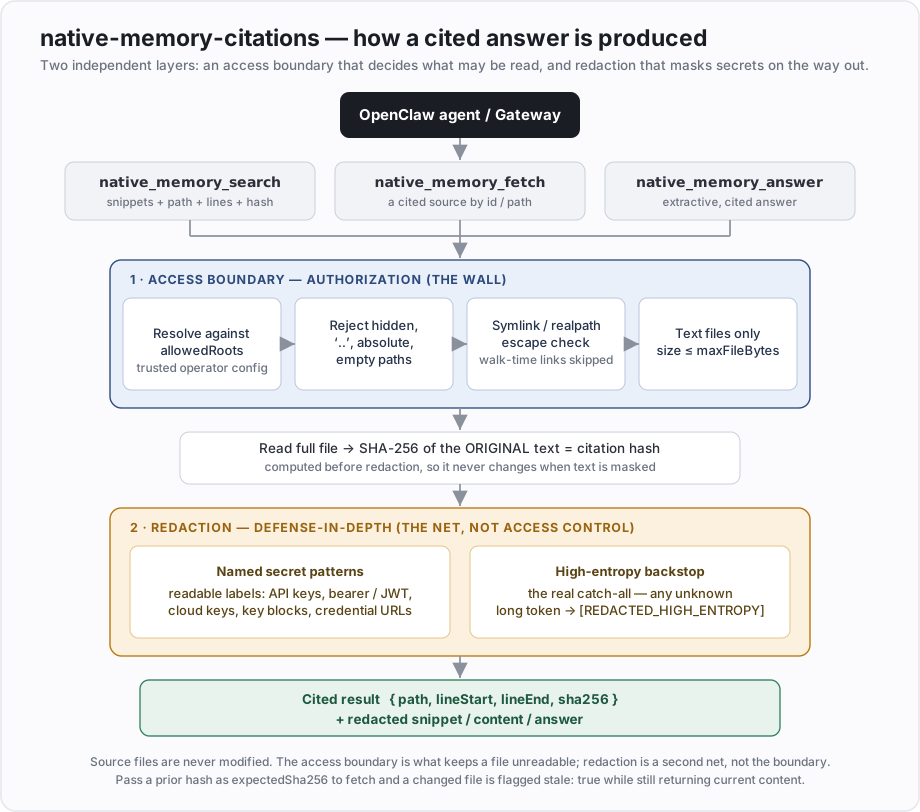
The plugin is built for environments where memory access must be explicit, bounded, and auditable. An operator defines which workspace files or directories may be searched. The plugin enforces that access boundary before reading any content, redacts secret-shaped material from what it returns, and attaches citation metadata so every answer can be traced back to its source. The objective is not broad memory access; it is operator-controlled retrieval with an audit trail.
Operating modes
The plugin runs in one of two modes, selected by the mode configuration key.
bounded(default). The behavior described throughout this README: read-only retrieval, keyword/substring search, extractive cited answers, no network calls, no model calls, and no changes to host configuration. This is what a default install does, and what every guarantee in this document refers to.enhanced(opt-in, experimental). Bounded mode is the stable production core; enhanced mode layers additional agentic-memory capabilities on top of it, reusing the same access boundary, redaction, and citation guarantees. This release adds a functional zero-LLM knowledge-graph sidecar plus experimental lifecycle scaffolding (snapshot injection, observation tagging, dreaming integration); richer semantic and reranked recall and a memory-wiki bridge are forthcoming. Every enhanced capability is disabled by default even in enhanced mode and is turned on explicitly, per feature.
Leaving configuration at its defaults keeps the plugin in bounded mode; an upgrade changes nothing until you opt in. Enhanced-mode capabilities are introduced incrementally beginning with the 2026.6.9 release - see Enhanced mode.
Key capabilities
- Operator-defined search scope, limited to workspace-relative roots.
- Optional shared mode that excludes private memory from the default set.
- Per-file size limits, with oversized files skipped rather than read.
- Redaction of secret-shaped content in all returned text (search, fetch, and answers).
- Citations on every result, with full-file SHA-256 hashes for staleness detection.
- Per-request output limits on fetched content.
- Read-only by default: bounded mode never creates, modifies, or deletes any file, and
in every mode the plugin never modifies your source memory files (
MEMORY.md, daily notes,DREAMS.md). Enhanced mode, when explicitly enabled, writes only its own size-bounded derived sidecars (e.g.memory/graph.jsonl,memory/observations.jsonl), which are excluded from retrieval and citation - so generated content never feeds back into what the plugin returns.
Install
From npm (recommended):
openclaw plugins install @ngo-a/native-memory-citationsFrom a local checkout (development):
openclaw plugins install ./native-memory-citationsReload the Gateway after installing so the plugin host exposes the tools.
Requirements
- Node.js 22.19.0 or newer.
- OpenClaw 2026.6.8 or newer (declared as a peer dependency).
- A local OpenClaw workspace containing text memory files.
Supported memory file types are .md, .txt, .json, .jsonl, .yaml, and
.yml. Files with other extensions are not scanned.
Getting started
Bounded mode (default) — no configuration needed
Bounded mode is the default and works read-only out of the box.
- Install the plugin and reload the Gateway so the plugin host registers its tools.
- Start a new agent session. A session that was already running keeps the tool list it started with and will not see newly registered tools until it restarts — if a tool seems missing right after install, this is almost always why.
- Confirm the three bounded tools are available:
native_memory_search,native_memory_fetch,native_memory_answer.
That is the entire setup for cited, read-only retrieval. Optionally narrow what the
plugin may read with allowedRoots (see Configuration).
Enabling enhanced features — step by step
Enhanced features are opt-in and gated individually. Settings live under
plugins.entries.native-memory-citations.config. Turning on enhanced mode exposes the
extra tools but does not activate any pillar by itself:
{
  "plugins": {
    "entries": {
      "native-memory-citations": {
        "config": {
          "mode": "enhanced", // exposes the enhanced tools; each pillar still gated below
          "graph": { "enabled": true } // turn on the one pillar you want
        }
      }
    }
  }
}
A visible tool is not an active one. With mode: "enhanced", native_memory_graph
and native_memory_extract appear in the tool list immediately, but they return no data
until the pillar is both enabled and built. Enable each feature deliberately:
- Knowledge graph — set
graph.enabled: true, reload, then runnative_memory_extractonce. It buildsmemory/graph.jsonlfrom your authorized memory files (only files insideallowedRoots). After that,native_memory_graphreturns edges. Beforenative_memory_extracthas run, an empty result fromnative_memory_graphis expected, not a failure. - Snapshot injection — set
injection.enabled: trueand grant the host hook gateplugins.entries.native-memory-citations.hooks.allowPromptInjection: true(note:hooks, a sibling ofconfig). Injection dispatches only on the embedded runner; under theclaude-clior Codex runners the hook does not fire, so injection is inactive there. The tools still work — only the hook-driven behavior is skipped. - Observation logging — currently deferred.
observations.enableddoes not write anything today; it emits a one-time notice and reserves the feature for the future structured-extraction release. Setting it has no effect for now. - Dreaming-dependent features — if OpenClaw
memory-coredreaming is off, the plugin does not change your host config. It detects the state and tells you to enable it yourself: setplugins.entries.memory-core.config.dreaming.enabled: trueif you want those features active.
See Configuration (enhanced keys) for the full key reference and defaults.
Two things to expect
- Reload after every change. Tools and config bind when a session — or the Gateway — starts. Enabling the plugin, switching modes, or editing config has no effect on a session that is already running. Reload the Gateway and start a fresh session for changes to take effect.
- Runner matters for hooks, not tools. All five tools register on any runner
(embedded,
claude-cli, Codex). The hook-driven features (snapshot injection, and the deferred observation logging) dispatch only on the embedded runner; onclaude-clior Codex the tools work normally but those hooks stay inactive, by design.
Intended use
Native Memory Citations is intended for OpenClaw deployments where an agent needs access to selected memory files without broad filesystem visibility. It suits single-user, team, and shared environments in which private memory, project notes, identity files, and tool references must be handled within clear boundaries.
Tools
native_memory_search- search the approved roots and return snippets with source paths, line numbers, and file SHA-256 hashes.native_memory_fetch- fetch a cited source bysourceIdor a safe path, optionally checking an expected citation hash.native_memory_answer- build an extractive answer from cited snippets, and state plainly when no cited memory is found.
Default scope
By default the plugin searches:
memory/MEMORY.mdUSER.mdIDENTITY.mdTOOLS.md
Set sharedMode: true to exclude the private MEMORY.md from this default set.
Setting allowedRoots explicitly overrides the default set entirely and takes
precedence over sharedMode.
Custom allowedRoots entries must be workspace-relative, visible paths. Empty
entries, ., .., paths containing .., absolute paths, and hidden segments such
as memory/.dreams are rejected.
Configuration
Plugin configuration is supplied in the plugin's entry within the OpenClaw Gateway configuration. It governs which files the plugin is permitted to read and cite. The bounded-mode plugin reads existing memory files only; it does not create, modify, or delete them. Enhanced mode can write only its own derived sidecars when explicitly enabled. All keys are optional.
| Key | Type | Default | Description |
|-----|------|---------|-------------|
| workspace | string | $OPENCLAW_WORKSPACE, then ~/.openclaw/workspace | Absolute path against which roots are resolved. |
| allowedRoots | string[] | Built-in default set (see Default scope) | Workspace-relative files or directories to search. When set to a non-empty array, it replaces the default set in full. |
| sharedMode | boolean | false | When true, excludes the private MEMORY.md from the default set. Has no effect when allowedRoots is set. |
| maxFileBytes | number | 1048576 (1 MiB) | Per-file size limit. Files exceeding this limit are skipped rather than reported as errors. |
Default search scope
The default roots are listed in Default scope above: memory/, MEMORY.md,
USER.md, IDENTITY.md, and TOOLS.md. With sharedMode: true, MEMORY.md is
excluded.
Defining custom roots
Set allowedRoots to the exact set of workspace-relative files or directories that
should be searchable. This value replaces the default set in full and takes
precedence over sharedMode. Any default entries that should remain searchable must
be listed explicitly.
Each entry must be a workspace-relative, visible path. An entry is rejected, with an
Invalid allowedRoots entry error, if it is empty, ., .., an absolute path,
contains a .. segment, or contains a hidden segment (a segment beginning with .,
for example memory/.dreams). These restrictions are part of the access boundary
and are enforced intentionally.
Examples
Shared or team deployment, retaining the defaults while excluding the private journal:
{ "sharedMode": true }Restricting the plugin to a specific, minimal set:
{ "allowedRoots": ["memory", "USER.md"] }Adding custom directories. Because allowedRoots replaces the default set, any
defaults that should remain searchable are listed again:
{ "allowedRoots": ["memory", "USER.md", "IDENTITY.md", "TOOLS.md", "notes", "decisions"] }Permitting larger files (4 MiB) and specifying a non-default workspace:
{ "workspace": "/srv/openclaw/workspace", "maxFileBytes": 4194304 }Operational notes
allowedRootsreplaces the default set; it does not extend it. A value of["notes"]makesMEMORY.md,USER.md, and the remaining defaults unreachable. List every path that should remain searchable.sharedModehas no effect onceallowedRootsis set; the explicit list takes precedence.- Files exceeding
maxFileBytesare skipped and logged rather than reported as errors. Set the limit to accommodate the largest memory files in use. - Hidden directories,
..segments, and absolute paths cannot be included. This is enforced by the access boundary.
Settings not exposed through configuration
Redaction is implemented in code and is not configurable through plugin
configuration; the schema rejects unrecognized keys. The named secret patterns and
the high-entropy backstop are defined in src/core.ts. Modifying redaction behavior
requires editing that file and re-running the test suite (npm test) to confirm
that the redaction invariants continue to hold. It is not a configuration setting in
this version.
Per-request limit
native_memory_fetch accepts a maxChars argument (default 8000, constrained to
the range 256 to 20000) that bounds the amount of cited content returned by a single
fetch. This is a per-call tool argument and is independent of plugin configuration.
Citation integrity
Search hits include a sha256, computed from the full text of the file used for
line splitting and citation line numbers. Fetch results include the current sha256
for the same full-file content.
To detect stale citations, pass the hash from a prior search hit:
{
 "sourceId": "memory/2026-06-17.md",
 "lineStart": 12,
 "lineEnd": 14,
 "expectedSha256": "..."
}
If the file has changed, fetch still returns the current content for inspection but
marks the result with stale: true and a staleMessage explaining the hash
mismatch. Because hashes cover the full file, appending to a daily journal marks
earlier citations stale even when the cited lines themselves are unchanged.
Enhanced mode (opt-in)
Enhanced mode layers the three pillars of agentic memory - storage, injection, and
recall - on top of the bounded core, while reusing the same access boundary,
redaction, and citation guarantees. It is opt-in and default-off: setting
mode: "enhanced" turns on the framework, and each pillar is then enabled
individually. Doing nothing leaves the plugin in bounded mode.
Enhanced-mode privacy & control. Enhanced mode is opt-in and default-off. When you enable its individual features, it can write local sidecars (
memory/graph.jsonland a session snapshot), inject redacted memory snapshot content into the model prompt, and depend on OpenClawmemory-coredreaming. Sidecar writes and injection are redacted, retained locally, and size-bounded, but redaction remains defense-in-depth rather than access control. Disable these surfaces withgraph.enabled: false,observations.enabled: false,injection.enabled: false, andrecall.snapshotFirst: false. The plugin never changes host config and no longer brokers approvals; if host dreaming is off, it tells the operator to setplugins.entries.memory-core.config.dreaming.enabledthemselves and degrades dreaming-dependent features.
Availability (2026.6.11). Enhanced mode is delivered incrementally. This release ships the bounded-mode guardrails, the enhanced config schema, plugin health checks, the deterministic zero-LLM knowledge-graph sidecar, and the enhanced lifecycle scaffolding. Enhanced snapshot and graph reads reuse the same access boundary as bounded tools. Observation logging is deferred until structured extraction ships. The richer recall, model-based, and wiki pillars - and full runtime dispatch/soak validation of the lifecycle hooks - are still pending (see Forthcoming). On any version, an unset or default configuration behaves exactly as bounded mode.
What 2026.6.11 ships
- Bounded mode (default) - unchanged guardrails and behavior (everything above).
- Enhanced config schema + plugin health checks - all enhanced keys are
schema-declared (so
openclaw doctor --fixwill not prune them), and the plugin registers health checks visible toopenclaw doctor. - Knowledge graph, zero-LLM (
graph.enabled).native_memory_extractwrites typed entity links (for exampleworks_at,invested_in,founded) from your authorized memory files intomemory/graph.jsonlwith no model call;native_memory_graphqueries it with a hard depth cap and cycle prevention. This pillar is functional in this release. Extraction uses the sameallowedRoots,sharedMode, hidden-path, symlink/realpath, text-only, andmaxFileBytesboundary as bounded search/fetch. The deterministic extractor surfaces explicit typed relationships; prose-style memory that does not state relationships directly may legitimately produce few graph edges. - Enhanced lifecycle scaffolding (
injection.enabled,observations.enabled,recall.snapshotFirst). The code paths are present:session_startwrites a capped session snapshot from authorizedMEMORY.md/DREAMS.mdonly when those files pass the access boundary, andbefore_prompt_buildinjects it.agent_endcurrently emits a one-time notice and does not write raw observation records; observation logging resumes only when structured extraction ships. On external-CLI runners or any other harness where in-process lifecycle hooks do not dispatch, these hook-dependent features degrade cleanly: the turn is unaffected and the three core cited-memory tools still work. Runtime hook dispatch and soak validation are still pending - treat these as experimental until validated on the embedded runner.
Forthcoming (not in 2026.6.9)
- Semantic recall fusion through the host
memory_search, RRF reranking, intent classification, and snapshot-first recall insidenative_memory_search/native_memory_answer. - Model-based structured observation extraction and its fail-open-under-slow-model
validation. Until that ships,
observations.enabledemits a one-time notice and writes no raw conversation-derived sidecar. When extraction ships, the default will use the host's configured summarization/fast model, not a provider-specific model name. - The
memory-wikibridge. - External gateway-perf, package-gauntlet, and long-soak validation lanes.
Dreaming requirement
Enhanced mode builds on OpenClaw's built-in dream cycle (Light -> REM -> Deep
consolidation), which is off by default in OpenClaw. When you enable enhanced
mode and dreaming is off, the plugin logs an operator instruction to set
plugins.entries.memory-core.config.dreaming.enabled and degrades
dreaming-dependent enhanced features. It does not request approval, persist consent,
or mutate host configuration under any setting. Bounded mode never touches the
dreaming setting.
Configuration (enhanced keys)
All keys default off/false; an absent block means bounded mode. Every key is part of
the plugin schema, so openclaw doctor --fix will not prune it. Keys for forthcoming
pillars - recall.semantic, recall.rerank, recall.intentClassifier,
observations.model and model-based observations.extraction, and wikiBridge.enabled
- are accepted by the schema but have no effect until those pillars ship. Omit
observations.modelto use the host's configured summarization/fast model when model-based extraction is implemented. Until structured extraction is implemented, observation tagging writes nothing and logs a one-time notice.
| Key | Type | Default | Description |
|-----|------|---------|-------------|
| mode | string | "bounded" | "bounded" or "enhanced". |
| graph.enabled | boolean | false | Enable knowledge-graph extraction and the graph tools. |
| graph.edgeTypes | string[] | built-in set | Typed edges to extract. |
| graph.maxDepth | number | 3 | Hard cap on multi-hop traversal depth. |
| recall.semantic | boolean | false | Add semantic retrieval to search/answer. |
| recall.rerank | boolean | false | Rerank retrieved results by relevance. |
| recall.snapshotFirst | boolean | false | Check the session snapshot before deeper search. |
| recall.intentClassifier | boolean | false | Classify query intent to steer retrieval. |
| injection.enabled | boolean | false | Inject a capped session snapshot into context. |
| injection.tokenCap | number | 1300 | Maximum tokens injected per session. |
| observations.enabled | boolean | false | Reserve per-turn observation tagging for the future structured-extraction release; no raw sidecar is written today. |
| observations.model | string | host default | Optional model profile for future extraction; when omitted, use the host's configured summarization/fast model. |
| observations.extraction | boolean | true | Reserved for the future structured-extraction release; raw observation persistence is disabled. |
| observations.maxBytes | number | 1048576 | Reserved retention cap for the future structured observation sidecar. |
| dreaming.notify | boolean | true | Warn with the host config path when dreaming is disabled in enhanced mode. |
| wikiBridge.enabled | boolean | false | Enrich a separately installed memory-wiki vault, if present. |
Compatibility
Enhanced mode requires a newer OpenClaw floor than bounded mode; the package declares the required version per release. Hook-dependent features require a host harness that dispatches in-process lifecycle hooks; external CLI runners and other non-dispatching harnesses keep the core tools working and simply do not run those enhanced hooks.
Security model
The plugin enforces a two-layer model.
activation.onStartup registers the bounded, read-only tools with OpenClaw. Tool
registration is not memory access: in bounded/default mode the plugin reads no
memory until native_memory_search, native_memory_fetch, or native_memory_answer
is explicitly invoked.
The access boundary determines what may be read. allowedRoots is trusted operator
configuration. Any caller-supplied fetch path, and any symlink that would escape a
root, is treated as untrusted and re-checked with realpath. Symlinks encountered
while walking directories during search are skipped. Fetch additionally rejects
hidden path segments, non-text files, and files larger than maxFileBytes.
Redaction is applied to all returned text as defense-in-depth. Named secret patterns provide readable labels for common formats; a high-entropy backstop masks unknown long tokens. Redaction is not an authorization or access-control boundary. It does not modify source memory files, and it does not affect citation hashes, which are computed from the original file text.
To report a vulnerability, see SECURITY.md.
Implementation notes
This v1 is intentionally local-file based. It is portable and dependency-light. A
future version can add vector search while keeping the same public tool names.
Search is keyword and substring based, with an mtime/size line cache, bounded scan
concurrency, and AbortSignal checks during the scan.
Contributing
Development setup, manifest generation, and the release process are documented in CONTRIBUTING.md.
License
MIT. See LICENSE.
Changelog
See CHANGELOG.md.