
@orbitalfee/mcfo-sdk
v0.2.0
Published
Orbital Fee fee selection for Ethereum transactions: a typed client for the Orbital Fee API plus an ethers/viem submission helper. Never handles private keys.

Maintainers
 trustsentinel
Readme
@orbitalfee/mcfo-sdk


Fee selection for Ethereum transactions from Orbital Fee.
The first release covers Ethereum. Bitcoin support is planned.
Two layers, both usable on their own:
McfoClient— typed access to/v1/quick,/v1/advice/saveand/v1/advanced, plusgetFeeParams()which returns EIP-1559 values in wei.sendTransaction()— merges those fees into a transaction and hands it to your ethersSigneror viemWalletClientfor signing and submission.
The SDK never handles private keys. Signing and submission stay with your own wallet client. Key management and autonomous submission are out of scope.
Install
npm install @orbitalfee/mcfo-sdk
# plus whichever client you already use:
npm install ethers      # or: npm install viem
Node 18+ (uses the global fetch). Use the SDK on a server: the Orbital Fee
API does not answer cross-origin requests from browsers, and an API key must
never be shipped to a browser anyway. The dashboard example
shows the pattern: the SDK on your server, your page talks to your server. Both ethers and viem are optional
peer dependencies — the SDK depends on neither at runtime, only on their
public method shapes.
Fee parameters only
import { McfoClient } from "@orbitalfee/mcfo-sdk";

const mcfo = new McfoClient({ apiKey: process.env.MCFO_API_KEY }); // anonymous = free tier

const fees = await mcfo.getFeeParams({ profile: "saver" });
// { maxFeePerGas: 40100000000n, maxPriorityFeePerGas: 100000000n, source: {...} }

await wallet.sendTransaction({ to, value, ...fees }); // your wallet, your keys
Profiles map onto /v1/quick's tiers: saver → slow, balanced → normal
(default), priority → fast. maxFeePerGas carries headroom for base-fee
growth — baseFee × baseFeeMultiplier + tip, multiplier 2 by default.
Need all three profiles? Fetch the quote once and derive them, so one request does the work of three:
import { McfoClient, feeParamsFromQuote } from "@orbitalfee/mcfo-sdk";

const quote = await mcfo.getQuote();
const saver = feeParamsFromQuote(quote, { profile: "saver" });
const fast = feeParamsFromQuote(quote, { profile: "priority" });
For confidence-targeted pricing (/v1/advanced), pass confidence and/or
blocks instead of a profile:
const fees = await mcfo.getFeeParams({ confidence: 0.95, blocks: 2 });With submission
import { McfoClient, sendTransaction } from "@orbitalfee/mcfo-sdk";

const { hash, feeParams } = await sendTransaction(
  mcfo,
  signer,                       // ethers Signer or viem WalletClient
  { to: "0x…", value: 10n ** 16n },
  { profile: "balanced" },
);
Fees you set explicitly on the transaction always win — the SDK only fills gaps. If the API is unavailable the call throws before anything is sent, so a transaction is never submitted unpriced.
Errors
Every failure is an McfoError with a code:
| code | meaning |
|---|---|
| feed_stale | 503 — collector feed is stale; retryAfterSeconds is set |
| rate_limited | 429 — tier limit hit; retryAfterSeconds from Retry-After |
| invalid_api_key | 401 — key unknown or revoked |
| invalid_param | 422 — param names the offending field |
| http_error / network_error | anything else / transport failure |
Examples
Each example runs from a clone of this repository after npm ci && npm run build.
Inside the repository @orbitalfee/mcfo-sdk resolves to the local build, so the
files run unchanged in your own project after npm install @orbitalfee/mcfo-sdk.
| Example | What it shows |
|---|---|
| examples/quick-fees.mjs | The three profiles from the live API, in gwei and wei, with typed error handling |
| examples/dry-run-transaction.mjs | sendTransaction with a recording wallet: confidence pricing, and a fee you set yourself winning over the SDK's |
| examples/dashboard/ | A live fee dashboard, below |
A live dashboard
npm ci && npm run build
node examples/dashboard/server.mjs      # then open http://localhost:8787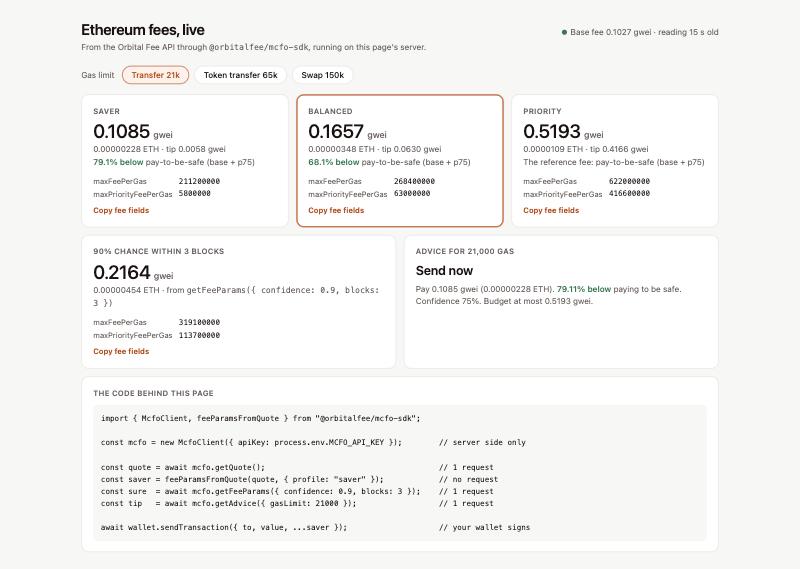
A Node server with no dependencies besides the SDK. It reads the live API on the server (three requests every 15 seconds, shared by every open tab, so a busy page stays inside the free tier's 30 a minute) and serves one page with:
- the Saver, Balanced and Priority fees, their cost for the chosen gas limit, and
the
maxFeePerGas/maxPriorityFeePerGasvalues ready to copy into a transaction; - the fee for a 90% chance of inclusion within 3 blocks;
- the advice (send now or wait) for the chosen gas limit;
- the last good reading and the reason when the API is unavailable or rate-limited.
Set MCFO_API_KEY to use a paid tier; the key stays on the server.
Tests
npm test               # everything below except the live suite
npm run test:unit      # unit and contract tests
npm run test:coverage  # the same, failing below 95% line/function and 90% branch coverage
npm run test:package   # pack, install, import by name, type-check a TypeScript consumer
npm run test:live      # against the real API (needs network)
| Suite | What it proves |
|---|---|
| test/client.test.js | Fee arithmetic, headers, and the mapping of every API error to McfoError |
| test/send.test.js | Fees merged into the transaction, delegation to ethers and viem, your own fees always win |
| test/contract.test.js | Responses recorded from the live API replayed through the client, with every derived wei value checked exactly; proxy pages, timeouts and unknown statuses become typed errors |
| test/package.test.js | What npm install delivers: the tarball contents, the exports, and the shipped type declarations |
| test/live.test.js | Invariants of the real API (fresh snapshot, ordered tiers, usable EIP-1559 values). Skipped unless MCFO_LIVE=1 |
CI runs the unit tests on Node 18, 20 and 22, then coverage and the package test. The live suite runs every day. A red "Live API" badge means the API changed or is down, not that the SDK broke.
No test framework: Node's built-in runner, against the compiled output, so the only development dependency is TypeScript.
License
MIT. See LICENSE.