
@overpunch/hoverboldly
v1.1.18
Published
Variable font weight hover and bold interactions without layout shift — wght increase with automatic wdth/tracking compensation
Downloads
164


Readme
Hover Boldly


Every browser reflows text when you hover to bold — words push down, lines shift. Bold Lock measures the exact width difference using Canvas measureText, then compensates with letter-spacing so the line never moves. One measurement pass on mount; zero reflow on hover.
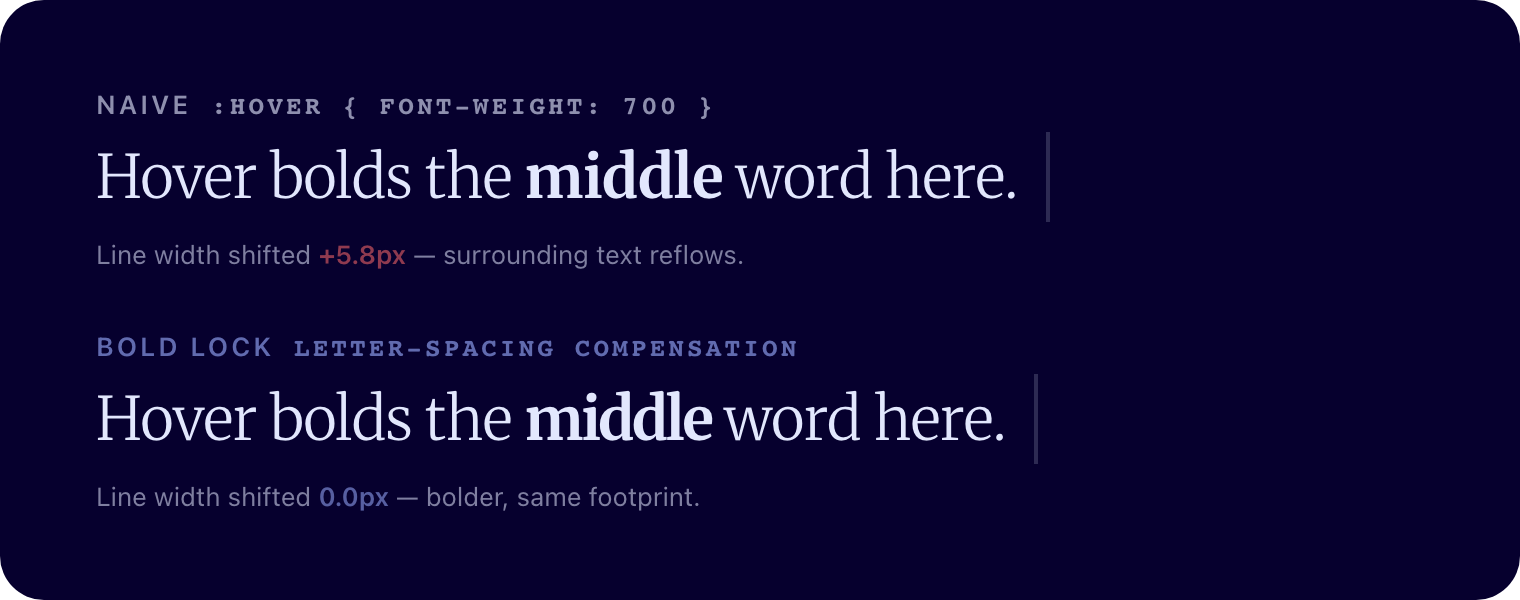
On hover, the naive row's right edge jumps +5.8px and pushes the rest of the line; Bold Lock holds the same width while the word gets bolder.
See it live → hoverboldly.com · npm · GitHub
Research: Weight Without Width, a paper and talk on why hover states should change emphasis, not layout. Bold widened navigation labels a median 4.8% across 15 variable fonts; the grade axis changes weight with zero width change, but only 5 of the 544 variable Google Fonts with a weight axis ship it. The paper recommends grade first, then the width axis, then measured spacing. (slides · measurements)
TypeScript · Canvas measurement · React + Vanilla JS · Zero runtime dependencies
Requires a variable font with a
wghtaxis (or at least two real weights). Bold Lock drivesfont-variation-settings, so the line gets heavier without swapping to a separate bold face.
Install
npm install @overpunch/hoverboldlyUsage
Next.js App Router: this library uses browser APIs. Add
"use client"to any component file that imports from it.
React component
import { BoldLockText } from '@overpunch/hoverboldly'

<BoldLockText normalWeight={300} hoverWeight={700} transitionDuration={150}>
  Hover over this text...
</BoldLockText>
React hook
import { useBoldLock } from '@overpunch/hoverboldly'

// Inside a React component:
const ref = useBoldLock({ normalWeight: 300, hoverWeight: 700 })
return <p ref={ref}>{children}</p>
The hook attaches all event listeners on mount and removes them on unmount or when options change.
Vanilla JS — interactive bold-lock
applyBoldLock attaches event listeners and returns a cleanup function.
import { applyBoldLock } from '@overpunch/hoverboldly'

const el = document.querySelector('p')
const cleanup = applyBoldLock(el, { normalWeight: 300, hoverWeight: 700 })

// Later — remove all listeners and reset styles:
cleanup()
Vanilla JS — static bold-shift (CSS :hover { font-weight: bold })
For elements that use a CSS rule to apply bold, applyBoldShift pre-compensates with letter-spacing so there is no reflow when the style activates.
import { applyBoldShift, removeBoldShift } from '@overpunch/hoverboldly'

const el = document.querySelector('p')
applyBoldShift(el, { normalWeight: 400, boldWeight: 700 })

// Later — remove the injected compensation styles:
removeBoldShift(el)
TypeScript
import type { BoldLockOptions, BoldShiftOptions } from '@overpunch/hoverboldly'

const lockOpts: BoldLockOptions = { normalWeight: 300, hoverWeight: 700, mode: 'word' }
const shiftOpts: BoldShiftOptions = { normalWeight: 400, boldWeight: 700 }
Options
BoldLockOptions (interactive hover)
| Option | Default | Description |
|--------|---------|-------------|
| normalWeight | computed font-weight | wght axis value at rest |
| hoverWeight | 700 | wght axis value on hover |
| transitionDuration | 150 | Transition duration in milliseconds. Set to 0 to disable |
| mode | 'element' | 'element' — whole element activates together. 'word' — each word is an independent hover target. 'proximity' — weight increases continuously per line based on cursor distance |
| proximityThreshold | 120 | Distance in px from a line's centre over which weight fades. Only used in 'proximity' mode |
| resizeObserver | true | Re-measure and reapply letter-spacing compensation when the element resizes |
| axes | undefined | Additional variable font axes to drive on hover, e.g. { slnt: { hover: -12 }, wdth: { normal: 100, hover: 95 } }. Letter-spacing compensation is only calculated for wght |
| falseSlant | undefined | Fake a slant via transform: skewX() for fonts without a slnt axis. e.g. { hoverDeg: -8 } |
| as | 'p' | HTML element to render. (React component only) |
BoldShiftOptions (static CSS bold)
| Option | Type | Default | Description |
|--------|------|---------|-------------|
| normalWeight | number | 400 | wght axis value at rest |
| boldWeight | number | 700 | wght axis value when bold |
How it works
In 'element' mode, Canvas measureText reads the element's full text content at both weights once on mount (a ResizeObserver re-measures when the element resizes). The width delta is distributed across character gaps as a negative letter-spacing, applied on mouseenter and reversed on mouseleave — total line width stays identical at both weights.
In 'word' mode, each word is measured and compensated independently so individual words can hover without affecting their neighbours.
Compensation is a Canvas-measured approximation tuned for the wght axis — only wght is compensated. Additional axes (e.g. wdth) and falseSlant change the lean or width but are not width-corrected, so keep their deltas small to stay imperceptible.
'element' mode responds to mouse, touch (touchstart/touchend) and keyboard (focusin/focusout), so the effect works on mobile and for keyboard navigation. 'word' mode responds to mouse and touch, and 'proximity' mode to pointer movement only; neither listens for keyboard focus yet. prefers-reduced-motion: reduce disables the CSS transition, keeping the weight change instantaneous but still happening.
applyBoldShift injects a scoped <style> rule targeting the element by a generated data-bold-shift attribute. Call removeBoldShift(element) to remove the injected <style> element and data-bold-shift attribute.
Line break safety: In 'element' and 'word' modes the compensation is applied as letter-spacing, not via line wrapping, so line breaks stay the browser's natural layout. 'proximity' mode is the exception: it groups text into fixed lines (nowrap spans joined by <br>) so each line can be weighted by its distance from the cursor, and those lines do not re-wrap on resize.
Dev notes
next in root devDependencies
package.json at the repo root lists next as a devDependency. This is a Vercel detection workaround — not a real dependency of the npm package. Vercel's build system inspects the root package.json to detect the framework; without next present it falls back to a static build and skips the Next.js pipeline, breaking the /site subdirectory deploy.
The package itself has zero runtime dependencies. Do not remove this entry.
Future improvements
- Axis-agnostic mode — support hovering any variable font axis, not just
wght; e.g.hoverAxis: 'wdth',hoverValue: 125 - Multi-weight cycles — hover through a sequence of weights rather than a single toggle (normal → semi-bold → bold → normal)
- Transition easing — expose the CSS
transition-timing-functionas an option alongsidetransitionDuration