
@pingpolls/svelte-adapter-bun-isr
v1.0.7
Published
SvelteKit adapter for Bun with Incremental Static Regeneration (ISR) support

Maintainers
 azvyae
Readme
SvelteKit Bun Adapter ISR
A production-ready SvelteKit adapter for Bun with built-in Incremental Static Regeneration (ISR), native multi-core clustering, and precompression — no reverse proxy or edge platform required.


- Bun-native server output — no Node.js required at runtime
- ISR for any prerendered route, page or endpoint (
.html,.json,.csv, whatever it renders) — static-file speed with background revalidation, no rebuild needed - Multi-core clustering via Bun's native
reusePort— scales across every CPU core out of the box - Static asset + prerendered page serving straight from Bun, with optional
.gz/.br/.zstprecompression - WebSocket support via
hooks.serverexport bundling
Install
bun add @pingpolls/svelte-adapter-bun-isrQuick start
svelte.config.js:
import adapter from '@pingpolls/svelte-adapter-bun-isr';

export default {
  kit: {
    adapter: adapter(), // all options below are optional, these are the defaults
  },
};
bun run build
bun run build/index.jsbuild/index.js is always the right entry point — it's either the server itself (cluster: false) or a supervisor spawning one worker per core in front of it (cluster: true, the default).
Options
| Option | Default | Does |
|---|---|---|
| out | 'build' | Output directory |
| serveAssets | true | Serve client assets + prerendered pages from Bun. Set false if a CDN/proxy does this instead |
| precompress | true | Emit .gz/.br/.zst variants at build time, negotiated via Accept-Encoding |
| envPrefix | '' | Prefix for runtime env vars (HOST, PORT, SOCKET_PATH, IDLE_TIMEOUT, CPUS, BUN_BINARY) |
| idleTimeout | 10 | Default Bun.serve idle timeout in seconds (runtime env wins if set) |
| websockets | true | Bundle hooks.server's websocket export into Bun.serve |
| cluster | true | Spawn one worker per CPU core behind SO_REUSEPORT. Set false if something else already manages process count (PM2, k8s HPA, fly.io) — running both multiplies your worker count |
Features by example
ISR on a page
// src/routes/isr/page/+page.server.ts
import type { Config } from '@pingpolls/svelte-adapter-bun-isr';

export const prerender = 'auto'; // required — see "prerender: auto vs true" below
export const config: Config = { revalidate: 15 }; // seconds
The page is served straight from the prerendered file on every request. Once it's older than 15s, the next request still gets the current file immediately, and a fresh render happens in the background and overwrites it for the request after that (stale-while-revalidate).
ISR on an endpoint (any content type)
// src/routes/isr/server.json/+server.ts
import { json } from '@sveltejs/kit';
import type { Config } from '@pingpolls/svelte-adapter-bun-isr';

export const prerender = 'auto';
export const config: Config = { revalidate: 30 };

export const GET = async () => json({ todos: await getTodos() });
Works identically for +server.ts endpoints — CSV, JSON, plain text, whatever Content-Type your handler sets is what gets served back on every subsequent request, not just text/html.
Dynamic ISR routes
// src/routes/isr/[slug]/+page.server.ts
import type { Config } from '@pingpolls/svelte-adapter-bun-isr';

export const prerender = 'auto';
export const config: Config = { revalidate: 60 };
export const entries = async () => (await getSlugs()).map((slug) => ({ slug }));
entries() is what SvelteKit itself already uses to know which params to prerender at build time — this adapter reuses it for manual regeneration too (see below).
Manual regeneration
// src/routes/api/regenerate/+server.ts
import { json } from '@sveltejs/kit';
import { regenerate } from '@pingpolls/svelte-adapter-bun-isr';
import type { RequestHandler } from './$types';

export const POST: RequestHandler = async ({ request }) => {
  const { paths = [], removePaths = [] } = await request.json();
  return json(await regenerate(paths, removePaths));
};
import { regenerate, type RegenerateResult } from '@pingpolls/svelte-adapter-bun-isr';
// concrete paths
const result: RegenerateResult = await regenerate(['/isr/page', '/isr/server.json'], ['/isr/stale-item']);
// a dynamic route's id instead of a concrete path expands every entries() param set
await regenerate(['/isr/[slug]']);regenerate() only works from inside a request while the built server is actually running (it throws otherwise). RegenerateResult:
interface RegenerateResult {
  regenerated: string[]; // existing paths re-rendered in place
  created: string[];     // brand-new paths written for the first time
  removed: string[];     // paths deleted (from removePaths)
  failed: { path: string; reason: string }[];
}
WebSockets
// src/hooks.server.ts
import type { Handle } from '@sveltejs/kit';

export const handle: Handle = async ({ event, resolve }) => {
  const { request } = event;
  const isUpgrade =
    request.headers.get('connection')?.toLowerCase().includes('upgrade') &&
    request.headers.get('upgrade')?.toLowerCase() === 'websocket';

  if (isUpgrade && new URL(request.url).pathname === '/ws') {
    const upgraded = event.platform?.server?.upgrade(event.platform?.request);
    if (upgraded) return new Response(null, { status: 101 });
  }

  return resolve(event);
};

export const websocket: Bun.WebSocketHandler<undefined> = {
  open(ws) { ws.send('connected'); },
  message(ws, message) { ws.send(message); }, // echo
};
Or upgrade per-route from a +server.ts with platform.server.upgrade(platform.request) instead of doing it globally in hooks.server.ts — either way works, since only the dynamic-SSR fallback ever reaches platform.server/platform.request.
Types:
// src/app.d.ts
declare global {
  namespace App {
    interface Platform {
      server: Bun.Server;
      request: Request;
    }
  }
}
export {};
Bun's pub/sub works as usual — ws.subscribe('room') / ws.publish(...), or event.platform.server.publish('room', data) from any hook or +server.ts.
prerender: 'auto' vs true
Use 'auto', not true, on any route you want ISR on. true strips the route from SvelteKit's SSR manifest entirely, and this adapter regenerates content by calling into that same SSR manifest at runtime — a route that isn't in it can't be regenerated. With prerender = true, revalidate is silently a no-op.
How requests are resolved
- Static client assets
- Prerendered/ISR files — the in-memory index (built at boot, updated on every regenerate/remove) maps the path straight to its file on disk; file bytes are still read fresh from disk per request, only the lookup is O(1) in memory. A background regeneration is kicked off first if the file is older than its
revalidatewindow - A path under an ISR-enabled route that has no prerendered file yet
- Everything else — normal SvelteKit SSR
Where this differs from stock SvelteKit
- Step 3 is the one real difference. A path that matches an ISR-enabled route but has never been rendered (e.g. a fresh dynamic slug not covered by
entries()at build time, and not yet regenerated on demand) gets a 404 immediately, with rendering kicked off in the background for the next request — it does not block the current request on a live SSR render the way an ordinary SvelteKit dynamic route would. Callregenerate()(or wait for the request-after-next) once you know the path exists. - Steps 1–3 use their own route matcher, not SvelteKit's router, purely to decide "is this path governed by an ISR route." It mirrors SvelteKit's own specificity rules (static segments > matched params > plain params > rest params), so the outcome never disagrees with SvelteKit — it only exists to make that decision without going through full SSR. Step 4 hands off to SvelteKit's real router unchanged.
File layout
build/
  client/
  prerendered/
  server/
    manifest.js
    index.js
    hooks.js   # only when a websocket export is bundled
    chunks/ entries/ nodes/ .vite/
  app.js       # only when cluster is enabled — the actual server
  index.js     # supervisor when cluster is enabled, otherwise the server
Caveats
- The prerendered-path index is per-process; under
cluster: trueeach worker rebuilds it independently at boot, but they all read/write the same files on disk, so staleness is briefly worker-local at worst prerender = 'auto'is required for ISR — see above.zstprecompression is best-effort (skipped if unsupported by the running Bun build)- Manual
regenerate()on a dynamic route id needs that route'sentries()export — without it, the call no-ops for that id rather than erroring cluster: trueplus an external process manager both managing worker count will multiply concurrency — use one or the other
Benchmarked performance
Load-tested with wrk (5m, 4 threads, 512 connections) against svelte-adapter-bun on:
- Intel i7-13700H (Only 2 CPU utilized for the test)
- 32 GB of RAM
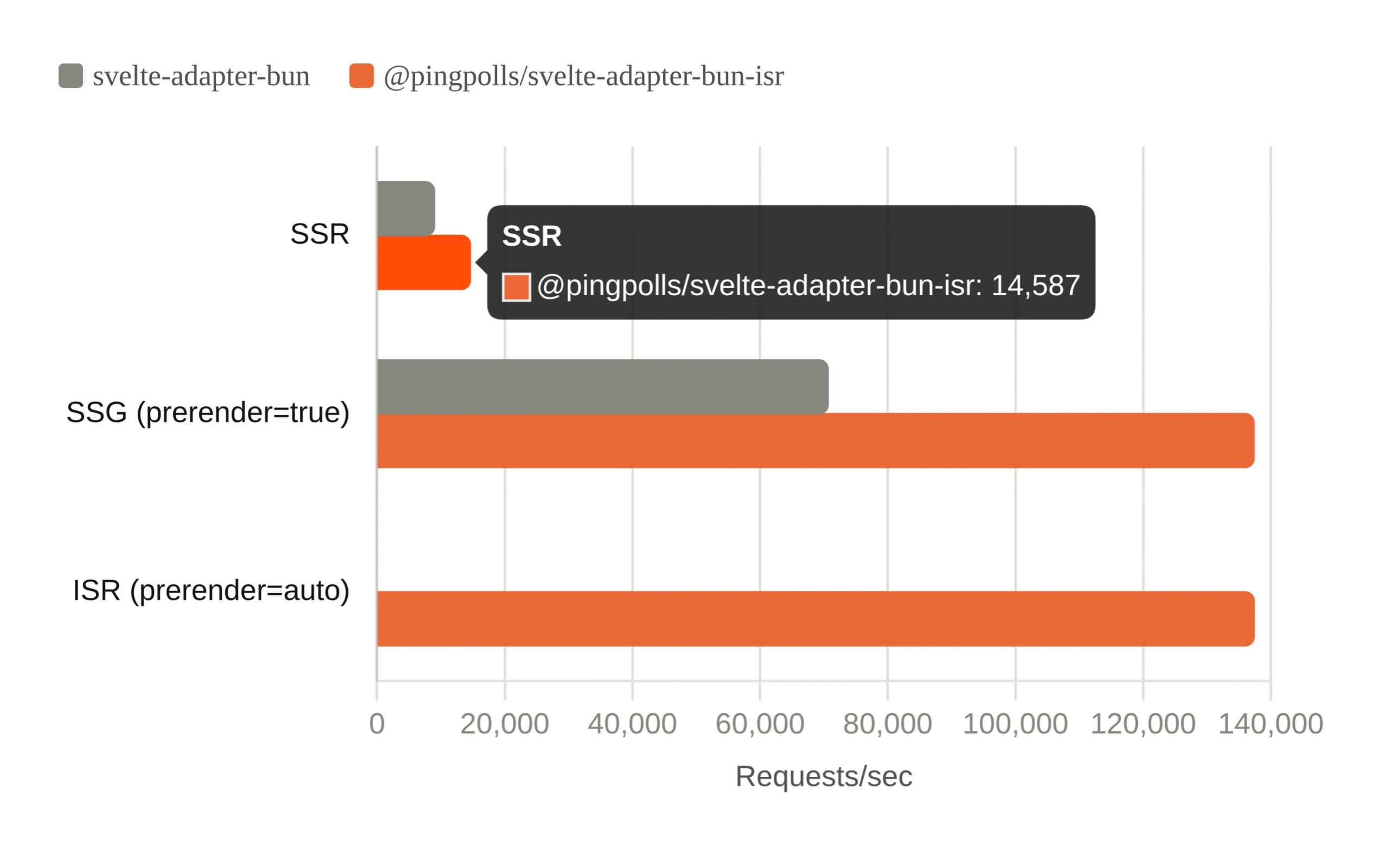
| Mode | svelte-adapter-bun | this adapter | Improvement | |---|---|---|---| | SSR, no caching | 8,975 req/s · 57.04ms avg | 14,587 req/s · 35.10ms avg | 1.6x throughput, 1.6x lower latency | | SSG, prerendered | 70,627 req/s · 7.25ms avg | 137,339 req/s · 3.73ms avg | 1.9x throughput, 1.9x lower latency | | ISR, prerender = auto | — | 137,362 req/s · 3.73ms avg | matches static prerender speed |
The SSR gap comes almost entirely from built-in clustering, not raw per-core speed. Pinned to 1 CPU, this adapter does 8,419 req/s · 60.14ms avg — essentially the same as svelte-adapter-bun's 8,975 req/s on the same single-core setup. The 1.6x SSR gap above only shows up at 2 CPUs, where
cluster: true(default) spawns one worker per core via Bun'sreusePortand throughput scales accordingly; pin the count with theCPUSenv var if needed.
Contributing
See GitHub.
License
MIT