
@power-seo/ai
v1.0.18
Published
LLM-agnostic prompt templates and response parsers for AI-assisted SEO

Maintainers
 ccbd.dev
Readme
@power-seo/ai
LLM-agnostic SEO prompt builders and structured response parsers — works with OpenAI, Anthropic Claude, Google Gemini, Mistral, and any other provider.





@power-seo/ai is a TypeScript library of SEO prompt templates and response parsers for developers who want AI-assisted meta descriptions, title tags, content suggestions, and SERP feature predictions without coupling their code to one LLM vendor. Prompt builders return a plain { system, user, maxTokens } object you pass to whatever LLM client you already use; parsers turn the raw text response back into typed results. No LLM SDK is bundled, no API keys are managed, and this package makes no network calls itself.
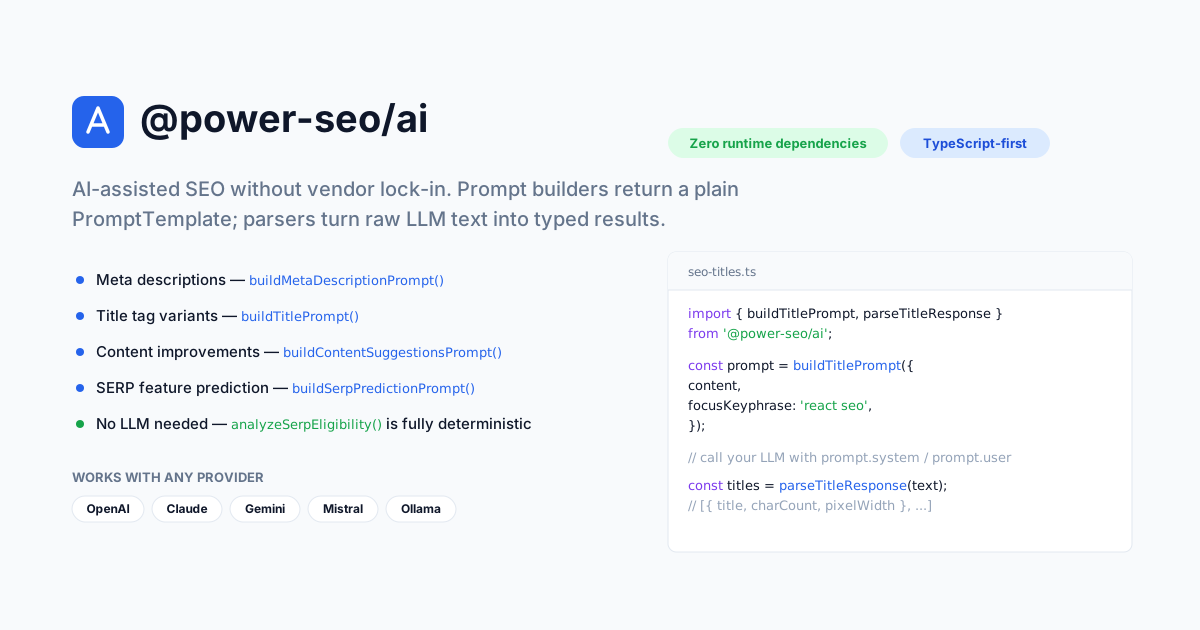
One export needs no LLM at all: analyzeSerpEligibility is a fully deterministic, rule-based check that inspects a page's content structure and schema markup to score its eligibility for FAQ, How-To, Product, Review, Video, and Featured Snippet SERP features — free to run on every build.
Why @power-seo/ai?
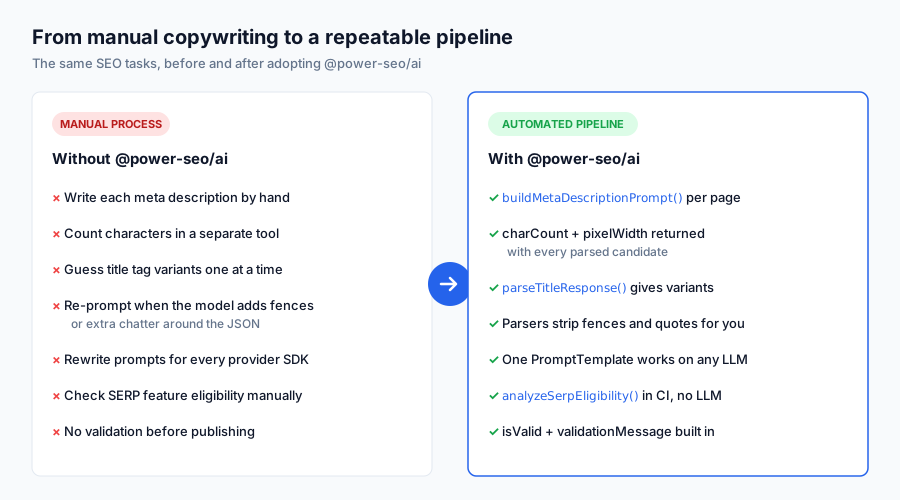
| | Without | With | | -------------------- | --------------------------- | ------------------------------------------------------------- | | Meta descriptions | ❌ Write manually | ✅ LLM-generated candidate validated against real SERP limits | | Title optimization | ❌ Guesswork | ✅ 5 keyphrase-focused variants with char + pixel metadata | | Content gaps | ❌ Manually identified | ✅ Typed, prioritized AI improvement suggestions | | SERP eligibility | ❌ Unknown | ✅ Rule-based + LLM prediction with likelihood scores | | Provider flexibility | ❌ Vendor-locked to one SDK | ✅ Any LLM: OpenAI, Claude, Gemini, Mistral, Ollama | | Structured output | ❌ Ad-hoc raw text parsing | ✅ Parsers handle JSON, code fences, and numbered lists | | CI integration | ❌ Manual review | ✅ Deterministic SERP eligibility check with zero API cost |
Features
- LLM-agnostic design — prompt builders return
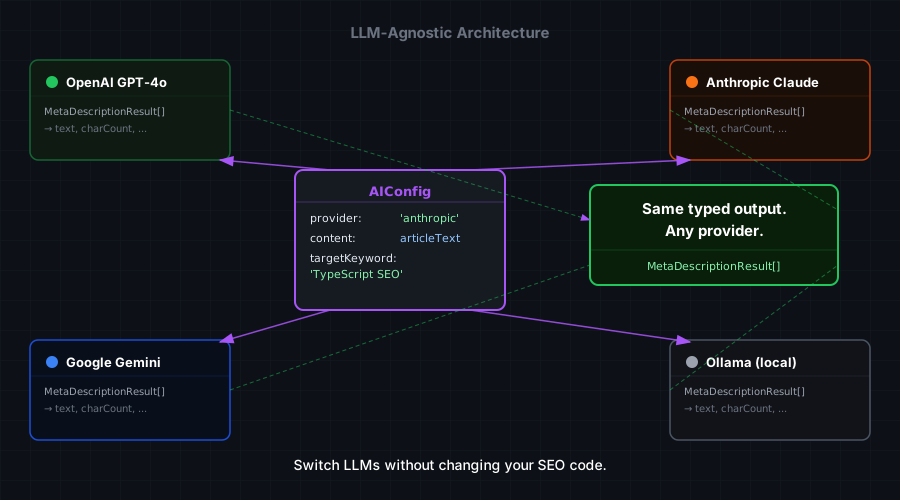
{ system, user, maxTokens }; parsers accept raw text strings; no SDK bundled - Works with any provider — OpenAI, Anthropic Claude, Google Gemini, Mistral, Cohere, local Ollama models, or any HTTP-based LLM
- Meta description generation —
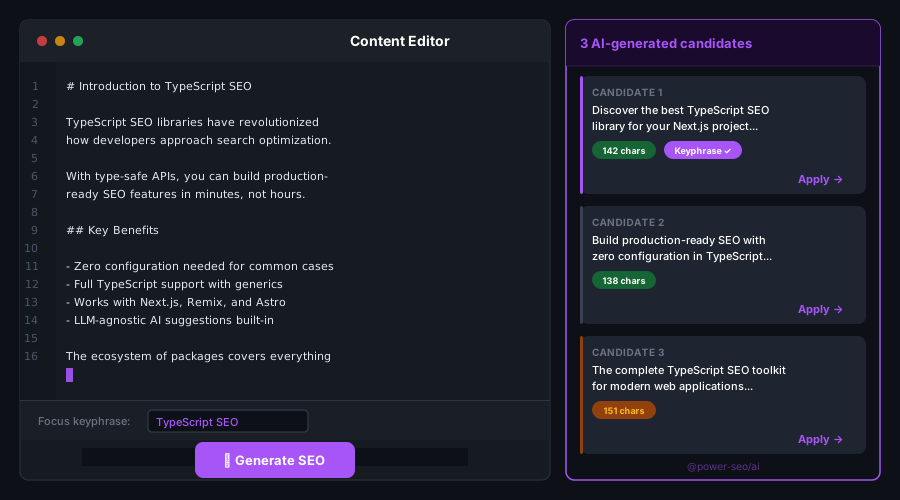
buildMetaDescriptionPrompttargets a configurable character limit (default 160) with focus keyphrase and call-to-action;parseMetaDescriptionResponsereturns the candidate with character count, estimated pixel width, and validation status from@power-seo/core - SEO title generation —
buildTitlePromptrequests 5 title tag variants capped at 60 characters each;parseTitleResponseaccepts JSON arrays or numbered lists and returnsTitleResult[] - Content improvement suggestions —
buildContentSuggestionsPromptincludes word count and prior analysis context;parseContentSuggestionsResponsereturns typed suggestions for headings, paragraphs, keywords, and links with 1–5 priority - SERP feature prediction —
buildSerpPredictionPrompt/parseSerpPredictionResponsepredict eligibility across 9 SERP features with likelihood scores, requirements, and met criteria - Rule-based SERP eligibility —
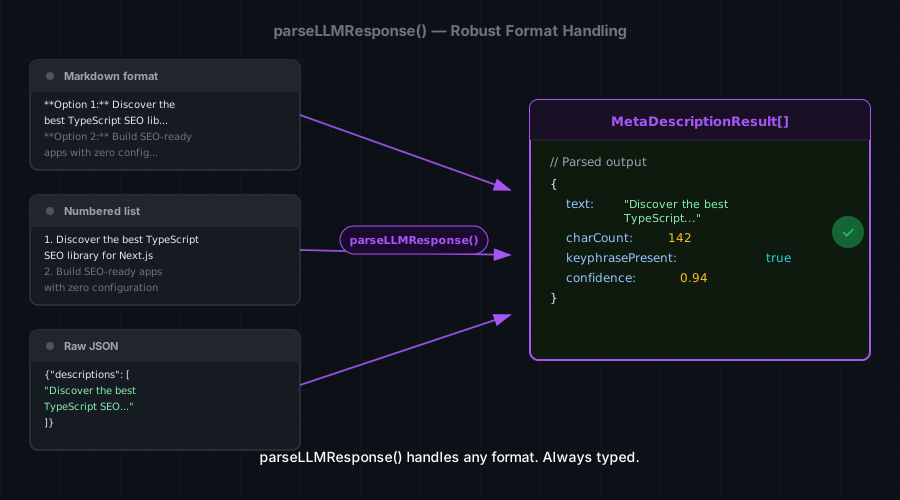
analyzeSerpEligibilityis deterministic: no LLM, no cost, instant; scores FAQ, How-To, Product, Review, Video, and Featured Snippet eligibility from schema markup and content patterns - Robust output parsing — parsers strip surrounding quotes, unwrap markdown code fences, fall back from JSON to numbered-list parsing, and return empty arrays instead of throwing on malformed responses
- Character and pixel width metadata — generated titles and descriptions include
charCountandpixelWidthcomputed with the same font-width tables used by@power-seo/preview - Type-safe throughout — every input, output, and union (
ContentSuggestionType,SerpFeature) is exported - Zero third-party runtime dependencies — depends only on
@power-seo/core
Comparison
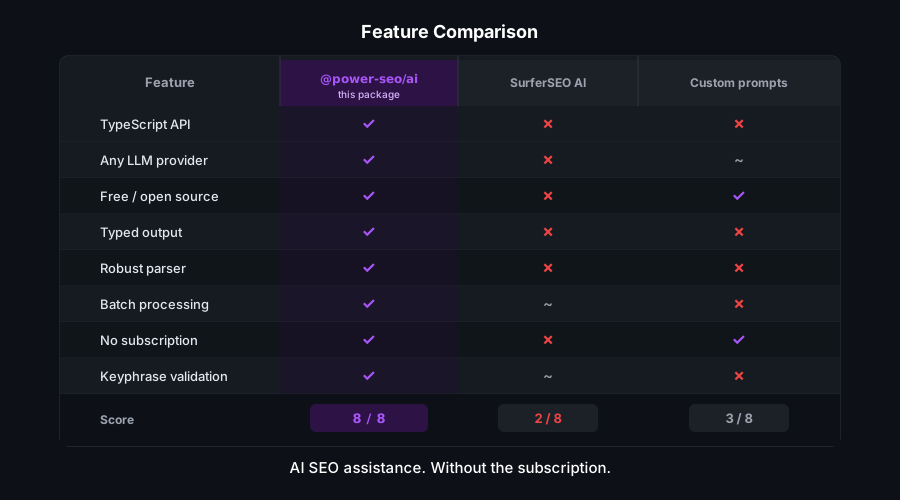
| Feature | @power-seo/ai | LangChain | Vercel AI SDK | Custom prompts | | -------------------------------- | :-----------: | :-------: | :-----------: | :------------: | | SEO-specific prompt templates | ✅ | ❌ | ❌ | Manual | | Provider-agnostic prompt objects | ✅ | Partial | ❌ | ❌ | | Structured SEO response parsers | ✅ | Partial | Partial | Manual | | Rule-based SERP eligibility | ✅ | ❌ | ❌ | ❌ | | Char + pixel width metadata | ✅ | ❌ | ❌ | ❌ | | Zero LLM SDK dependencies | ✅ | ❌ | ❌ | ✅ | | TypeScript-first | ✅ | Partial | ✅ | — | | Tree-shakeable | ✅ | ❌ | Partial | — |
Installation
npm install @power-seo/aiyarn add @power-seo/aipnpm add @power-seo/aiRequires Node.js 18 or newer. Ships dual ESM + CJS builds with TypeScript declarations.
Usage
Every workflow follows the same three steps: build a prompt, send it with your own LLM client, parse the raw text that comes back.
How do I generate an SEO meta description with an LLM?
Call buildMetaDescriptionPrompt with the page title, content, and optional focus keyphrase. It returns a PromptTemplate with a system role, a user message (content is excerpted to the first 500 characters), and a maxTokens budget of 200. Send those to any chat-completion API, then pass the model's raw reply to parseMetaDescriptionResponse, which strips surrounding quotes and validates the result against real Google SERP limits — 160 characters and 920 pixels by default, via @power-seo/core.
import { buildMetaDescriptionPrompt, parseMetaDescriptionResponse } from '@power-seo/ai';
import type { MetaDescriptionResult } from '@power-seo/ai';

const prompt = buildMetaDescriptionPrompt({
  title: 'How to Optimize React Apps for SEO',
  content: 'Full article HTML or plain text about React SEO strategies...',
  focusKeyphrase: 'react seo optimization',
});
// { system: 'You are an expert SEO specialist...', user: 'Write a compelling meta description...', maxTokens: 200 }

const rawResponse = await yourLLM.complete(prompt.system, prompt.user, prompt.maxTokens);
const result: MetaDescriptionResult = parseMetaDescriptionResponse(rawResponse);

console.log(`"${result.description}"`);
console.log(`  ${result.charCount} characters, ~${result.pixelWidth}px`);
console.log(`  Valid: ${result.isValid}`);
if (result.validationMessage) console.log(`  Message: ${result.validationMessage}`);
How do I generate SEO title tags with AI?
buildTitlePrompt asks the model for 5 title variants — question, how-to, list, benefit, and action approaches — each capped at 60 characters, with the focus keyphrase placed near the beginning. parseTitleResponse accepts either a JSON array (of strings or { title } objects) or a numbered list (1. Title) and returns each candidate with its character count and estimated pixel width, so you can filter to titles that fit Google's display limits.
import { buildTitlePrompt, parseTitleResponse } from '@power-seo/ai';
import type { TitleResult } from '@power-seo/ai';

const prompt = buildTitlePrompt({
  content: 'Article about the best tools for keyword research...',
  focusKeyphrase: 'keyword research tools',
  tone: 'informative',
});

const rawResponse = await yourLLM.complete(prompt.system, prompt.user, prompt.maxTokens);
const results: TitleResult[] = parseTitleResponse(rawResponse);

results.forEach(({ title, charCount }, i) => {
  const status = charCount <= 60 ? 'OK' : 'TOO LONG';
  console.log(`${i + 1}. "${title}" — ${charCount} chars [${status}]`);
});
How do I get AI content improvement suggestions?
buildContentSuggestionsPrompt strips HTML from the content, includes the word count and an 800-character excerpt, and can carry prior analysis results (for example a score from @power-seo/content-analysis) so the model targets known weaknesses. parseContentSuggestionsResponse unwraps markdown code fences, parses the JSON array, filters out malformed entries, and returns ContentSuggestion[] — or an empty array if the response is unusable, never an exception.
import { buildContentSuggestionsPrompt, parseContentSuggestionsResponse } from '@power-seo/ai';
import type { ContentSuggestion } from '@power-seo/ai';

const prompt = buildContentSuggestionsPrompt({
  title: 'React SEO Best Practices',
  content: '<h1>React SEO</h1><p>React is a JavaScript library...</p>',
  focusKeyphrase: 'react seo best practices',
  analysisResults: 'Current score: 58/100. Missing headings structure.',
});

const rawResponse = await yourLLM.complete(prompt.system, prompt.user, prompt.maxTokens);
const suggestions: ContentSuggestion[] = parseContentSuggestionsResponse(rawResponse);

suggestions.forEach(({ type, suggestion, priority }) => {
  console.log(`[Priority ${priority}] ${type}: ${suggestion}`);
});
| Suggestion type | Description |
| --------------- | ---------------------------------------------- |
| heading | Heading structure improvements and additions |
| paragraph | Paragraph content improvements and rewrites |
| keyword | Keyphrase density and placement optimization |
| link | Internal linking opportunities and suggestions |
How do I predict SERP features with an LLM?
buildSerpPredictionPrompt sends the page title, an 800-character content excerpt, any schema.org types present, and an optional content-type hint. The model returns a JSON array that parseSerpPredictionResponse validates into SerpFeaturePrediction[] — one entry per feature with a 0–1 likelihood, the requirements for that feature, and which requirements the page already meets. Nine features are covered: featured-snippet, faq-rich-result, how-to, product, review, video, image-pack, local-pack, and sitelinks.
import { buildSerpPredictionPrompt, parseSerpPredictionResponse } from '@power-seo/ai';
import type { SerpFeaturePrediction } from '@power-seo/ai';

const prompt = buildSerpPredictionPrompt({
  title: 'How to Make Cold Brew Coffee at Home',
  content: '<h1>Cold Brew Coffee</h1><h2>Step 1: Grind the Coffee</h2><p>...</p>',
  schema: ['HowTo', 'Recipe'],
  contentType: 'guide',
});

const rawResponse = await yourLLM.complete(prompt.system, prompt.user, prompt.maxTokens);
const predictions: SerpFeaturePrediction[] = parseSerpPredictionResponse(rawResponse);

predictions.forEach(({ feature, likelihood, met }) => {
  console.log(`${feature}: ${(likelihood * 100).toFixed(0)}% — met: ${met.join(', ')}`);
});
How do I check SERP eligibility without an LLM?
Use analyzeSerpEligibility. It is entirely deterministic — no API call, no cost, no variance between runs — which makes it safe for CI pipelines. It scores six features from a 0.1 baseline: matching schema markup adds 0.4 (FAQ, How-To) or 0.5 (Product, Review, Video), question or step patterns in the content add 0.3, and Featured Snippet eligibility adds 0.1 each for a 300+ word count and h2–h4 heading structure.
import { analyzeSerpEligibility } from '@power-seo/ai';

// How-To: HowTo schema (+0.4) plus step-sequence wording (+0.3)
const howto = analyzeSerpEligibility({
  title: 'How to Install Node.js on Ubuntu',
  content: '<p>First, update apt. Next, install nvm. Finally, verify the version.</p>',
  schema: ['HowTo'],
});
// Includes: { feature: 'how-to', likelihood: 0.8, requirements: [...], met: ['HowTo schema markup', 'Step-by-step content'] }

// FAQ: FAQPage schema (+0.4) plus question-pattern content (+0.3)
const faq = analyzeSerpEligibility({
  title: 'React SEO FAQ',
  content: '<h2>What is React SEO?</h2><p>...</p><h2>How to add meta tags?</h2><p>...</p>',
  schema: ['FAQPage'],
});
// Includes: { feature: 'faq-rich-result', likelihood: 0.8, requirements: [...], met: [...] }
How do I use @power-seo/ai with OpenAI, Claude, or Gemini?
The same PromptTemplate maps onto every provider's chat API: system becomes the system message or parameter, user becomes the user message, and maxTokens becomes the token budget. Swap providers without changing any prompt or parsing code.
import { buildMetaDescriptionPrompt, parseMetaDescriptionResponse } from '@power-seo/ai';

const prompt = buildMetaDescriptionPrompt({
  title: 'My Article',
  content: '...',
  focusKeyphrase: 'my topic',
});

// OpenAI
import OpenAI from 'openai';
const openai = new OpenAI({ apiKey: process.env.OPENAI_API_KEY });
const openaiResponse = await openai.chat.completions.create({
  model: 'gpt-4o',
  messages: [
    { role: 'system', content: prompt.system },
    { role: 'user', content: prompt.user },
  ],
  max_tokens: prompt.maxTokens,
});
const result = parseMetaDescriptionResponse(openaiResponse.choices[0].message.content ?? '');

// Anthropic Claude
import Anthropic from '@anthropic-ai/sdk';
const anthropic = new Anthropic({ apiKey: process.env.ANTHROPIC_API_KEY });
const claudeResponse = await anthropic.messages.create({
  model: 'claude-sonnet-4-5',
  system: prompt.system,
  messages: [{ role: 'user', content: prompt.user }],
  max_tokens: prompt.maxTokens ?? 200,
});
const result2 = parseMetaDescriptionResponse(
  claudeResponse.content[0].type === 'text' ? claudeResponse.content[0].text : '',
);

// Google Gemini
import { GoogleGenerativeAI } from '@google/generative-ai';
const genai = new GoogleGenerativeAI(process.env.GEMINI_API_KEY!);
const model = genai.getGenerativeModel({ model: 'gemini-1.5-pro' });
const geminiResponse = await model.generateContent(`${prompt.system}\n\n${prompt.user}`);
const result3 = parseMetaDescriptionResponse(geminiResponse.response.text());
API Reference
Prompt budgets and excerpt limits (verified from source):
| Builder | Content excerpt limit | maxTokens | Parser return type |
| ------------------------------- | --------------------- | ----------- | ------------------------- |
| buildMetaDescriptionPrompt | 500 characters | 200 | MetaDescriptionResult |
| buildTitlePrompt | 500 characters | 500 | TitleResult[] |
| buildContentSuggestionsPrompt | 800 characters | 1000 | ContentSuggestion[] |
| buildSerpPredictionPrompt | 800 characters | 1000 | SerpFeaturePrediction[] |
buildMetaDescriptionPrompt(input) / parseMetaDescriptionResponse(text)
| Parameter | Type | Default | Description |
| ---------------------- | -------- | -------- | ---------------------------------- |
| input.title | string | required | Page title for context |
| input.content | string | required | Page content (HTML or plain text) |
| input.focusKeyphrase | string | — | Focus keyphrase to include |
| input.maxLength | number | 160 | Maximum character length requested |
| input.tone | string | — | Tone hint for the LLM |
buildMetaDescriptionPrompt returns PromptTemplate. parseMetaDescriptionResponse(text) returns MetaDescriptionResult — validation uses validateMetaDescription and calculatePixelWidth from @power-seo/core (limits: 160 characters, 920 px).
buildTitlePrompt(input) / parseTitleResponse(text)
| Parameter | Type | Default | Description |
| ---------------------- | -------- | -------- | ----------------------------- |
| input.content | string | required | Page content for context |
| input.focusKeyphrase | string | — | Focus keyphrase for the title |
| input.tone | string | — | Tone hint for the LLM |
buildTitlePrompt returns PromptTemplate requesting 5 variants of at most 60 characters. parseTitleResponse(text) returns TitleResult[]; it tries JSON first, then falls back to numbered-list parsing (1. Title / 1) Title).
buildContentSuggestionsPrompt(input) / parseContentSuggestionsResponse(text)
| Parameter | Type | Default | Description |
| ----------------------- | -------- | -------- | ---------------------------------- |
| input.title | string | required | Page title |
| input.content | string | required | Page HTML or plain text content |
| input.focusKeyphrase | string | — | Focus keyphrase |
| input.analysisResults | string | — | Prior analysis results for context |
buildContentSuggestionsPrompt returns PromptTemplate. parseContentSuggestionsResponse(text) returns ContentSuggestion[]; entries missing a valid type, suggestion, or numeric priority are filtered out, and malformed responses yield [].
buildSerpPredictionPrompt(input) / parseSerpPredictionResponse(text)
| Parameter | Type | Default | Description |
| ------------------- | ---------- | -------- | ---------------------------------------- |
| input.title | string | required | Page title |
| input.content | string | required | Page content |
| input.schema | string[] | — | Schema.org types present on the page |
| input.contentType | string | — | Content type hint (guide, article, etc.) |
buildSerpPredictionPrompt returns PromptTemplate. parseSerpPredictionResponse(text) returns SerpFeaturePrediction[] with likelihood in the 0–1 range.
analyzeSerpEligibility(input)
Takes the same SerpFeatureInput as buildSerpPredictionPrompt. Returns SerpFeaturePrediction[] for six features, computed deterministically:
| Feature | Baseline | Schema signal | Content signal |
| ------------------ | -------- | --------------------------------- | ---------------------------------------------------- |
| faq-rich-result | 0.1 | FAQPage +0.4 | 2+ question patterns +0.3 |
| how-to | 0.1 | HowTo +0.4 | 2+ step patterns (step N, first, next, finally) +0.3 |
| product | 0.1 | Product +0.5 | — |
| review | 0.1 | Review / AggregateRating +0.5 | — |
| video | 0.1 | VideoObject +0.5 | — |
| featured-snippet | 0.1 | — | 300+ words +0.1; h2–h4 headings +0.1 |
Likelihood is capped at 1. No LLM, no network, no cost.
Types
import type {
  PromptTemplate, // { system: string; user: string; maxTokens?: number }
  MetaDescriptionInput, // { title, content, focusKeyphrase?, tone?, maxLength? }
  MetaDescriptionResult, // { description, charCount, pixelWidth, isValid, validationMessage? }
  ContentSuggestionInput, // { title, content, focusKeyphrase?, analysisResults? }
  ContentSuggestionType, // 'heading' | 'paragraph' | 'keyword' | 'link'
  ContentSuggestion, // { type: ContentSuggestionType; suggestion: string; priority: number; reason? }
  SerpFeature, // 'featured-snippet' | 'faq-rich-result' | 'how-to' | 'product' | 'review' | 'video' | 'image-pack' | 'local-pack' | 'sitelinks'
  SerpFeatureInput, // { title, content, schema?, contentType? }
  SerpFeaturePrediction, // { feature: SerpFeature; likelihood: number; requirements: string[]; met: string[] }
  TitleInput, // { content, focusKeyphrase?, tone? }
  TitleResult, // { title: string; charCount: number; pixelWidth: number }
} from '@power-seo/ai';
Use Cases
- Headless CMS editors — generate meta description and title candidates at publish time and present validated options to authors before going live
- Programmatic page pipelines — automate meta generation for large sets of generated pages, with every candidate checked against real character and pixel limits
- Content quality dashboards — feed low scores from
@power-seo/content-analysisintoanalysisResultsand surface prioritized AI improvement suggestions - SERP feature regression checks — run
analyzeSerpEligibilityin CI so schema changes that drop rich-result eligibility fail the build, at zero API cost - Multi-LLM evaluation — compare output quality across OpenAI, Claude, and Gemini using identical prompt builders and identical parsers
Architecture Overview
- Pure TypeScript — no compiled binary, no native modules
- Provider-agnostic contract — builders emit
PromptTemplate; parsers consume raw strings; the LLM client is entirely yours - Defensive parsing — quote stripping, code-fence unwrapping, JSON-then-list fallback, entry-level validation; parsers never throw on bad model output
- Shared SEO engine — character limits, pixel-width estimation, and validation come from
@power-seo/core, so AI-generated meta matches what the rest of the ecosystem measures - Framework-agnostic — works in Next.js, Remix, Vite, Node.js, or any JS runtime
- SSR and Edge safe — no browser-specific or Node-specific APIs
- Tree-shakeable —
"sideEffects": falsewith named per-function exports - Dual ESM + CJS — ships both formats with TypeScript declarations
Supply Chain Security
- Published to npm with provenance attestation — every release is built and signed by the verified
github.com/CyberCraftBD/power-seoGitHub Actions workflow, so you can trace each tarball back to its exact source commit - Zero third-party runtime dependencies — packages depend only on other
@power-seopackages, nothing else gets pulled in - No network access at runtime — pure computation on the inputs you pass; nothing is fetched, phoned home, or telemetered
- No install scripts (
postinstall,preinstall) - No
evalor dynamic code execution - Safe for SSR, Edge, and server environments
The @power-seo Ecosystem
All 17 packages are independently installable — use only what you need.
| Package | Install | Description |
| ------------------------------------------------------------------------------------------ | ----------------------------------- | ---------------------------------------------------------------------------------- |
| @power-seo/ai | npm i @power-seo/ai | LLM-agnostic prompt templates and response parsers for AI-assisted SEO |
| @power-seo/analytics | npm i @power-seo/analytics | Merge Search Console data with audit results — trends and ranking insights |
| @power-seo/audit | npm i @power-seo/audit | SEO site health auditing with meta, content, structure, and performance rules |
| @power-seo/content-analysis | npm i @power-seo/content-analysis | Yoast-style SEO content analysis engine with scoring, checks, and React components |
| @power-seo/core | npm i @power-seo/core | Framework-agnostic SEO analysis engines, types, validators, and utilities |
| @power-seo/images | npm i @power-seo/images | Image SEO analysis — alt text quality, lazy loading, formats, image sitemaps |
| @power-seo/integrations | npm i @power-seo/integrations | Semrush and Ahrefs API clients with a shared rate-limited HTTP client |
| @power-seo/links | npm i @power-seo/links | Internal link graph analysis — orphan detection, suggestions, equity scoring |
| @power-seo/meta | npm i @power-seo/meta | SSR meta tag helpers for Next.js App Router, Remix v2, and generic SSR |
| @power-seo/preview | npm i @power-seo/preview | SERP, Open Graph, and Twitter Card preview generators with React components |
| @power-seo/react | npm i @power-seo/react | React SEO components — meta tags, Open Graph, Twitter Card, breadcrumbs |
| @power-seo/readability | npm i @power-seo/readability | Readability scoring — Flesch-Kincaid, Gunning Fog, Coleman-Liau, ARI |
| @power-seo/redirects | npm i @power-seo/redirects | Redirect rule engine with Next.js, Remix, and Express adapters |
| @power-seo/schema | npm i @power-seo/schema | Type-safe JSON-LD structured data — 23 schema.org builders plus React components |
| @power-seo/search-console | npm i @power-seo/search-console | Google Search Console API client — OAuth2, service accounts, rate limiting, retry |
| @power-seo/sitemap | npm i @power-seo/sitemap | XML sitemap generation, streaming, and validation with image, video, news support |
| @power-seo/tracking | npm i @power-seo/tracking | Analytics script builders with consent management and React components |
Keywords
ai seo, llm seo, seo prompts, prompt templates, meta description generator, seo title generator, content suggestions, serp features, serp prediction, featured snippet, provider-agnostic, openai, anthropic claude, google gemini, ai content optimization, seo automation, typescript seo, structured output parsing, rich results, edge runtime
About CyberCraft Bangladesh
CyberCraft Bangladesh is a Bangladesh-based enterprise-grade software development and Full Stack SEO service provider company specializing in ERP system development, AI-powered SaaS and business applications, full-stack SEO services, custom website development, and scalable eCommerce platforms. We design and develop intelligent, automation-driven SaaS and enterprise solutions that help startups, SMEs, NGOs, educational institutes, and large organizations streamline operations, enhance digital visibility, and accelerate growth through modern cloud-native technologies.




© 2026 CyberCraft Bangladesh · Released under the MIT License