
@qmilab/asterism
v0.9.3
Published
Many agents. One runtime. Separate lives. Run distinct local AI agents — each with its own soul, memory, secrets, skills, workspace, and autonomy level.

Maintainers
 cybernandan
Readme
Asterism
Many agents. One runtime. Separate lives.
Run distinct local AI agents from one install — each with its own soul, memory, secrets, skills, workspace, event log, and autonomy level. Agents run alone by default; nothing crosses between them unless you say so.
One agent for work, one per client, one for the side project — without a runtime, a config tree, or a VM each.
A soul is nothing exotic: a small persona file giving an agent its voice, values, and operating style.
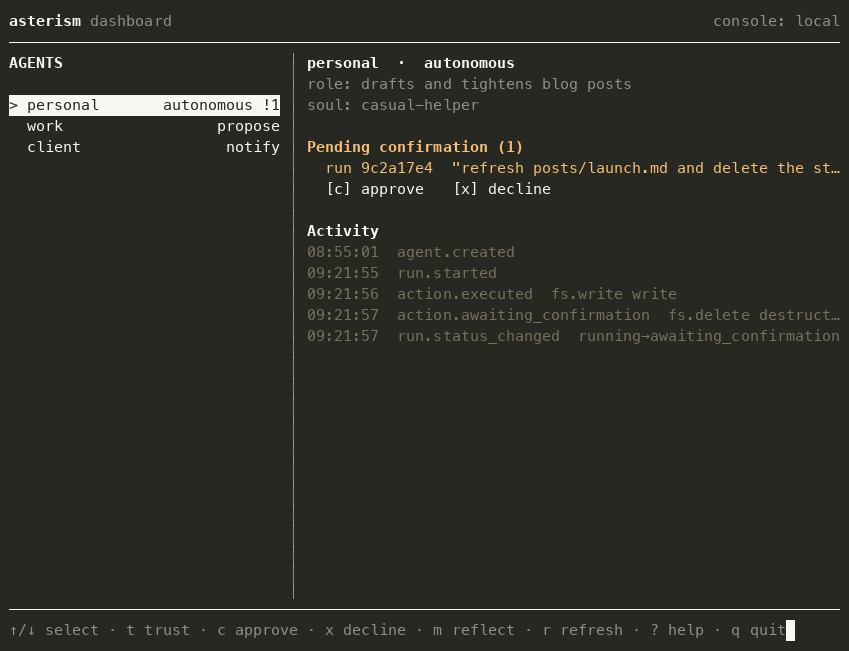
Every agent and its autonomy in one view — including an autonomous one stopped before a destructive action.
Quickstart
npx @qmilab/asterism init     # Node 22.19+   (Bun: bunx --bun @qmilab/asterism init)

# create two agents with distinct souls and autonomy
asterism new writer  --soul casual-helper       --trust autonomous
asterism new client  --soul careful-consultant  --trust propose

# give each agent its own secrets and skills
asterism secrets add client GITHUB_TOKEN ghp_example_token   # value: inline, piped, from $GITHUB_TOKEN — or omit it and be prompted
# a skill is just a markdown file you write
echo "# Blog writer: tighten drafts, keep the author's voice" > blog-writer.md
asterism skill   add writer blog-writer.md

# put them to work
asterism run writer "update my blog draft"
asterism run client "summarize the client meeting"

# review what each agent knows and did — separately
asterism memory inspect writer
asterism events tail client
asterism reflect writer --reviewwriter's memory never appears in client, and client's GITHUB_TOKEN cannot be read from writer — those boundaries hold from the moment the agents exist. The run and reflect steps need a model; a local one needs no key and no account.
Requires Node 22.19+, Bun 1.1+, or Deno 2+. The installed binary runs under Node by default; under Bun, force Bun's runtime with bunx --bun, and under Deno give it a node_modules directory. The installation guide has the one line each of those takes, and what npm, pnpm and yarn need.
Autonomy you can dial
Every agent gets one of three trust levels:
propose— never acts on its own; returns a plan or diff for you to apply.notify— acts automatically inside its workspace, then surfaces each action prominently for after-the-fact review. It does not ask first.autonomous— acts freely inside its workspace, recording everything to its event log.
One rule overrides all three. A destructive action — deleting files, force-pushes, reading out a secret, spending money, irreversible external calls — never happens without you, whatever the agent's trust level, unless you have specifically allowed that capability for it. At notify and autonomous the run stops and asks; a propose agent does not take one at all, and hands you the plan instead.
This is what the gate looks like when it fires — an autonomous agent, mid-run:
$ asterism run writer "tighten the draft in posts/launch.md, then clear out dist/"
Run paused: a destructive action needs your confirmation before it can proceed.
Confirm it to continue:  asterism confirm writer a1b2c3d4
Whatever the agent had already done stands; the destructive step is parked, and stays parked until you type that line. The gate acts on an agent's tools: the shipped CLI registers a default catalog of workspace-scoped file tools behind it — read-only read_file/list_dir/stat/find, the writes write_file/append_file/mkdir/move, and delete_file — so with a configured model an ordinary edit runs under autonomous while a deletion pauses. None of that is asserted on trust: in the source, packages/cli/src/acceptance.test.ts proves all five claims of the walkthrough end to end, and catalog.test.ts drives the shipped tools directly.
What "separate" means today
Each agent's memory, secrets, skills, workspace, and event log are scoped to it and enforced everywhere data is read or written — real, tested separation. This is logical scoping, not OS-level containment: it does not yet claim to safely contain deliberately hostile code. Stronger execution isolation comes in a later phase. See what isolation means today, or the threat model for the enforced-versus-not account in full.
Learning you can review
asterism reflect <agent> --review proposes typed memories from an agent's recent runs. Nothing is written until you accept it — and every memory belongs to exactly one agent. Run it by hand, or queue proposals with --propose and review the pile later.
Bring your own model
Asterism does not ship a model; you point it at one. Name a hosted provider — openai, anthropic, openrouter and others — and the endpoint and wire protocol come with the name, with the key read from the environment and never stored. Or point it at Ollama or LM Studio on your own machine, where there is nothing else to configure:
$ asterism config set llama3.2 --provider ollama
Set the model for the install default: llama3.2 (provider: ollama).
API keys are never stored here — keep them in the environment (e.g. OPENAI_API_KEY).
Every provider and the variable it reads is listed under Models and providers.
What else it does
| | |
|---|---|
| Agents that work together | Open a one-way channel between two agents and choose what it is for — a result, the files it made, a screened extract of what it knows, standing context both run with, or one tool called on its behalf. Only that crosses; memory, secrets and tools never do. → Working together |
| Earned trust | An agent can earn the right to take one capability without pausing — always proposed for your approval, and lost the moment something goes wrong. → Earned autonomy |
| Choose which tools an agent has | Narrow a single agent to less than the standard toolkit, separately from how much it may do with it. → capabilities |
| One address, one credential | Bind a stored credential to exactly one https address. The agent supplies nothing, never sees the credential, and can never earn its way out of asking you. → api |
| Recall, objectives, working notes | The most relevant memories ranked into each run under a budget; standing goals that frame what an agent works toward; and the agent's own running picture of its situation, shown as unverified and yours to accept or reject. → Concepts |
| Cognition trace | Opt one agent into an auditable, tool-by-tool record of its runs — observe-only, off by default. → trace |
| Live dashboard | Watch and steer every agent — autonomy, approvals, memory — in one terminal view. → Dashboard |
| Chat channels | Reach one agent from a Telegram or Discord chat. → Channels |
| Local HTTP endpoint | Serve one agent over HTTP, token-protected, with the same guarantees as the CLI. → HTTP |
| Run as a service | Keep an agent running in the background, started by your OS. → Service |
| Container image | The same runtime, multi-arch, on any container host. → Container |
Documentation · Getting started · Command reference · Five-claims walkthrough · Source and issue tracker
Apache-2.0 © QMI Lab