
@qzlcorp/typed-i18n-react
v1.1.0
Published
React bindings for @qzlcorp/typed-i18n

Maintainers
 lengerrong
Readme
@qzlcorp/typed-i18n-react
React bindings for @qzlcorp/typed-i18n with full TypeScript support.
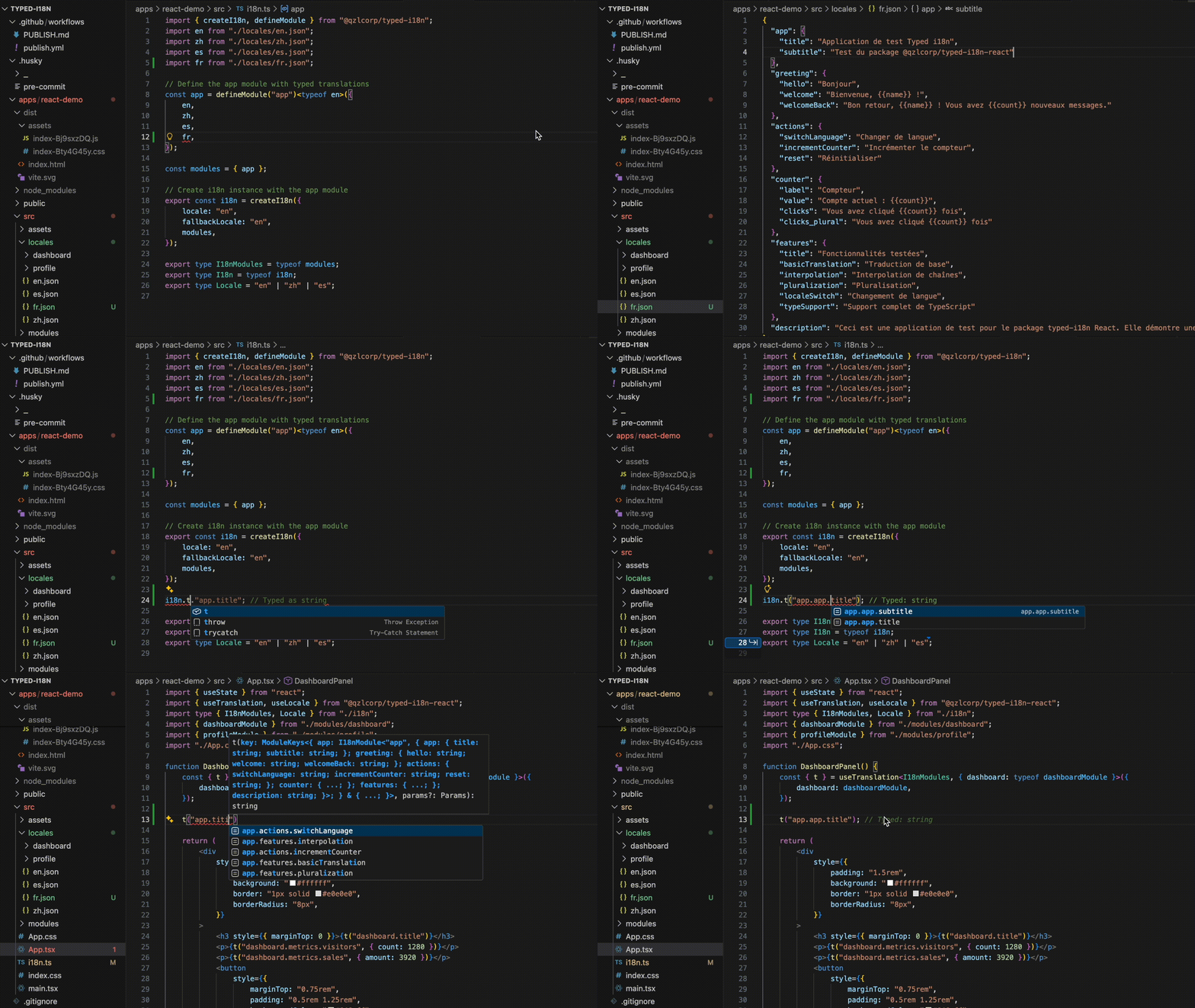
See how TypeScript ensures type-safe translations in React apps with full autocomplete and compile-time validation.
Live Demo
🚀 View Live Demo - See dynamic module loading, locale switching, and type-safe translations in action.
Used By
- QZ-L.com — Fast, secure URL shortening to share links easily. Shorten, track, and manage your URLs at https://qz-l.com.
Installation
pnpm add @qzlcorp/typed-i18n @qzlcorp/typed-i18n-reactUsage
Important: Preserve Key Type Safety
To get static type errors for incorrect translation keys you MUST pass your module type (or use a pre-bound wrapper hook). Without the generic, t() falls back to a loose pattern like ${string}.${string} and invalid keys will not error at compile time.
// i18n.ts
const app = defineModule('app')<typeof enApp>({ en: enApp, fr: frApp });
export const i18n = createI18n({ locale: 'en', fallbackLocale: 'en', modules: { app } });
export type I18nModules = { app: typeof app };

// Component: GOOD (strict key union)
const { t } = useTranslation<I18nModules>();
t('app.title');           // OK
t('app.missing');         // ❌ Type error at compile time

// Component: WEAK (no generic) – do NOT use this form if you want key checking
const { t: tLoose } = useTranslation();
tLoose('app.missing');    // ✅ Compiles (no static safety)
Recommended ergonomic wrapper so you never forget the generic:
// i18n-hooks.ts
export const useAppTranslation = () => useTranslation<I18nModules>();
export const useAppLocale = () => useLocale<I18nModules>();
export const useAppI18n = () => useI18n<I18nModules>();

// Component
const { t } = useAppTranslation();
If you later add modules dynamically, you can widen the type:
const dashboard = defineModule('dashboard')<typeof enDashboard>({ en: enDashboard });
const updated = useAppI18n().addModule(dashboard);
// For immediate strict typing in this scope:
const { t: tWithDashboard } = useTranslation<I18nModules & { dashboard: typeof dashboard }>();
Dynamic Modules (Page-Level Splitting)
Load only the namespaces a feature needs by passing a modules object to useTranslation. Each module is registered once and cached by namespace, so repeated renders stay cheap.
import { dashboardModule } from "./modules/dashboard";

const { t } = useTranslation<
  I18nModules,
  { dashboard: typeof dashboardModule }
>({
  dashboard: dashboardModule,
});

console.log(t("dashboard.title"));
Keep the modules object stable (imported or memoized) to avoid unnecessary effect churn. After the hook registers a module, the provider widens the shared i18n instance so other components can access the new namespace without reloading it.
Setup Provider
import { createI18n, defineModule } from '@qzlcorp/typed-i18n';
import { I18nProvider } from '@qzlcorp/typed-i18n-react';

// Define your modules
const common = defineModule('common')<typeof enCommon>({
  en: enCommon,
  fr: frCommon,
});

// Create i18n instance
const i18n = createI18n({
  locale: 'en',
  fallbackLocale: 'en',
  modules: { common },
});

// Wrap your app
function App() {
  return (
    <I18nProvider i18n={i18n}>
      <YourApp />
    </I18nProvider>
  );
}
Use in Components
import { useTranslation, useLocale } from '@qzlcorp/typed-i18n-react';

function MyComponent() {
  const { t, locale } = useTranslation();
  const { setLocale, locales } = useLocale();

  return (
    <div>
      <h1>{t('common.hello')}</h1>
      <p>Current locale: {locale}</p>

      <select value={locale} onChange={(e) => setLocale(e.target.value)}>
        {locales.map((loc) => (
          <option key={loc} value={loc}>{loc}</option>
        ))}
      </select>
    </div>
  );
}
API
I18nProvider
Provider component that makes i18n instance available to all child components.
Props:
i18n- The i18n instance created withcreateI18n()children- React children
useTranslation()
Returns translation function and current locale.
Returns:
t(key, params?)- Translate function with parameter interpolationt(key, options?)- Translate function with options (supportsreturnObjects)locale- Current active locale
function MyComponent() {
  const { t, locale } = useTranslation();

  // Simple translation
  const title = t('common.title');

  // With parameters
  const greeting = t('common.greeting', { name: 'React' });

  // Get nested objects (i18next compatible)
  const config = t('app.config', { returnObjects: true });

  // Both params and returnObjects
  const data = t('dashboard.stats', {
    params: { count: 5 },
    returnObjects: false
  });

  return <div>{title}</div>;
}
⚠️ Pass your module type generic (e.g. useTranslation<I18nModules>()) for strict key unions.
Optional argument: useTranslation<I18nModules, ExtraModules>({ ...ExtraModules }) dynamically registers more namespaces (e.g. page-level modules) and widens t to cover them.
useLocale()
Returns locale management functions.
Returns:
locale- Current active localesetLocale(locale)- Change locale (triggers re-renders)locales- Array of all available locales
useI18n()
Returns the full i18n instance for advanced use cases.
Returns:
- Full
I18nInstancewith all methods
<Trans> Component
Component for translating JSX with embedded HTML tags and React components. Safer than dangerouslySetInnerHTML - parses translation strings and builds React elements.
Props:
i18nKey- Translation key (optional - if not provided, useschildren)children- Can be used as the translation source instead ofi18nKey(optional)values- Interpolation parameters (optional)components- Custom React components to use for tags (optional)defaults- Include default HTML components like<strong>,<em>, etc. (default:true)
Note: Either i18nKey or children should be provided. If both are present, i18nKey takes precedence.
Default supported tags (when defaults={true}):
<strong>,<b>- Bold text<em>,<i>- Italic text<u>- Underlined text<br/>- Line break<p>,<span>- Block/inline containers
// Translation JSON
{
  "welcome": "Hello <strong>{{name}}</strong>!",
  "action": "Click <link>here</link> to continue"
}

// Using i18nKey (recommended for externalized translations)
<Trans i18nKey="common.welcome" values={{ name: "John" }} />
// Renders: Hello <strong>John</strong>!

// Using children as translation source (inline translations)
<Trans values={{ name: "John" }}>
  Hello <strong>{{name}}</strong>!
</Trans>
// Renders: Hello <strong>John</strong>!

// Using children with JSX elements (preserves attributes)
const description = (
  <>
    Check the <a href="/docs">documentation</a> for more info
  </>
);
<Trans components={{ a: <a /> }}>{description}</Trans>
// Renders: Check the <a href="/docs">documentation</a> for more info

// Custom components with i18nKey
<Trans
  i18nKey="common.action"
  components={{
    link: <a href="/next" className="btn" />
  }}
/>
// Renders: Click <a href="/next" class="btn">here</a> to continue

// Custom components with children
<Trans components={{ link: <a href="/next" className="btn" /> }}>
  Click <link>here</link> to continue
</Trans>
// Renders: Click <a href="/next" class="btn">here</a> to continue

// Multiple tags
// Translation: "This is <strong>bold</strong> and <em>italic</em>"
<Trans i18nKey="common.formatted" />

// Nested tags
// Translation: "Text with <strong>bold and <em>italic</em> nested</strong>"
<Trans i18nKey="common.nested" />

// Disable default components
<Trans i18nKey="common.text" defaults={false} components={{ custom: <CustomComponent /> }} />
Safety note: The <Trans> component does NOT use dangerouslySetInnerHTML. It safely parses the translation string and builds React elements using React.cloneElement(), preventing XSS vulnerabilities.
Features
✅ Automatic Re-renders - Components re-render when locale changes
✅ Full Type Safety - All translation keys are typed
✅ Trans Component - Safe HTML/JSX translation without XSS risks
✅ React 18 Ready - Built with modern React patterns
✅ Small Bundle - Minimal overhead
✅ Tree Shakeable - Only import what you use
Support
License
MIT © Q.Z.L Corp.