
@reneza/ats-adapter-composite
v0.12.0
Published
Cross-source adapter for the Agentic Task System. Query GitHub + Notion + TickTick + any ATS backends as ONE fused corpus: a single `ats find` returns one RRF-ranked list across all of them, each result tagged with its backend. The thing a single-vendor M

Maintainers
 reneza
Readme
@reneza/ats-adapter-composite
ats-adapter-composite is the cross-source adapter for the Agentic Task System (ATS). It queries several backends — GitHub, Notion, TickTick, Obsidian, and more — as one fused corpus, so a single ats find returns one RRF-ranked list across all of them, each result tagged with its backend.
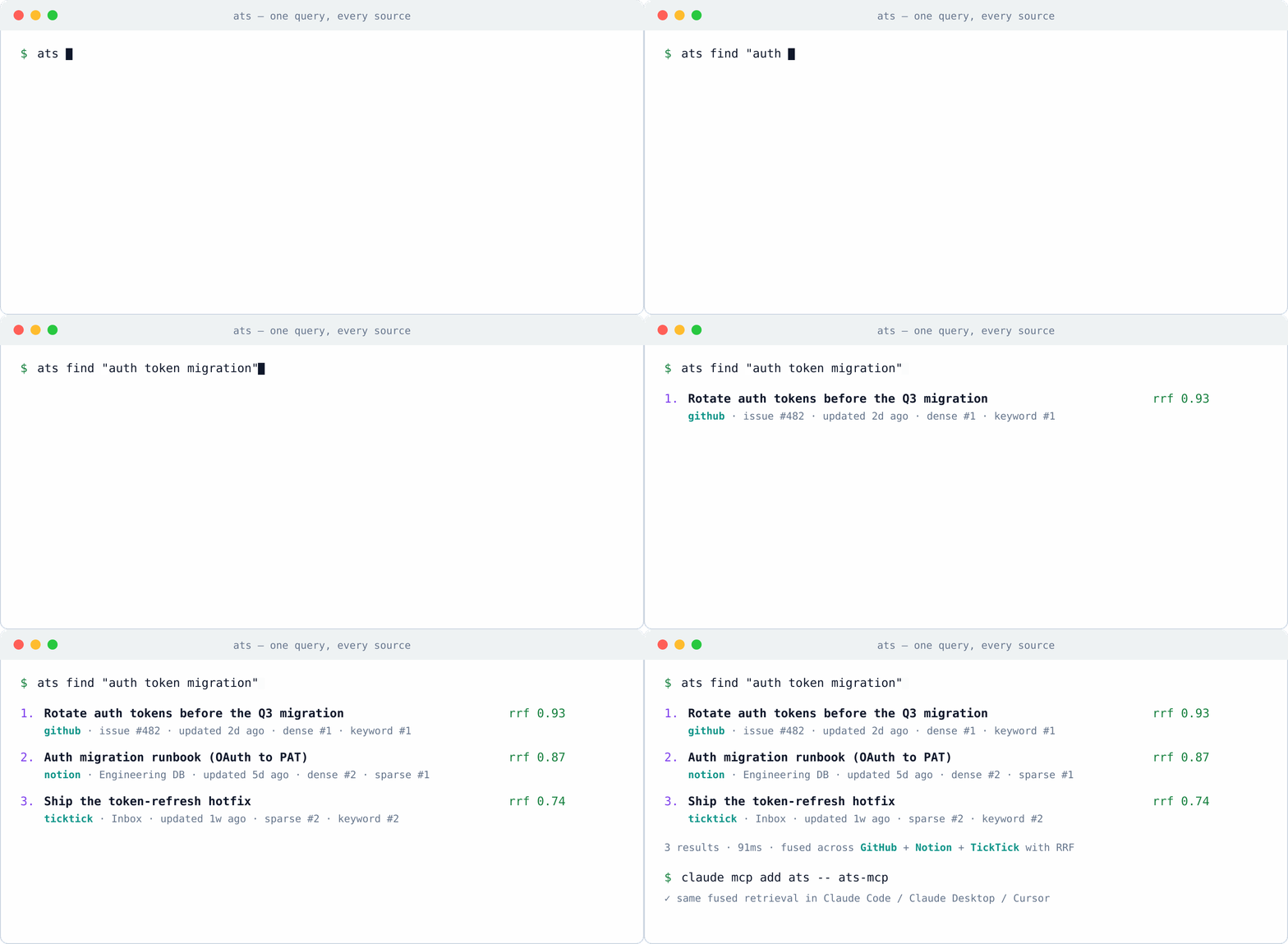
You already have connectors. This is the semantic layer they're missing.
Your agent can already reach Notion, GitHub, and your task app — every vendor ships an official MCP connector now. That gives the agent access: read this page, create that issue, list those tasks. What it does not give you is retrieval.
A connector answers "fetch page X." It cannot answer "what do I know about the auth migration?" across three tools, ranked by relevance. That is a search problem, and connectors don't solve it — they hand the model an API and hope it queries the right thing.
ats-adapter-composite is the semantic layer over your connectors:
- Ranked by meaning, not endpoints. Hybrid retrieval (keyword + dense + sparse) fused with Reciprocal Rank Fusion, so the first result is the relevant one — not whatever the model guessed to query.
- One query, every source. GitHub issues, Notion pages, and your tasks come back in a single ranked list, deduped, each tagged with its backend. No connector does cross-source.
- Provenance. Every hit says which retrieval branch found it and which backend it came from.
- No vector database. Keyword + RRF works out of the box; dense search is optional (local Qdrant + Ollama), never a hosted vector store to maintain.
The connectors are the plumbing. This is the retrieval brain on top.
Setup
Install the composite plus whichever child adapters you want fused:
npm install -g @reneza/ats-cli @reneza/ats-mcp \
  @reneza/ats-adapter-composite \
  @reneza/ats-adapter-github @reneza/ats-adapter-notion @reneza/ats-adapter-ticktick
List the children in ~/.config/ats/composite.json:
{
  "adapters": [
    "@reneza/ats-adapter-github",
    "@reneza/ats-adapter-notion",
    "@reneza/ats-adapter-ticktick"
  ]
}
Each child reads its own existing config and auth (ATS_GITHUB_TOKEN, ATS_NOTION_TOKEN, the TickTick OAuth login). The composite adds none of its own — it just namespaces ids and routes. Then:
ats config use @reneza/ats-adapter-composite
ats doctor                                  # shows per-backend auth
ats find "auth token migration"             # one ranked list across all backends
claude mcp add ats -e ATS_ADAPTER=@reneza/ats-adapter-composite -- ats-mcp
Mapping
| ATS | Composite |
| ---------- | --------------------------------------------------------------- |
| Project | a child project, id namespaced <backend>:<projectId> (e.g. github:owner/repo, notion:db-1111) |
| Task | a child record, id namespaced <backend>:<taskId>, re-stamped with source: <backend> |
| find | bulkFetch() concatenates every child's corpus → Core runs hybrid + RRF over the union |
| writes | routed to the child named by the project id's <backend>: prefix |
Trust levels and redaction
Backends differ in who can read them. Mark a child "trust": "public" and give
the composite redaction rules, and any createTask/updateTask routed to that
child is screened first — a match blocks the write with a clear error (never
a silent strip), so content an agent picked up from a private backend cannot
flow into a public one through ATS unnoticed:
{
  "adapters": [
    { "package": "@reneza/ats-adapter-ticktick", "trust": "private" },
    { "package": "@reneza/ats-adapter-github", "trust": "public" }
  ],
  "redact": [
    { "label": "street address", "pattern": "\\b\\d{1,4}\\s+[A-Za-z]+\\s+(Street|St|Ave|Road|Rd)\\b" },
    { "label": "internal hostname", "pattern": "\\b[a-z0-9-]+\\.internal\\b" }
  ]
}
trust defaults to private (no screening between private backends). An
invalid pattern fails loudly at load — a protective rule is never dropped
silently. Scope honestly: this guards the composite's own write path; a
client that calls a child adapter directly bypasses it, and it is not
general data-loss prevention.
FAQ
I already have a Notion MCP server and a GitHub MCP server. Why this? Those are connectors — they give your agent access to one tool each. This is the retrieval layer: one query, ranked by meaning, fused across all of them, with provenance. Access is not search.
Does it need a vector database? No. Keyword + RRF works out of the box across every backend; dense retrieval is optional (local Qdrant + Ollama).
How does auth work across backends?
Each child authenticates itself with its own token/OAuth. The composite aggregates status (ats doctor) but holds no credentials of its own.
Part of the Agentic Task System
The composite fuses these backends (install the ones you use):
- @reneza/ats-adapter-ticktick
- @reneza/ats-adapter-obsidian
- @reneza/ats-adapter-notion
- @reneza/ats-adapter-github
- @reneza/ats-adapter-airtable
- @reneza/ats-adapter-google
- @reneza/ats-adapter-okf
- @reneza/ats-adapter-taskmaster
- @reneza/ats-adapter-beads
Main repo: agentic-task-system.
Verify
node --test # offline unit tests (fake child adapters)