
@samebase/identity-broker
v0.11.0
Published
An OpenID Provider for Convex that holds a team's upstream sign-in connections once and keeps no user accounts.


Readme
identity-broker
An OpenID Provider that runs on Convex. One deployment holds a team's sign-in
connections once, such as Google and GitHub, and signs users in to many small apps. The broker keeps
no user accounts and no sessions: every sign-in goes upstream again, and each app creates its own
user from the id_token it receives.
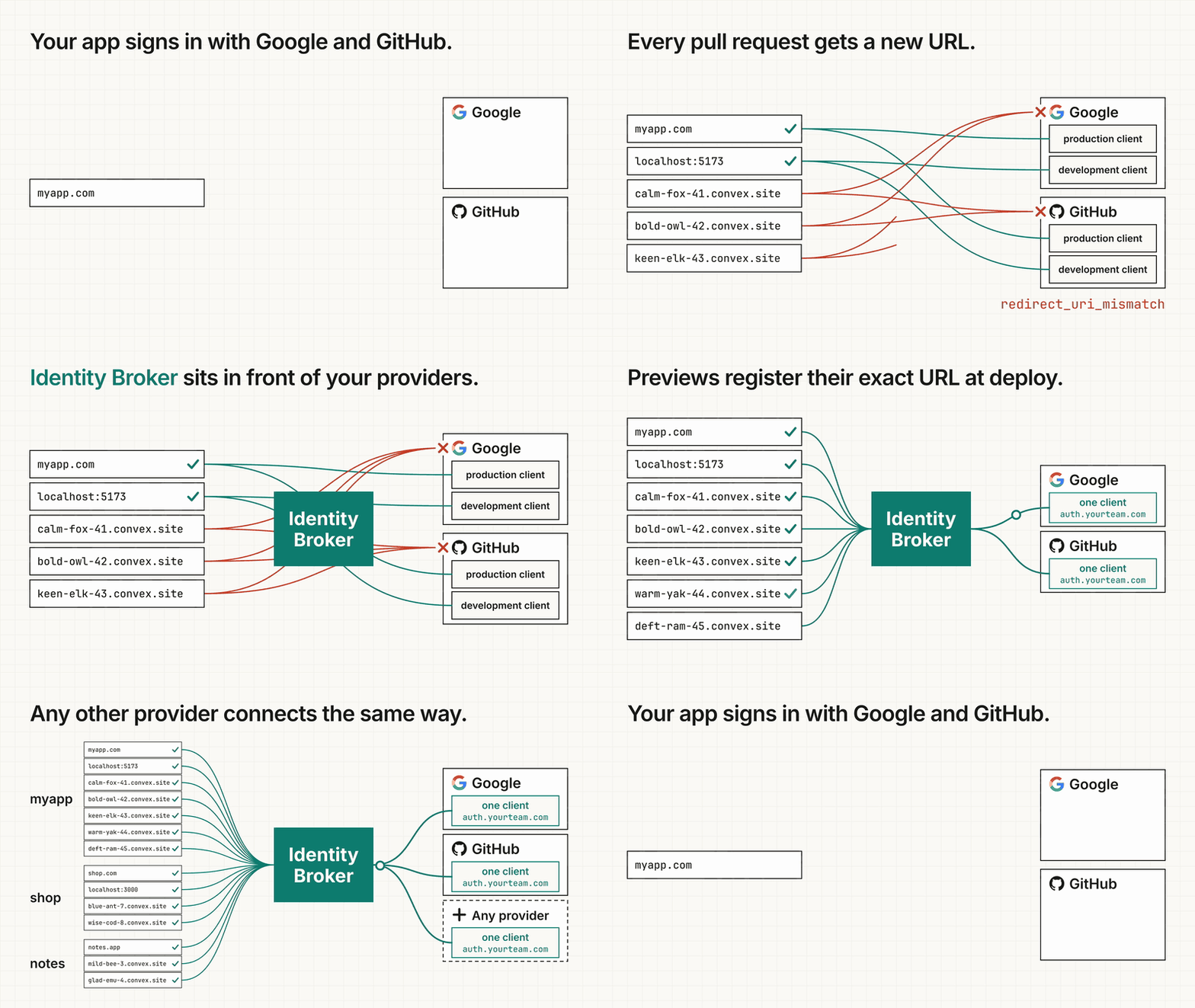
Why: every new app otherwise needs its own OAuth app registrations, and a preview deployment with a fresh callback URL cannot have them at all. With the broker, an app registers each deployment as a client at deploy time and never touches GitHub or Google.
Start from our hub
A hub is a small Convex app that mounts this component.
apps/identity-hub is the hub
we run in production, and it is also the example: there is no separate template. To run your own,
copy that folder and change the values in alchemy.run.ts and convex/connectors.ts, or ask your
agent to do it. Its
README has the deploy
steps.
What it is
@samebase/identity-broker: a Convex component plus the host-side endpoints. Authorization code flow with PKCE, discovery, JWKS, userinfo, and an internal function that registers a client. RS256id_tokens with pairwise subjects per app; a first-party app also gets the connector's own id for the account inconnector_account_id.- Connectors are configuration: any OAuth 2.0 provider that publishes RFC 8414 metadata, and any
OpenID Connect provider.
github()andgoogle()are included. Convex.HubClientof@samebase/alchemy-convex, an Alchemy v2 resource, registers a deployment as a client at deploy time.
Mount it
npm install @samebase/identity-broker// convex/convex.config.ts
import { defineApp } from "convex/server";
import identityBroker from "@samebase/identity-broker/convex.config";
const app = defineApp();
app.use(identityBroker);
export default app;// convex/http.ts
import { httpRouter } from "convex/server";
import { defineIdentityBroker, github, google } from "@samebase/identity-broker";
import { components } from "./_generated/api";
export const broker = defineIdentityBroker({
component: components.identityBroker,
issuer: process.env.ISSUER ?? process.env.CONVEX_SITE_URL!,
keys: () => process.env.IDENTITY_BROKER_KEYS,
connectors: [
github({
clientId: () => process.env.GITHUB_CLIENT_ID!,
clientSecret: () => process.env.GITHUB_CLIENT_SECRET!,
}),
google({
clientId: () => process.env.GOOGLE_CLIENT_ID!,
clientSecret: () => process.env.GOOGLE_CLIENT_SECRET!,
}),
],
});
const http = httpRouter();
broker.addHttpRoutes(http);
export default http;// convex/identityBroker.ts: administration for `npx convex run`
import { broker } from "./http";
export const {
createApp,
registerClient,
deleteClient,
deleteApp,
listApps,
listClients,
cleanup,
} = broker.admin();Keys: npx identity-broker keys prints the value for IDENTITY_BROKER_KEYS; keys --rotate
advances it, and keys --rotate --no-overlap replaces a compromised key at once. Back up the key
set: its salt makes every sub. parseKeySet checks a value's shape before a deploy, and
assertKeySetUsable signs a test token with it and verifies that token against its JWKS.
Register an app's deployments
Registration is an internal function of the hub, so it needs the hub's deploy key and no token of its own:
npx convex run identityBroker:registerClient '{"appId":"bristol","redirectUri":"https://bristol.example/oauth/hub/callback","deploymentType":"production","clientName":"prod","softwareVersion":"1","tokenEndpointAuthMethod":"client_secret_post"}'The reply holds the issuer, the clientId, and the clientSecret, which only this reply carries.
The first client of an appId creates the app as a first-party app. For an app that is not your
own, run createApp with firstParty false first. A Convex Auth v2 app points its generic OAuth
method at <issuer>/authorize and <issuer>/token; see the
docs.
When a deployment goes away, identityBroker:deleteClient deletes its client. A client that is gone
is no error.
Standards
OAuth 2.0 and the OAuth 2.1 draft (code flow, PKCE S256, exact redirect URIs, iss on responses),
OpenID Connect Core and Discovery, RFC 8414, RFC 9207, RFC 9700, and the JWT, JWS, JWK and cookie
standards under them. A client gets its credentials out of band, which RFC 6749 section 2 leaves
open.
docs/standards.md
lists each with its sections and status, and departures are named in
docs/design.md.
License
Apache-2.0.